Project Management Professional (PMP) July 2026 Update
Find out if you're ready for PMP. Take the free timed mock exam and get your score in minutes, or study the free PMP questions below with answers and explanations.
A key project stakeholder who was a big supporter and motivator for the project team is
leaving the organization The project team is experiencing low morale and poor teamwork
What should the project manager do to improve morale?
Show answerHide answer
Correct answer: BBuild team connections and emotional bonds
Question 2
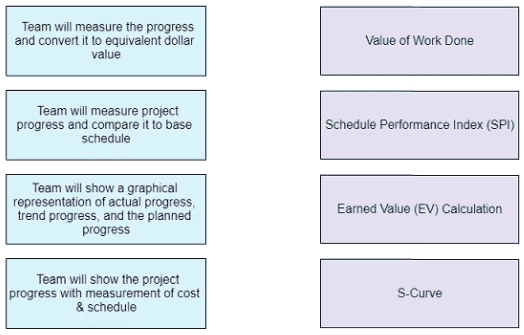
During a project's planning session, the project team discussed selecting the required
information to be included in the monthly progress report This report will be produced in the
Executing and Monitor and Controlling phases and will be used when communicating
project progress to the client
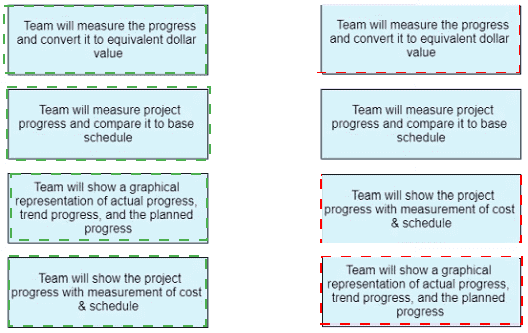
Match the scenario on the left with the action on the right.
Show answerHide answer
Explanation
Question 3Choose 1
A project manager is leading an in-house company project in its very early stages This
current project is similar to another project that ended a year ago
What should the project manager do to analyze the involved stakeholders?
Show answerHide answer
Correct answer: BUse lessons learned from the previous project as a guide for the current project's
stakeholder register
Question 4Choose 1
One of a project manager’s team members is continuously improving This team member
has been a role model and mentor to others in the organization
How should the project manager acknowledge this team member’s commitment?
Show answerHide answer
Correct answer: BAppreciate this team member’s performance throughout the project life cycle
Question 5Choose 1
A new team member has joined an agile project, replacing a team member who recently
left The project team needs the new team member to speed up their ability to contribute
effectively to the project
What should the project manager do to help in this situation?
Show answerHide answer
Correct answer: BSchedule knowledge transfer sessions and assign less complex tasks to the new team
member
Question 6Choose 3
A company is changing their current business model The change requires implementing a
complex project using multiple agile teams.
What three options should the project manager have the testing team adopt as testing
mechanisms? (Choose three)
Show answerHide answer
Correct answer: B, D, ESecurity and performance testingStory testingTests based on behavior and test-driven development
Question 7Choose 1
During the third iteration, the team encounters a major delay that has not had significant
improvements over the last few weeks What should the project manager do?
Show answerHide answer
Correct answer: ARetrospect frequently and suggest improvements.
Question 8Choose 1
A company is implementing a new system The project manager has identified that it is best to complete this project using a mix of Scrum and Kanban methodologies The product
owner is confused as to how to start delivering the functionalities required
How should the project manager assist the product owner?
Show answerHide answer
Correct answer: ACoach the product owner on how to create a product backlog
Question 9Choose 2
The project manager has observed that two team members have been arguing with each
other openly at meetings To push their ideas through, each team member individually
spoke with the sponsor directly and made decisions without informing the project manager
or other team members
What two actions should project manager take? (Choose two)
Show answerHide answer
Correct answer: C, DReiterate ground rules at the next meeting and ensure that all team members are clear
about these rules.Address the behavioral issue with each team member
Question 10Choose 2
A project manager led the implementation of an electronic invoicing project that has just
been completed. The financial manager communicated that the team discovered three
invoices with errors.
Which two documents should the project manager update as soon as possible? (Choose
two)
Show answerHide answer
Correct answer: A, DIssue logChange log
Full mock exam
Sit the PMP exam before exam day
Full-length mocks with the same number of questions and the same time limit as the real PMP exam. Every attempt draws a new set of questions from the full bank, so you can keep going until you pass comfortably.
PMP Exam: Project Leadership, Delivery, and Business Strategy Explained
The Project Management Professional (PMP) certification is a globally recognized professional credential offered by the Project Management Institute (PMI). It validates the knowledge and practical capabilities required to lead projects, manage teams, deliver business value, and align project outcomes with organizational objectives.
The PMP exam evaluates a candidate's ability to handle real-world project management challenges across predictive, agile, and hybrid environments—covering leadership, stakeholder engagement, project planning, resource management, risk assessment, financial considerations, governance, compliance, and strategic business priorities.
Credential Value
What Is the PMP Certification?
The Project Management Professional (PMP) certification demonstrates that an individual has the professional knowledge and experience to lead projects across different industries and organizational environments.
Offered by PMI, the certification focuses on managing people, coordinating project activities, addressing business challenges, and delivering measurable outcomes. It is not restricted to a single methodology—candidates must apply predictive, adaptive, agile, and hybrid approaches according to project requirements.
Exam Facts
PMP Exam Overview
Certification name
Project Management Professional (PMP)
Exam code
PMP
Certification provider
Project Management Institute (PMI)
Exam format
Computer-based examination
Number of questions
180
Exam duration
240 minutes (4 hours)
Exam domains
People, Process, Business Environment
Breaks
Two 10-minute breaks
People weighting
33%
Process weighting
41%
Business Environment
26%
Certification validity
3 years, subject to renewal requirements
Question approaches
Predictive, adaptive/agile, and hybrid
Official Domain Split · 100% Total
PMP Exam Blueprint and Domain Weightings
The updated PMP examination is organized into three official domains, each measuring a distinct pillar of professional project management.
Process41%
People33%
Business Environment26%
Which PMP Exam Domain Deserves the Most Attention?
Process (41%) carries the highest weighting and evaluates planning, organizing, executing, monitoring, and closing project work. People (33%) focuses on leadership, team development, communication, conflict management, and stakeholder engagement, while Business Environment (26%) evaluates governance, compliance, risk, organizational change, and external influences. Across all three domains, roughly 60% of questions cover adaptive/agile and hybrid approaches and 40% cover predictive approaches.
PMI Application Requirements
PMP Certification Eligibility Requirements
Candidates must satisfy PMI's education, project management experience (within a 10-year qualifying window, without double-counting overlapping projects), and 35 hours of project management training (waived with an active CAPM certification).
5 Years
High School Diploma
Or secondary school certificate + 35 training hours (or active CAPM)
4 Years
Associate Degree
Or vocational trade school diploma + 35 training hours (or active CAPM)
3 Years
Bachelor's Degree or Higher
Four-year degree or postgraduate equivalent + 35 training hours (or active CAPM)
2 Years
PMI GAC-Accredited Degree
Bachelor's or postgraduate degree from a GAC-accredited program + training requirement
Delivery Approaches
Project Management Approaches Covered in the PMP Exam
Predictive Project Management
~40% of Exam
Structured delivery where scope, schedule, resources, and major deliverables are planned upfront.
Project scope definition
Work breakdown structures
Schedule development
Cost estimation and budgeting
Risk identification
Change control
Quality management
Project monitoring and closure
Agile & Adaptive Management
Part of ~60% Share
Iterative development, continuous feedback, and adaptability when requirements evolve.
Scrum and Kanban fundamentals
Iterative and incremental delivery
Product backlogs
Sprint planning
Daily coordination
Reviews and retrospectives
Continuous stakeholder feedback
Adaptive planning
Hybrid Project Management
Part of ~60% Share
Blends structured predictive governance with iterative adaptive execution across project components.
Combining predictive and agile practices
Managing changing requirements
Coordinating multiple delivery approaches
Balancing governance and flexibility
Managing dependencies
Monitoring outcomes across methods
10 Core Competencies
Important Skills Measured by the PMP Certification