Explanation
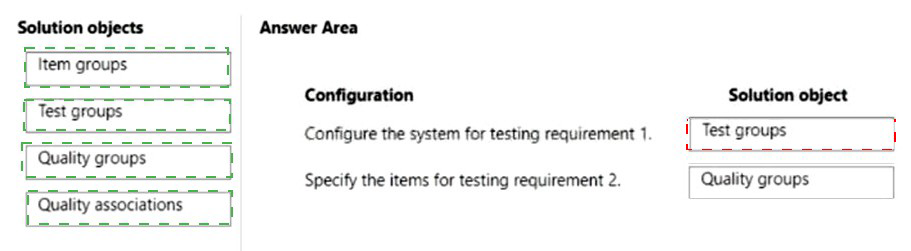
Explanation:
Box 1: Test groups
Requirement 1: 100 percent of all nutritional supplements and 50 percent of all energy
drinks must be tested when production orders are completed. After a product is in testing,
100 percent of all tests must be completed.
You use the Test groups page to set up, edit, and view test groups and the individual tests
that are assigned to them. The upper part of the page shows the test groups, and the lower part shows the tests that are assigned to a selected test group.
You assign several policies to a test group, such as a sampling plan, an acceptable quality
level (AQL), and the requirement for destructive testing. Then, when you assign an
individual test to a test group, you define additional information, such as the sequence,
documents, and validity dates. For a quantitative test, the information that you define also
includes the acceptable measurement values. For a qualitative test, the information
includes the test variable and default outcome.
The test group that is assigned to a quality order defines the default set of tests that must
be performed on the specified item. However, you can add, delete, or change tests for the
quality order. Test results are reported for each test on a quality order.
Box 2: Quality groups
Requirement 2: 75 percent of all nutritional supplements and energy drinks should be
tested against their required tests during an outbound process.
Quality groups
A quality group represents common testing requirements for items.
Use and create item quality groups to logically group products so that they can be assigned
to quality associations for the automatic generation of quality orders.
Example of an item quality group
A manufacturing company purchases various raw materials that have the same testing
requirements for incoming inspection. Therefore, the company defines a quality group and
then assigns the item numbers that are associated with the raw materials to that group.
Later, the company purchases a new type of raw material that has the same testing
requirements. Instead of setting up new testing requirements for the new material, the
company adds the item number for the new material to the existing quality group.