Microsoft certification · Exam MB-330

MB-330 Mock Exam

Microsoft Dynamics 365 for Finance and Operations - Supply Chain Management

Free MB-330 questions on Topic 1: Wide World Importers, each with the answer and an explanation.

20 questions · 33 minutes · free, no sign-up

Topic 1: Wide World Importers questions

1–3 of 3 free
Question 1
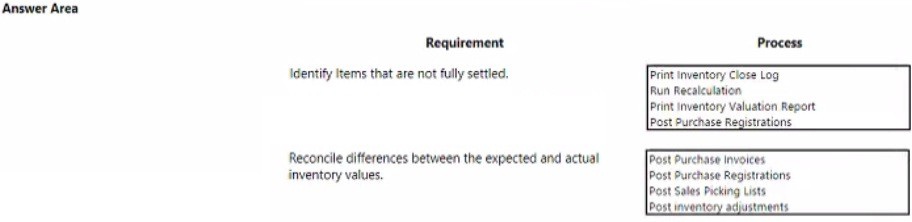
You need to configure settlement reports for the finance team.

Which processes should you use? To answer, select the appropriate options in the answer area.

NOTE: Each correct selection is worth one point
Show answerHide answer

Explanation


Explanation:
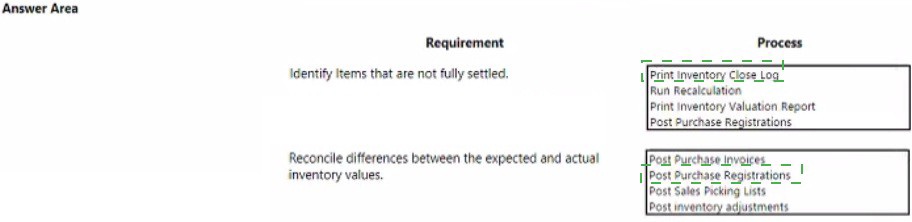
The finance team needs settlement reports to finalize inventory financial periods. This requires a closing process that identifies unsettled transactions, recalculates costs to resolve value discrepancies, and produces a final valuation report. These steps ensure inventory financial records are accurate and complete before the period is locked.

Correct Option:

Print Inventory Close Log:
This is a prerequisite report that identifies unposted or unsettled transactions (like open inventory receipts) that would prevent a clean period close. It must be reviewed and resolved.

Run Recalculation:
This process recalculates the inventory value for all items based on the costing method (FIFO, LIFO, etc.). It reconciles expected and actual inventory values, which is the core requirement for financial settlement.

Print Inventory Valuation Report:
This is the final, authoritative financial report showing the closing inventory value for the period. It is the key deliverable for the finance team to review and archive.

Incorrect Option:

Post Purchase Registrations / Invoices / Sales Picking Lists:
These are daily operational posting processes, not periodic closing steps. Running these during close would introduce new, unsettled transactions, undermining the goal of finalizing the period.

Post Inventory Adjustments:
While sometimes necessary to correct counts, this is a corrective operational action. The settlement process uses recalculation to adjust values systematically based on cost layers, not manual adjustments.

Reference:
Microsoft Learn: "Close inventory" procedures (Dynamics 365 Supply Chain Management). The closing workflow specifically involves generating the close log, running recalculation, and printing the valuation report to settle and finalize inventory financial periods.
Question 2
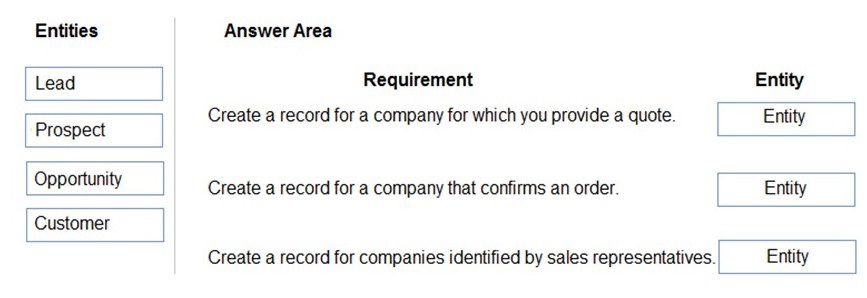
You need to configure the system to meet the metric requirement for sales representatives.

How should you configure the system? To answer, drag the appropriate entities to the correct requirements. Each entity may be used once, more than once, or not at all. You may need to drag the split bar between panes or scroll to view content.

NOTE: Each correct selection is worth one point

Show answerHide answer

Explanation

Explanation:
This question tests the standard sales process lifecycle in Dynamics 365. The configuration must map business activities (providing a quote, confirming an order, identifying prospects) to the correct entity that represents that stage of the sales funnel, ensuring accurate tracking and reporting for sales metrics.

Correct Option:

Requirement 1 (Company for a quote) → Opportunity:
An Opportunity is the core entity for managing a potential sale. The act of providing a formal quote is a key sales activity that occurs within an Opportunity's timeline, signifying a qualified sales pursuit.

Requirement 2 (Company that confirms an order) → Customer:
A Customer record is the master entity for any company that engages in commercial transactions. Once an order is confirmed, the entity must be an established Customer to process the sales order and future transactions.

Requirement 3 (Companies identified by reps) → Lead:
A Lead is the initial entity created for a potential contact or company identified through marketing or prospecting. It represents an unqualified sales possibility that sales representatives work to qualify and convert.

Incorrect Option:
Prospect: This entity is not used in the standard sales process hierarchy (Lead > Opportunity > Customer). "Prospect" is often a status or category within a Lead or Account, not a primary transactional entity for tracking these specific metrics. Using it here would not align with the default pipeline.

Reference:
Microsoft Learn documentation on "Sales processes" outlines the standard entity flow: Leads are initial inquiries, which are qualified into Opportunities for active selling (including quotes), and upon success, result in Customer accounts for order management.
Question 3
You need to configure the system to meet the item testing requirements.

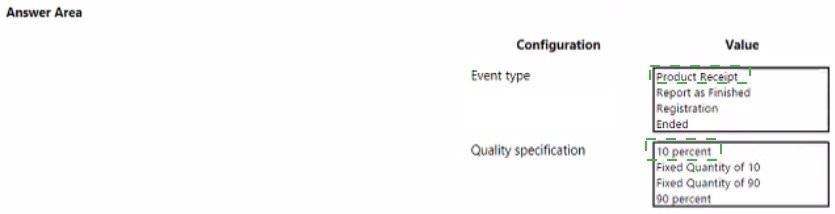
How should you configure the system? To answer, select the appropriate options in the answer area.

NOTE: Each correct selection is worth one point

Show answerHide answer

Explanation


Explanation:
This scenario requires setting up a quality test that triggers automatically and tests a specific, fixed sample size. The configuration must define the production event that initiates the test and the exact sampling rule. "Report as Finished" is a key production milestone, and a fixed quantity is used for precise sampling requirements.

Correct Option:

Event Type - Report as Finished:
This event occurs when a production order batch is completed at an operation resource. Configuring the test to trigger at this point ensures the finished goods are inspected before they are officially added to inventory, which is a critical quality control point.

Quality Specification - Fixed Quantity of 10:
This rule dictates that exactly 10 units from the lot must be selected for testing, regardless of the total lot size. This is the standard method for meeting a strict requirement like "test 10 items," providing consistent and predictable sampling for quality assurance.

Incorrect Option:

Event Type (Other):

Product Receipt:
Typically triggers tests for purchased items upon warehouse receipt, not for production items.

Registration:
A granular inventory movement event (like picking), too early for finished goods testing.

Ended:
Refers to the final closure of a production order, which is too late for in-process quality control.

Quality Specification (Other):

10 percent / 90 percent:
These are variable percentage rules. The test quantity would change with the lot size (e.g., 10% of 100 units is 10, but 10% of 200 units is 20), not fulfilling the fixed quantity requirement.

Fixed Quantity of 90:
This is simply the wrong fixed number. The requirement is to test a specific 10 items.

Reference:
Microsoft Learn: "Set up quality orders" and "Quality management processes". Documentation specifies that quality orders can be triggered by various inventory and production events, with Report as Finished being a primary trigger for production. Sampling rules are defined as either a fixed quantity or a percentage of the lot.

That's the last free question in Topic 1: Wide World Importers

You've seen the free 30% (3 of 13 questions). Full access unlocks every question and full-length MB-330 mock exams (65 questions, 105 minutes), a different mock on every attempt.

Unlock full mock exam
Full mock exam

Sit the MB-330 exam before exam day

Full-length mocks with the same number of questions and the same time limit as the real MB-330 exam. Every attempt draws a new set of questions from the full bank, so you can keep going until you pass comfortably.

Get full MB-330 mock exam
  • 65questions per mock
  • 105 mintime limit
  • 403questions in the bank
  • Newmock on every attempt