Microsoft certification · Exam MB-330

MB-330 Mock Exam

Microsoft Dynamics 365 for Finance and Operations - Supply Chain Management

Free MB-330 questions on Topic 3: Adventure Works Cycles, each with the answer and an explanation.

20 questions · 33 minutes · free, no sign-up

Topic 3: Adventure Works Cycles questions

1–3 of 3 free
Question 1 Choose 2
You need to segregate inventory for the brakes that are in inventory.

Which two actions should you perform? Each correct answer presents part of the solution.

NOTE: Each correct selection is worth one point.
Show answerHide answer

Correct answer: A, B Assign a blocked status to the inbound purchase order from VendorA.Create a disposition code.

Explanation

Explanation:
Segregating potentially faulty inventory from Vendor A requires two key actions: preventing new stock from Vendor A from entering usable inventory, and creating a method to identify and move the existing faulty stock. This isolates both future receipts and current inventory.

Correct Option:

A. Assign a blocked status to the inbound purchase order from VendorA:
This action prevents the future receipt of brakes from the problematic vendor (Vendor A) from being posted into available inventory. When the purchase order line is marked as "Blocked," the received quantity will automatically be given a quarantine or blocked inventory status.

B. Create a disposition code:
A disposition code is used during quality order processing or inventory adjustment to specify what should happen to the segregated items (e.g., "Return to Vendor," "Scrap," "Rework"). Creating a specific code (e.g., "Vendor A Hold") is essential for tracking and managing the existing, potentially faulty inventory already in the warehouse.

Incorrect Option:

C. Set default inventory status on the item:
This sets a status (e.g., Available, Blocked) for all new receipts of the item, regardless of vendor. This is too broad, as it would incorrectly block receipts from the good vendor (Vendor B) as well.

D. Assign an item filter code:
Item filter codes are used for reporting and filtering items in lists and reports. They do not functionally block or segregate inventory in the warehouse management system.

E. Assign a blocked status to the inbound purchase order from VendorB:
This is incorrect and counterproductive. Vendor B is the good vendor. Blocking their PO would stop the flow of good inventory, which is not the goal. The segregation is targeted specifically at Vendor A.

Reference:
Microsoft Learn: "Inventory blocking" and "Disposition codes." You can block inventory at the purchase order line level. Disposition codes are used in quality management and inventory adjustment processes to define the action for non-conforming or suspect inventory, enabling proper segregation and tracking.
Question 2
Negotiations with the vendor are complete.

You need to set up the new price for tires.

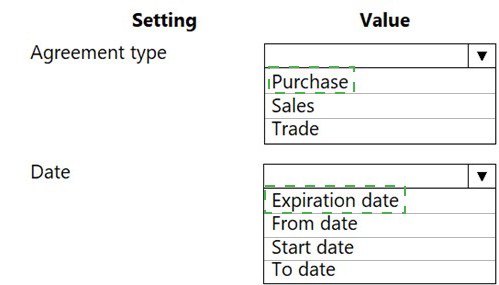
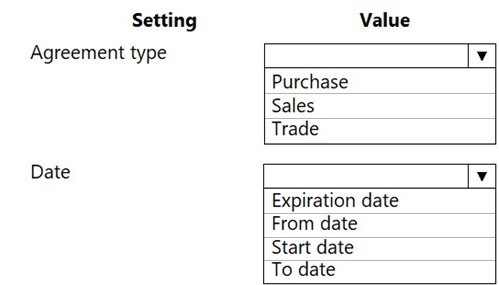
What should you configure to meet the business requirements? To answer, select the appropriate options in the area.

NOTE: Each correct selection is worth one point.

Show answerHide answer

Explanation


Explanation:
To set up a new, time-bound price negotiated with a vendor, you must create a Purchase trade agreement. This agreement type is used to record vendor-specific prices. The agreement must have defined effective dates to specify the period during which the price is valid.

Correct Option:

Agreement Type: Purchase:
A Purchase agreement is the correct trade agreement type for recording prices, discounts, or rebates negotiated with a vendor for items you buy. "Sales" agreements are for customers, and "Trade" is a broad category; the specific type for vendor pricing is "Purchase."

Date: From date and To date:
A time-bound price agreement requires both a From date (the effective start date) and a To date (the expiration or end date) to define the exact validity period. "Expiration date" is less common as a standalone field, and "Start date" is typically called "From date" in this context.

Incorrect Option:

Agreement Type (Other):
Sales: This is for setting prices charged to customers, not prices paid to vendors.

Trade: While "Trade agreements" is the module name, the specific type for vendor pricing is "Purchase." Selecting just "Trade" is too vague.

Date (Other):
Expiration date: This is often a single field that implies the end date. However, standard setup requires both a start and an end (From and To dates) for precise control.

Start date: This is essentially the "From date," but the standard paired fields are "From date" and "To date." Using only one is insufficient.

Reference:
Microsoft Learn: "Create purchase trade agreements." Purchase trade agreements are used to maintain specific purchase prices, discounts, or rebates for items per vendor. When creating a new trade agreement line, you must specify the From date and To date to define the period during which the agreement is valid.
Question 3 Choose 2
You need to set up testing for brakes to meet the operations requirements.

Which two actions should you perform? Each correct answer presents part of the solution.

NOTE: Each correct selection is worth one point.
Show answerHide answer

Correct answer: A, D Set execution to after product receipt.Set per updated quantity to no.

Explanation

Explanation:
To meet operational requirements for testing purchased brakes (likely for safety/quality), the test must occur after the goods are physically received into inventory, and it must be performed on the full received quantity, not just on a variable sample based on what was updated in the system.

Correct Option:

A. Set execution to after product receipt:
This ensures the quality inspection (test) is triggered after the item has been received into inventory via the Product receipt posting. This is standard for incoming quality control, where goods are received, placed in a quarantine or inspection location, and then tested before being released to available stock.

D. Set per updated quantity to no:
When set to No, the system creates the quality order for the entire received quantity specified on the purchase order line. This is crucial for critical items like brakes, where you likely want to test 100% of the batch or lot, not just a percentage of what was posted.

Incorrect Option:

B. Set per updated quantity to yes:
Setting this to Yes means the quality order quantity will adjust dynamically if the posted receipt quantity changes. For critical testing, you want the test to be based on the original, planned quantity (e.g., the full PO line), making No the correct choice for ensuring comprehensive inspection.

C. Set execution to before product receipt:
This is typically used for inspections before goods are formally received into company inventory, such as at a vendor's site or at the dock. For standard incoming quality control in your own warehouse, testing happens after the goods are received into your system but before they are made available for use.

Reference:
Microsoft Learn: "Set up and use quality management for inventory and warehouse management." The Test execution setting determines when a quality order is created (e.g., After product receipt). The Per updated quantity parameter controls whether the test quantity is fixed to the original order line or varies with partial receipts.

That's the last free question in Topic 3: Adventure Works Cycles

You've seen the free 30% (3 of 12 questions). Full access unlocks every question and full-length MB-330 mock exams (65 questions, 105 minutes), a different mock on every attempt.

Unlock full mock exam
Full mock exam

Sit the MB-330 exam before exam day

Full-length mocks with the same number of questions and the same time limit as the real MB-330 exam. Every attempt draws a new set of questions from the full bank, so you can keep going until you pass comfortably.

Get full MB-330 mock exam
  • 65questions per mock
  • 105 mintime limit
  • 403questions in the bank
  • Newmock on every attempt