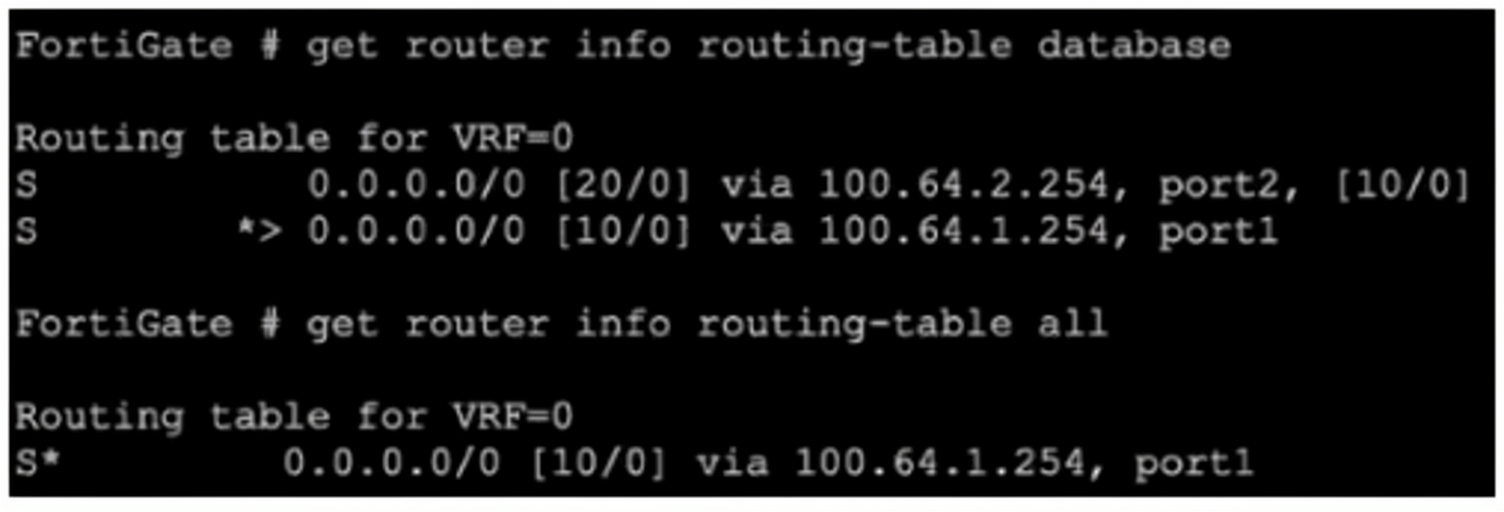
In which order does FortiGate consider the following elements during the route lookup process?
Show answerHide answer
Correct answer: D Policy routes, ISDB routes, SD-WAN rules, static routes.
Explanation
ExplanationFortiGate's route lookup process follows a strict hierarchical order. It begins with the most specific and policy-driven rules, only falling back to the general routing table if no match is found . The process identifies the best route for traffic by examining these elements in a specific sequence .
Correct Option
D. Policy routes, ISDB routes, SD-WAN rules, static routes.
This correctly represents the sequential order in which FortiGate considers these elements during the route lookup process .
Policy Routes: These are the first to be checked and take the highest precedence. They are user-defined rules that can match traffic based on more than just the destination IP, such as source, protocol, or port .
ISDB Routes: Next in line are routes created using the Internet Service Database (ISDB). While configured like static routes, these are treated as policy routes and are evaluated after user-defined policy routes .
SD-WAN Rules: Following ISDB routes, FortiGate evaluates SD-WAN rules, which also function as policy routes to steer traffic based on criteria like link quality . Static Routes: Finally, FortiGate falls back to the standard routing table entries, which include static and dynamic routes (like BGP, OSPF) .
Reference
Fortinet Documentation and study guides clearly outline the route lookup process, confirming the order: Policy Routes -> ISDB Routes -> SD-WAN Rules -> Routing Table/Static Routes .