Fortinet certification · Exam NSE7_FSN_AR-7.6

NSE7_FSN_AR-7.6 Mock Exam

Fortinet NSE 7 Secure Networking 7.6 Architect

Free NSE7_FSN_AR-7.6 questions on Security profiles, each with the answer and an explanation.

20 questions · 30 minutes · free, no sign-up

Security profiles questions

1–9 of 9 free
Question 1 Choose 2


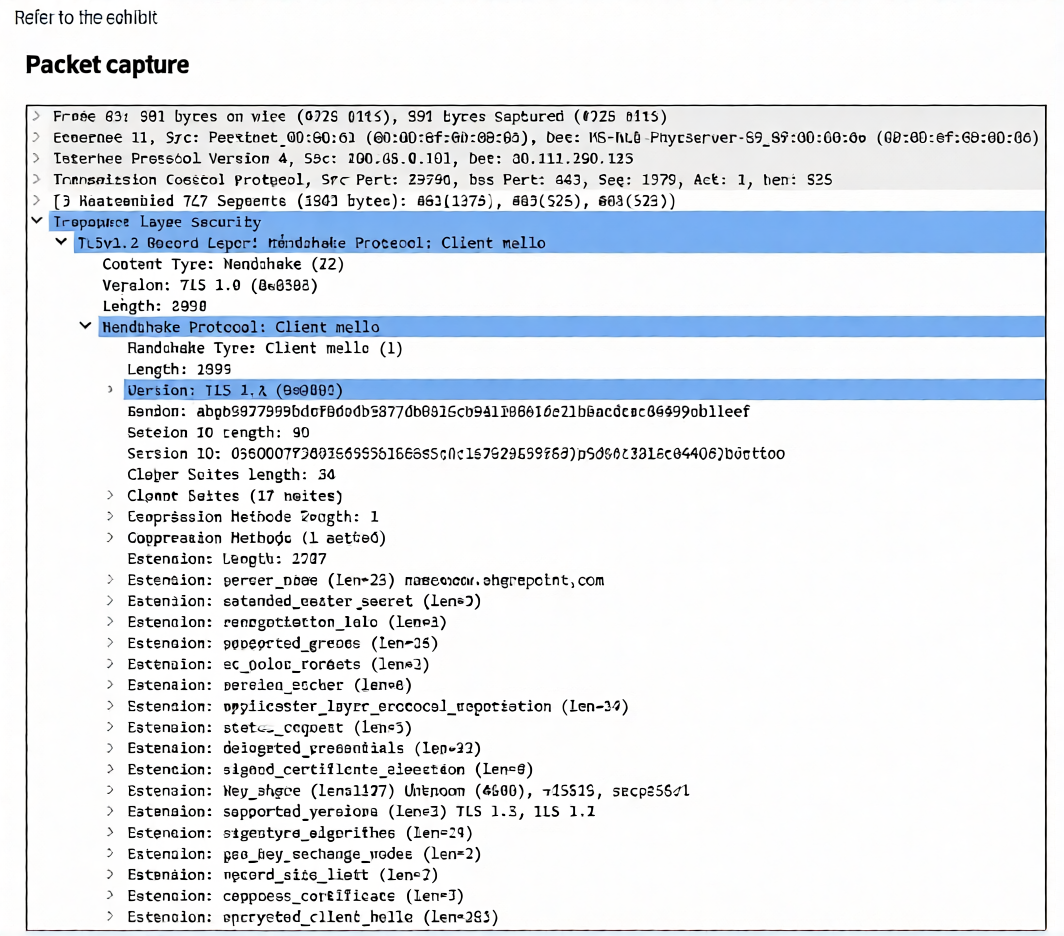
The packet capture output of a ClientHello message is shown.

You are updating a firewall policy that includes SSL certificate inspection. You are capturing packets from traffic passing through this firewall policy.

Which two statements about the packet capture are correct? (Choose two.)
Show answerHide answer

Correct answer: B, D You can effectively apply a web filtering profile to this traffic.The client supports only TLS versions 1.2 and 1.3.

Explanation

Explanation
The provided packet capture shows a TLS 1.3 Client Hello message. This is the first handshake message sent by the client to the server. Crucially, for a firewall performing SSL/TLS inspection (like FortiGate's certificate inspection), this is the point where the initial visibility into the connection is established. However, the actual content of the traffic is still encrypted. Security profiles that rely on inspecting the decrypted payload (like Antivirus) cannot be applied effectively at this stage, while profiles that inspect the initial handshake metadata (like Web Filtering) can be applied .

Correct Option: B

You can effectively apply a web filtering profile to this traffic.
This is correct. A Web Filtering profile can be applied based on the Server Name Indication (SNI) extension present in the Client Hello. In this capture, the SNI extension clearly shows the destination is www.sharepoint.com . The firewall can use this information to apply web filtering policies and categorize the traffic without needing to decrypt the entire payload. This allows for policy enforcement based on the intended destination domain.

Correct Option: D

The client supports only TLS versions 1.2 and 1.3.
This is correct. The packet capture contains a supported_versions extension within the Client Hello. The length of this extension is 5, which indicates it offers two versions. The listed versions are TLS 1.3 and TLS 1.2. The client explicitly states its support for these two protocol versions, confirming that it does not support older, less secure versions like TLS 1.1 or 1.0 .

Incorrect Option: A

You can effectively apply an antivirus security profile to this traffic.
This is incorrect. For an Antivirus profile to be effective, the firewall must perform full SSL/TLS decryption (deep inspection) to see the actual application payload (e.g., HTTP data or file transfers). With only certificate inspection, the firewall is looking at the encrypted handshake but does not decrypt the data. Therefore, it cannot inspect the content for viruses or malware patterns, making this statement false.

Incorrect Option: C

The subject alternative name (SAN) is necessary to apply security profiles.
This is incorrect. The SAN is a field used in the server's certificate, which is sent later in the handshake (in the Certificate message). In the Client Hello shown here, the SAN is not present and is not necessary for applying Web Filtering. The Web Filtering profile uses the SNI extension from the Client Hello to identify the destination, not the SAN. The SAN is used for validating a certificate, not for applying security policies.

Reference
Fortinet SSL/TLS Inspection Documentation
Question 2 Choose 1
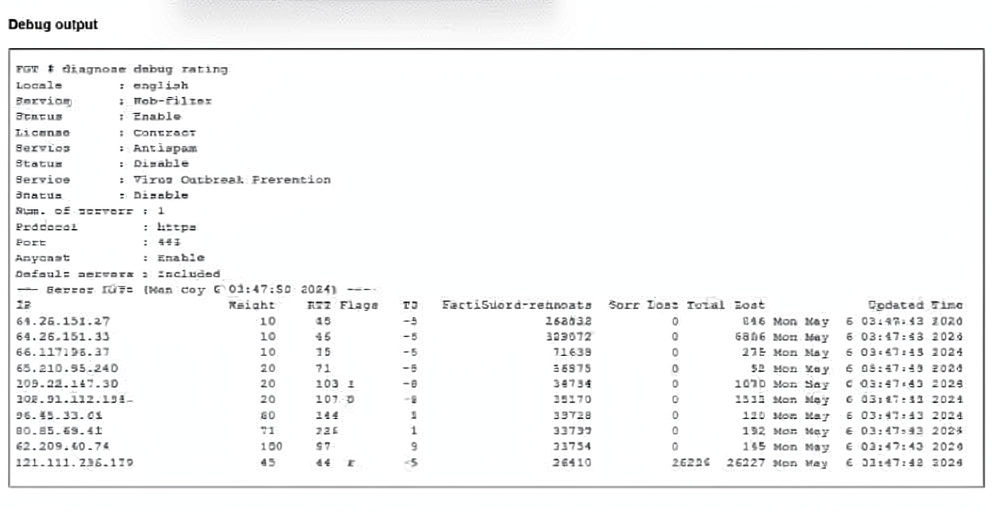
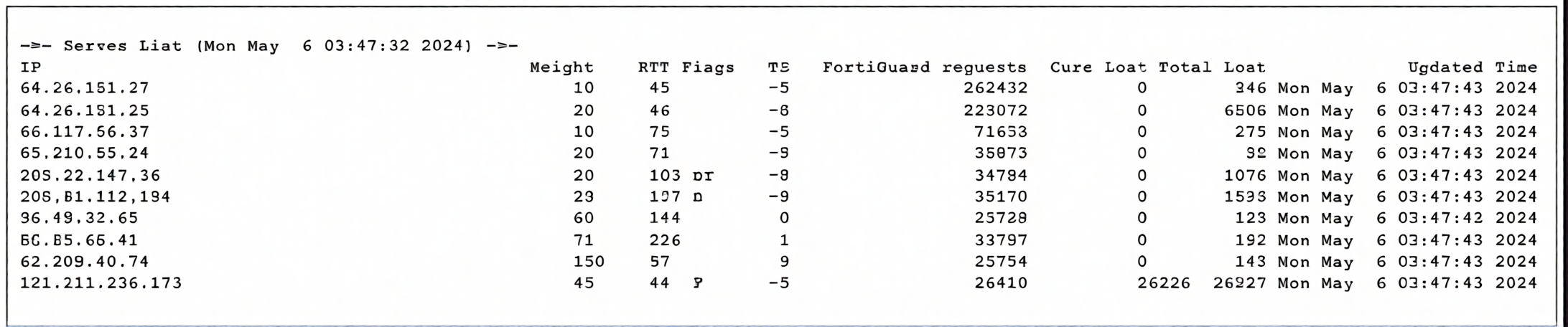
Refer to the exhibit, which shows the partial output of command diagnose debug rating.


In this exhibit, which FDS server will the FortiGate algorithm choose?
Show answerHide answer

Correct answer: D 64.26.151.37

Explanation

Explanation
The diagnose debug rating command displays the status of FortiGuard servers that the FortiGate uses for web filtering and antivirus rating queries. The FortiGate selects the "best" server using a proprietary algorithm that considers multiple factors. Key metrics include Round Trip Time (RT) , Weight, and Total Lost packets. The algorithm prioritizes servers with the lowest overall score, balancing low latency and high reliability (fewer lost packets) .

Correct Option: D (64.26.151.37)
This is the correct choice based on FortiGate's selection logic. This server has the lowest Round Trip Time (RT = 45 ms) among all listed servers. It also has a high Weight (10) and zero current losses, indicating a stable and responsive connection. The FortiGuard selection algorithm heavily favors the server with the lowest latency (RTT) as long as its loss rate remains within acceptable thresholds . Therefore, 64.26.151.37 is the optimal choice.

Incorrect Option: A (66.117.56.37)
While this server has a low RT of 75 ms and a Weight of 10, its latency is higher than that of 64.26.151.37 (45 ms) and 64.26.151.35 (46 ms). The FortiGate algorithm prioritizes the server with the lowest Round Trip Time to ensure the fastest response for rating queries, making this server less preferred despite being relatively fast .

Incorrect Option: B (208.91.112.194)
This server has a Weight of 20 and an RT of 107 ms. While its weight is higher than servers with Weight 10, the RT is significantly higher than the top-performing servers. The algorithm gives more importance to low latency for responsiveness, so this server would not be the primary choice unless all lower-latency servers were unavailable .

Incorrect Option: C (209.22.147.36)
Similar to option B, this server has a Weight of 20 and an RT of 103 ms. Although its "Total Lost" count (107) is lower than some others (e.g., 121.111.236.179 has 26227 losses), its latency is more than double that of the 64.26.151.37 server. The selection algorithm favors the lowest RT combination, making this a secondary or backup choice .

Reference

Fortinet FortiGate Administration Guide – FortiGuard Server Selection Algorithm (diagnose debug rating)

FortiGate Troubleshooting Guide – Understanding diagnose debug rating Output (RTT and Weight Metrics)
Question 3 Choose 2
You want to harden the SSL/SSH inspection profile for access to HTTPS web servers.

Which two configuration changes allow you to remove vulnerabilities? (Choose two answers.)
Show answerHide answer

Correct answer: A, B Set unsupported-ssl-version to block.Set Server certificate SNI check to Enable.

Explanation

Explanation:
To harden an SSL/SSH inspection profile and remove vulnerabilities for HTTPS web server access, you should implement the configuration changes described in options A and B. The reasoning is as follows:

Correct Option: A

Set unsupported-ssl-version to block.
This is a direct measure to eliminate weak cryptographic protocol support. By setting this parameter to block, the FortiGate will terminate any SSL/TLS session that attempts to use a protocol version considered obsolete or weak, such as SSL 3.0 or TLS 1.0 . Blocking these protocols prevents attackers from exploiting known vulnerabilities (e.g., POODLE) that rely on forcing connections to downgrade to these outdated versions.

Correct Option: B

Set Server certificate SNI check to Enable.
Enabling the Server Name Indication (SNI) check enhances the firewall's ability to verify the server's identity and enforce correct policies. When set to Enable, the FortiGate compares the SNI in the Client Hello with the Common Name (CN) or Subject Alternative Name (SAN) in the returned server certificate . If a mismatch is found, it uses the certificate's CN for URL filtering, ensuring that the traffic is correctly identified and policy is applied. This prevents attackers from using mismatched certificates to bypass web-filtering policies.

Incorrect Option: C

Set Untrusted SSL certificates to Ignore.
This is a dangerous action for hardening a profile. The "Ignore" option for untrusted certificates is typically used only for Full SSL Inspection in very specific troubleshooting scenarios, where the FortiGate re-signs the certificate to force trust . For a security-hardening objective, ignoring an untrusted certificate completely defeats the purpose of certificate validation, as it silently allows potentially malicious or misconfigured servers to establish connections without any warning or block.

Incorrect Option: D

Set min-allowed-ssl-version to ssl-3.0.
This configuration would have a counterproductive and insecure effect. The min-allowed-ssl-version parameter sets the lowest protocol version that the FortiGate will accept . Setting this to ssl-3.0 explicitly permits SSL 3.0 connections. Since SSL 3.0 is notoriously insecure and deprecated, allowing it introduces a significant vulnerability, the exact opposite of the hardening goal.
Question 4 Choose 2
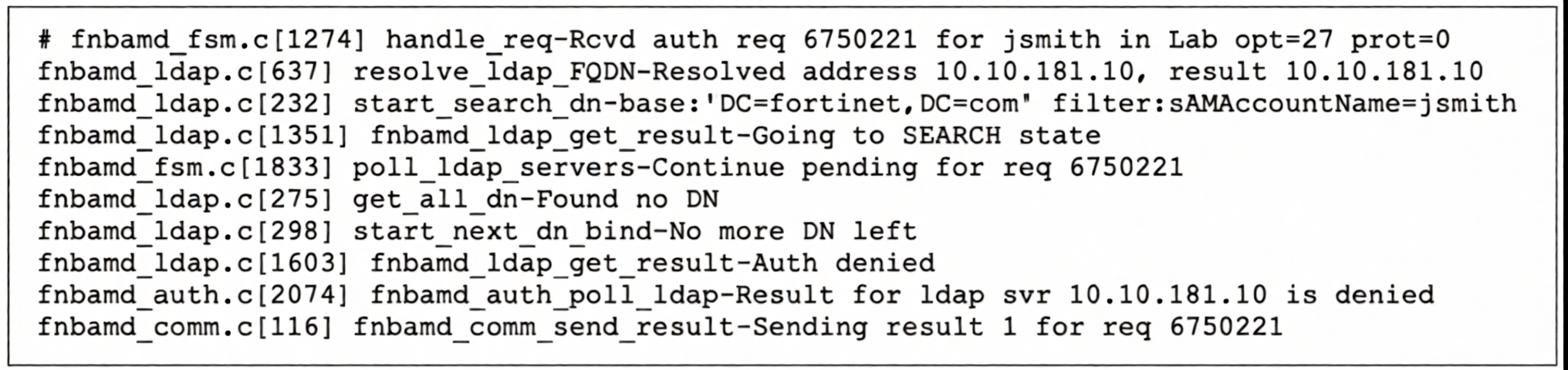
Refer to the exhibit, which shows a partial output of the real-time LDAP debug.


What two actions can the administrator take to resolve this issue? (Choose two.)
Show answerHide answer

Correct answer: B, D Ensure the user is providing the correct user credentials.Ensure the account is active.

Explanation

Explanation
The debug output shows a failed LDAP authentication attempt for user jsmith in the domain fortinet.com. The key error messages are "Found no DN" (Distinguished Name) and "Auth denied". These indicate that while the FortiGate could resolve the LDAP server's IP and contact it, it could not find the user's account in the directory. Based on the search filter sAMAccountName=jsmith, this error specifically occurs when the user account is not found or is inactive .

Correct Option: B

Ensure the user is providing the correct user credentials.
This is a relevant step because, while the immediate error is "Found no DN," providing incorrect credentials can sometimes cause a failed search or bind operation that manifests as a "no DN found" error. However, more importantly, if the credentials are correct, the authentication process moves to the bind stage. In this case, the "Auth denied" result after trying to bind suggests the password might be wrong, or the account is locked/inactive. Verifying credentials is a basic but necessary step in the troubleshooting process.

Correct Option: D

Ensure the account is active.
This is the most critical action based on the debug output. The sAMAccountName=jsmith search filter is correct, and the LDAP server responded but returned "Found no DN". In Active Directory, this typically occurs when:

The user account does not exist.

The user account is disabled.

The account is locked out.

The account is expired.

Since the output shows the search returned no DN, it strongly indicates the account may be inactive, disabled, or not present in the directory .

Incorrect Option: A

Ensure the user logs in using ' John Smith ' not ' jsmith ' .
This is incorrect. The debug output shows the search filter used is sAMAccountName=jsmith. In Active Directory, sAMAccountName is the pre-Windows 2000 logon name (typically a short username like jsmith), not the full display name (John Smith). If the administrator configured the LDAP server to use the sAMAccountName attribute for authentication, the user must log in with their short username. Using the full display name would not work.

Incorrect Option: C

Ensure the user is a member of at least one AD group to ensure step 4 of the LDAP authentication process is successful.
This is incorrect. The debug output fails at the "Found no DN" stage, which occurs during the user search phase (step 2 of the LDAP authentication process). Group membership is checked after a valid DN is found and the user's credentials are successfully bound (step 4). Since the FortiGate cannot even locate the user's DN, group membership verification has not yet been reached and is irrelevant to this specific error.

Reference

Fortinet FortiGate Administration Guide – LDAP Authentication Debugging and Troubleshooting

Fortinet Knowledge Base – Troubleshooting LDAP Authentication: "Found no DN" and "Auth denied" Errors

Microsoft Active Directory Documentation – sAMAccountName Attribute and User Account States
Question 5 Choose 1
Consider the scenario where the server name indication (SNI) does not match either the common name (CN) or any of the subject alternative names (SAN) in the server certificate.

Which action will FortiGate take when using the default settings for SSL certificate inspection?
Show answerHide answer

Correct answer: D FortiGate uses the CN information from the Subject field in the server certificate.

Explanation

Explanation
When FortiGate performs SSL certificate inspection, it receives the SNI from the client's TLS handshake and the CN/SAN from the server's certificate. The default behavior of the Server Certificate SNI Check setting determines how FortiGate handles a mismatch between these two identifiers.

The official Fortinet documentation states:

Enable (default): If it is mismatched, use the CN in the server certificate for URL filtering.

Therefore, in the described scenario, the FortiGate will disregard the mismatched SNI and proceed using the CN from the server certificate to perform its functions, such as URL filtering.

Correct Option: D

FortiGate uses the CN information from the Subject field in the server certificate.
This statement is correct. As per the default configuration (Enable), the "Server certificate SNI check" is active. When a mismatch between the SNI and the certificate's CN/SAN is detected, the FortiGate's configured action is to use the CN from the server certificate.

Incorrect Options

A. FortiGate uses the SNI from the user's web browser.
This is incorrect. While the SNI is the initial identifier, the default Enable setting is specifically designed to override it with the CN from the certificate when a mismatch occurs.

B. FortiGate closes the connection because this represents an invalid SSL/TLS configuration.
This is incorrect. Closing the connection is the behavior associated with the Strict setting, not the default Enable setting.

C. FortiGate uses the first entry listed in the SAN field in the server certificate.
This is incorrect. This action is not part of the default SSL certificate inspection behavior. The official configuration guide explicitly states that the fallback is to the CN, not to an entry in the SAN list.

Reference

Fortinet Administration Guide: Configuring an SSL/SSH inspection profile, Server certificate SNI check option.

FortiOS 7.2.4 Administration Guide: Certificate inspection.

Exam discussion identifying the correct option and its configuration parameter.
Question 6 Choose 1
Refer to the exhibit.


The administrator did not override the FortiGuard FODN or IP address in the FortiGate configuration

Which IP address did FortiGate get when resolving the servicem,fortiguard.net name?
Show answerHide answer

Correct answer: A 208.91.112.194

Explanation

Explanation
The diagnose debug rating command displays a list of FortiGuard servers, with the selection algorithm's top choice presented at the top of the list. Since the administrator did not override the FortiGuard FQDN (it remains service.fortiguard.net) and the fortiguard-anycast setting is enabled by default, DNS resolution for this Anycast domain points to a single IP address—not a list.

Correct Option: A
208.91.112.194 is the correct answer because it is the first server listed in the diagnose debug rating output. With the default Anycast setting enabled, the service.fortiguard.net domain resolves to a specific Anycast IP address that is already included in the server list. In the exhibit, 208.91.112.194 is the top server, which indicates it was either the resolved address or selected as the active server.

Incorrect Options

B. 209.22.147.36 is incorrect because, although it appears in the server list, it is not at the top. Since the FortiGate sends rating requests to the top server during normal operation, this would not be the resolved IP address for the FQDN.

C. 64.26.151.37 is also incorrect. While it appears with a lower RTT value than 208.91.112.194, the RTT value does not determine DNS resolution. The standard selection algorithm selects the server with the smallest RTT for sorting, but the DNS resolve step happens before the list is generated for the algorithm.

D. 96.45.33.65 is incorrect and does not match the top server in the server list. This IP address does not appear as the first entry in the provided exhibit.

Reference

Fortinet Administration Guide: Diagnose debug rating command output and server sorting.

Exam discussion confirming the top server selection algorithm.

Fortinet Documentation: Anycast domain service.fortiguard.net resolves to a single anycast IP address.
Question 7 Choose 3
Which three common FortiGate-to-collector-agent connectivity issues can you identify using the FSSO realtime debug? (Choose three.)
Show answerHide answer

Correct answer: B, C, D The connection was refused. There may be a mismatch of the TCP port.FortiGate cannot reach the IP address of the collector agent.The pro-shared key does not match

Explanation

Explanation
The FSSO real-time debug (using diagnose debug application authd -1 and diagnose debug application fssod -1) helps identify a range of communication issues. The debug output will show specific error messages that correspond to particular problems. A connection refused error indicates a TCP port or connectivity issue, while a server authentication failed error points to a pre-shared key mismatch .

Correct Options

B. The connection was refused. There may be a mismatch of the TCP port.
The real-time debug will show an error like connection refused if the FortiGate attempts to connect to the collector agent but nothing is listening on the specified TCP port. The default port for FSSO communication is TCP 8000. If the collector agent is configured to use a different port, or if a firewall is blocking the port, the debug log will reveal this "refused" state .

C. FortiGate cannot reach the IP address of the collector agent.
If the FortiGate cannot establish a connection with the collector agent, a common reason is that the collector agent's IP address is unreachable. This is often due to routing issues or network segmentation. The fssod and authd debugs will show error messages related to a failed connection attempt, indicating that the FortiGate cannot reach the defined IP address .

D. The pre-shared key does not match.
Authentication between the FortiGate and the collector agent uses a pre-shared key (or password). If the key configured in the FortiGate's FSSO configuration does not match the key in the collector agent, the authentication will fail. The debug output will log an error such as server authentication failed or authentication failure, clearly indicating a mismatch of the pre-shared key .

Incorrect Options

A. The SSL certificate used for FSSO over SSL has expired.
While FSSO over SSL uses certificates, this is not a common issue identified by the standard real-time debug. The authentication failure error points to a pre-shared key mismatch, not a certificate validation issue .

E. The group filters do not match.
A mismatch of group filters is a configuration issue on the collector agent, not a connectivity issue. When group filters do not match, the FortiGate may not receive user logon information or may not apply the correct policies, but the connection itself would still be established. This problem is identified by a lack of user information in the debug output or diagnose firewall auth list, rather than a connection error .

Reference

Fortinet FSSO Study Guide – Troubleshooting Common Collector Agent Connection Issues

Fortinet Troubleshooting Guides – Diagnosing FSSO with Real-Time Debug Commands
Question 8 Choose 3
While troubleshooting a FortiGate web filter issue, users report that they cannot access any websites, even though those sites are not explicitly blocked by any web filter profiles that are applied to firewall policies.


What are the three most likely reasons for this behavior? (Choose three answers)
Show answerHide answer

Correct answer: B, D, E The SSL/TLS deep inspection was configured but the browsers do not have the FortiGate certificate installed.The DNS server is unreachable, preventing URL resolution.The FortiGuard Web Filtering license has expired, causing FortiGate to apply the default block action.

Explanation

Explanation
Web filtering on a FortiGate relies on the FortiGuard service to categorize URLs. If users cannot access websites that aren't explicitly blocked, the core issue is often that the FortiGate cannot successfully query the FortiGuard service for a rating. This can happen due to a communication failure (like a blocked protocol or unreachable DNS) or a licensing issue that forces an action on unrated sites. Additionally, SSL/TLS deep inspection can prevent access if the client browser does not trust the FortiGate's certificate.

Correct Option: B

The SSL/TLS deep inspection was configured but the browsers do not have the FortiGate certificate installed.
This is a very common cause. When full SSL/TLS deep inspection is enabled, the FortiGate acts as a "man-in-the-middle" to decrypt and inspect encrypted traffic. It re-encrypts the traffic using a certificate from the FortiGate itself. If this certificate is not installed as a trusted root CA on the client's browser, the browser will display a certificate error and often prevent the user from accessing the website entirely.

Correct Option: D

The DNS server is unreachable, preventing URL resolution.
For the FortiGate to contact FortiGuard servers, it needs to resolve the domain names for its services. If the configured DNS servers are unreachable, the FortiGate cannot resolve service.fortiguard.net and thus cannot send web filtering queries to get URL ratings. This is a common and widely documented cause of web filter failures.

Correct Option: E

The FortiGuard Web Filtering license has expired, causing FortiGate to apply the default block action.
When the FortiGuard Web Filtering license expires, the FortiGate can no longer perform real-time lookups for unrated or new websites. The exact behavior when a license expires can depend on the configuration, but it is a common scenario for the FortiGate to treat unrated sites as blocked, leading to the described issue. An expired license is a foundational reason for this behavior.

Incorrect Option: A

The web filter cache has been cleared causing all websites to take longer to be rated.
This is incorrect. Clearing the web filter cache would affect performance for previously rated sites, as the FortiGate would need to query FortiGuard servers again to get their rating. However, it would not cause websites to be completely inaccessible and would not prevent access to new, unrated sites.

Incorrect Option: C

The webfilter-force-off setting has been enabled under config system fortiguard.
This is incorrect. The webfilter-force-off command is a system-wide CLI setting to globally disable all web filtering activities on the FortiGate. If this were enabled, web filtering would be off entirely, which is different from the problem described where sites are being blocked despite not being explicitly in a block list.
Question 9 Choose 1
In the SAML negotiation process, which section does the Identity Provider (IdP) provide the SAML attributes utilized in the authentication process to the Service Provider (SP)?
Show answerHide answer

Correct answer: D Assertion dump

Explanation

Explanation
In the SAML authentication process, the Identity Provider (IdP) sends the user's identity and group attributes to the Service Provider (SP) within a SAML assertion . This assertion is the core security token that the SP relies on to grant access. It is delivered from the IdP to the user's browser, which then forwards it (as an HTTP POST) to the SP's assertion consumer service (ACS) URL . In the context of a FortiGate's diagnostic output, this message is displayed as an "Assertion dump" .

Correct Option: D

Assertion dump
The SAML assertion, seen in debug outputs as an "Assertion dump", is the message that contains the actual user attributes like username and group-name . It is the IdP's way of telling the SP who the user is and what groups they belong to, which the SP then uses for authorization decisions .

Incorrect Options

A. SP Login dump
This is not a standard term in SAML debug outputs. While debug logs for SAML can be extensive, the specific message containing attributes is the assertion.

B. Authentication Response
"Authentication Response" is a generic term that can describe the broader SAML response message. However, the specific part of that response carrying the user attributes is the assertion itself, which is displayed as an "Assertion dump" in FortiGate diagnostics .

C. Authentication Request
The "Authentication Request" (AuthnRequest) is sent from the SP to the IdP to initiate the authentication process . It does not contain user attributes, as the user has not yet authenticated at this stage.

That's the last free question in Security profiles

You've seen the free 30% (9 of 33 questions). Full access unlocks every question and full-length NSE7_FSN_AR-7.6 mock exams (40 questions, 60 minutes), a different mock on every attempt.

Unlock full mock exam
Full mock exam

Sit the NSE7_FSN_AR-7.6 exam before exam day

Full-length mocks with the same number of questions and the same time limit as the real NSE7_FSN_AR-7.6 exam. Every attempt draws a new set of questions from the full bank, so you can keep going until you pass comfortably.

Get full NSE7_FSN_AR-7.6 mock exam
  • 40questions per mock
  • 60 mintime limit
  • 176questions in the bank
  • Newmock on every attempt