Fortinet certification · Exam NSE6_FMG_AD-7.6

NSE6_FMG_AD-7.6 Mock Exam Page 2

Fortinet NSE 6 FortiManager 7.6 Administrator

Free NSE6_FMG_AD-7.6 mock exam questions 11–18, each with the answer and an explanation.

18 questions · 36 minutes · free, no sign-up

Free NSE6_FMG_AD-7.6 questions

11–18 of 18 free
Question 11 Choose 1
Refer to the exhibit
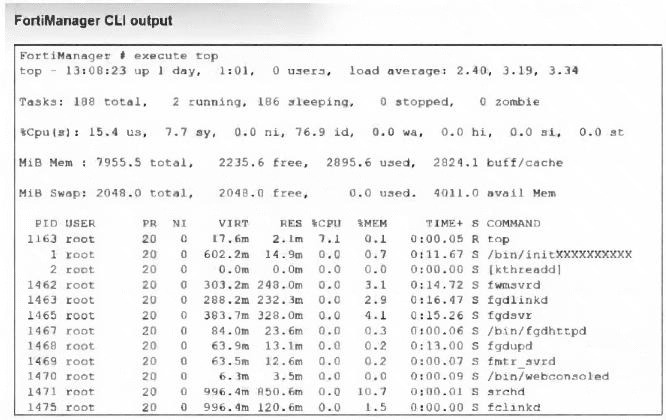
What percentage of the available RAM is being used by the process in charge of downloading the web and email filter databases from the public FortiGuard servers?
Show answerHide answer

Correct answer: C 4.1

Explanation

✅ Explanation:

In the FortiManager process list from the execute top output, the process responsible for downloading and managing FortiGuard web and email filter databases from public FortiGuard servers is fgdsvr (FortiGuard Daemon Server). This daemon handles the download and update of web filtering, email filtering, antivirus, IPS, and other FortiGuard databases.

In the output, the fgdsvr process shows:
RES (resident memory) = 328.0m
%MEM = 4.1

The question asks for the percentage of available RAM being used by the process in charge of downloading web and email filter databases. Since fgdsvr manages these updates, the correct value is 4.1%.

❌ Why Other Options Are Incorrect:

A. 1.5
– This corresponds to the fclinkd process (FortiClient Link Daemon), which is unrelated to FortiGuard database downloads.

B. 3.1
– This corresponds to the fwmsvrd process (FortiManager Server Daemon), which handles overall system management and is not responsible for web/email filter database updates.

D. 2.9
– This corresponds to the fgdlinkd process (FortiGuard Link Daemon), which manages communication with FortiGuard services but is not the primary process for downloading and storing the web/email filter databases.

📚 References:

FortiManager CLI Reference – execute top command – Explains the output fields and identifies fgdsvr as the FortiGuard daemon process responsible for managing security database updates.

FortiManager 7.6 Administration Guide, Chapter "System Settings" → Section "FortiGuard Updates" – Describes that fgdsvr is the process handling downloads of web, email, antivirus, and IPS databases from FortiGuard servers.
Question 12 Choose 1
An administrator created a new ADOM named Training for FortiGate devices only. Then, the administrator added the root FortiGate device of a Security Fabric group to the Training ADOM. Which statement correctly describes the expected result for the downstream devices in the Security Fabric, given the actions taken by the administrator? Choose one answer
Show answerHide answer

Correct answer: D The downstream devices must be added using the Add Device wizard.

Explanation

✅ Explanation

When an administrator creates a new ADOM (e.g., Training) and adds the root FortiGate of a Security Fabric group to that ADOM, the downstream devices (Security Fabric members) do not automatically move or become members of the new ADOM. Each FortiGate device must be explicitly added to FortiManager and assigned to an ADOM individually.

❌ Why Other Options Are Incorrect

A. The downstream devices are automatically authorized.
This is incorrect. Adding the root FortiGate to a new ADOM does not automatically authorize or import downstream devices. Each device must be manually authorized and added to FortiManager separately.

B. The downstream devices will appear in the Managed FortiGate section of the root ADOM.
This is incorrect. The root FortiGate itself is moved to the Training ADOM. Downstream devices are not automatically added to any ADOM. If they were later added without specifying an ADOM, they would default to the root ADOM (ADOM 0), but they do not appear simply because the root device was moved.

C. The downstream devices show as unauthorized in the root ADOM.
This is incorrect. Devices do not show as "unauthorized" in an ADOM just because the root FortiGate was moved. Unauthorized devices are those that have been discovered (e.g., via Security Fabric) but not yet approved/authorized in FortiManager. This status is separate from ADOM assignment and does not occur automatically.

📚 References

FortiManager 7.6 Administration Guide, Chapter "ADOMs" → Section "Adding Devices to ADOMs" – Explains that devices must be manually added to ADOMs using the Add Device wizard; moving or adding a root device does not automatically add downstream Security Fabric devices.
Question 13 Choose 1
What is the best explanation of how FortiManager helps with mass provisioning?
Show answerHide answer

Correct answer: C It uses templates to configure the same settings on many devices simultaneously.

Explanation

✅ Explanation

FortiManager's primary strength in mass provisioning is its ability to apply consistent configurations across multiple devices efficiently using templates. Templates allow administrators to define system settings (DNS, SNMP, admin accounts, logging, etc.) and security profiles once and then assign them to dozens or hundreds of FortiGate devices simultaneously. This eliminates the need to manually configure each device individually, reducing human error, ensuring consistency, and saving significant time.

❌ Why Other Options Are Incorrect

A. It upgrades the OS of each FortiGate device.
This is incorrect. While FortiManager can upgrade firmware on managed devices (via firmware templates and the Device Manager), this is a subset of provisioning, not the primary definition of mass provisioning. Provisioning covers a wide range of configuration tasks, not just OS upgrades.

B. It provides local FortiGuard Distribution Server (FDS) services to the network.
This is incorrect. FDS services are used for distributing FortiGuard updates (antivirus, IPS, web filtering) to FortiGate devices. While this is a useful feature, it is not mass provisioning—it's a service for security updates, not configuration deployment.

D. It sends email alerts when new devices connect.
This is incorrect. FortiManager does not automatically send email alerts when new devices connect as a standard provisioning feature. Device discovery and authorization are manual or automated via configuration, but email alerts are not a core mass provisioning capability.

📚 References

FortiManager 7.6 Administration Guide, Chapter "Provisioning Templates" – Explains that templates allow administrators to standardize and deploy configurations to multiple devices at scale, which is the essence of mass provisioning.

FortiManager 7.6 Administration Guide, Chapter "System Templates" – Describes how system templates are used to apply consistent device-level settings across many FortiGates.
Question 14 Choose 1
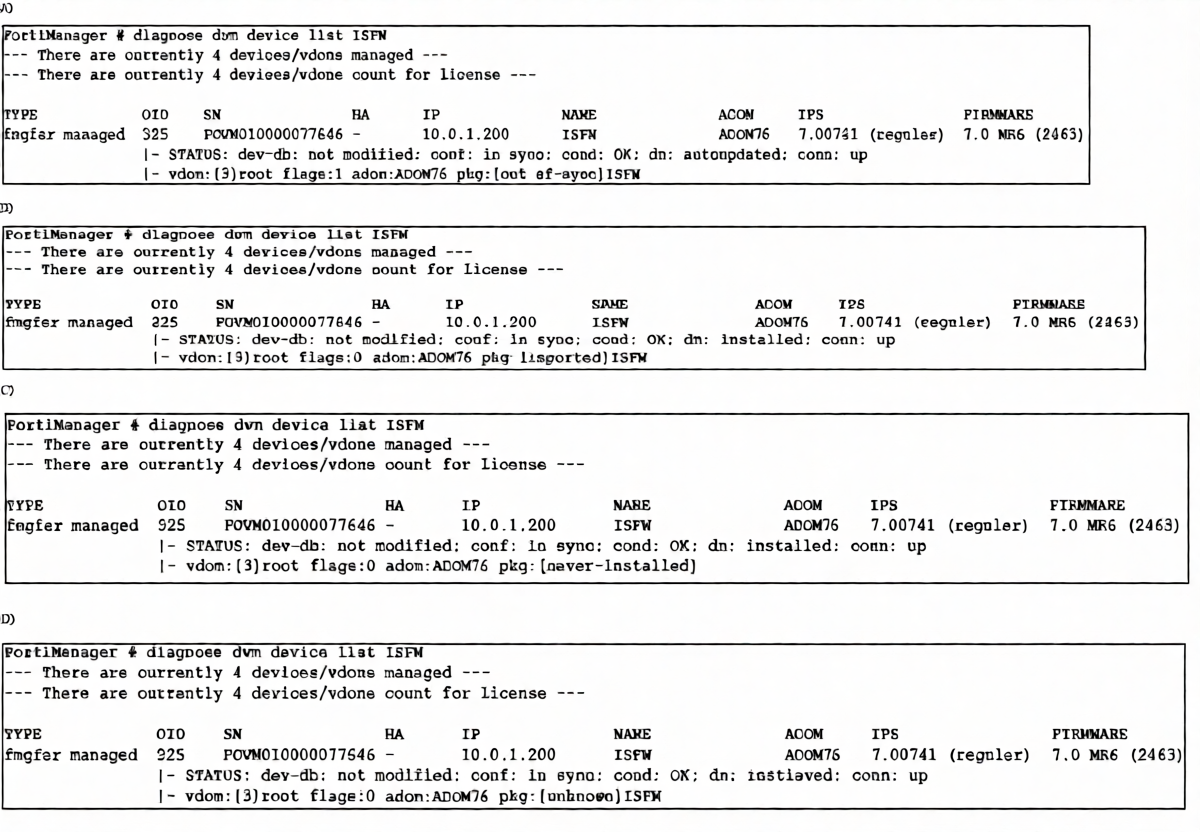
Which output is displayed right after moving the ISFW device from one ADOM to another?

Show answerHide answer

Correct answer: C Option C

Explanation

✅ Explanation

When a FortiGate device is moved from one ADOM to another in FortiManager, the device's policy package status in the new ADOM is initially set to [never-installed]. This is because the device has not yet had any policy package installed from the new ADOM's database. The policy package associated with the device in the new ADOM does not exist yet, and FortiManager marks it as never-installed until the administrator imports or assigns a policy package and performs an installation.

❌ Why Other Options Are Incorrect

Option A
– Shows pkg:[out of sync]ISFW. This indicates that a policy package exists but is out of sync with the device, which is not the state immediately after a move.

Option B
– Shows pkg:[installed]ISFW. This indicates that a policy package has already been installed on the device in the new ADOM, which is not the case immediately after the move.

Option D
– Shows pkg:[unknown]ISFW. This status is not a valid FortiManager policy package state and does not occur after an ADOM move.

📚 References

FortiManager 7.6 Administration Guide, Chapter "ADOMs" → Section "Moving Devices Between ADOMs" – Explains that after moving a device, the policy package status in the new ADOM is set to never-installed because no policy package from the new ADOM has been installed on the device yet.

FortiManager CLI Reference – diagnose dvm device list – Describes the output fields, including pkg statuses such as never-installed, installed, out of sync, and unknown.
Question 15 Choose 1
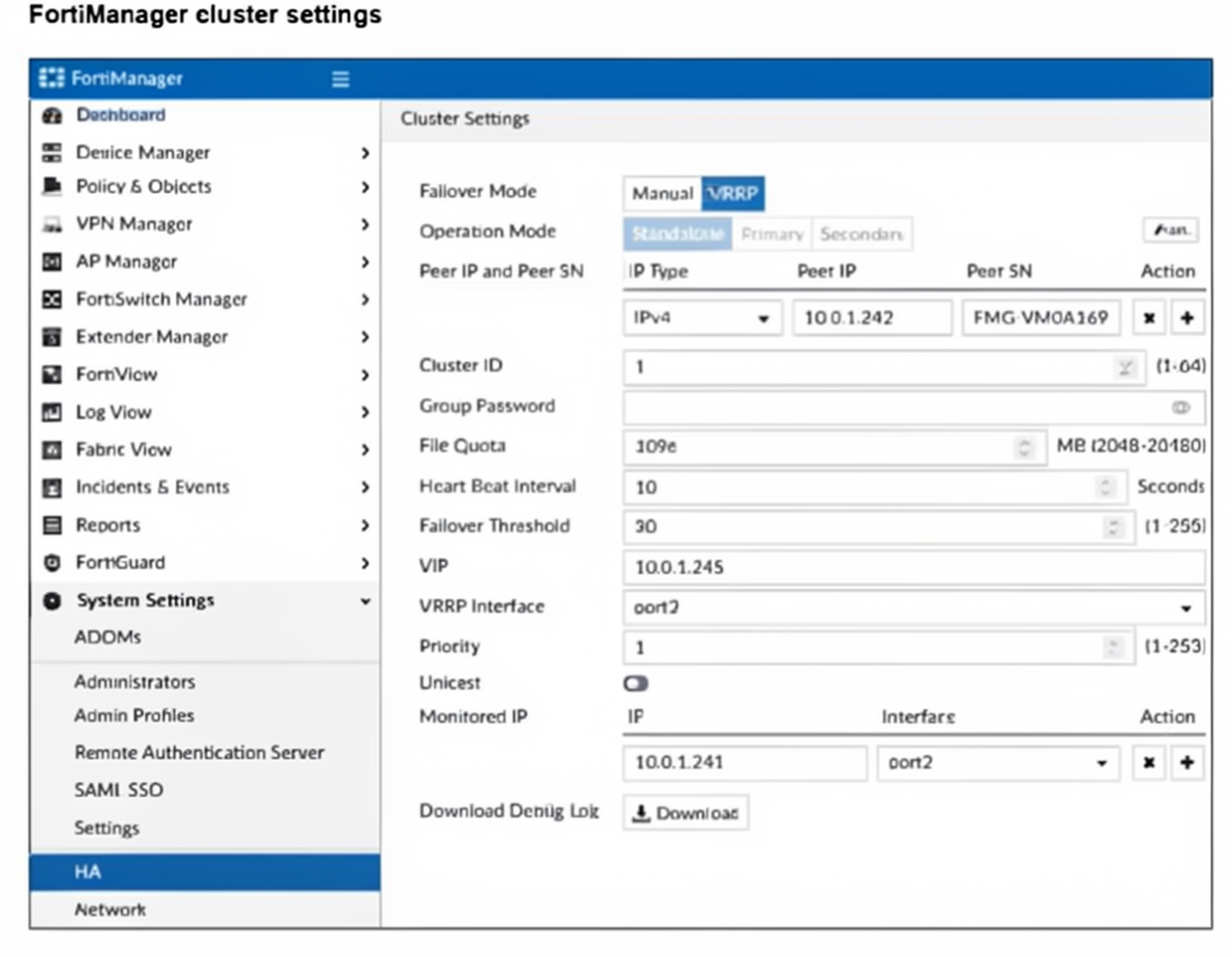
Refer to the exhibit.

If the monitored interface for the primary FortiManager device fails, what must you do to maintain high availability (HA)?
Show answerHide answer

Correct answer: A The FortiManager HA failover is transparent to administrators and does not require any additional action.

Explanation

✅ Explanation:

The exhibit shows FortiManager HA configured in VRRP mode with a VIP (10.0.1.245) and monitored interfaces. In this setup, the primary and secondary FortiManager devices share a virtual IP address. If the monitored interface on the primary device fails, VRRP detects the failure and automatically triggers a failover to the secondary device. The secondary assumes the VIP and takes over the primary role, providing seamless continuity. This failover is transparent to administrators—they continue to access FortiManager using the same VIP, and the HA cluster handles the switch without requiring manual intervention. No manual promotion, rebooting, or reconfiguration is needed.


❌ Why Other Options Are Incorrect

B. Manually promote one of the working secondary devices to the primary role and reboot the original primary device to remove the peer IP address of the failed device.
This is incorrect because VRRP-based HA in FortiManager performs automatic failover when the monitored interface fails. Manual intervention, such as promoting a secondary or rebooting the primary, is not required.

  • C. Reconfigure the primary device to remove the peer IP address of the failed device from its configuration.
    This is incorrect. Reconfiguring the primary or removing peer IP addresses is not a required step for failover. VRRP handles the failover automatically, and peer IPs are only used for cluster member identification, not for failover triggering.

    D. Check the integrity database of the primary device to force a secondary device to become the new primary with all active interfaces.
    This is incorrect. Database integrity checks are used to verify FortiManager’s configuration consistency, not to trigger HA failover. The failover is handled by VRRP, not by database integrity commands.

    📚 References

    FortiManager 7.6 Administration Guide, Chapter "High Availability (HA)" → Section "VRRP HA Mode" – Explains that when VRRP is configured, the failover between primary and secondary FortiManager devices is automatic and transparent when a monitored interface fails.

  • Question 16 Choose 2
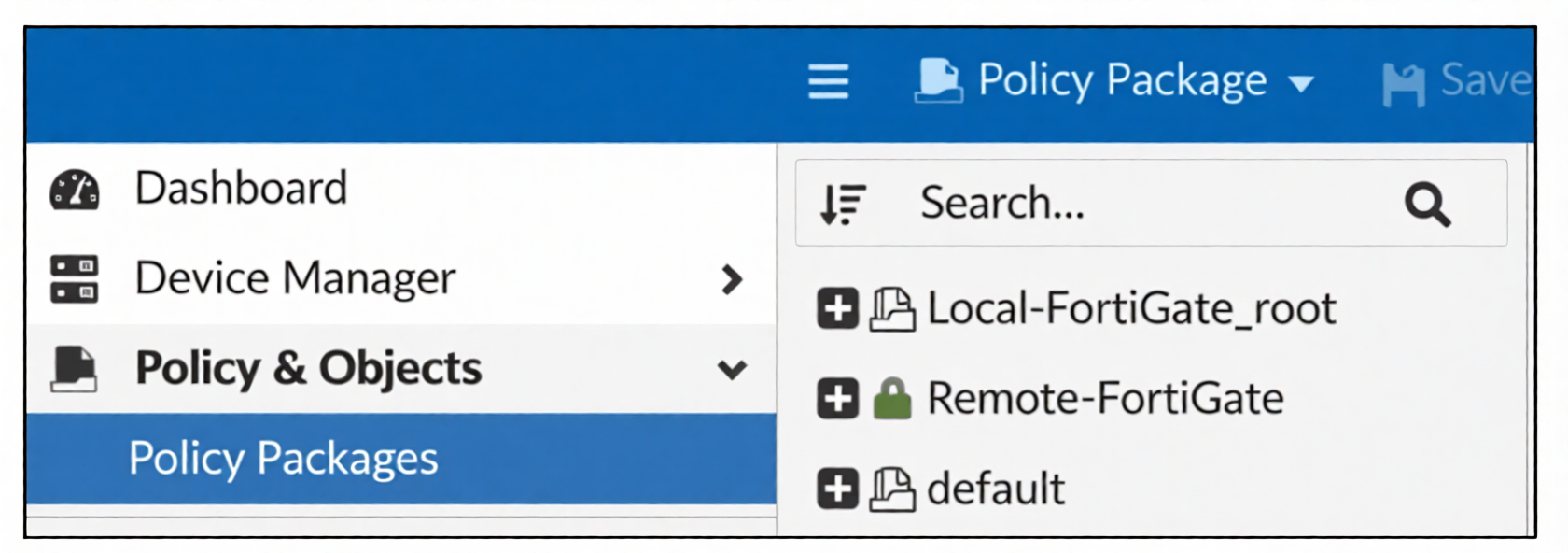
    Refer to the exhibit.

    Which two statements about the configuration shown in the exhibit are true? Choose two answers.
    Show answerHide answer

    Correct answer: A, D An administrator can lock the Local-FortiGate_root policy package.The FortiManager is in workflow mode.

    Explanation

    ✅ Explanation

    The exhibit shows a FortiManager policy package interface with an "Unlock" button displayed (indicated by the lock icon and the word "Unlock" in the screenshot). This indicates that the policy package Local-FortiGate_root is currently locked by an administrator. Therefore:

    A. An administrator can lock the Local-FortiGate_root policy package.
    This is correct. The presence of the "Unlock" button means the package is locked, which implies that administrators have the ability to lock it. Locking is a feature of workspace mode or workflow mode, allowing administrators to prevent conflicting changes.

    The exhibit also shows a "Save" and "Preview" button, which are characteristic of workflow mode (change management with approval workflow). In workflow mode, changes are saved as drafts and require approval before installation. The "Preview" button allows reviewing changes before submitting for approval. Therefore:

    D. The FortiManager is in workflow mode.
    This is correct. The Save and Preview buttons are typical of workflow mode, where changes are staged, reviewed, and approved before installation.

    ❌ Why Other Options Are Incorrect

    B. The administrator created a snapshot of the Remote-FortiGate policy package.
    This is incorrect. The exhibit does not show any snapshot creation for Remote-FortiGate. The lock icon is only displayed next to Local-FortiGate_root, indicating it is locked, not that a snapshot was created.

    C. The FortiManager ADOM workspace mode is set to normal.
    This is incorrect. In normal workspace mode, the interface typically shows Lock/Unlock buttons but does not display Save and Preview buttons. The presence of Save and Preview indicates workflow mode, not normal workspace mode.

    📚 References

    FortiManager 7.6 Administration Guide, Chapter "Policy and Objects" → Section "Workspace Mode" – Explains that in normal workspace mode, administrators lock policy packages to edit them, and the interface shows Lock/Unlock buttons.

    Question 17 Choose 1
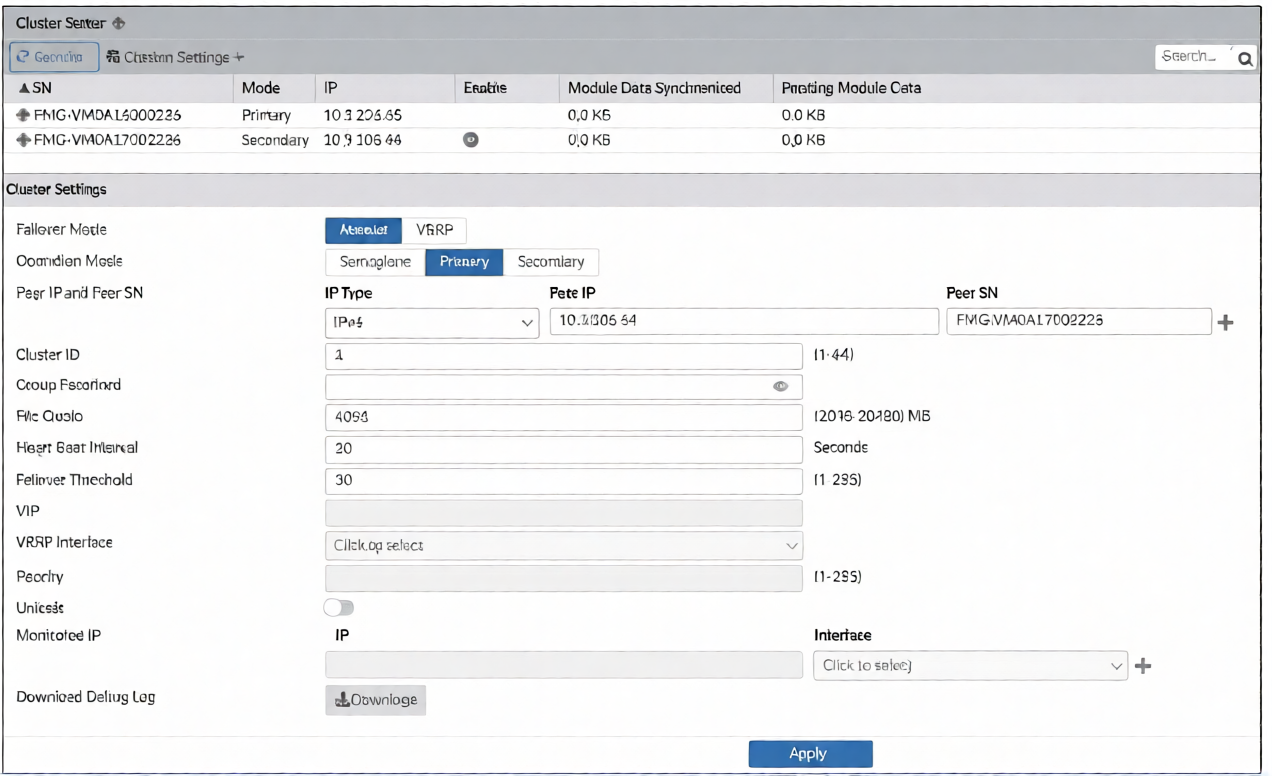
    Refer to the exhibit.

    Which statement about the environment shown in the exhibit is true? Choose one answer
    Show answerHide answer

    Correct answer: D FortiAnalyzer features are not enabled on this FortiManager device.

    Explanation

    ✅ Explanation

    The exhibit shows the output of the diagnose system ha status command on a FortiManager HA cluster. The line FortiAnalyzer ... disabled clearly indicates that FortiAnalyzer features are not enabled on this FortiManager device. FortiManager can operate in two modes:

    FortiManager-only mode – Management and provisioning only.

    FortiManager with FortiAnalyzer features enabled – Combines management with log collection and analytics.

    Since the output explicitly states disabled, the FortiAnalyzer features are turned off on this device, meaning it does not collect or analyze logs from FortiGate devices.

    ❌ Why Other Options Are Incorrect

    A. You must restart the secondary device if you promote it to primary.
    This is incorrect. In FortiManager HA, promoting a secondary to primary does not require a restart. The secondary takes over the primary role automatically (or manually) without rebooting.

    B. No FortiGuard packages have been synchronized between the cluster members.
    This is incorrect. The FortiGuard packages line shows synchronized, indicating that FortiGuard updates (antivirus, IPS, web filtering databases) are in sync between cluster members.

    C. A failover will take place after five minutes without receiving heartbeat packets.
    This is incorrect. The Heartbeat lost (threshold): 5 means the HA cluster will declare a peer as failed after 5 missed heartbeat intervals, not after 5 minutes. The actual failover time depends on the heartbeat interval setting (e.g., if interval is 1 second, failover occurs after 5 seconds, not 5 minutes).


    📚 References

    FortiManager 7.6 Administration Guide, Chapter "High Availability (HA)" → Section "HA Status Commands" – Explains that the diagnose system ha status command output shows HA status, including FortiAnalyzer feature status, FortiGuard sync status, and heartbeat settings.

    Question 18 Choose 1
    An administrator wants to configure and manage multiple objects in the FortiManager database and give access to other users who work in the same database.
    To stay in control of the changes made to firewall policies by other team members, the administrator needs a setup where all modifications go through a central check before they can be installed.
    How can the administrator create this setup?
    Show answerHide answer

    Correct answer: D Enable workflow mode and the ADOM lock feature.

    That's the last free question

    You've seen the free 30% (18 of 65 questions). Full access unlocks every question and full-length NSE6_FMG_AD-7.6 mock exams (35 questions, 70 minutes), a different mock on every attempt.

    Unlock full mock exam
    Full mock exam

    Sit the NSE6_FMG_AD-7.6 exam before exam day

    Full-length mocks with the same number of questions and the same time limit as the real NSE6_FMG_AD-7.6 exam. Every attempt draws a new set of questions from the full bank, so you can keep going until you pass comfortably.

    Get full NSE6_FMG_AD-7.6 mock exam
    • 35questions per mock
    • 70 mintime limit
    • 65questions in the bank
    • Newmock on every attempt