Select the phrase that best describes the purpose of a quality management system to ISO
9001 in relation to the performance of an organization.
Show answerHide answer
Correct answer: DImproves the performance
Question 52Choose 1
You work as an external quality consultant for an organisation, 'A', which provides
packaged food to the public. You are asked to lead a team (you as the leader and two
other auditors) to audit a supplier, 'B', to ISO 9001 which provides packaging materials to
your organisation. It is 4 pm and the audit is close to an end; you are having an internal
meeting with the team to decide what will be presented to the auditee during the Closing
meeting. The Closing meeting was scheduled at 5 pm.
You, as Audit Team Leader, audited top management. You explain to the audit team that
you identified two nonconformities:
a. There is no documented information on Top Management Reviews, as required in
clause 9.3 of ISO 9001:2015.
b. There is no evidence of Top Management Commitment as required in clause 5.1 of ISO
9001:2015. (e.g., not ensuring the availability of resources
to operate the QMS, not ensuring the establishment of objectives, no promotion of
improvement, no promotion of the process approach).
All agreed to present these two nonconformities. They went to meet the Top Management
of 'B' and noticed that the General Manager and three other managers (Production, Human
Resources, and Sales) were present in the meeting room.
Considering the seriousness of the two nonconformities to Top Management, as audit team
leader, from the following select the best option:
Show answerHide answer
Correct answer: DPresent the nonconformities to the whole group and analyse with them how to overcome
this situation.
Explanation
Explanation:
According to the guidance on conducting the audit closing meeting1, the audit team leader
should provide a summary of the audit findings and conclusions, invite discussions, and
agree on timelines for any corrective actions. The audit team leader should also be
respectful, constructive, and objective when presenting the nonconformities, and avoid any
personal or emotional comments. The audit team leader should also consider the impact of
the disruptive event (such as the Covid-19 pandemic) on the auditee’s context, interested
parties, and risks2, and acknowledge any good practices or improvements observed during
the audit. Therefore, option D is the best option, as it follows the best practices for the
closing meeting and allows the auditee to understand the nonconformities and their
implications, and to participate in the analysis and resolution of the issues. Option A is not
correct, as it is not respectful, constructive, or objective, and it does not invite any
discussion or feedback from the auditee. It also assumes that the audit team leader has the
authority to recommend the removal of the supplier from the approved list, which may not
be the case. Option B is not correct, as it does not provide enough information or
explanation to the auditee, and it does not allow any discussion or feedback from the auditee. It also does not follow the best practices for the closing meeting, such as providing
a summary of the audit, acknowledging any good practices, and agreeing on timelines for
corrective actions. Option C is not correct, as it does not involve the other managers who
are responsible for the functions or processes that were audited, and who may have
valuable input or information to share. It also does not follow the best practices for the
closing meeting, such as providing a summary of the audit, inviting discussions, and
agreeing on timelines for corrective actions.
Question 53Choose 2
In the context of a third-party management system certification audit, which two of the
following statements are correct?
Show answerHide answer
Correct answer: C, FThe purpose of a Stage 2 audit is to evaluate the implementation of the auditee's
management system.The Stage 2 audit should include an opening meeting at the start of the audit and a
closing meeting at the conclusion of the audit.
Question 54Choose 1
The Closing meeting of a second-party audit was planned for 6 pm with the general
manager and the quality manager.
At 6 pm, when the audit team enters the meeting room, only the Quality Manager is present
and walting for them.
The dialogue among them is as follows:
Auditor team leader: "Good evening, could you please inform the general manager that we
are ready to start with the closing meeting?"
Quality manager: "Good evening. I am sorry to inform you that the general manager will not
be able to attend the meeting. He will try to
participate virtually to make some closing remarks."
Auditor team leader: "OK. We identified seven nonconformities - these are the reports.
Could you please review them and sign them?"
Quality manager: "OK. As you know, I reviewed them after yesterday's meeting and accept
of all them, where shall I sign?"
General manager (from speakers in the room and addressing the quality manager): "Hold
on! Do not sign the two nonconformities related to ABC
Bank! I have just checked, and we did not provide any services to ABC Bank during
September! You can sign the remaining five nonconformities."
How would you proceed with the audit? Select one.
Show answerHide answer
Correct answer: CI will review this issue at length with the audit team tonight and will phone you tomorrow
to let you know our decision
Question 55Choose 2
XYZ Corporation is an organisation that employs 100 people. As audit team leader, you are
conducting a
certification audit at Stage 1. When reviewing the quality management system (QMS)
documentation, you
find that quality objectives have been set for every employee in the organisation except top
management.
The Quality Manager complains that this has created a lot of resistance to the QMS, and
the Chief Executive
is asking questions about how much it will cost. He asks for your opinion on whether this is
the correct
method of setting objectives.
Three months after Stage 1, you return to XYZ Corporation to conduct a Stage 2
certification audit as Audit
Team Leader with one other auditor. You find that the Quality Manager has cancelled the
previous quality objectives for all employees and replaced them with a single objective for himself. This
states that "The
Quality Manager will drive multiple improvements in the QMS in the next year". The Quality
Manager indicates
that this gives him the authority to issue instructions to department managers when quality
improvement is
needed. He says that this approach has the full backing of senior management. He shows
you the latest
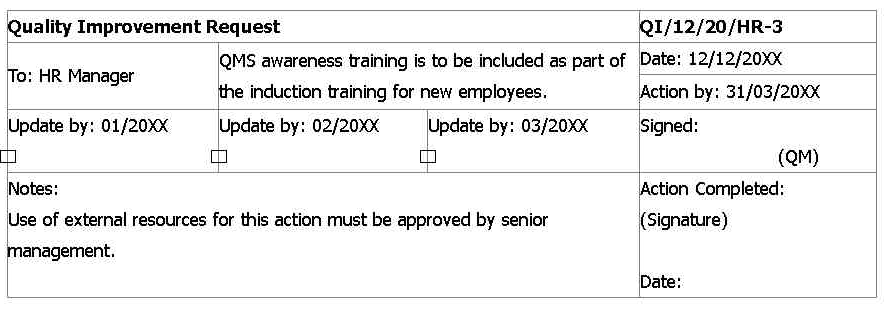
Quality Improvement Request that was included in the last management review.
After further auditing, the issues below were found. Select two statements that apply to the
term
`nonconformity'.
Show answerHide answer
Correct answer: A, ENo quality objectives planned for the top management teamQuality improvements not aligning with the quality policy.
Explanation
Explanation:
According to the ISO 9001:2015 standard, clause 10.2.1 defines nonconformity as the nonfulfilment
of a requirement. A requirement can be related to the quality management
system, the products and services, the customer expectations, or the applicable statutory
and regulatory requirements. Nonconformities can be detected through various sources,
such as audits, inspections, tests, customer complaints, or internal reviews.
Nonconformities must be addressed by taking appropriate actions to correct them and
prevent their recurrence.
In this scenario, the auditee has shown several issues that indicate nonconformities in their
quality management system. Two statements that apply to the term nonconformity are:
A. No quality objectives planned for the top management team: According to ISO 9001,
clause 6.2.1, the organization must establish quality objectives at relevant functions, levels,
and processes. The quality objectives must be consistent with the quality policy and the
strategic direction of the organization. The top management team is responsible for
providing leadership and direction for the quality management system and ensuring its
alignment with the organization’s purpose and context. Therefore, the absence of quality
objectives for the top management team is a nonconformity as it violates the requirement of clause 6.2.1.
E. Quality improvements not aligning with the quality policy: According to ISO 9001, clause
5.2.1, the quality policy is a statement of the organization’s intentions and direction
regarding quality, as formally expressed by top management. The quality policy must
provide a framework for setting quality objectives and be compatible with the context and
strategic direction of the organization. The quality policy must also be communicated,
understood, and applied within the organization. Therefore, if the quality improvements are
not aligned with the quality policy, it is a nonconformity as it violates the requirement of
clause 5.2.1.
Question 56Choose 3
An audit team leader arrives at a printing company to carry out a Stage 2 audit for a
certification body. At a meeting with the Quality Manager, she is told that they have won
their biggest contract from a computer manufacturer to print and compile computer
documentation packages. The Quality Manager wants the ISO 9001 certificate to cover the
new contract.
During the audit, a team member found that some print jobs had been rejected by several
clients over some months due to spelling errors in the print run. The Print Manager blames
the new employees they had to take on because of a big contract.
The auditor finds that the responsibility for checking spelling errors is placed on the printer
that sets up the print run.
In line with the policy of the certification body, the audit team raise improvement
opportunities in the audit report. Which
three of the following options would represent acceptable opportunities for improvement in
the report?
Show answerHide answer
Correct answer: A, C, EOperational planning activities may benefit from a clearer risk-based approach.The responsibility for checking printing needs to be independent of the operators.A plan to determine why the errors occur and to prevent them.
Explanation
Explanation:
According to the ISO 9001 Auditing Practices Group Guidance on Improvement
Opportunities1, an improvement opportunity is a suggestion made by the auditor for the
auditee to consider that, if implemented, may enhance the performance of the QMS.
Improvement opportunities are not mandatory, but they should be based on objective
evidence and aligned with the audit criteria and objectives. Improvement opportunities
should also be realistic, feasible, and beneficial for the auditee. In this case, the evidence
statements that represent acceptable improvement opportunities in the report are A, C, and
E, because they address the potential causes and effects of the spelling errors in the print
run, and propose possible actions that may improve the quality of the products and
services, and the effectiveness of the QMS. These options are consistent with the
requirements and principles of ISO 9001, such as clause 6.1 on actions to address risks
and opportunities, clause 8.1 on operational planning and control, clause 8.5.1 on control of
production and service provision, and clause 10.2 on nonconformity and corrective action.
The other options are not appropriate improvement opportunities, because they are either
irrelevant, unrealistic, or unhelpful for the auditee. For example, option B may contradict the
audit objective and scope, option D may imply a lack of auditor competence or impartiality,
option F may not address the root cause of the problem, option G may not be applicable or
effective, and option H may not be feasible or justified.
Question 57Choose 2
You are carrying out an annual audit at an organisation that has been certificated to ISO
9001 for two years. The organisation offers home security
services. The scope of the quality management system covers alarm installation, alarm
servicing, alarm monitoring and response. The business
operates from a single office and employs subcontract installers and service technicians
across the country.
You have just completed the opening meeting. You are interviewing the Managing Director
(MD).
You: "I would like to gain an understanding of how the quality management system has
been supporting your business and its strategic direction."
MD: "We are continuing to face difficult times. The market is extremely competitive, and
customers typically look for the least expensive option when
choosing home security services. We have not yet seen any business benefit from our
quality management system."
You: "Tell me how you determine external and internal issues."
MD: "We use SWOT analysis (Strengths Weaknesses, Opportunities, Threats)."
You: "How have the outputs from your SWOT been used?"
Select two of the following audit trails would you take to explore the extent to which the
SWOT analysis and the outputs from this
have been used to enable the business to achieve the intended results(s) of its quality
management system according to ISO 9001.
Show answerHide answer
Correct answer: B, DEstablish how the organisation reviews information about external and internal issuesEstablish what actions were taken to improve the QMS
Explanation
Explanation: According to ISO 9001:2015, clause 4.1, the organisation must determine
the external and internal issues that are relevant to its purpose and that affect its ability to
achieve the intended results of its quality management system. The organisation must also
monitor and review the information about these issues. SWOT analysis is a tool that can
help the organisation to identify its strengths, weaknesses, opportunities, and threats.
However, the SWOT analysis alone is not sufficient to comply with the requirement, as the
organisation also needs to review the information periodically and update it as necessary.
Therefore, one audit trail would be to establish how the organisation reviews information
about external and internal issues, such as how often, by whom, using what criteria, and
with what results. 123
According to ISO 9001:2015, clause 10.3, the organisation must continually improve the
suitability, adequacy, and effectiveness of the quality management system. The organisation must also consider the results of analysis and evaluation, and the outputs
from management review, to determine if there are any needs or opportunities for
improvement. SWOT analysis can help the organisation to identify the areas where
improvement is needed or possible, such as addressing the weaknesses and threats, or
exploiting the strengths and opportunities. However, the SWOT analysis alone is not
sufficient to comply with the requirement, as the organisation also needs to take actions to
implement the improvement, such as setting objectives, allocating resources, assigning
responsibilities, and evaluating the effectiveness. Therefore, another audit trail would be to
establish what actions were taken to improve the QMS, such as what, when, by whom,
how, and with what results.
Question 58Choose 4
'XYZ' has already sent to you a list with all documented procedures and work instructions
related to the services provided to 'ABC' (a quality manual is not included in the list).
To complete the audit planning which additional information would you ask to XYZ to
submit? Select four.
Show answerHide answer
Correct answer: A, C, D, EXYZ's organisational structureA description of responsibilities and authorities of the key roles of XYZThe number of personnel involved in activities related to the quality management systemInformation to understand XYZ's operations
Explanation
Explanation: The ISO 9001 Lead Auditor exam requires the auditor to have a thorough
understanding of the ISO 9001:2015 standard and its requirements, as well as the
organization’s context, processes, risks, opportunities, and performance. Therefore, the
auditor needs to ask for additional information that can help them verify these aspects
during the audit planning stage. Some of the information that can be useful are:
A description of responsibilities and authorities of the key roles of XYZ: This can help the
auditor to identify who is accountable for what in the organization and how they
communicate with each other.
The number of personnel involved in activities related to the quality management system:
This can help the auditor to assess if there are enough resources and competencies to
support the QMS implementation and operation.
Information to understand XYZ’s operations: This can help the auditor to understand how
XYZ produces or delivers its products or services and what are its main processes and
inputs.
The results of XYZ’s last internal audit: This can help the auditor to evaluate if XYZ has
implemented corrective actions based on previous audit findings and if it has maintained its
QMS effectiveness.
The results of the last two management reviews: This can help the auditor to determine if
XYZ has monitored its QMS performance against its objectives and if it has identified any
significant changes or opportunities for improvement.
The quality manual (B) is not a required document for ISO 9001 certification, but it may be
useful for internal reference or training purposes. It is not necessary for audit planning.
Question 59Choose 2
Which two of the following statements related to Stage 1 of an initial certification audit
against ISO 9001:2015 are true?
Show answerHide answer
Correct answer: D, GReviews the client's management system documented informationReviews the processes with high level of risk
Question 60Choose 1
You are conducting a Stage 1 audit at an organisation that services refrigeration equipment
for a large customer base.
The scope of certification is "Provision of refrigeration equipment maintenance and repair
services". You are interviewing
the Managing Director to learn more about the organisation and to explore how the
requirements for policy, objectives,
and risks and opportunities in ISO 9001 are addressed.
The Managing Director explains that they only use sub-contract refrigeration engineers and
do not have any full-time
refrigeration engineers, which helps to optimise overhead costs. The full-time staff employed are essentially a small team
of office staff who process customer enquiries, schedule jobs and process invoices.
The Managing Director adds that the ISO 9001 requirements for competence of personnel
extends to both sub-contract
and full-time staff. He also states that the full-time staff are aware of the Quality Policy,
objectives and plans to address
risk and opportunities.
You ask if the sub-contract engineers have been informed of the Quality Policy, objectives
and plans to address risks and
opportunities, to which the Managing Director replies that this is not applicable as they only
use sub-contractors who
operate ISO 9001 certificated quality management systems. The documented information
provided to the auditor
confirms this.
Which clause in ISO 9001 is most likely not to have been fulfilled in this instance?
Show answerHide answer
Correct answer: C7.4 Communication
Explanation
Explanation: Questions no: 16 Verified Answer: = C. 7.4 Communication Comprehensive
But Short Explanation: = Clause 7.4 of ISO 9001:2015 requires the organization to
determine the internal and external communications relevant to the quality management
system, including what will be communicated, when, with whom, and how. The scenario
indicates a potential gap in communication with subcontractors regarding the Quality
Policy, objectives, and plans to address risks and opportunities, which is a requirement
even if the subcontractors have their own ISO 9001 certified systems123.
Full mock exam
Sit the ISO-9001-Lead-Auditor exam before exam day
Full-length mocks with the same number of questions and the same time limit as the real ISO-9001-Lead-Auditor exam. Every attempt draws a new set of questions from the full bank, so you can keep going until you pass comfortably.