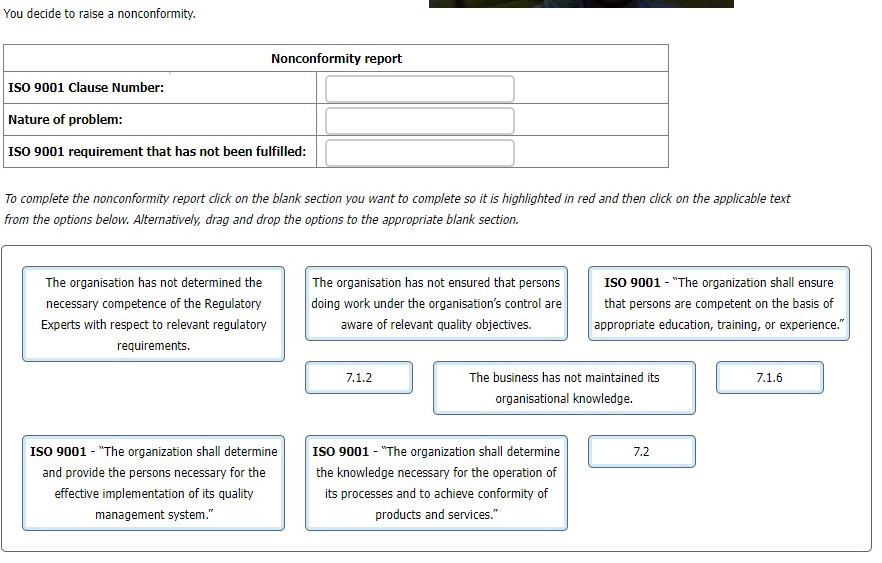
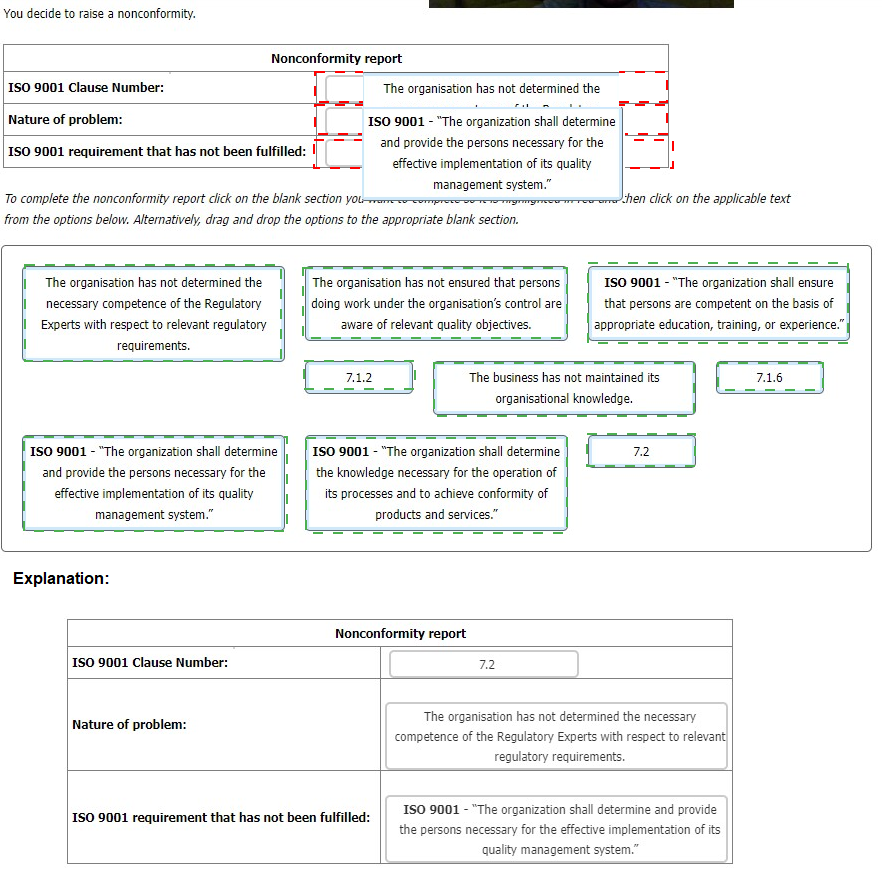
You are carrying out an audit to ISO 9001 at an organisation which offers regulatory
consultancy services to manufacturers of cosmetics.
You are interviewing the Technical Director (TD), who manages a team of regulatory
experts responsible for providing regulatory services to customers.
You: "How do you ensure your regulatory team's competence concerning regulatory
requirements is maintained?"
TD: "The two Regulatory Experts we employ full-time have years of experience of working
in the cosmetics industry."
You: "How is their regulatory competence maintained?"
TD: "They are dedicated individuals with lots of contacts in the sector."
You: "How does the business enable them to maintain their understanding of current
regulatory requirements?"
TD: "We leave that up to them."
Show answerHide answer
Explanation
Question 32Choose 1
Noitol is an organisation specialising in the design and production of e-learning training
materials for the insurance market. During an ISO 9001 audit
of the development department, the auditor asks the Head of Development about the
process used for validation of the final course design. She states that they usually ask
customers to validate the product with volunteers. She says that the feedback received
often leads to key improvements.
The auditor samples the design records for a recently completed course for the 247
Insurance organisation. Design verification was carried out but there was no validation report. The Head of Development advises that this customer required the product on an
urgent basis, so the validation stage
was omitted. When asked, the Head estimates that this occurs about 50% of the time. She
confirms that they always ask for feedback and often make changes. There is no record of
feedback in the design file for the course.
The auditor raises a nonconformity against ISO 9001. Which one of the following options is
the basis for the nonconformity?
Show answerHide answer
Correct answer: C8.3.4.d - Design validation is not always conducted. It is omitted about half of the time.
Explanation
Explanation: Clause 8.3.4.d of ISO 9001:2015 requires that design and development
validation be performed to ensure that the resulting products or services meet the
requirements for their specified application or intended use. Validation is critical to confirm
that the product works as intended in real-world conditions.
In this case, Noitol omitted the design validation step approximately 50% of the time, which
is a direct violation of Clause 8.3.4.d. Although they collect feedback after the fact, this is
not a substitute for formal validation before the product is released. The nonconformity
arises because the process of validation was neglected, not the recording of improvements
or feedback.
Other options, such as documenting improvements (A) or issues with planning verification
(B), are important but do not directly address the primary concern: the lack of consistent
design validation before product release. Option D (8.6) concerns product release, but this
nonconformity focuses on the validation stage, not just approval for release.
Question 33Choose 2
During a third-party audit of a pharmaceutical organisation (CD9000) site of seven COVID-
19 testing laboratories in various terminals at
a major international airport, you interview the CD 9000's General Manager (GM), who was accompanied by Jack, the legal compliance
expert. Jack is acting as the guide in the absence of the Technical Manager due to him
contracting COVID-19.
You: "What external and internal issues have been identified that could affect CD9000 and
its quality management system?"
GM: "Jack guided us on this. We identified issues like probable competition of another
laboratory organisation in the airport, legal
requirements on COVID-19 continuously changing, the shortage of competent laboratory
analysists, the epidemic declining soon,
shortage of chemicals for the analysis. It was quite a good experience."
You: "Did you document these issues?"
GM: "No. Jack said that ISO 9001 does not require us to document these issues."
You: "How did you determine the risks associated with the issues and did you plan actions
to address them?"
GM: "I am not sure. The Technical Manager is responsible for this process. Jack may be
able to answer this question in his absence."
Select two options for how you would respond to the General Manager's suggestion:
Show answerHide answer
Correct answer: A, DI would not accept the legal compliance expert answering the question.I would look for evidence that the actions resulting from the risk assessment had been
taken.
Question 34
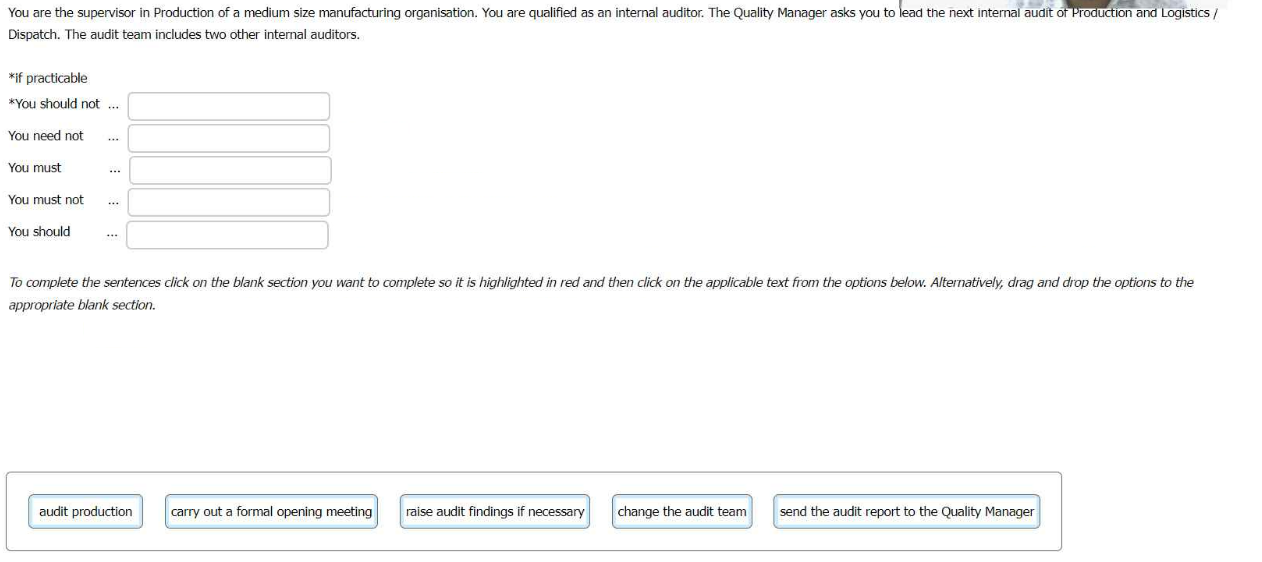
You are the supervisor in Production of a medium size manufacturing organisation. You are
qualified as an internal auditor. The Quality Manager asks you to lead the next internal
audit of Production and Logistics Dispatch. The audit team includes two other internal
auditors.
Show answerHide answer
Explanation
Explanation:
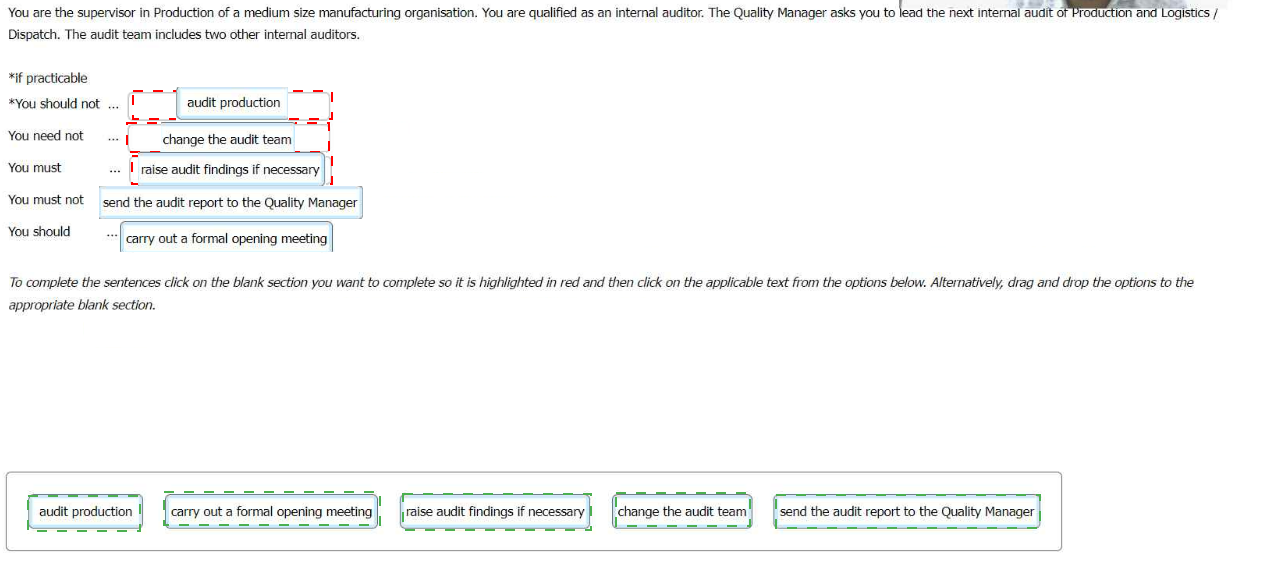
Here is the correct matching of actions to the statements in the context of leading
the internal audit:
If practicablecarry out a formal opening meeting
You should notaudit production (as you are a supervisor in that area, and this
would compromise audit objectivity)
You need notchange the audit team (unless there is a specific reason, such as
conflict of interest)
You mustraise audit findings if necessary (this is a key responsibility of an auditor
when nonconformities are found)
You must notsend the audit report to the Quality Manager (the audit report must be
reviewed first; it is typically part of the internal audit process to go through
necessary channels before final submission)
You shouldsend the audit report to the Quality Manager (after appropriate reviews
and approvals)
This reflects key principles of conducting an internal audit according to ISO 9001:2015,
ensuring objectivity, proper documentation, and clear reporting procedures.
Question 35Choose 1
TIX provides services to the informatic equipment of large organisations. They operate an
ISO 9001:2015 QMS that is being audited by an important
customer (second-party audit). During the audit, the audit team has identified two
nonconformities. When preparing the Closing meeting, the audit
team discussed and agreed both nonconformities with TIX's quality manager. The Closing
meeting was planned for 6pm with the general manager,
quality manager and service manager at the meeting room.
At 6pm, when the audit team enters the meeting room, only two people are present and
waiting for them: the Health and Safety supervisor and the
warehouse supervisor. Neither have participated in the audit.
The dialogue among them is as follows:
Audit team leader: "Good evening, could you please inform the three managers that we are
ready to start with the Closing meeting?"
Health and Safety supervisor: "Good evening. We are sorry to inform you that the general
manager was involved in a serious car accident, and
the other two managers have had to leave urgently to attend the emergency."
Warehouse supervisor: "They have asked us to listen to what you need to say and to sign
whatever we need to sign. We also have a message
from them about the two nonconformities. They wanted us to ask you if you could contact them in a couple of days to determine how to proceed."
Which one of the following options would be your preferred response to the final comment
made by the warehouse manager?
Show answerHide answer
Correct answer: DWe will hear what you were asked to tell us and will then leave. Please ask the
managers to contact us as soon as the emergency is over to agree on a new date to carry
out the Closing meeting.
Question 36
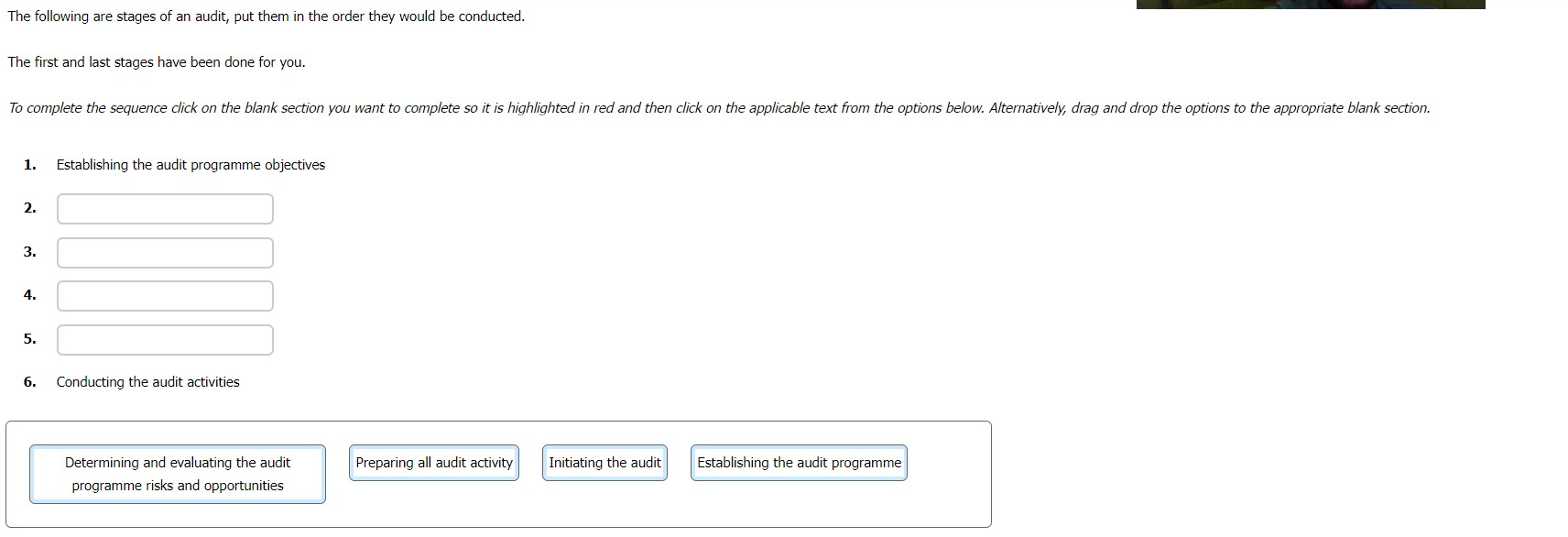
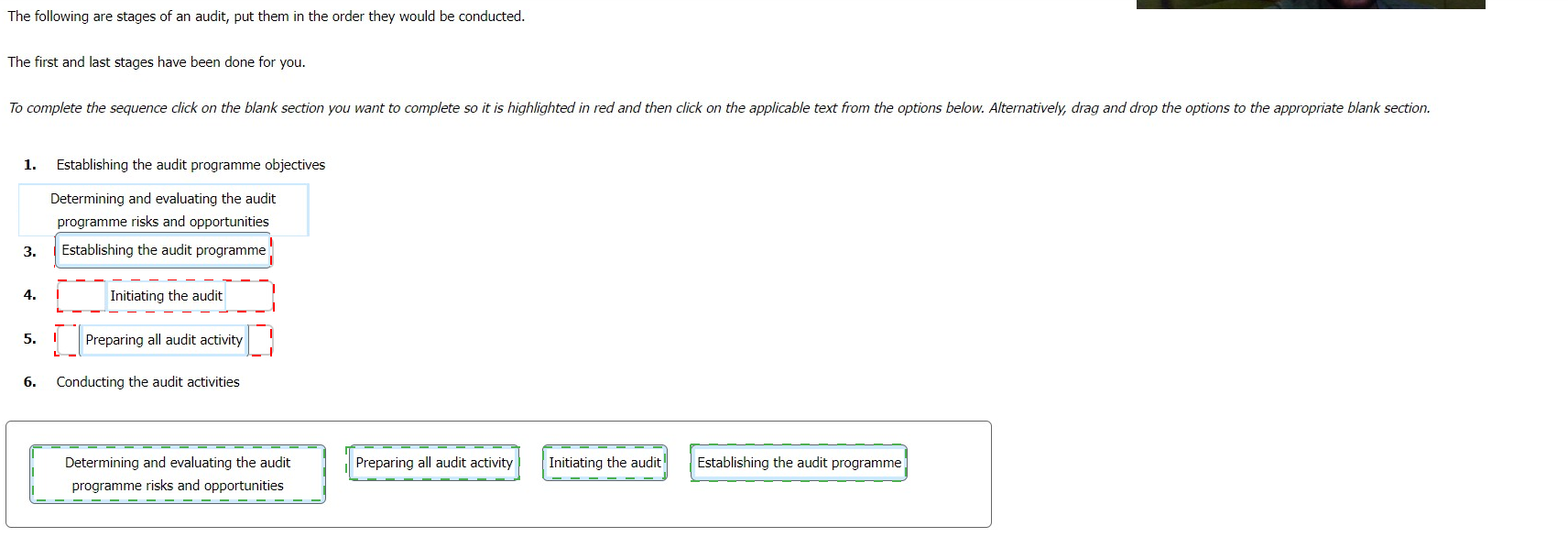
The following are stages of an audit, put them in the order they would be conducted.
Show answerHide answer
Explanation
Question 37Choose 1
During an internal audit, it was discovered that the calibration of a spectrometer used daily
for production had expired, causing a nonconformance under Clause 7.1.5.2 of ISO
9001:2015. The root cause was the organization not considering the risk of the calibration
provider leaving the country.
Which corrective action is the best one?
Show answerHide answer
Correct answer: DWe will add this to our external issue register, assess its associated risk, and plan
action to address that risk.
Explanation
Explanation:
Understanding Clause 7.1.5.2 – Measurement Traceability:ISO 9001:2015
requires organizations to ensure that measuring equipment (e.g., spectrometers) is
calibrated and traceable to recognized standards. The failure to maintain
calibration within valid dates directly violates this clause and raises concerns about
the reliability of the measurement results.
Root Cause of the Nonconformity:The organization failed to plan for the possibility
that the calibration service provider (X-TECH) might become unavailable, leading
to expired calibration. This indicates inadequate risk-based thinking, which is
required under Clause 6.1 of ISO 9001:2015.
Option Analysis:
Why D is the Best Option:
ISO 9001 References:
Question 38Choose 1
Select one option that must be considered when determining the scope of a QMS to ISO
9001.
Show answerHide answer
Correct answer: CExternal issues of the organisation's context
Explanation
Explanation:
According to ISO 9001:2015, clause 4.3, the organization is required to determine the
scope of its quality management system (QMS) by considering the external and internal
issues referred to in clause 4.1. Clause 4.1 requires the organization to determine the
external and internal issues that are relevant to its purpose and strategic direction, and that
affect its ability to achieve the intended results of its QMS. These issues can include
positive and negative factors or conditions for consideration, such as legal, technological,
competitive, market, cultural, social, and economic environments, whether international,
national, regional, or local. The organization is also required to monitor and review these
issues.
Therefore, the correct answer is C, as external issues of the organization’s context are one
of the factors that must be considered when determining the scope of the QMS. The other
options are either not directly related to the scope of the QMS, or are not explicitly
mentioned in clause 4.3.
Question 39Choose 1
According to the ISO 9001 standard, which one of the following is a defined responsibility
of top management?
Show answerHide answer
Correct answer: CEstablishing the Quality Management System quality policy.
Explanation
Explanation: Top management is responsible for establishing, implementing, and
maintaining the quality policy. The quality policy provides a framework for setting quality
objectives and must be compatible with the context of the organization and support its
strategic direction. It should also provide a commitment to satisfy applicable requirements
and to continuous improvement.
Question 40
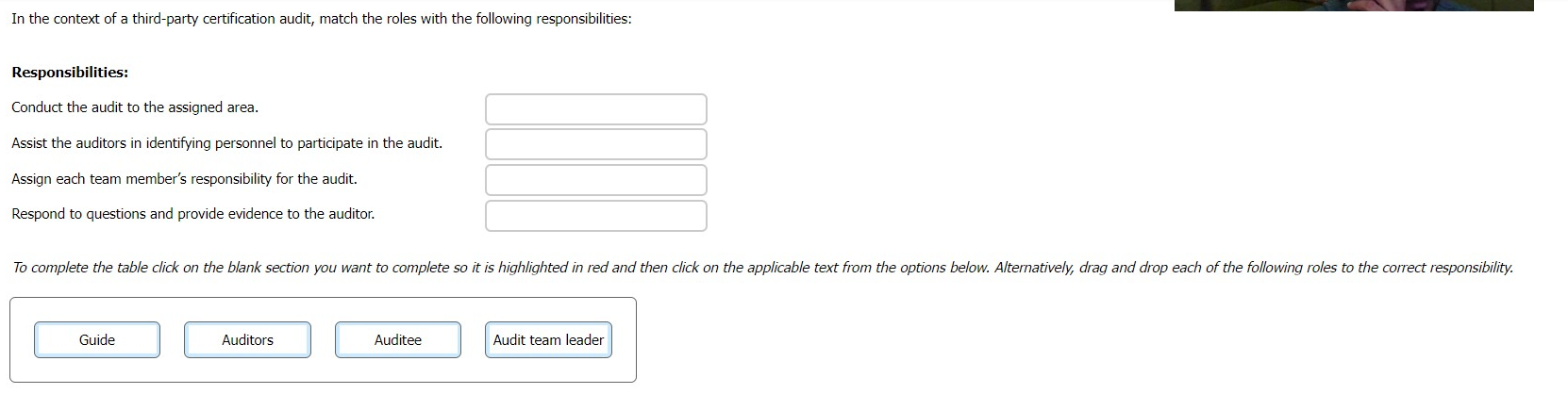
In the context of a third-party certification audit, match the roles with the following
responsibilities:
Show answerHide answer
Explanation
Explanation:
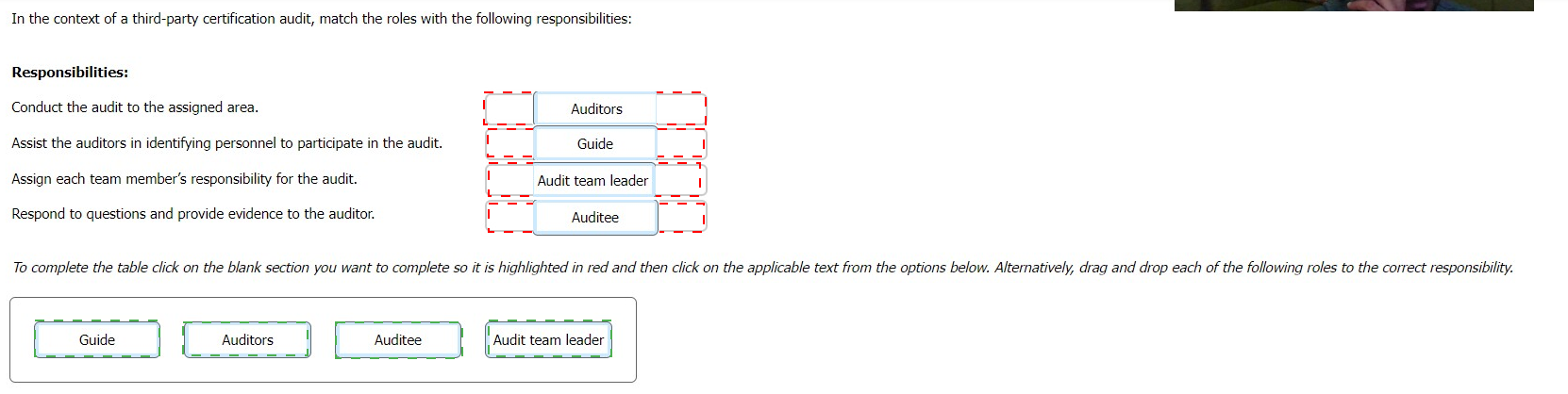
In the context of a third-party certification audit, match the roles with the following
responsibilities:
Responsibilities:
Conduct the audit to the assigned area.= Auditors
Assist the auditors in identifying personnel to participate in the audit.= Guide
Assign each team member’s responsibility for the audit.= Audit team leader
Respond to questions and provide evidence to the auditor.= Auditee
According to ISO 19011:2018, clause 3, the definitions of the roles are as follows1:
Auditors: persons with the competence to conduct an audit
Guide: person appointed by the auditee to assist the audit team
Auditee: organization being audited
Audit team leader: member of an audit team appointed to manage the audit or an audit
team
Therefore, the roles can be matched to the responsibilities based on these definitions and
the description of the audit process in clause 6 of the standard1.
Full mock exam
Sit the ISO-9001-Lead-Auditor exam before exam day
Full-length mocks with the same number of questions and the same time limit as the real ISO-9001-Lead-Auditor exam. Every attempt draws a new set of questions from the full bank, so you can keep going until you pass comfortably.