PECB certification · Exam ISO-9001-Lead-Auditor

ISO-9001-Lead-Auditor Mock Exam

QMS ISO 9001:2015 Lead Auditor Exam

Find out if you're ready for ISO-9001-Lead-Auditor. Take the free timed mock exam and get your score in minutes, or study the free ISO-9001-Lead-Auditor questions below with answers and explanations.

20 questions · 33 minutes · free, no sign-up

Free ISO-9001-Lead-Auditor questions

1–10 of 64 free
Question 1 Choose 3
Whistlekleen is a national dry cleaning and laundry company with 50 shops. You are conducting a surveillance audit of the Head Office and are sampling customer complaints.
80% of complaints originate from five shops in the same region. Most of these complaints relate to customer laundry not being cleaned as customers require. The Quality Manager tells you that these are the oldest shops in the company. The cleaning equipment needs replacing but the company cannot afford it now. You learn that the shop managers were told to dismiss most of the complaints because of the poor quality of the laundered materials.
On raising the matter with senior management, you are told that there are plans to replace the equipment in these shops over the next five years.
You raised a nonconformity against clause 8.5.1 of ISO 9001.
Based on the scenario, select the three options which best describe the evidence for raising such a nonconformity.
Show answerHide answer

Correct answer: A, B, G Customer complaints are not taken seriously by the organisation.Shop managers were told to make excuses to customers with complaints.The organisation failed to control the laundry operations in 5 shops adequately.
Question 2 Choose 1
At the end of a second-party audit, the audit team enters the meeting room to hold the closing meeting; only two people are present and waiting for them: the Health and Safety supervisor and the Administrative Officer.
Neither has participated in the audit. However, the team had previously agreed with the auditee Quality Manager on two nonconformities identified during the audit (NC1 and NC2).
They said:

Health and Safety Supervisor: "Good evening. We are sorry to inform you that the general manager was involved in a serious car accident, and the other two managers have had to leave urgently to attend to the emergency."
The Administration Officer: "Concerning 'nonconformity 2', the General Manager left a message asking us to tell you that he does not accept it and requests you not to include it in the audit report. Here is a note in which he explains why."
Which one of the following would be your preferred answer (as team leader) to the General Manager's request?
Show answerHide answer

Correct answer: B OK. Please, let me review the message. I will try to see if I can change the text of the nonconformity if necessary. Let's take a 10-minute break, as I would like to discuss this issue with the audit team.

Question 3 Choose 2
During a second-party audit, the auditor examines the records that are available for the external provider, ABC Forgings, to whom manufacturing has recently been outsourced.
There are standard external provider checklists for three competitors for the contract and there are inspection records from the trial manufacturing batches produced by ABC Forgings. There is no documented evidence of the criteria used to confirm the appointment of ABC Forgings, and no contract or terms and conditions. Ongoing monitoring indicates that external provider performance is satisfactory, but no documented information has been retained.
Select two options for the evidence which demonstrates a nonconformity with clause 8.4 of ISO 9001.
Show answerHide answer

Correct answer: A, C There was no documentation which provided evidence of any monitoring of the external provider.The auditee did not retain documentation on the selection and evaluation of the external provider.

Explanation

Explanation: According to clause 8.4 of ISO 9001:2015, the organization should ensure that externally provided processes, products, and services conform to the specified requirements. To do so, the organization should:

•Establish the criteria for the selection, evaluation, and re-evaluation of external providers, based on their ability to provide processes, products, and services in accordance with the requirements. The criteria should be documented and applied consistently.

•Evaluate the potential external providers before selecting them, using the established criteria. The evaluation methods may include questionnaires, audits, references, samples, etc. The results of the evaluation should be documented and reviewed.

•Select the external providers that have demonstrated their competence and conformity to the requirements. The selection should be based on the evaluation results and the organization’s needs. The selection should be documented and approved.

•Communicate the requirements for the processes, products, and services to be provided by the external provider, including the verification and validation activities, the acceptance criteria, the documentation requirements, the changes control, etc. The communication methods may include purchase orders, contracts, agreements, etc. The communication should be clear, complete, and timely.

•Monitor the performance and conformity of the external provider, using the established criteria and methods. The monitoring methods may include inspections, tests, audits, feedback, complaints, etc. The monitoring results should be documented and analyzed. In this case, the evidence statements that demonstrate a nonconformity with clause 8.4 are A and C, because they show that the organization did not retain documented information of the selection and evaluation of the external provider, and the monitoring of the external provider’s performance. These are requirements of the standard and essential for ensuring the quality of the externally provided processes, products, and services. The other options are not directly related to clause 8.4, although they may indicate other nonconformities or weaknesses in the organization’s QMS. For example, option B may relate to clause 7.1.3 on contingency planning, option D may relate to clause 8.2.3 on review of requirements, option E may relate to clause 8.6 on release of products and services, and option F may relate to clause 5.1.1 on leadership and commitment. References: ISO 9001:2015, [ISO 9001 Auditing Practices Group Guidance on Scope], Mastering the Scope of ISO 9001 Quality Management Systems
Question 4
You, as auditor, are in dialogue with the quality lead and managing director of a small business that supplies specialist laboratory equipment and furniture.
You: "I'd like to look at how you manage change in the organisation. What changes have you made as a business, say, over the last 12 months?"
Auditee: "We have made some strategic changes, the main one being that we no longer manufacture our own products in house."
You: "That sounds like quite a significant change. What has been the impact of that?"
Auditee: "We now mainly sell other manufacturers' products, under their brand names, and have outsourced manufacture of our own brand products to one of our suppliers. Unfortunately, we had to make six members of our staff redundant. This represents about 20% of our workforce, so this has been quite a challenging time." You: "I'm sure. What were the reasons for making the change?" Auditee: "Our manufacturing section was a small operation, and we struggled to cope with fluctuations in demand. During busy periods, we found it hard to meet lead times, and in quiet periods we had staff with little to do. This was having an impact on customer satisfaction and meant we had to charge premium prices that made our product uncompetitive."
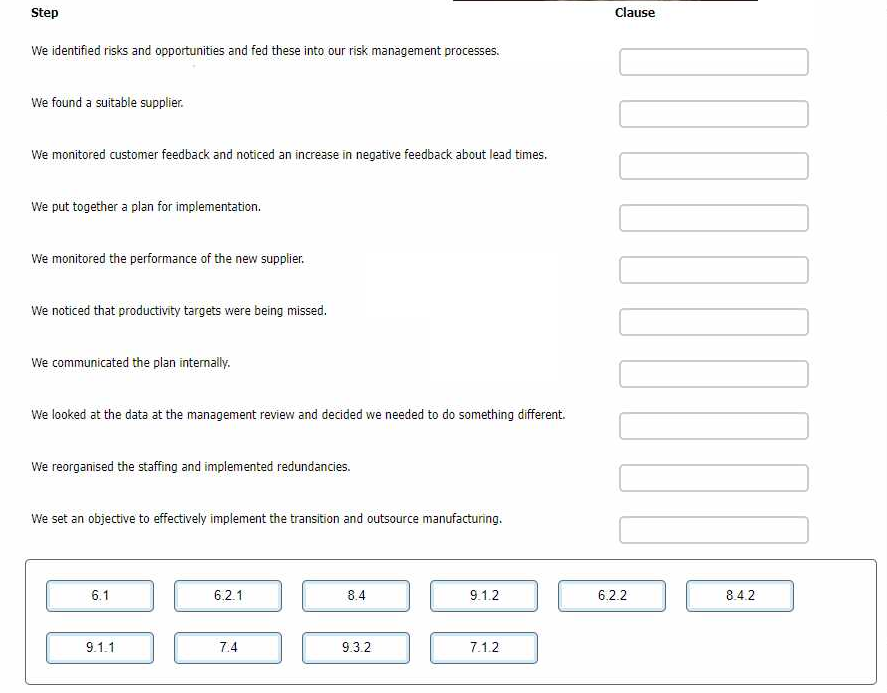
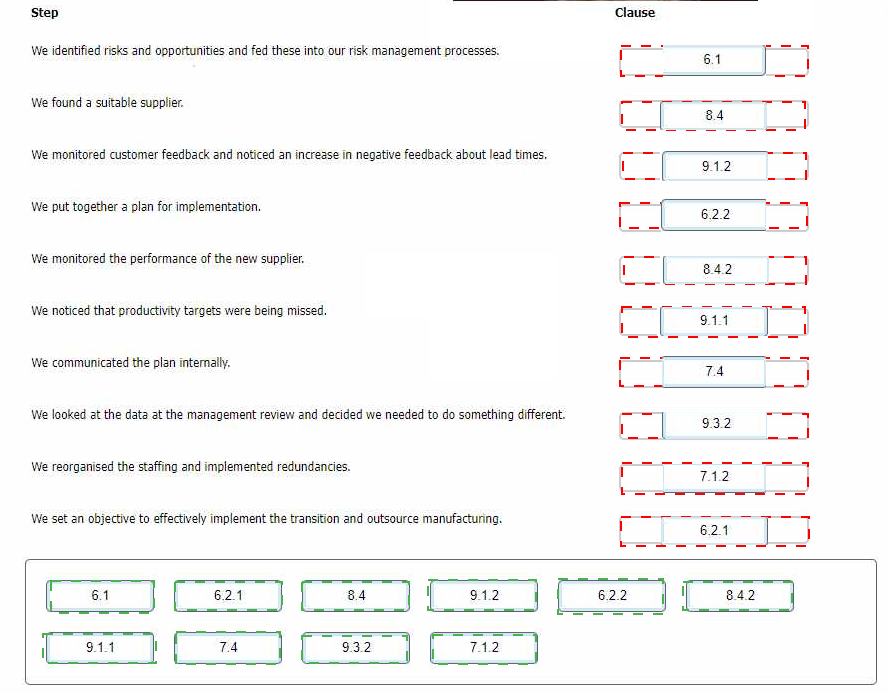
You: "How did you go about the change?" In relation to the auditor's question about how the change was managed, the auditee mentions the steps listed below. Match the ISO 9001 clauses to the steps.
To complete the table, click on the blank section you want to complete so it is highlighted in red and then click on the ISO 9001 clauses listed below. Alternatively, drag and drop each clause to show which step the requirement applies to.

Show answerHide answer

Explanation


Explanation:
Here is the correct matching of ISO 9001:2015 clauses to the steps mentioned in the change management process:
We identified risks and opportunities and fed these into our risk management processes.
uk.co.certification.simulator.questionpool.PList@202706c
We found a suitable supplier.
We monitored customer feedback and noticed an increase in negative feedback about lead times.
We put together a plan for implementation.
We monitored the performance of the new supplier.
We noticed that productivity targets were being missed.
We communicated the plan internally.
We looked at the data at the management review and decided we needed to do something different.
We reorganised the staffing and implemented redundancies.
We set an objective to effectively implement the transition and outsource manufacturing.
This aligns the steps of the change process with relevant ISO 9001:2015 clauses related to risk, planning, communication, and monitoring.
Question 5
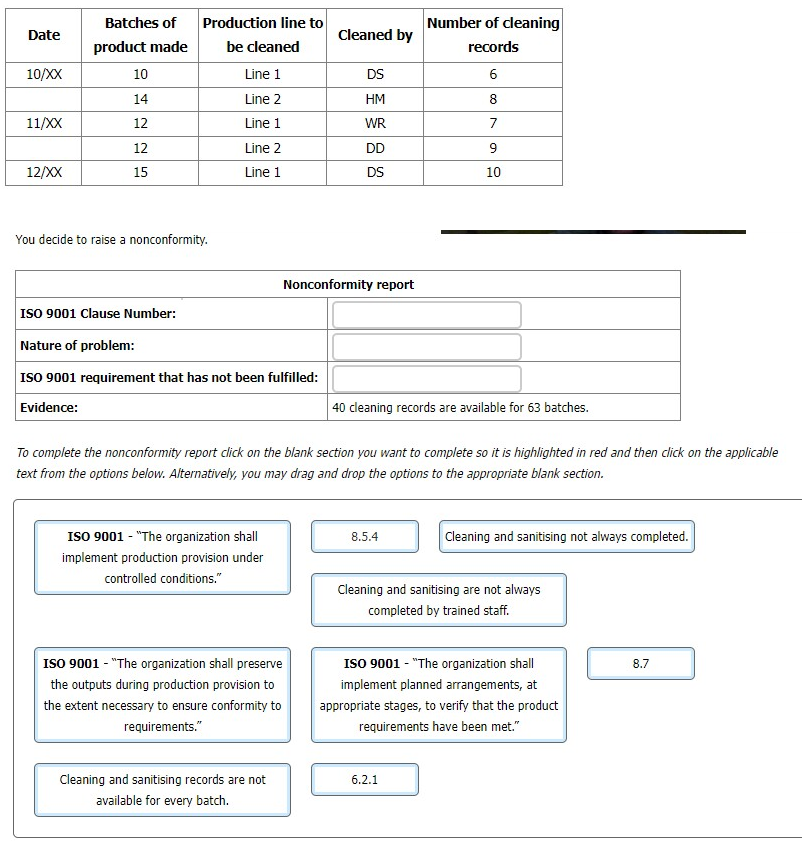
You are carrying out an audit at a single-site organisation seeking certification to ISO 9001 for the first time. The organisation manufactures cosmetics for major retailers.
You are interviewing the Manufacturing Manager (MM).
You: "I would like to begin by looking at the cleaning controls."
MM: "We record the cleaning of the equipment at the end of every batch. This document details the minimum cleaning frequency and the procedures to follow for all areas and each item of equipment. The person who carries out the cleaning puts their initial on the document and records the time and date alongside."
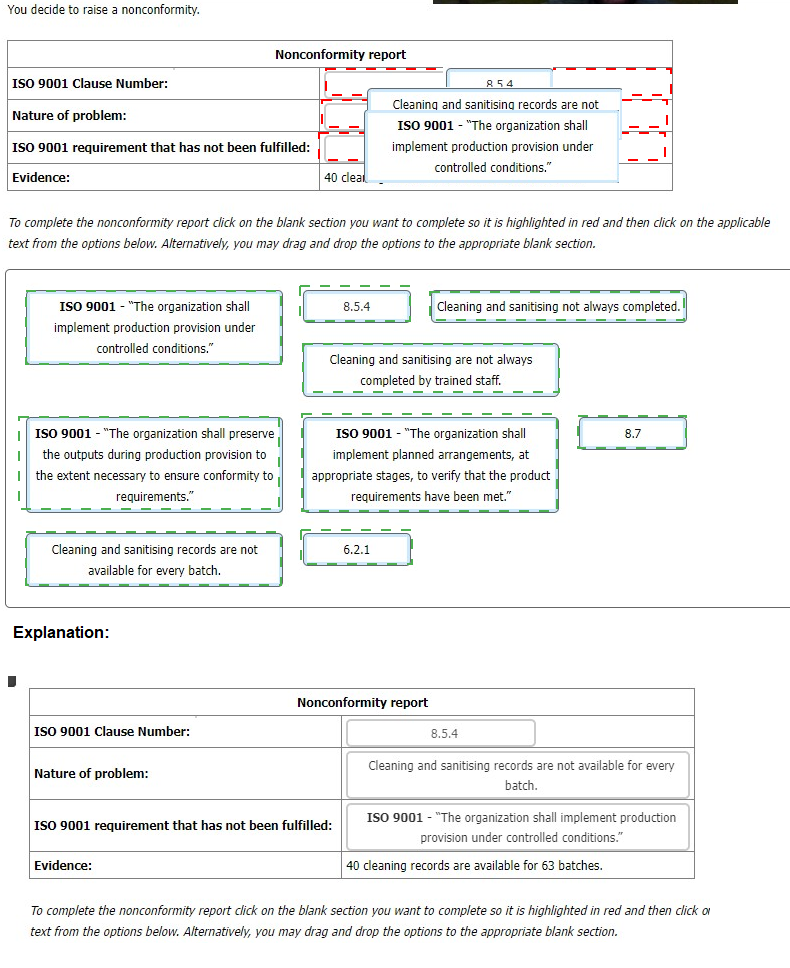
Narrative: You sample production records over 3-days and note down evidence of nonconformity as per the table below.

Show answerHide answer

Explanation

Question 6 Choose 4
You have been just hired as the Internal Lead Auditor of a large organisation, responsible for internal audits. Your first job is to analyse the answers to nonconformities included in the report of a recent internal audit to Top Management.
The report contained one nonconformity as follows:
There is no evidence of Top Management ensuring the availability of resources to operate the QMS, the establishment of objectives, the promotion of continual improvement, and the promoting of the process approach.
Which four of the following Top Management actions can be considered 'corrections to the nonconformity'?
Show answerHide answer

Correct answer: D, E, F, G Improvement action has been promotedObjectives have been establishedProcess approach has been communicated to the personnelResources have been provided

Question 7 Choose 6
ABC is a service organisation that cleans and irons bed and table linen for four large hospitals in the city centre. It claims to meet ISO 9001:2015 requirements. During an internal audit, an auditor observes that machine No. 4 is being operated with the three variables outside the limits established in the applicable documented procedure SP-701. The auditor has decided to raise a nonconformity.
Which six elements should be included in the nonconformity report?
Show answerHide answer

Correct answer: B, C, D, H, I, J Applicable procedure: SP-701Competence record of the machine operatorIdentification number of the washing machineThe concentration of the cleaning liquid used vs the concentration fixed in SP-701The planned duration of the process vs the minimum time required in SP-701Weight of linen being washed vs the maximum weight required in SP-701

Explanation

Explanation:
B. Applicable procedure: SP-701
D. Identification number of the washing machine
H. The concentration of the cleaning liquid used vs the concentration fixed in SP-701
I. The planned duration of the process vs the minimum time required in SP-701
J. Weight of linen being washed vs the maximum weight required in SP-701
C. Competence record of the machine operator
Question 8
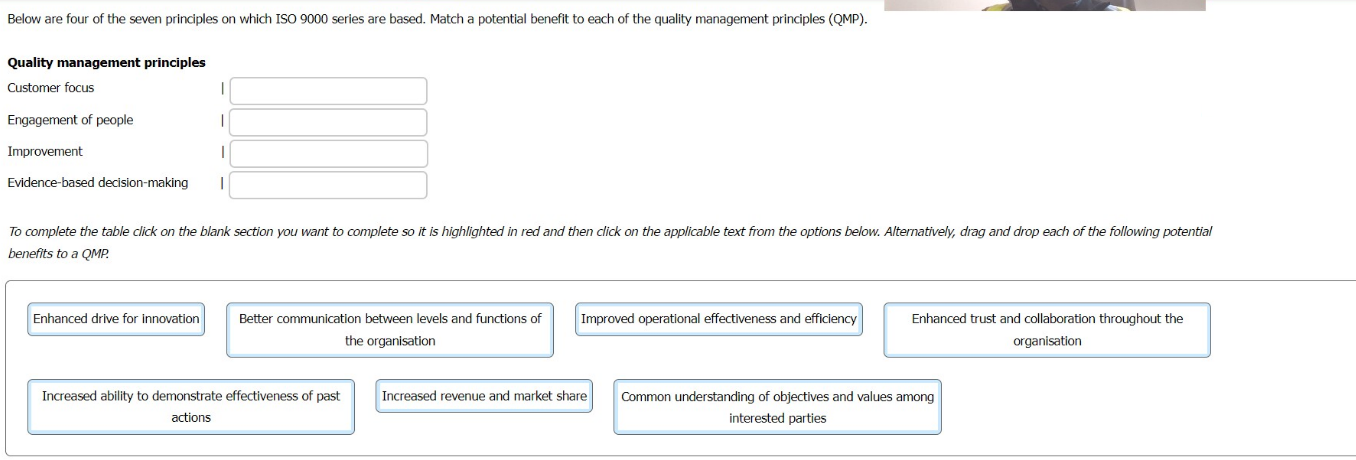
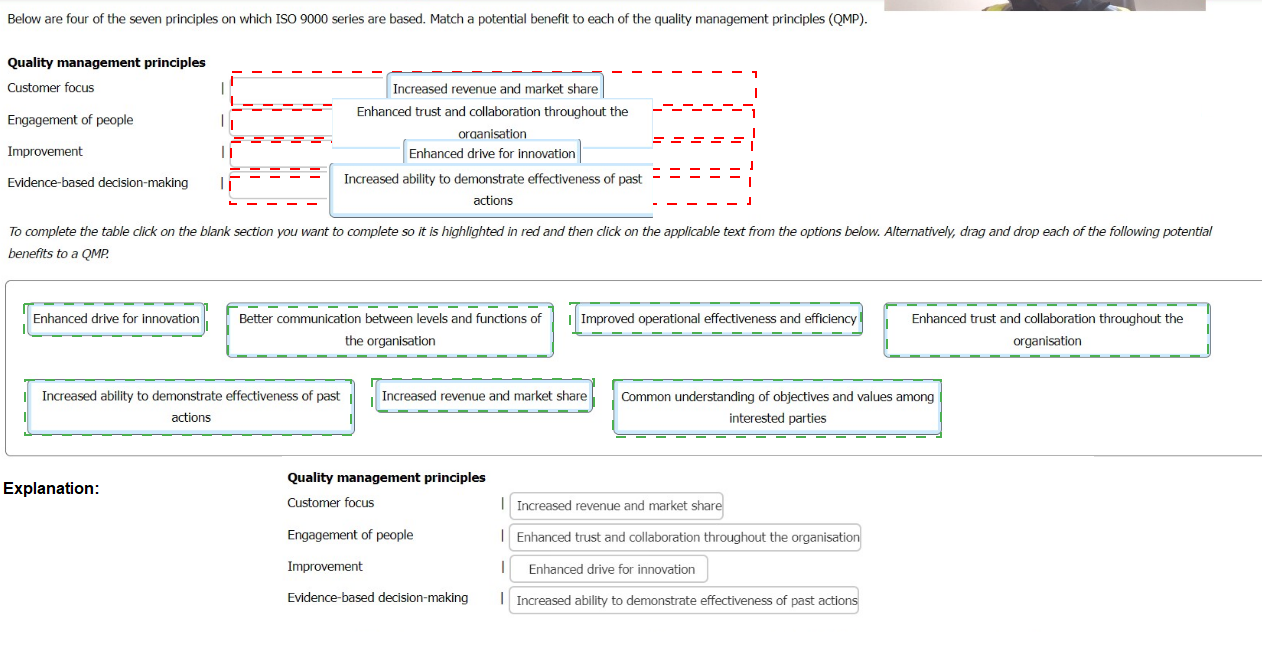
Below are four of the seven principles on which ISO 9000 series are based. Match a potential benefit to each of the quality management principles (QMP).

Show answerHide answer

Explanation


A screenshot of a chat Description automatically generated According to the ISO 9000:2015 document, the seven quality management principles are:
Customer focus Leadership Engagement of people Process approach Improvement Evidence-based decision making Relationship management For each principle, the document provides a statement, a rationale, key benefits, and actions you can take to apply the principle in your organization.
Based on the document, here is a possible way to match a potential benefit to each of the four quality management principles you mentioned:
Table Quality management principle Potential benefit Customer focus Increased revenue and market share Engagement of people Enhanced trust and collaboration throughout the organization Improvement Enhanced drive for innovation Evidence-based decision making Increased ability to demonstrate effectiveness of past actions
Question 9 Choose 2
Which two of the following are the key expected results of a quality management system that conforms to the requirements of ISO 9001:2015?
Show answerHide answer

Correct answer: A, E Consistently provide products that meet customers' requirementsEnhanced customer satisfaction

Explanation

Explanation: The key expected results of a quality management system that conforms to the requirements of ISO 9001:2015 are stated in clause 0.1 of the standard, which says: “The adoption of a quality management system is a strategic decision for an organization that can help to improve its overall performance and provide a sound basis for sustainable development initiatives. The potential benefits to an organization of implementing a quality management system based on this International Standard are: a) the ability to consistently provide products and services that meet customer and applicable statutory and regulatory requirements; b) facilitating opportunities to enhance customer satisfaction; c) addressing risks and opportunities associated with its context and objectives; d) the ability to demonstrate conformity to specified quality management system requirements.” Therefore, the two options that best match these benefits are A and E, as they directly relate to providing products and services that meet customer requirements and enhancing customer satisfaction. The other options are not explicitly mentioned as key expected results, although they may be possible outcomes of implementing a quality management system.
References: ISO 9001:2015 - Quality management systems — Requirements, Key Elements of an ISO 9001:2015 Quality Management System, What is ISO 9001 2015 as a Quality Management Systems?
Question 10 Choose 3
You, as auditor, are in dialogue with the quality lead and managing director of a small business that supplies specialist laboratory equipment and furniture.
You: "I'd like to look at how you manage change in the organisation. What changes have you made as a business, say, over the last 12 months?"
Auditee: "We have made some strategic changes, the main one being that we no longer manufacture our own products in house."
You: "That sounds like quite a significant change. What has been the impact of that?"
Auditee: "We now mainly sell other manufacturers' products, under their brand names, and have outsourced manufacture of our own brand products to one of our suppliers. Unfortunately, we had to make six members of our staff redundant. This represents about 20% of our workforce, so this has been quite a challenging time."
This scenario presents a number of audit trails to different ISO 9001 requirements.
Which three of the following requirements would be relevant audit trails for this scenario?
Show answerHide answer

Correct answer: B, C, F Control of externally provided processes, products, and servicesDesign and development of products and servicesOrganisation roles and responsibilities

Explanation

Explanation: B. Control of externally provided processes, products, and services: This is relevant because the organization has outsourced the manufacture of its own brand products to a supplier. According to ISO 9001, the organization must ensure that externally provided processes remain within the control of its quality management system.
C. Design and development of products and services: Even though the organization no longer manufactures in-house, it still needs to control the design and development of its products, especially since they are now being produced by an external provider.
F. Organisation roles and responsibilities: The change in strategy has led to a significant reduction in staff, which would have an impact on the roles and responsibilities within the organization. It is important to audit how these changes have been managed and communicated within the organization to ensure continued effectiveness of the quality management system.
These audit trails are aligned with the requirements of ISO 9001:2015, which emphasizes the importance of controlling externally provided processes and products, managing design and development, and clearly defining roles and responsibilities within the quality management system.
Full mock exam

Sit the ISO-9001-Lead-Auditor exam before exam day

Full-length mocks with the same number of questions and the same time limit as the real ISO-9001-Lead-Auditor exam. Every attempt draws a new set of questions from the full bank, so you can keep going until you pass comfortably.

Get full ISO-9001-Lead-Auditor mock exam
  • 65questions per mock
  • 105 mintime limit
  • 216questions in the bank
  • Newmock on every attempt