You are leading a Stage 2 certification audit of a multi-site organisation and have received
the audit schedule below;
Head Office and Site 1 - Day 1
Site 2 (150 Km from HQ) - Days 2 and 3
During Day 1 of the audit, the dient informs you that the laboratory at Site 2 has been
dosed for decontamination due to a serious outbreak of an infectious disease among
workers. In Site 2, all other functions could be audited as planned.
As the audit team leader, what would you do?
Choose the best acceptable action you could take:
® Ask the audit Programme Manager for direction.
Complete the audit on day 3 and report back to the certification body for a certification
decision.
Continue the audit on days 2 and 3 and return later to audit the Site 2 laboratory.
Immediately cancel the audit since the audit plan cannot be completed.
Who has the responsibility for assigning work to the audit team?
Show answerHide answer
Correct answer: AThe audit team leader
Explanation
Explanation:
In the context of ISO 9001:2015 audits, it is the audit team leader who holds the
responsibility for assigning work to the audit team. According to ISO 19011:2018
(Guidelines for auditing management systems, which complements ISO 9001:2015), the
audit team leader is responsible for the organization and direction of the audit, including
assigning specific roles and responsibilities to audit team members. This includes
preparation of the audit plan, leading the audit, and ensuring that each team member
understands their tasks.
Question 22Choose 2
You are conducting a third-party audit to ISO 9001 and interviewing the Training Manager.
She explains that training is more
important than ever because the organisation has had to reduce the number of staff
employed. Many of the remaining staff
are now required to be 'multi-skilled'. You ask to see plans for the multi-skilling training and
are shown plans that look
comprehensive, and include both 'on the job" training and internal and external training
courses.
The records indicate that several staff required parts of their training to be repeated one
month after the first training was
provided. You ask why this was needed and are told that an investigation of customer
complaints identified that several staff
members did not complete certain tasks in the correct manner. The extra training was
therefore recommended as a
corrective action.
Based on this interview, which two of the tollowing audit trails would be the most
appropriate to follow?
Select the two most appropriate audit trails from the following.
Show answerHide answer
Correct answer: A, FAsk if customer complaints had ceased since the multi-skilled training finished.Review records to assess if all planned training has been completed.
Explanation
Explanation: When conducting a third-party audit to ISO 9001, especially in the context of
training and corrective actions taken due to customer complaints, the most appropriate
audit trails to follow would be:
A. Ask if customer complaints had ceased since the multi-skilled training finished. This
audit trail is relevant because it directly relates to the effectiveness of the corrective action
taken. If customer complaints have decreased or ceased, it could indicate that the
additional training was effective1.
F. Review records to assess if all planned training has been completed. This trail is
important to ensure that the training plan has been fully implemented and to verify that all
staff members have received the necessary training. It also helps in assessing the
adequacy of the training in terms of content, frequency, and outcomes1.
These two trails, A and F, are closely linked to the issue of customer complaints and the
organization’s response to them. They provide insight into whether the actions taken were
suitable and whether they have led to improvements in staff performance and customer
satisfaction1. The other options, while potentially useful, do not directly address the
immediate concern of the effectiveness of the corrective actions taken in response to the
customer complaints1.
Question 23Choose 2
A Health Trust has contracted with Servitup, a catering services organisation which has
been certified to ISO 9001 for 1 year. It provides services to ten, small rural hospitals in remote locations involving purchase and storage of dry goods and fresh
produce, preparing meals and loading heated trolleys for ward service by hospital
staff. An auditor is conducting the first sole surveillance audit at one site with the Deputy
Catering Manager (DCM).
At the closing meeting attended solely by the DCM, the auditor informs him that he has
found numerous gaps in the QMS processes which lead him to consider
recommending suspension of the organisation's certification. He is particularly concerned
with the evidence that patient health is being adversely affected by produce
stored beyond its safe consumption date, poor kitchen hygiene and undercooked meals.
The DCM says that he cannot make any decisions about these issues in the
absence of the Catering Manager due to illness but will write everything down and report to
the Catering Manager.
Which two actions should you take in the context of the audit?
Show answerHide answer
Correct answer: B, CCall the individual(s) managing the audit programme to explain the situation and
recommend immediate suspension of certification to protect the integrity of the Certification
Body.Continue with the meeting, present the audit conclusions and inform the DCM that the
organisation will receive the audit report in due course.
Explanation
Explanation:
The actions that should be taken in the context of the audit are:
•Option B: Call the individual(s) managing the audit programme to explain the situation and
recommend immediate suspension of certification to protect the integrity of the Certification
Body. This option is correct because the auditor has found serious and significant gaps in
the QMS processes that affect the health and safety of the patients, which is a major
nonconformity that may warrant suspension of certification. The auditor should inform the
individual(s) managing the audit programme of the situation and the audit findings, and
recommend immediate suspension of certification to protect the integrity of the Certification Body and the credibility of the certification scheme. The auditor should also follow the
Certification Body’s procedures and rules for suspension of certification and communicate
the decision and the consequences to the auditee.
•Option C: Continue with the meeting, present the audit conclusions and inform the DCM
that the organisation will receive the audit report in due course. This option is correct
because the auditor should not terminate or postpone the closing meeting due to the
absence of the Catering Manager, as the DCM is the auditee’s nominated representative
for the audit. The auditor should continue with the meeting, present the audit conclusions
and the audit findings, and inform the DCM that the organisation will receive the audit
report in due course. The auditor should also explain the audit outcome recommendation
and the suspension of certification, and request the DCM to acknowledge the receipt and
understanding of the audit results.
The following options are not correct:
•Option A: Close the meeting immediately after the DCM’s response and advise that the
issues will be addressed at the next surveillance visit. This option is not correct because
the auditor should not close the meeting without presenting the audit conclusions and the
audit findings, as this would violate the audit principles of fairness and transparency. The
auditor should also not advise that the issues will be addressed at the next surveillance
visit, as this would imply that the auditor is accepting the auditee’s delay and inaction, and
that the auditor is not taking the major nonconformity seriously.
•Option D: Conclude the meeting early and advise that it will be rescheduled once the
Catering Manager has returned to work. This option is not correct because the auditor
should not conclude the meeting early or reschedule it due to the absence of the Catering
Manager, as this would disrupt the audit process and the audit schedule. The auditor
should also not wait for the Catering Manager to return to work, as this would delay the
communication and resolution of the major nonconformity, and potentially compromise the
health and safety of the patients.
•Option E: Recommend that all personnel should be given urgent in-depth training in the
QMS. This option is not correct because the auditor should not recommend or prescribe
specific corrective actions to the auditee, as this would violate the audit principles of
independence and objectivity. The auditor should only report the audit findings and the
audit outcome recommendation, and leave the responsibility and authority for determining
and implementing the corrective actions to the auditee.
•Option F: Thank the DCM for his time and express an expectation that improvements will
be made in the QMS. This option is not correct because the auditor should not thank the
DCM for his time and express an expectation that improvements will be made in the QMS,
as this would imply that the auditor is satisfied and optimistic with the auditee’s
performance and response, and that the auditor is not taking the major nonconformity
seriously. The auditor should instead express the concern and dissatisfaction with the
auditee’s QMS processes and the impact on the health and safety of the patients, and communicate the suspension of certification and the need for urgent and effective
corrective actions.
Question 24Choose 1
Select the term which best describes the quality management system process of modifying
a non-conforming product to bring it within acceptance criteria.
Show answerHide answer
Correct answer: BCorrection
Explanation
Explanation:
According to the ISO 9000:2015 - Quality management systems — Fundamentals and
vocabulary, correction is defined as “action to eliminate a detected nonconformity”. A
nonconformity is defined as “non-fulfilment of a requirement”. Therefore, the process of
modifying a non-conforming product to bring it within acceptance criteria is a correction, as
it eliminates the non-fulfilment of the product specification. The other options are not
correct, as they have different definitions and purposes:
•Concession: permission to release or use a nonconforming product, service or process
•Corrective action: action to eliminate the cause of a nonconformity and to prevent
recurrence
•Preventive action: action to eliminate the cause of a potential nonconformity or other undesirable potential situation
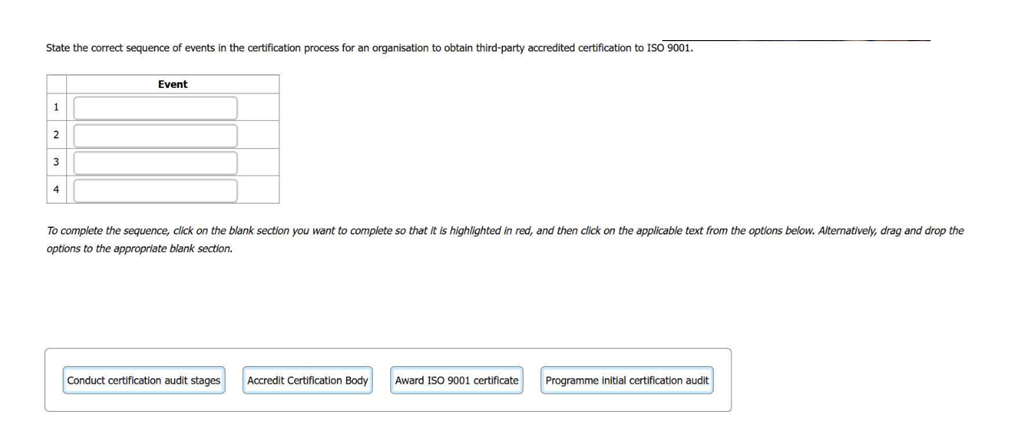
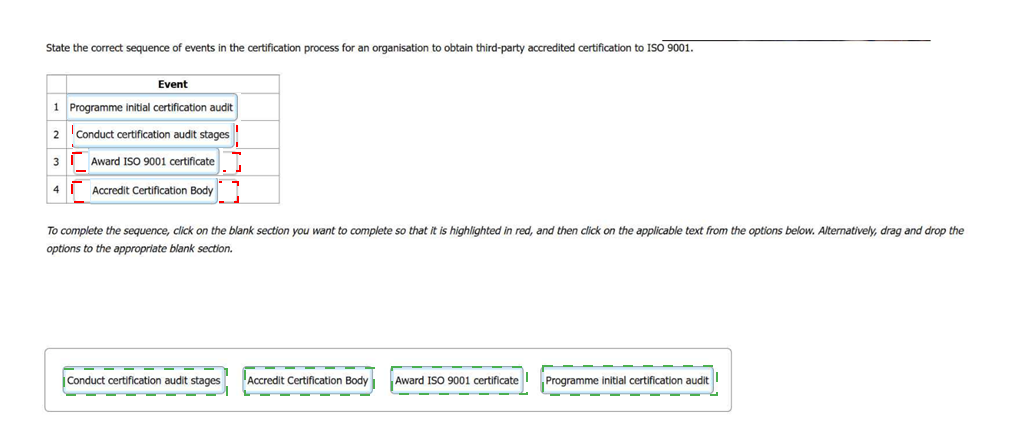
Question 25
State the correct sequence of events in the certification process for an organisation to
obtain third-party accredited certification to ISO 9001.
Show answerHide answer
Explanation
Question 26Choose 2
You have been nominated audit team leader of a third-party audit. Which of the following
could be the two most relevant objectives of this audit?
Show answerHide answer
Correct answer: B, DEvaluate the effectiveness of the management systemEvaluate the capability of the management system to establish and achieve objectives
Explanation
Explanation:
Evaluate the effectiveness of the management system: This objective involves verifying
that the quality management system meets the requirements of a specific standard, such
as ISO 9001:2015, and that it achieves the intended results and outcomes. The audit team
will collect and analyse audit evidence to determine the degree of conformity and
performance of the quality management system23.
•Evaluate the capability of the management system to establish and achieve objectives:
This objective involves verifying that the quality management system supports the strategic
direction and policies of the organization, and that it addresses the needs and expectations
of the interested parties. The audit team will assess the suitability, adequacy, and
alignment of the quality management system objectives, and the effectiveness of the
planning and implementation processes to achieve them23.
The other options are not the most relevant objectives of a third-party audit, according to
the web search results from my internal tool. They may be related to other aspects or types
of audits, but they are not the focus of a third-party audit.
Therefore, the correct answer is B and D.
Question 27Choose 2
During a third-party audit of a pharmaceutical organisation (CD9000) site of seven COVID-
19 testing laboratories in various terminals at a major international airport, you interview the CD
9000's General Manager (GM), who was accompanied by Jack, the legal compliance
expert. Jack is acting as the guide in the absence of the Technical Manager due to him
contracting COVID-19.
You: "What external and internal issues have been identified that could affect CD9000 and
its quality
management system?"
GM: "Jack guided us on this. We identified issues like probable competition of another
laboratory
organisation in the airport, legal requirements on COVID-19 continuously changing, the
shortage of
competent laboratory analysists, the epidemic declining soon, shortage of chemicals for the
analysis. It was
quite a good experience."
You: "Did you document these issues?"
GM: "No. Jack said that ISO 9001 does not require us to document these issues."
You: "How did you determine the risks associated with the issues and did you plan actions
to address
them?"
GM: "I am not sure. The Technical Manager is responsible for this process. Jack may be
able to answer this question in his absence."
Select two options for how you would respond to the General Manager's suggestion:
Show answerHide answer
Correct answer: B, CI would ask for a different guide instead of the legal compliance expert.I would look for evidence that the actions resulting from the risk assessment had been
taken.
Explanation
Explanation:
According to the ISO 9001:2015 standard, clause 4.1 requires organizations to determine
the external and internal issues that are relevant to their purpose and that affect their ability
to achieve the intended outcomes of their quality management system. Clause 6.1 requires
organizations to plan actions to address the risks and opportunities associated with these
issues. These actions must be integrated into the quality management system processes
and evaluated for effectiveness.
In this scenario, the General Manager of the pharmaceutical organization has shown a lack
of understanding and involvement in the process of identifying and addressing the external
and internal issues that affect their quality management system. The General Manager has
relied on the legal compliance expert, who is not an employee of the organization, to guide
them on this process. The General Manager has also admitted that they did not document
these issues, which is contrary to the requirement of retaining documented information on
the context of the organization. The General Manager has also delegated the responsibility
of determining and planning the actions to address the risks and opportunities to the
Technical Manager, who is absent due to COVID-19.
Based on this information, you can respond to the General Manager’s suggestion by taking
two options:
B. I would ask for a different guide instead of the legal compliance expert: You can request
to have a different guide who is an employee of the organization and who is familiar with
the quality management system processes and the external and internal issues that affect
them. The legal compliance expert may not have the necessary knowledge and authority to
answer your questions or provide you with the relevant evidence.
C. I would look for evidence that the actions resulting from the risk assessment had been
taken: You can verify whether the organization has implemented and evaluated the actions
to address the risks and opportunities associated with the external and internal issues. You
can look for evidence such as records of risk analysis, action plans, monitoring and review
results, and improvement measures.
These two options would help you to assess the conformity and effectiveness of the
organization’s quality management system with respect to the requirements of clauses 4.1
and 6.1.
Question 28Choose 3
XYZ Corporation is an organisation that employs 100 people. As the audit team leader, you
are conducting a certification audit at Stage 1. When reviewing the quality management system (QMS)
documentation, you find that quality objectives have been set for every employee in the
organisation except top management. The Quality Manager complains that this has created
a lot of resistance
to the QMS, and the Chief Executive is asking questions about how much it will cost. He
asks for your opinion on whether this is the correct method of setting objectives.
How would you respond with the following options? Select three.
Show answerHide answer
Correct answer: B, C, DAdvise the Quality Manager to read the ISO 9001 standard and interpret in relation to
the organisation's requirements.Advise the Quality Manager that you will raise an opportunity for improvement if the
quality objectives are not addressed properly.Inform the Quality Manager that you will comment on the subject in your audit report.
Question 29Choose 2
Which two of the following aspects of a quality management system must the organisation
continually improve?
Show answerHide answer
Correct answer: C, DEffectivenessEfficiency
Explanation
Explanation: Effectiveness and efficiency are two of the seven quality management
principles that form the basis of ISO 9001. According to ISO 9000:2015, clause 3.2.14,
effectiveness is the “extent to which planned activities are realized and planned results
achieved”. According to clause 3.2.15, efficiency is the “relationship between the result
achieved and the resources used”. In other words, effectiveness is about doing the right
things, and efficiency is about doing things right. ISO 9001:2015, clause 10.3, requires the organisation to continually improve the suitability, adequacy, and effectiveness of the
quality management system. This implies that the organisation should also improve the
efficiency of its processes, products, and services, as efficiency is a key factor in achieving
customer satisfaction, reducing costs, and increasing profitability. Some of the ways that
the organisation can improve its effectiveness and efficiency are: - Establishing SMART
(specific, measurable, achievable, relevant, and time-bound) objectives and monitoring
their progress - Implementing the Plan-Do-Check-Act (PDCA) cycle to plan, execute,
evaluate, and improve its activities - Applying the process approach to manage its
interrelated processes as a coherent system - Using evidence-based decision making to
analyse data and information and take appropriate actions - Seeking feedback from
customers and other interested parties and addressing their needs and expectations -
Identifying and addressing risks and opportunities that can affect its performance and
conformity - Encouraging innovation and creativity to find new and better ways of doing
things - Benchmarking its performance against best practices and industry standards -
Providing training and development opportunities for its personnel to enhance their
competence and motivation 12345
Question 30Choose 2
Select the two statements that are true.
Show answerHide answer
Correct answer: C, EWhere the available audit evidence indicates that the audit objectives are unattainable,
the individual(s) managing the audit programme shall be immediately informed.During the audit, the audit team leader shall periodically assess audit progress.
Full mock exam
Sit the ISO-9001-Lead-Auditor exam before exam day
Full-length mocks with the same number of questions and the same time limit as the real ISO-9001-Lead-Auditor exam. Every attempt draws a new set of questions from the full bank, so you can keep going until you pass comfortably.