PECB certification · Exam ISO-9001-Lead-Auditor

ISO-9001-Lead-Auditor Mock Exam Page 5

QMS ISO 9001:2015 Lead Auditor Exam

Free ISO-9001-Lead-Auditor mock exam questions 41–50, each with the answer and an explanation.

20 questions · 33 minutes · free, no sign-up

Free ISO-9001-Lead-Auditor questions

41–50 of 64 free
Question 41 Choose 3
An internal auditor of a manufacturer of polystyrene packaging products for the electronics industry raised a nonconformity against section 10.3 of ISO 9001 in Report IA202. The nonconformity (NC 3) stated:

"The reject rate of the finished product of 9.7% needs improvement as it doesn't meet the stated objective of top management of 5%."
As the third-party auditor reviewing the internal audit process, you come across the nonconformity. For corrective action, the Quality Manager conducted an investigation into the reject rates. He reported that the collection baskets for products ejecting from the moulding machines were not large enough. About 6% of products fell onto the wet and dirty factory floor. Management stated that replacing the baskets was too costly and ordered the Maintenance Manager to ensure that the floor was kept clean and dry to prevent rejects.
The auditor later checked the factory floor, which was wet and dirty in places.
From the following nonconformities, select three that the auditor could raise to ISO 9001.
Show answerHide answer

Correct answer: A, B, C 10.3 - The organisation did not continuously improve. Reject rates were unchanged.7.1.4 - The factory environment is not suitably maintained to prevent dirty products.7.1.1 - The organisation failed to provide the required resources to prevent nonconforming products.

Explanation

Explanation: The auditor could raise the following nonconformities to ISO 9001 based on the scenario: •Option A: 10.3 - The organisation did not continuously improve. Reject rates were unchanged. This option is correct because ISO 9001:2015 clause 10.3 requires the organization to improve the suitability, adequacy and effectiveness of the quality management system. The organization did not demonstrate any improvement in reducing the reject rate of the finished product, which was a stated objective of top management.
The corrective action taken by the organization was not effective in addressing the root cause of the problem and preventing its recurrence.
•Option B: 7.1.4 - The factory environment is not suitably maintained to prevent dirty products. This option is correct because ISO 9001:2015 clause 7.1.4 requires the organization to determine, provide and maintain the environment necessary for the operation of its processes and to achieve conformity of products and services. The organization did not ensure that the factory floor was clean and dry, which affected the quality of the products and increased the risk of nonconformity.
•Option C: 7.1.1 - The organization failed to provide the required resources to prevent nonconforming products. This option is correct because ISO 9001:2015 clause 7.1.1 requires the organization to determine and provide the resources needed for the establishment, implementation, maintenance and continual improvement of the quality management system. The organization did not provide adequate collection baskets for the products ejecting from the moulding machines, which resulted in products falling onto the factory floor and becoming nonconforming.
The following options are not correct:
•Option D: 9.2.2 - Report IA202 contained a poorly worded nonconformity (NC 3). This option is not correct because ISO 9001:2015 clause 9.2.2 does not specify the requirements for the wording of nonconformities in internal audit reports. The nonconformity (NC 3) stated by the internal auditor was clear and relevant to the audit criteria and audit evidence. The issue is not with the report, but with the corrective action taken by the organization.
•Option E: 8.6 - Dirty products were released to the customer. This option is not correct because ISO 9001:2015 clause 8.6 requires the organization to implement planned arrangements, at appropriate stages, to verify that the product and service requirements have been met. The scenario does not indicate that the dirty products were released to the customer, but that they were recalled and repaired then returned to the customers. The issue is not with the release, but with the production process and the environment.
•Option F: 7.3 - Staff were not aware that products were falling onto the factory floor. This option is not correct because ISO 9001:2015 clause 7.3 requires the organization to ensure that the persons doing work under its control are aware of the quality policy, relevant quality objectives, their contribution to the effectiveness of the quality management system, and the implications of not conforming with the quality management system requirements. The scenario does not indicate that the staff were not aware of these aspects, but that the management did not provide adequate resources and environment for the staff to perform their work. The issue is not with the awareness, but with the management responsibility and resource provision.
•Option G: 10.2.1 - Conduct of an investigation was not sufficient to understand the cause of the nonconformity. This option is not correct because ISO 9001:2015 clause 10.2.1 requires the organization to react to the nonconformity and, as applicable, take action to control and correct it and deal with the consequences. The scenario indicates that the Quality Manager conducted an investigation into the reject rates and identified the cause of the nonconformity. The issue is not with the investigation, but with the corrective action taken by the management.
•Option H: 8.5.1 - Production operations were not properly controlled to avoid reject products. This option is not correct because ISO 9001:2015 clause 8.5.1 requires the organization to implement production and service provision under controlled conditions.
The scenario indicates that the production operations were controlled by the moulding machines, which ejected the products into the collection baskets. The issue is not with the production operations, but with the size of the collection baskets and the condition of the factory floor.
Question 42 Choose 2
You are conducting an ISO 9001 audit of a Materials Recycling Facility (MRF). The organisation processes waste plastics into raw materials for plastic bottle manufacturers. You reach the manual picking line where operators are removing contaminant materials from incoming products, such as plastic bags, plastic film and badly contaminated items that would compromise the recycling process. You interview the line supervisor.
You: "Why are these plastic items being rejected at this stage?"
Auditee: "They do not meet our processing standards."
You: "What is the reason for that?"
Auditee: "These items are likely to damage the machinery down the line. They can also compromise our quality standards. We need to protect our reputation for good quality output materials."
You: "What happens to the rejected items?"
Auditee: "Some get melted down in another process later on and some are disposed of as waste products that cannot be recycled."
You: "What happens to the waste products?"
Auditee: "I'm not sure. I suppose they go to landfill."
Which two. of the following actions would you take to investigate further?
Show answerHide answer

Correct answer: A, D Check the process for handling nonconforming items.Determine what happens to the waste products.

Explanation

Explanation: According to the ISO 9001:2015 standard, clause 8.7 requires that an organization identify and control any nonconforming outputs that do not conform to the requirements of the customer or other relevant requirements. Nonconforming outputs are any outputs from the process, product or service that do not meet the specified quality criteria. Nonconforming outputs must be dealt with in one or more of the following ways:

Correction of the nonconformity Segregation, containment, return or suspension of provision of products and services Informing the customer Authorisation for acceptance under concession
The organization must also retain documented information on the description of the nonconformity, the actions taken, any concessions obtained, and the identification of the authority deciding the action to resolve the nonconformity.
In this scenario, you have interviewed a line supervisor who is responsible for managing a manual picking line where operators are removing contaminant materials from incoming products. The supervisor has explained that these plastic items are rejected at this stage because they do not meet their processing standards and they can damage their machinery and compromise their quality standards. The supervisor has also mentioned that some of these rejected items are melted down in another process later on and some are disposed of as waste products that cannot be recycled.

Based on this information, you can investigate further by taking two actions:

A. Check the process for handling nonconforming items: You can verify whether there is a documented procedure for identifying, segregating, containing, returning or suspending provision of nonconforming items at this stage. You can also check whether there is a system for informing customers about any nonconforming items that may affect their satisfaction or expectations.
D. Determine what happens to the waste products: You can verify whether there is a documented procedure for disposing of waste products that cannot be recycled as per environmental regulations and customer requirements.
These two actions would help you to determine whether there are any nonconforming outputs at this stage and how they are controlled by the organization.
Question 43
You are carrying out an audit at a single-site organisation seeking certification to ISO 9001 for the first time. The organisation offers warehousing and export services to customers. Customers are invoiced for the time stock items are stored in the warehouse. Transport to and from the warehouse is controlled by the organisation and approved subcontract transport services are used. The organization does not have its own transport vehicles. Stock items are not purchased by the organisation.
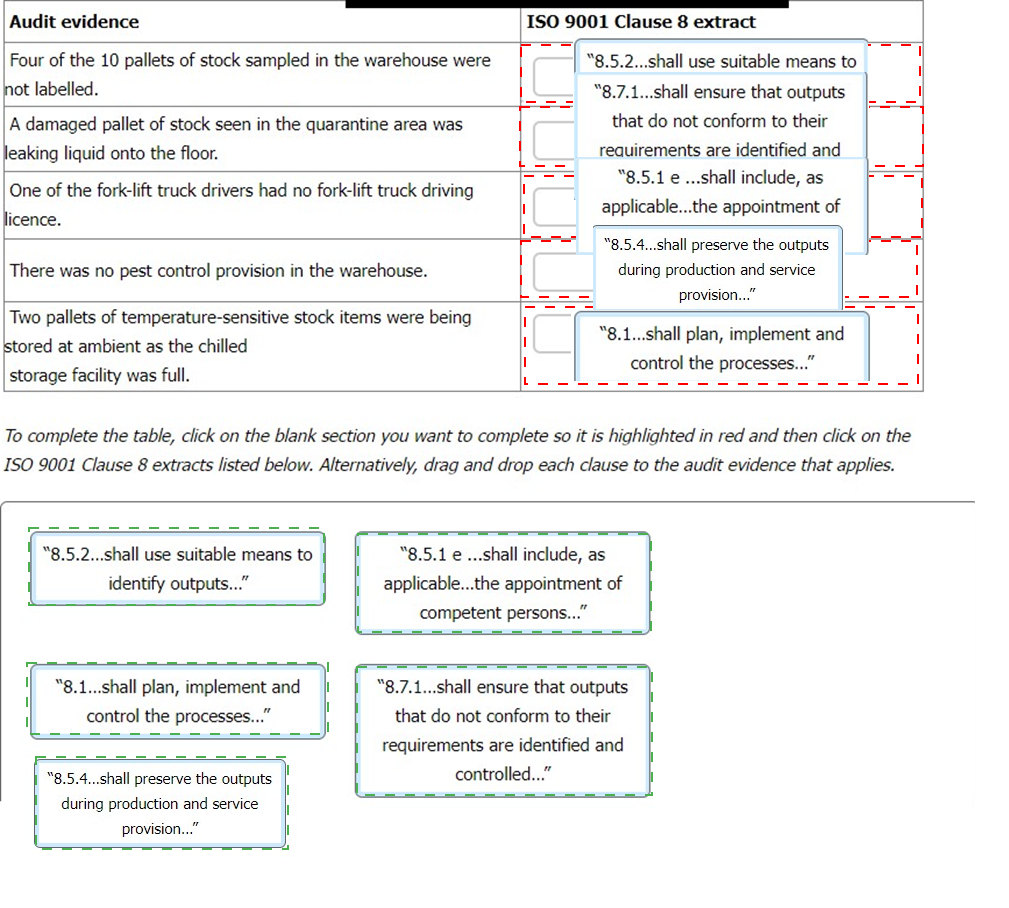
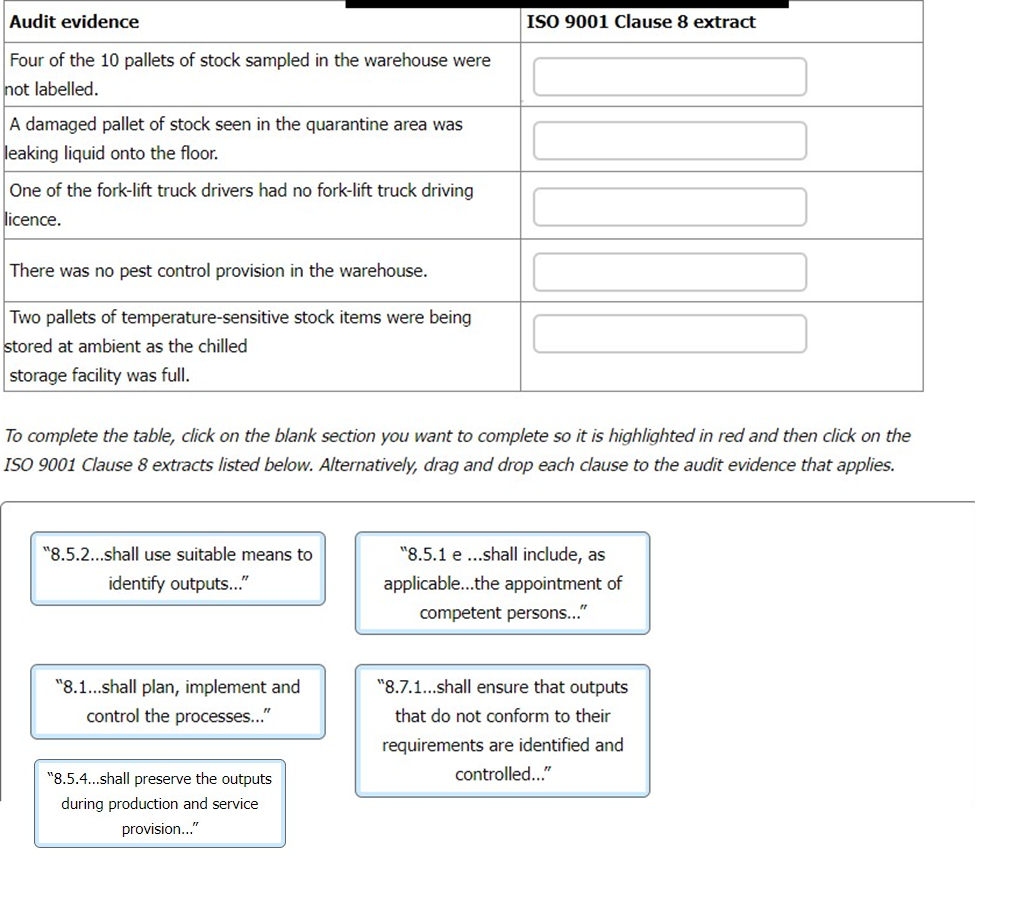
You have gathered audit evidence as outlined in the table. Match the ISO 9001 Clause 8 extract to the audit evidence.

Show answerHide answer

Explanation


Explanation:
The table below shows the possible matching of the ISO 9001 Clause 8 extract to the audit evidence.
Table
Audit evidence ISO 9001 Clause 8 extract Four of the 10 pallets of stock sampled in the warehouse were not labelled. “8.5.2 … shall use suitable means to identify outputs …”
A damaged pallet of stock seen in the quarantine area was leaking liquid onto the floor.
“8.7.1 … shall ensure that outputs that do not conform to their requirements are identified and controlled …”
One of the fork-lift truck drivers had no fork-lift truck driving licence. “8.5.1 e … shall include, as applicable … the appointment of competent persons …” There was no pest control provision in the warehouse. “8.5.4 … shall preserve the outputs during production and service provision …” Two pallets of temperature-sensitive stock items were being stored at ambient as the chilled storage facility was full. “8.1 … shall plan, implement and control the processes …”
Question 44 Choose 2
Which two of the following auditors would not participate in a first-party audit?
Show answerHide answer

Correct answer: A, F An auditor employed by an external consultancy organisationAn auditor from a customer

Explanation

Explanation: A first-party audit is an internal audit conducted by auditors who are employed by the organization being audited but who have no vested interest in the audit results of the area being audited1. The purpose of a first-party audit is to assess the conformity of the organization’s quality management system to the requirements of ISO 9001 and to identify opportunities for improvement2. Therefore, the two auditors who would not participate in a first-party audit are:
•A. An auditor employed by an external consultancy organization: This auditor is not employed by the organization being audited, and therefore does not qualify as a first-party auditor. This auditor may be hired to conduct a second-party audit (if the external consultancy organization is a customer or supplier of the organization being audited) or a third-party audit (if the external consultancy organization is a certification body or registrar). •F. An auditor from a customer: This auditor is not employed by the organization being audited, and therefore does not qualify as a first-party auditor. This auditor may be hired to conduct a second-party audit, as a customer is an interested party that has specific requirements for the organization being audited.
The other options are not correct, as they could participate in a first-party audit, as long as they are employed by the organization being audited and have no vested interest in the audit results of the area being audited:
•B. An auditor from an interested party: This auditor could be a first-party auditor, as long as the interested party is within the organization being audited. For example, an auditor from the finance department could audit the production department, as long as they are not involved in the production process or affected by its outcomes.
•C. An auditor trained in-house: This auditor could be a first-party auditor, as long as they are employed by the organization being audited and have no vested interest in the audit results of the area being audited. The source of the auditor’s training is not relevant for determining the type of audit, as long as the auditor is competent and qualified to perform the audit.
•D. An auditor trained in the IRCA scheme: This auditor could be a first-party auditor, as long as they are employed by the organization being audited and have no vested interest in the audit results of the area being audited. The IRCA scheme is a professional certification scheme for auditors of management systems, which provides recognition of the auditor’s competence and credibility3. However, being trained in the IRCA scheme does not determine the type of audit, as long as the auditor is competent and qualified to perform the audit.
•E. An auditor certified by IRCA: This auditor could be a first-party auditor, as long as they are employed by the organization being audited and have no vested interest in the audit results of the area being audited. Being certified by IRCA means that the auditor has met the requirements of the IRCA scheme and has demonstrated their competence and credibility as an auditor of management systems3. However, being certified by IRCA does not determine the type of audit, as long as the auditor is competent and qualified to perform the audit.
Question 45 Choose 2
Read the following role descriptions. Select two roles that are not directly involved in the audit process.
Show answerHide answer

Correct answer: D, E An interpreter - a person who witnesses the audit to assist the auditors with language issues.An observer - a person who sees the performance of the audit team leader, audit team members and/or auditee.

Question 46
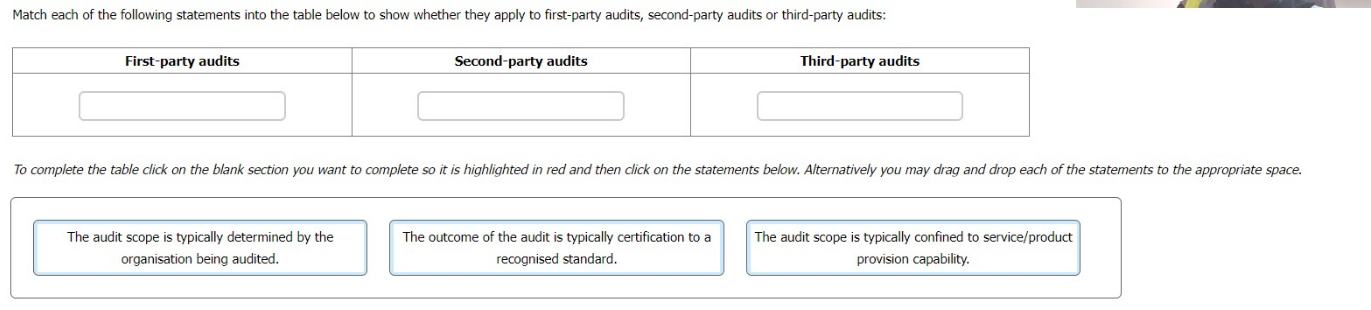
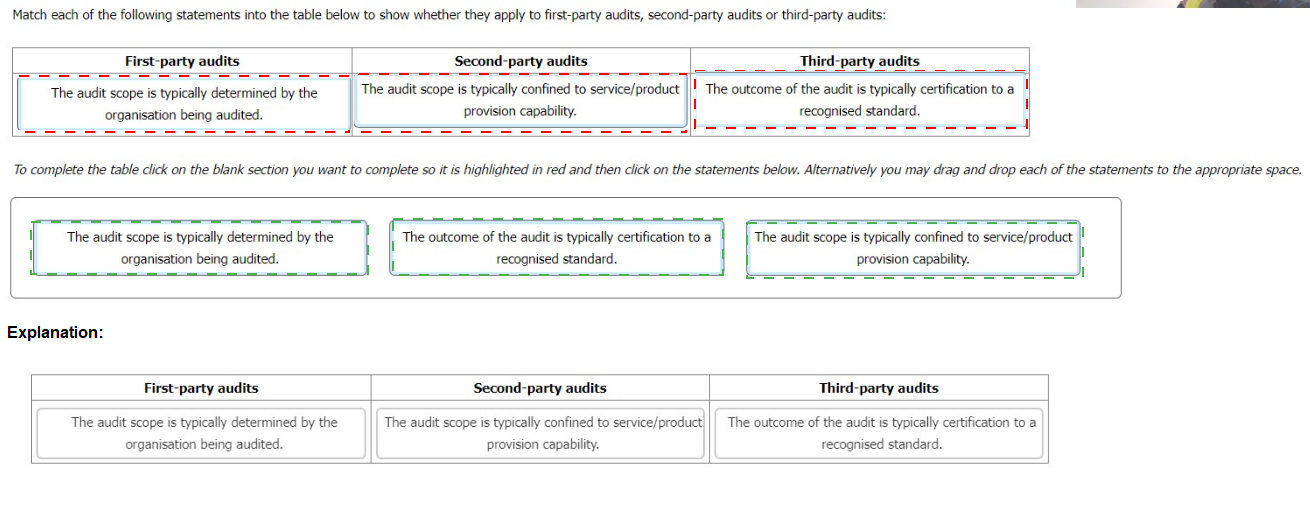
Match each of the following statements into the table below to show whether they apply to first-party audits, second-party audits or third-party audits:

Show answerHide answer

Explanation

Question 47 Choose 1
In the context of a third-party audit, select the issue which is not expected to be included in the audit plan.
Show answerHide answer

Correct answer: C Expectations of the organisation's management

Explanation

Explanation:
According to ISO 19011:2018, clause 6.3.2, the audit plan is a document that provides the basis for agreement regarding the conduct of the audit. The audit plan should include the following information1:
•the audit objectives, scope and criteria
•the audit team members and their roles and responsibilities
•the audit schedule, including the date, time and location of each audit activity
•the expected time and duration of meetings and interviews
•the allocation of appropriate resources to critical areas of the audit
•the identification of the audit client and the auditee
•the identification of the guides and observers, if any
•the documents and records to be reviewed before and during the audit
•the audit methods and tools to be used
•the audit language and terminology
•the audit report content, format, distribution and expected completion date
•the risk to achieving audit objectives and the contingency plan, if any
Therefore, the issue which is not expected to be included in the audit plan is C, expectations of the organisation’s management. This issue is not relevant to the conduct of the audit, as the audit is based on the audit criteria, not on the management’s expectations. The management’s expectations may be considered during the audit initiation or the audit programme management, but they are not part of the audit plan.
Question 48 Choose 2
Audit criteria are a set of requirements used as a reference against which objective evidence is compared.
Which two of the following are not potential audit criteria?
Show answerHide answer

Correct answer: F, H Commercial advertisementsClaims made on the organisation's website

Explanation

Explanation: According to ISO 19011:2018, clause 3.2, audit criteria are a set of policies, procedures or requirements used as a reference against which objective evidence is compared. Audit criteria are usually selected by the audit client or by agreement between the audit client and the auditee, and they should be appropriate for the audit scope and objectives1. Audit criteria may include, but are not limited to, the following sources2:
•ISO management system standards, such as ISO 9001, ISO 14001, ISO 45001, etc.
•Verbal statements by the general manager or other top management, as long as they are consistent with the documented policies and objectives of the organisation
•Verbal agreements with interested parties, such as customers, suppliers, regulators, etc., as long as they are documented and approved by the relevant authorities
•Health and safety notices, such as posters, signs, labels, etc., that communicate the organisation’s legal obligations, policies, or procedures
•Written agreements with interested parties, such as contracts, orders, specifications, etc., that define the requirements and expectations of the parties involved
•Organisation’s documented information, such as policies, procedures, manuals, records, etc., that describe the organisation’s management system and its processes
•Commitment to follow principles issued by an NGO, such as the United Nations Global Compact, the International Labour Organization, etc., as long as they are relevant to the organisation’s context and objectives
•Environmental aspects register, such as a list of the environmental impacts and risks associated with the organisation’s activities, products, and services
Therefore, the two options that are not potential audit criteria are F and H, as they are not reliable or verifiable sources of information, and they may not reflect the actual performance or conformity of the organisation’s management system. Commercial advertisements and claims made on the organisation’s website are forms of marketing communication that may be exaggerated, misleading, or inaccurate, and they are not subject to the same level of scrutiny or approval as the other sources of audit criteria.
Question 49 Choose 2
XYZ Corporation is an organisation that employs 100 people. As the audit team leader, you conduct a certification audit at Stage 1. When reviewing the quality management system (QMS), you find that the objectives have been defined by an external consultant using those of a competitor, but nothing is documented. The Quality Manager complains that this has created a lot of resistance to the QMS, and the Chief Executive is asking questions about how much it will cost.
Which two options describe the circumstances in which you could raise a nonconformity against clause 6.2 of ISO 9001?
Show answerHide answer

Correct answer: B, C Quality objectives were not established in alignment with the organisation's quality policy.Quality objectives are not maintained as documented information.

Question 50 Choose 1
A small cleaning services organisation is about to start work on a hospital cleaning contract for the local Health Trust. You, as auditor, are conducting a Stage 2 audit to ISO 9001 and review the contract with the Service Manager. The contract requires that a cleaning plan is produced.
You: "How was the cleaning plan for the contract developed?"
Service Manager: "We have a basic template that covers the materials, labour requirements and cleaning methods to be employed. Some of that is specified by the customer."
You: "How does the plan deal with locations like the intensive care wards and the operating theatres, which are included in the contract?"
Service Manager: "The basic plan covers general wards, but we will do more frequent cleaning in those areas if the hospital requests it."
You: "Are you aware of the regulatory requirements for cleaning standards in hospitals?"
Service Manager: "No. We depend on the hospital to look after that side of things in the contract."
You decide to raise a non-conformity against section 8.2.2.a.1 of ISO 9001.
You decide to raise another non-conformity against section 8.2.4 of ISO 9001 when finding that the cleaning plan was amended without the agreement of the Health Trust. A different cleaning chemical was substituted to that specified in the contract. At the follow-up audit, the corrective action proposed was to "obtain a concession from the Health Trust for use of the new chemical."
Which one of the following options is the reason why you did not accept this action taken?
Show answerHide answer

Correct answer: C The process for making changes to the contract has not been addressed.

Full mock exam

Sit the ISO-9001-Lead-Auditor exam before exam day

Full-length mocks with the same number of questions and the same time limit as the real ISO-9001-Lead-Auditor exam. Every attempt draws a new set of questions from the full bank, so you can keep going until you pass comfortably.

Get full ISO-9001-Lead-Auditor mock exam
  • 65questions per mock
  • 105 mintime limit
  • 216questions in the bank
  • Newmock on every attempt