PECB certification · Exam ISO-9001-Lead-Auditor

ISO-9001-Lead-Auditor Mock Exam Page 2

QMS ISO 9001:2015 Lead Auditor Exam

Free ISO-9001-Lead-Auditor mock exam questions 11–20, each with the answer and an explanation.

20 questions · 33 minutes · free, no sign-up

Free ISO-9001-Lead-Auditor questions

11–20 of 64 free
Question 11 Choose 1
Which one of the following is not an ISO 9000:2015 quality management principle?
Show answerHide answer

Correct answer: D Risk-based approach

Explanation

Explanation: According to the ISO 9000:2015 quality management principles document1, risk-based approach is not one of the seven quality management principles that ISO 9000, ISO 9001 and other related quality management standards are based on. The seven quality management principles are:
Customer focus
Leadership
Engagement of people
Process approach
Improvement
Evidence-based decision making
Relationship management
Therefore, risk-based approach is not a quality management principle under ISO 9001:2015.
Question 12 Choose 2
You are carrying out an audit at an organisation seeking certification to ISO 9001 for the first time. The organisation offers health and safety training to customers. Training courses are offered either as open courses, delivered at a public venue, or online, or as courses that are tailored to meet specific requirements. The business operates from a single office and those who deliver the training are either full-time employees or subcontractors.
You are interviewing the Training Manager (TM).
You: "What quality objectives apply to the training process?"
TM: "One of the quality objectives we aim for is a 90% minimum exam pass rate for all open training courses."
You: "How do you measure this objective?"
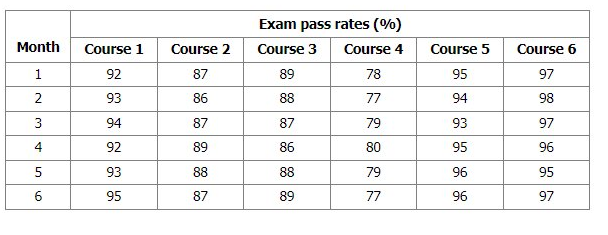
The Training Manager shows you a record on her computer and you see the following:


Which two of the following statements are true?
Show answerHide answer

Correct answer: B, D You would determine how the exam pass rate figures were analysed.You would determine what corrective action was being taken to address the low pass rates.

Explanation

Explanation: In this scenario, the organization has set a quality objective of achieving a 90% minimum exam pass rate for all courses. The auditor’s task is to assess whether this objective is being monitored effectively and if appropriate actions are taken when the objective is not met.

B. You would determine how the exam pass rate figures were analysed: ISO 9001:2015, particularly Clause 9.1 (Monitoring, measurement, analysis, and evaluation), requires organizations to evaluate performance data. The auditor should verify how the organization analyses the pass rate data to ensure trends are identified, and corrective actions are planned based on this analysis.

D. You would determine what corrective action was being taken to address the low pass rates: When performance falls short of the objective, as seen with Course 4 (where the pass rate is below 90% in all months), Clause 10.2 (Nonconformity and corrective action) requires organizations to take corrective actions to address issues. The auditor would need to check if corrective actions have been initiated to address consistently low pass rates.
Statements A, C, E, and F do not directly address the monitoring and corrective action required under ISO 9001:2015 in this context.
Question 13 Choose 1
Select which one of the following statements is true.
Show answerHide answer

Correct answer: A The team leader shall be an auditor that is qualified in the scheme.

Explanation

Explanation: According to the ISO 19011:2018 standard, which provides guidelines for auditing management systems, the team leader of an audit team should be an auditor who has demonstrated the competence to manage an audit of the relevant management system scheme. This means that the team leader should have the appropriate knowledge, skills, and experience to plan, conduct, report, and follow-up an audit of the specific management system, such as ISO 9001 for quality management systems. The other options are false because: B. An audit team can include non-qualified auditors, but only as observers or trainees who do not contribute to the audit findings or conclusions. C. A technical expert can assist a qualified auditor on an audit team, but cannot replace them, as a technical expert does not have the competence to perform audits. D. Audits leading to auditor qualification are not undertaken annually, but rather as part of a certification process that involves meeting certain criteria, such as education, work experience, audit experience, and examination. References: ISO 19011:2018, PECB Certified ISO 9001 Lead Auditor Exam Preparation Guide, ISO 9001:2015 Quality Management Systems Lead Auditor Training Course
Question 14
Select the word that best completes the sentence:


Show answerHide answer

Explanation

Question 15
You are carrying out an audit at a single-site organisation seeking certification to ISO 9001 for the first time. The organization manufactures cosmetics for major retailers.
You are interviewing the Manufacturing Manager (MM).
You: "I would like to begin by looking at the cleaning controls."
MM: "We record the cleaning of the equipment at the end of every batch. This document details the minimum cleaning frequency and the procedures to follow for all areas and each item of equipment. The person who carries out the cleaning puts their initial on the document and records the time and date alongside."
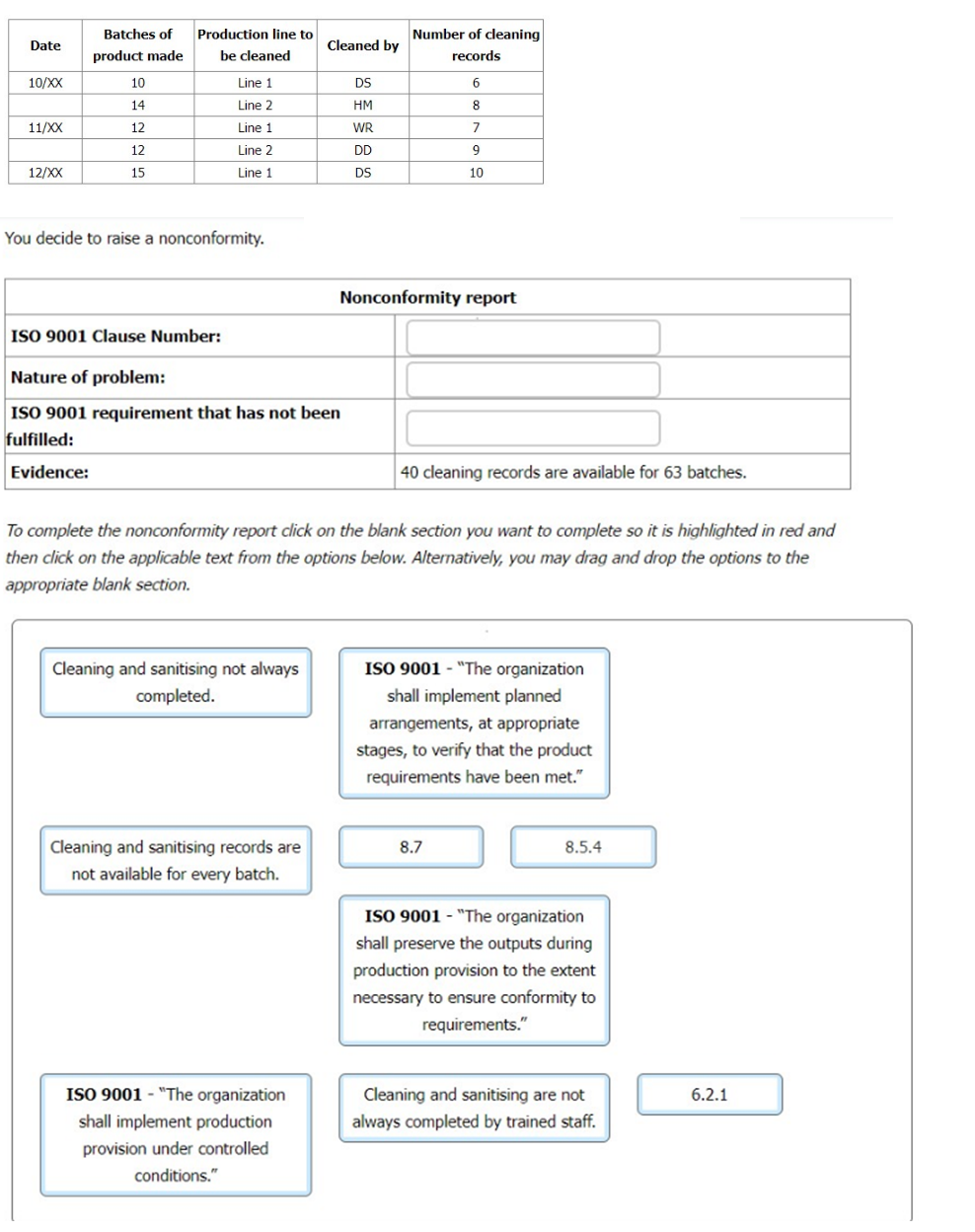
Narrative: You sample production records over 3-days and note down evidence of nonconformity as per the table below.

Show answerHide answer

Explanation


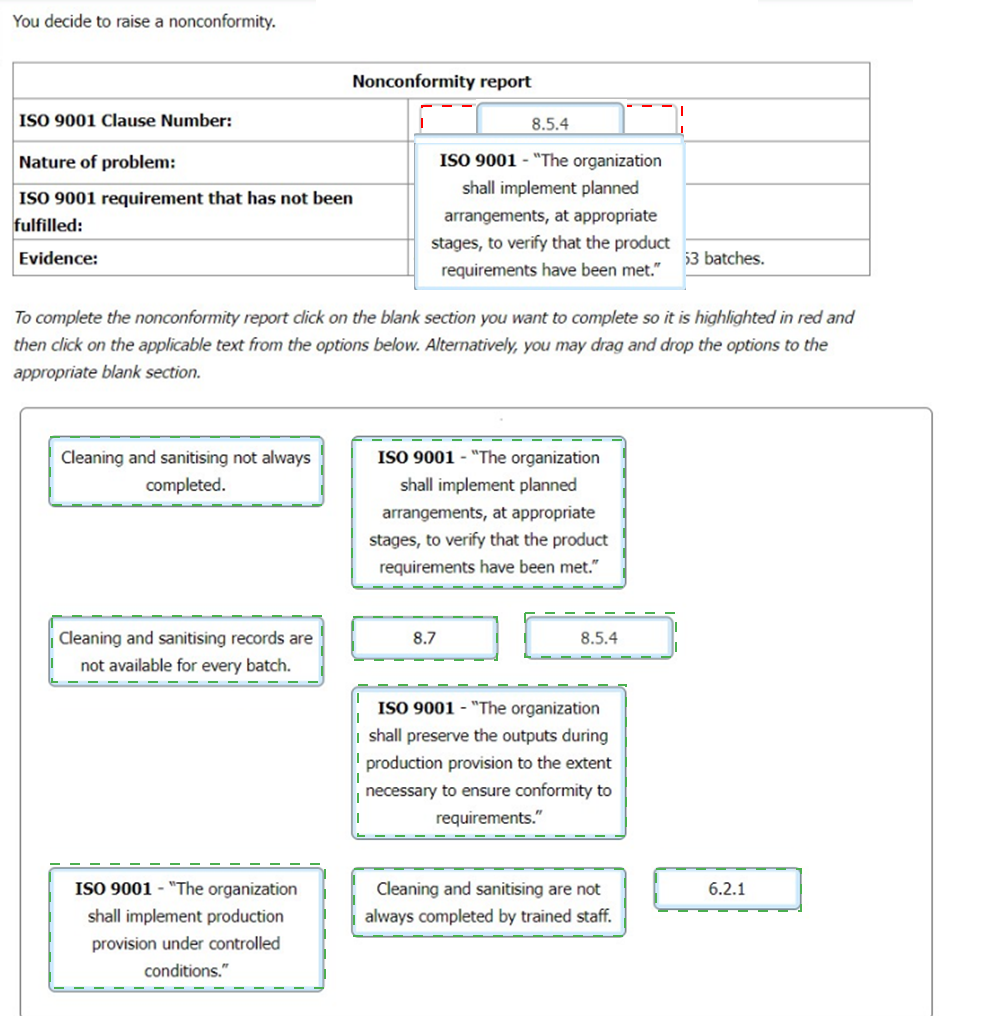
Explanation: Nonconformity report ISO 9001 Clause Number: 8.5.4 Nature of problem: Cleaning and sanitising records are not available for every batch. ISO 9001 requirement that has not been fulfilled: ISO 9001 - “The organization shall implement planned arrangements, at appropriate stages, to verify that the product requirements have been met.” Evidence: 40 cleaning records are available for 63 batches.
Question 16
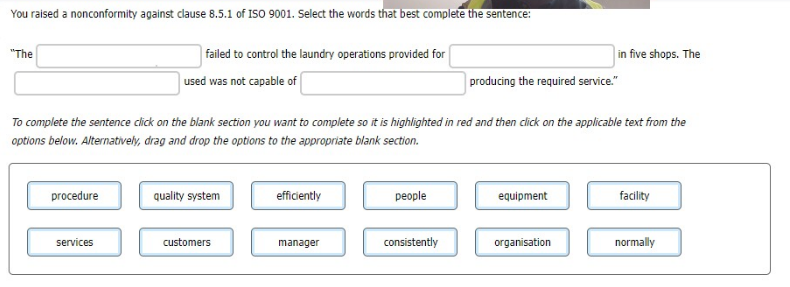
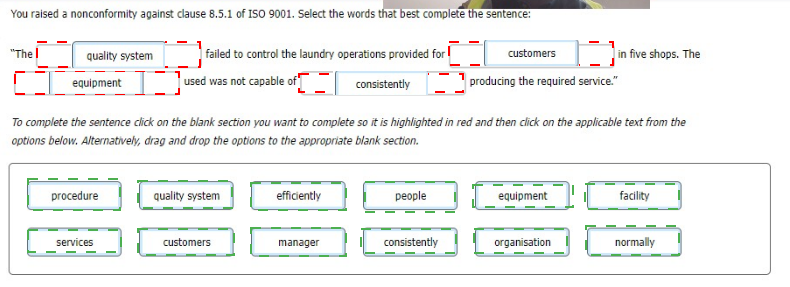
Whistlekleen is a national dry cleaning and laundry company with 50 shops. You are conducting a surveillance audit of the Head Office and are sampling customer complaints. You find that 80% of complaints originate from five shops in the same region.
Most of these complaints relate to damage to customer laundry. The Quality Manager tells you that these are the oldest shops in the company. The cleaning equipment needs replacing but the company cannot afford it at the moment. You learn that the shop managers were told to dismiss most of the claims on the basis of the poor quality of the laundered materials.
On raising the matter with senior management, you are told that there are plans to replace the equipment in these shops over the next five years.

Show answerHide answer

Explanation

Question 17 Choose 1
Even though past audits have highlighted a consistently large number of nonconformities within an organisation's design team, the organisation has not varied the frequency or duration of audits on its audit plan.
The decision for whether this situation is acceptable or not should be governed by which of the following?
Show answerHide answer

Correct answer: A A risk-based approach to the audit programme

Question 18
You are conducting an audit at an organisation seeking certification to ISO 9001 for the first time. The organisation offers health and safety training to customers. Training courses are offered either as open courses, delivered at a public venue, or online, or as courses that are tailored to meet specific requirements. The business operates from a single office and those who deliver the training are either full-time employees or subcontractors.
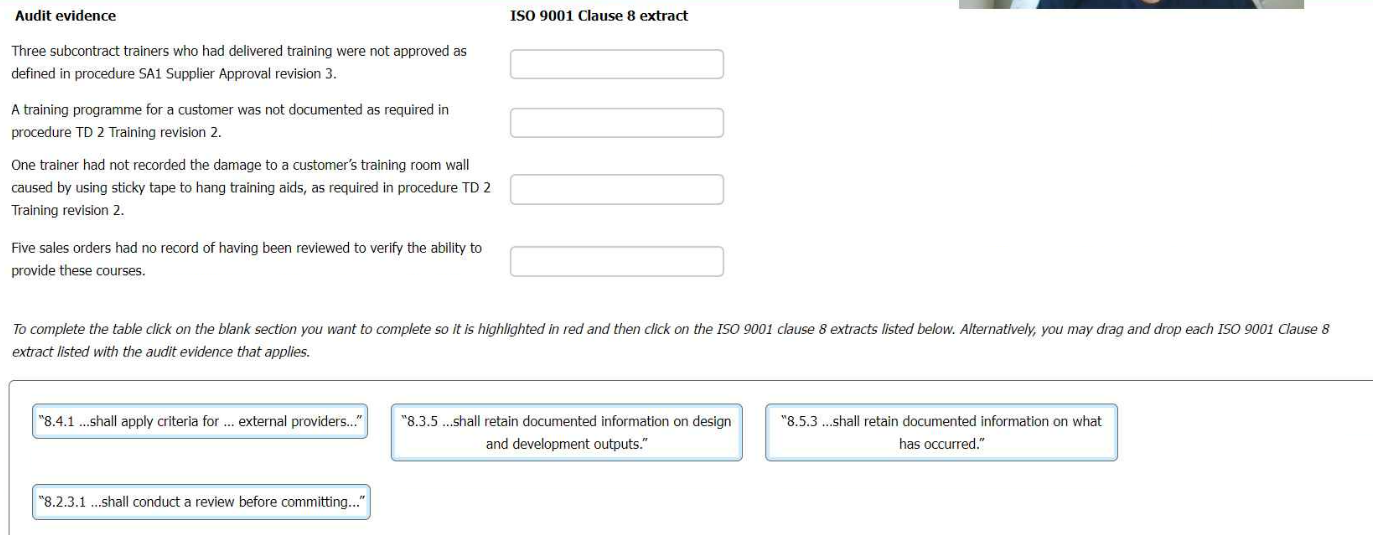
You have gathered audit evidence as outlined below. Match the ISO 9001 Clause 8 extract to the audit evidence.

Show answerHide answer

Explanation


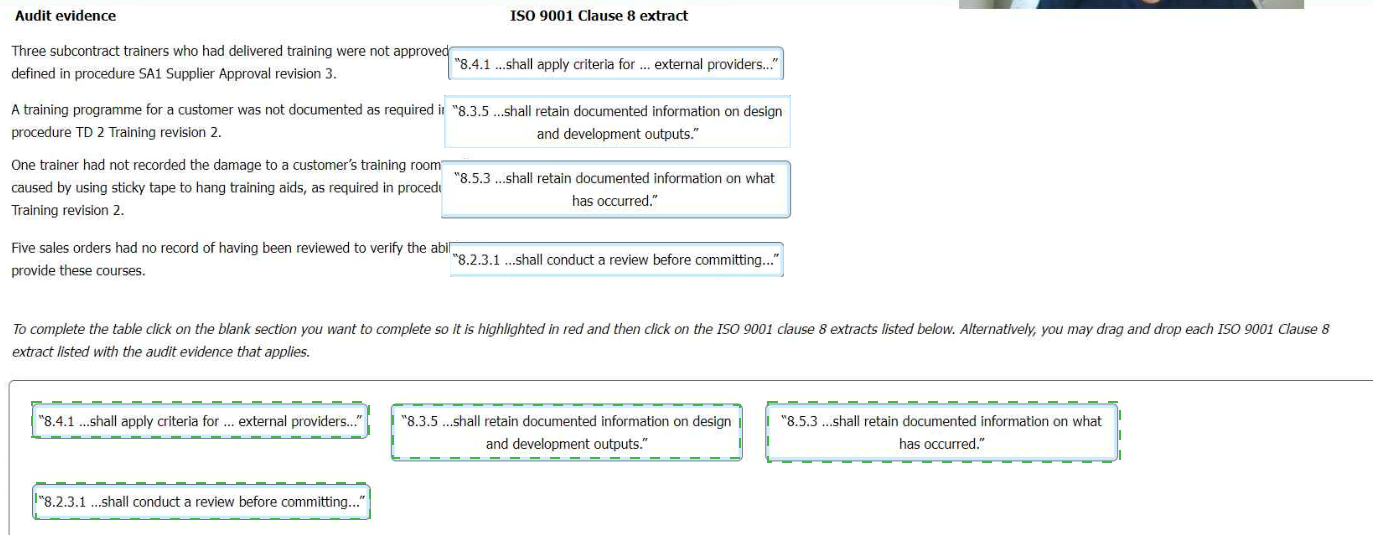
Explanation: Here is the correct matching of the ISO 9001 Clause 8 extracts to the audit evidence:
Audit evidence: Three subcontract trainers who had delivered training were not approved as defined in procedure SA1 Supplier Approval revision 3.ISO 9001 Clause 8 extract: 8.4.1 ...shall apply criteria for ... external providers...(This clause requires the organization to control external providers, including ensuring their approval and competence.)
Audit evidence: A training programme for a customer was not documented as required in procedure TD 2 Training revision 2.ISO 9001 Clause 8 extract: 8.3.5 ...shall retain documented information on design and development outputs.(This clause addresses the need to retain documented information related to design and development outputs, such as a training programme.)
Audit evidence: One trainer had not recorded the damage to a customer’s training room wall caused by using sticky tape to hang training aids, as required in procedure TD 2 Training revision 2.ISO 9001 Clause 8 extract: 8.5.3 ...shall retain documented information on what has occurred.(This clause relates to retaining documented information on activities and outcomes, including records of damage or issues encountered.)
Audit evidence: Five sales orders had no record of having been reviewed to verify the ability to provide these courses.ISO 9001 Clause 8 extract: 8.2.3.1 ...shall conduct a review before committing...(This clause specifies the requirement to review and verify the organization's ability to meet customer requirements before accepting sales orders.)
These mappings reflect the specific requirements of ISO 9001:2015 for managing external providers, retaining documented information, and reviewing contracts.
Question 19
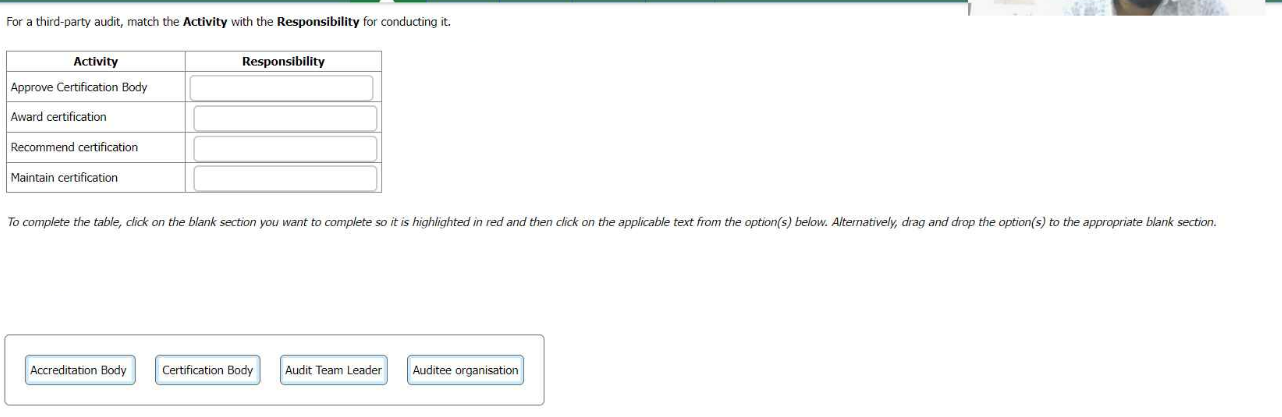
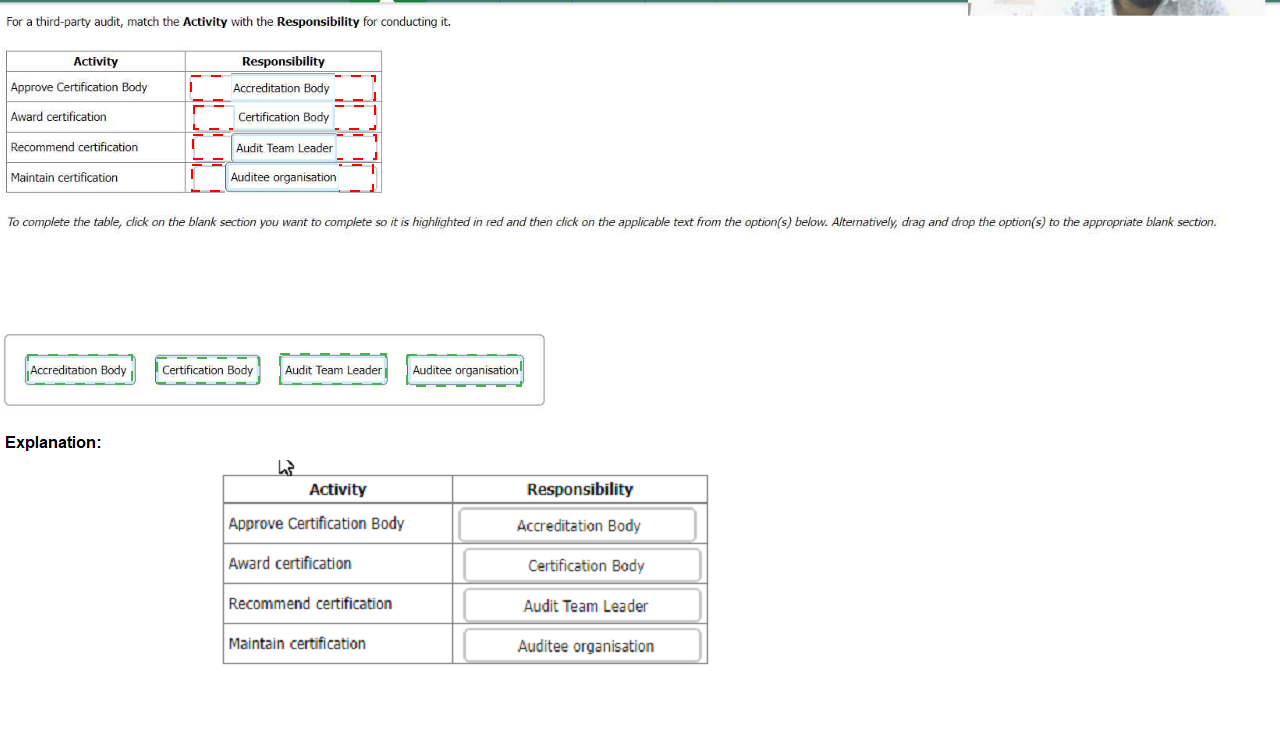
For a third-party, match the Activity with the Responsibility for conducting it.

Show answerHide answer

Explanation

Question 20 Choose 1
You are a member of the audit team of a second-party audit of an organisation with 625 employees. The audit procedure recommends using sampling criteria which requires the review of the documented competence for 25 personnel. The audit team leader developed an audit plan allocating one hour to audit the Human Resources department (from 11:30 am to 12:30 pm). She told you that she could not allocate any additional time.
What would you do?
Show answerHide answer

Correct answer: B Plan to review less than 25 cases.

Explanation

Explanation: In this scenario, the time allocated by the audit team leader for the Human Resources audit is fixed, and as an auditor, you must work within that constraint. Although the sampling criteria suggests reviewing 25 personnel files, it is acceptable to adjust the sample size based on time and resource limitations. ISO 9001:2015 emphasizes riskbased thinking and practical resource management (Clause 7.1), so it is reasonable to review a smaller sample if the time is insufficient.
Option B is a pragmatic approach, allowing you to focus on quality over quantity by reviewing as many cases as time allows without compromising the audit schedule.
Options like extending the audit (A, C, D) are impractical in a structured audit environment, especially for second-party audits where maintaining the agreed schedule is important.
Full mock exam

Sit the ISO-9001-Lead-Auditor exam before exam day

Full-length mocks with the same number of questions and the same time limit as the real ISO-9001-Lead-Auditor exam. Every attempt draws a new set of questions from the full bank, so you can keep going until you pass comfortably.

Get full ISO-9001-Lead-Auditor mock exam
  • 65questions per mock
  • 105 mintime limit
  • 216questions in the bank
  • Newmock on every attempt