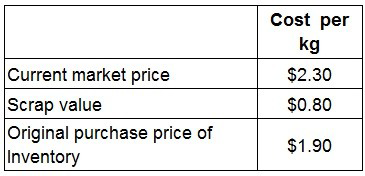
FGH used to manufacture components that required raw material Q. Currently there are 80 kg of material Q in inventory. The company has no use for the material in the foreseeable future and intends to sell it for scrap. A potential new customer has asked for a price for a large order. This order would require 100 kg of material Q. The company management has decided to quote a price for this work on a relevant cost basis. Details of costs for material Q are as follows:
What would be the relevant cost of Material Q to use in this order?
Show answerHide answer
Correct answer: C$110
Question 12Choose 1
A company is bidding to win a special contract.
Which of the following is NOT a relevant cost to the company of undertaking the contract?
Show answerHide answer
Correct answer: DThe depreciation charge on the tools which will be used during the contract.
Question 13Choose 1
Which of the following statements about expected value is NOT correct?
Show answerHide answer
Correct answer: BIt draws management attention to the possibility of very high or very low outcomes.
Question 14
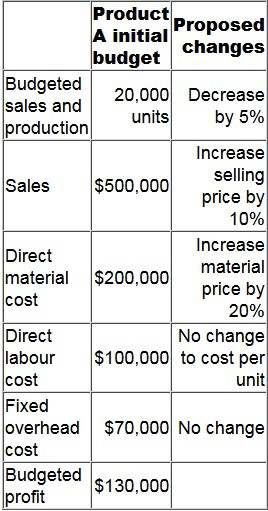
Company M is preparing its budgeted profit statement for the next year. The initial budget for Product A is as follows with some changes proposed by the sales director to increase the quality of the product. What would the budgeted profit of Product A be if the proposed changes are made?
Give your answer as a whole number.
Show answerHide answer
Explanation
Answer: $129500
Question 15Choose 1
A company operates a standard costing system.
The company combines two raw materials in a process in order to produce a finished product. During month 6 the direct material mix variance was favourable and the direct material yield variance was adverse.
Which of the following statements would explain both of the variances?
Show answerHide answer
Correct answer: AThere was more wastage in the process than standard and a greater proportion of the cheaper of the two materials was input than standard.
Question 16Choose 3
‘Public sector organizations are often judged by their economy, efficiency and effectiveness. Consequently, they should use an approach to budgeting other than incremental budgeting.’
Required:
Explain ONE advantage and TWO disadvantages of public sector organizations using incremental budgeting.
Select all true statements.
Show answerHide answer
Correct answer: B, C, EPublic sector organizations tend to be fairly complex and in many cases outputs cannot be measured in monetary terms therefore the link between inputs and outputs is difficult to establish. An incremental approach can therefore provide a cost effective approach to budgeting.Under an incremental approach to budgeting, existing operations and the current budgeted allowance for these existing activities are taken as the base level for preparing the budget.The incremental approach means that budget holders in public sector organizations will be encouraged to use up this year’s budget will be as high as possible.
Question 17Choose 3
Company NBO is providing a quote to manufacture 500 passenger seats for a bus company. Relevant cost is being used as the basis for the quote. Which THREE of the following should be included as relevant costs or savings in the production of the 500 passenger seats?
Show answerHide answer
Correct answer: B, D, EElectricity charges of $1,500 for the completion of the order.Seat cover material, to be bought for $6,000, which cannot be used on other products.Idle time pay of $1,000 which would be paid to workers if the quote is not accepted
Question 18Choose 1
A museum charges a reduced entrance fee for students in full-time education. The budgeted cost per customer is the same regardless of the entrance fee paid. 4,000 customers were budgeted to visit the museum during period 6, with 25% of customers paying the reduced fee. 3,000 customers visited the museum during period 6 and 1,000 of these paid the reduced entrance fee. Costs were as budgeted but the actual full-priced entrance fee was $2 higher than budgeted. Which of the following statements is true?
Show answerHide answer
Correct answer: AThe sales mix variance is adverse and the sales quantity variance is adverse.
Question 19
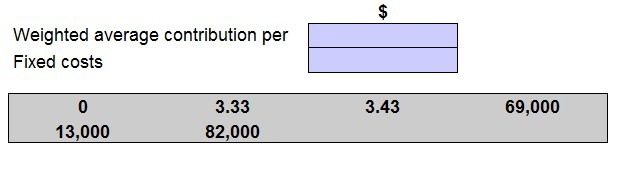
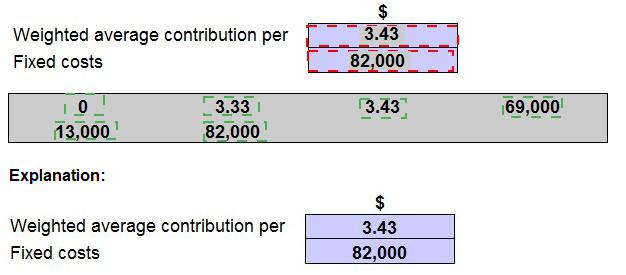
A company sells three products A, B and C in a ratio of 2:2:3.
Each unit of A,B and C earns a contribution of $4.00, $2.00 and $4.00 respectively. Production fixed costs are $69,000 each month and selling fixed costs are $13,000 each month.
The company holds no inventory. The management accountant wants to know the total number of units needed to break-even. However, he is unsure about how to calculate the weighted average contribution per unit or what category of fixed cost to use.
Place the amounts given to complete the table in order to calculate the total number of units to break even.
Show answerHide answer
Explanation
Question 20Choose 1
A company is considering whether to launch a new product. The selling price and costs for each unit of the product are shown in table below:
The fixed overhead cost is based on expected production of 2,000 units. The company will only launch the product if it is expected to be profitable.
To which of the following is the decision to launch the product most sensitive?
Show answerHide answer
Correct answer: BSelling price
Full mock exam
Sit the P1 exam before exam day
Full-length mocks with the same number of questions and the same time limit as the real P1 exam. Every attempt draws a new set of questions from the full bank, so you can keep going until you pass comfortably.
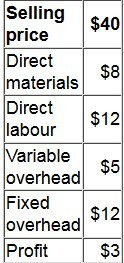 The fixed overhead cost is based on expected production of 2,000 units. The company will only launch the product if it is expected to be profitable.