Fortinet certification · Exam NSE6_FSM_AN-7.4

NSE6_FSM_AN-7.4 Mock Exam Page 2

Fortinet NSE 6 - FortiSIEM 7.4 Analyst

Free NSE6_FSM_AN-7.4 mock exam questions 11–13, each with the answer and an explanation.

13 questions · 23 minutes · free, no sign-up

Free NSE6_FSM_AN-7.4 questions

11–13 of 13 free
Question 11 Choose 1
What can you use to send data to FortiSIEM for user and entity behavior analytics (UEBA)?
Show answerHide answer

Correct answer: A FortiSIEM agent

Explanation

Explanation:
This question tests your knowledge of how FortiSIEM ingests data specifically for User and Entity Behavior Analytics (UEBA). UEBA requires deep, structured log data—such as authentication logs, DHCP logs, and VPN logs—to build behavioral baselines. Not all data collection methods are suitable for this purpose.

Correct Option:

A. FortiSIEM agent
The FortiSIEM agent (installed on Windows or Linux systems) is the primary method for collecting the detailed, high-fidelity event logs required for UEBA. Agents can parse and forward security-relevant logs (e.g., Windows Event Logs for authentication, DHCP lease logs) directly to the FortiSIEM Supervisor or Worker. This ensures the structured data needed for user behavior modeling is reliably ingested.

Incorrect Option:

B. SSH
SSH is used for remote command execution or secure file transfers, not as a standard data ingestion method for UEBA. While FortiSIEM can use SSH for some log collection via scripts, it is not the recommended or primary method for feeding UEBA-specific data at scale.

C. SNMP
SNMP is primarily used for collecting performance metrics (e.g., CPU, memory, interface traffic) and simple trap-based alerts. It does not carry the detailed user-level event data (like logon/logoff, privilege changes, or file access) required for UEBA analysis.

D. FortiSIEM worker
The FortiSIEM Worker is a processing component responsible for event correlation, rule evaluation, and incident generation—not data collection. Workers consume events that have already been ingested by agents or other collectors; they do not directly send or collect data for UEBA.

Reference:
FortiSIEM 7.4.0 Administration Guide, Chapter 4: Data Collection → UEBA Data Sources – "FortiSIEM Agents are the recommended method for collecting Windows Event Logs, DHCP logs, and other user-centric data required for UEBA analytics." Also refer to Chapter 15: User and Entity Behavior Analytics for data source requirements.
Question 12 Choose 1
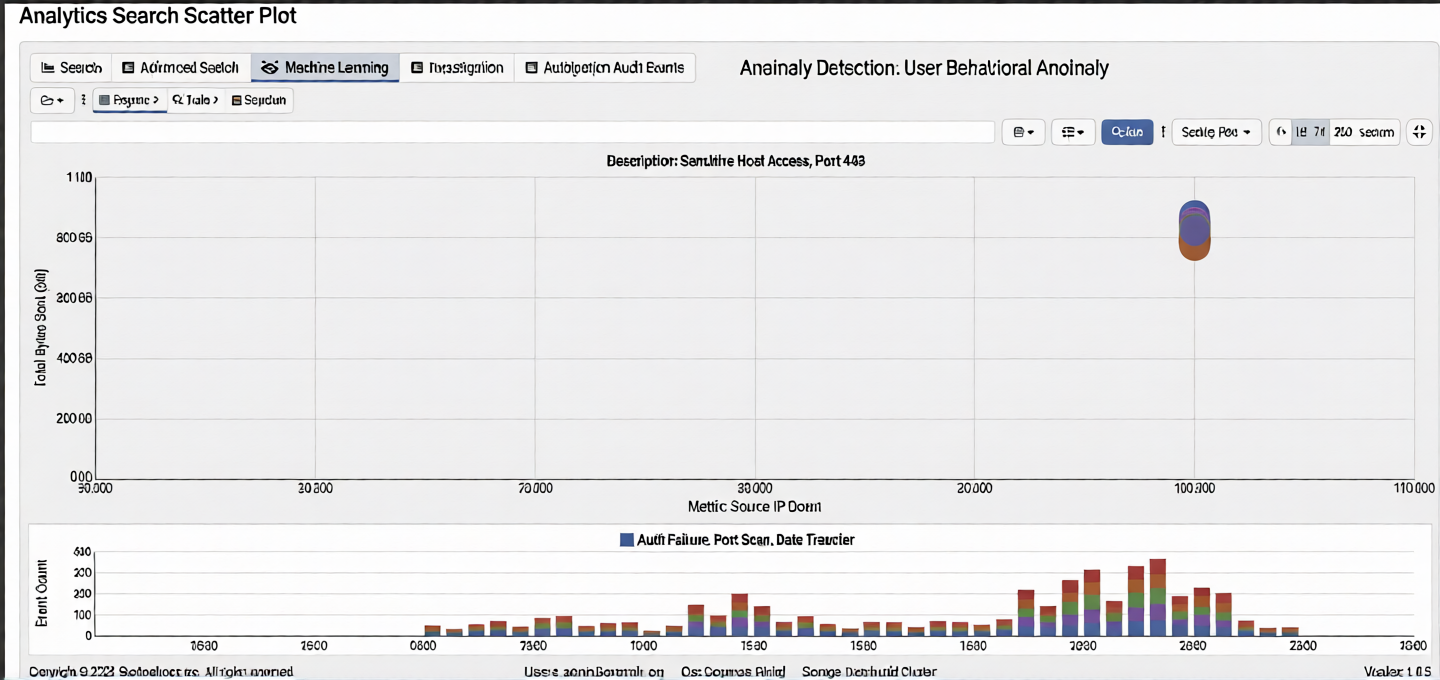
Refer to the exhibit.


An analyst wants to perform a KMeans machine learning (ML) job on this data. How many N clusters would be a good fit for the data? (Choose one answer)
Show answerHide answer

Correct answer: A Two

Explanation

Explanation:
This question tests your understanding of KMeans clustering and how to visually determine the optimal number of clusters from a scatter plot. The goal of KMeans is to group data points into distinct, meaningful clusters based on similarity. The ideal number of clusters should naturally separate the visible patterns in the dataset without overfitting.

Correct Option:

A. Two
Based on the scatter plot shown, the data points clearly form two distinct vertical bands or clusters. One cluster appears around the lower range (approximately 0–50 on the x-axis) and another around the higher range (approximately 60–120+). This natural separation makes k=2 the most logical and parsimonious choice. Using the "elbow method" visually, adding more clusters would over-segment these two obvious groupings.

Incorrect Option:

B. 50
Choosing 50 clusters would massively overfit the data. KMeans with 50 clusters would force every small grouping of points into its own cluster, creating meaningless micro-segments. This defeats the purpose of clustering for pattern discovery and would produce fragmented, hard-to-interpret results with high variance.

C. 100
This is even worse than 50 clusters. With 100 clusters, nearly every data point or tiny group would become its own cluster. This provides zero analytical value, offers no generalization, and violates the fundamental principle of clustering—which is to find meaningful, broad groupings. It would simply memorize the data rather than reveal patterns.

D. One
A single cluster would treat all data points as belonging to one group, ignoring the clear visual separation between the lower and upper bands. This would obscure the distinct behavioral patterns visible in the data (e.g., normal vs. anomalous traffic). KMeans with k=1 is rarely useful unless data is truly homogeneous.

Reference:
FortiSIEM 7.4.0 Analytics Guide, Chapter 5: Machine Learning → KMeans Clustering – "The optimal number of clusters can often be estimated visually from scatter plots. Look for natural groupings or density separations. Use the elbow method or silhouette scores to validate. Over-clustering (too many clusters) leads to overfitting and reduces interpretability."
Question 13 Choose 1
Which analytics search can be used to apply a user and entity behavior analytics (UEBA) tag to an event for a failed login by the user JSmith?
Show answerHide answer

Correct answer: D Username CONTAIN smit

Explanation

Explanation:
This question tests your understanding of how UEBA tags are applied to events in FortiSIEM. UEBA tags are typically assigned based on specific user identification attributes. To tag an event for a failed login by the user JSmith, you need a filter that correctly identifies that exact username while maintaining flexibility for case variations or partial matches commonly found in authentication logs.

Correct Option:

D. Username CONTAIN smit
The CONTAIN operator (or CONTAINS) performs a substring match, which is ideal for UEBA tagging because usernames may appear with different case formats (e.g., "jsmith", "JSMITH", "jSmith") or include domain prefixes (e.g., "DOMAIN\jsmith"). Searching for "smit" as a substring captures all variants of "JSmith" while avoiding exact-case restrictions, ensuring the UEBA tag applies consistently to this user.

Incorrect Option:

A. User = smith
This is an exact match for "smith" (lowercase), which would miss "JSmith" with a capital 'J' and 'S'. UEBA tagging requires more flexible matching to accommodate case variations and formatting differences in log sources, so this filter is too restrictive.

B. Username NOT END WITH jsmith
This is a negative condition that explicitly excludes events ending with "jsmith". Since you want to tag JSmith's failed logins, this filter would do the opposite—it would tag everyone except JSmith. This is logically incorrect for the stated goal.

C. User IS jsmith
Similar to option A, IS performs an exact case-sensitive match (depending on configuration) for "jsmith" (all lowercase). It would miss "JSmith", "JSMITH", "jSmith", or domain-qualified variants like "DOMAIN\jsmith". UEBA tagging needs broader matching to be effective.

Reference:
FortiSIEM 7.4.0 User Guide, Chapter 15: User and Entity Behavior Analytics → Tagging Events – "Use the CONTAINS operator for username-based UEBA tagging to accommodate case variations and domain prefixes commonly found in authentication logs. Exact-match operators like = or IS may miss legitimate events due to formatting differences across log sources."

That's the last free question

You've seen the free 30% (13 of 49 questions). Full access unlocks every question and full-length NSE6_FSM_AN-7.4 mock exams (40 questions, 70 minutes), a different mock on every attempt.

Unlock full mock exam
Full mock exam

Sit the NSE6_FSM_AN-7.4 exam before exam day

Full-length mocks with the same number of questions and the same time limit as the real NSE6_FSM_AN-7.4 exam. Every attempt draws a new set of questions from the full bank, so you can keep going until you pass comfortably.

Get full NSE6_FSM_AN-7.4 mock exam
  • 40questions per mock
  • 70 mintime limit
  • 49questions in the bank
  • Newmock on every attempt