Find out if you're ready for InsuranceSuite-Developer. Take the free timed mock exam and get your score in minutes, or study the free InsuranceSuite-Developer questions below with answers and explanations.
An insurer requires a single column of information to be displayed in several places in the application. The insurer anticipates that fields may be added to or removed from this column in the future and wants to do this without making changes in multiple places. Which container meets this requirement?
Show answerHide answer
Correct answer: BInputSet
Explanation
Answer Option (Which option is correct) B. InputSet Explanation:
An InputSet PCF file centralizes a reusable group of input fields. Referencing that file from multiple containers allows one change to update every use of the shared layout.
Verification note: The exact option selection could not be independently verified from accessible official documentation. Relevant official topic links are provided, but some exact configuration or training rules require the product Configuration Guide or Cloud Standards behind sign-in. The source key is retained.
Why the other options are incorrect:
A. Input column: An InputColumn arranges fields inside a detail view. It does not identify the shared reusable file requested here. The layout needs an InputSet reference.
C. ListView Panel: A ListView displays repeated records. The requirement describes one column of inputs. Introducing a row-based panel changes the requested structure.
D. Wizard: A Wizard organizes a sequence of pages. It is intended for a multistep workflow. The insurer needs reusable fields rather than sequential navigation.
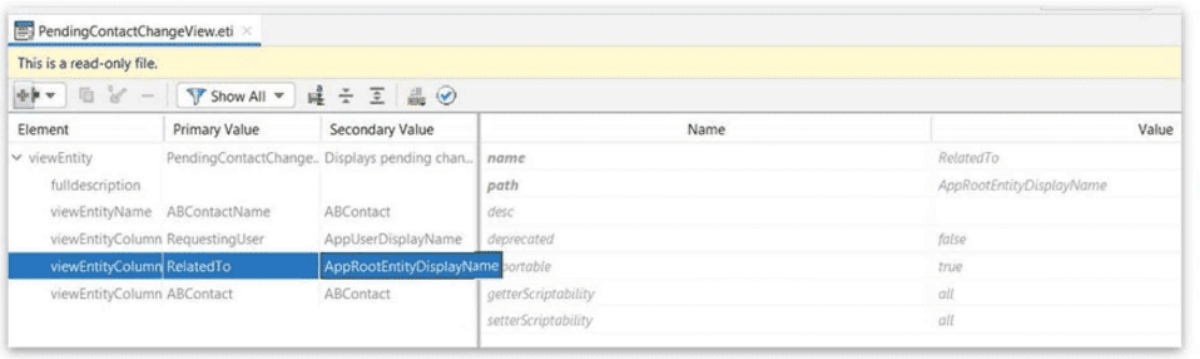
What configuration item is needed to add ABContact.Notes to PendingContactChangeView following best practices?
Visual content transcription: The screenshot shows PendingContactChangeView and its existing view-entity fields. Small field details remain in the original image.
Show answerHide answer
Correct answer: AAdd a viewEntityType for Note to PendingContactChangeView.etx
Explanation
Answer Option (Which option is correct) A. Add a viewEntityType for Note to PendingContactChangeView.etx Explanation:
A query-backed list view should read projected fields from its view entity. Extending the existing view entity in its .etx file preserves the base definition and avoids navigating back to the full underlying entity for each row.
Verification note: The exact option selection could not be independently verified from accessible official documentation. Relevant official topic links are provided, but some exact configuration or training rules require the product Configuration Guide or Cloud Standards behind sign-in. The source key is retained.
Why the other options are incorrect:
B. Add a viewEntityType for Note to PendingContactChangeView.eti: Editing the delivered eti file changes the base definition. That bypasses the extension file selected by the source. The existing view should be customized through etx metadata.
C. Set the value on the input widget to PendingContactChangeView.ABContact.Note: Navigating to ABContact reads through the underlying entity relationship. That does not add Notes to the view projection. The question asks for view-entity configuration.
D. Create a viewEntity that includes Note: Creating a separate view duplicates the existing projection. The requirement is to add information to PendingContactChangeView. An extension targets that existing view directly.
Correct answer: BImproves application performance by reducing the size of the database
Explanation
Answer Option (Which option is correct) B. Improves application performance by reducing the size of the database Explanation:
Archiving moves eligible older business data out of the active database while retaining it for retrieval. A smaller active dataset can reduce the work involved in routine application operations; archiving is different from permanent purging, compression, or index rebuilding.
Why the other options are incorrect:
A. Reorganizes and compresses the contents of the database to conserve space: Compression changes physical storage representation. Archiving instead removes eligible records from the active dataset. These are different database operations.
C. Reindexes the contents of the database to increase data retrieval speed: Reindexing rebuilds an access structure. It does not transfer old business records into an archive. Index maintenance is not the benefit asked about.
D. Reduces database size by permanently removing data marked for purge: Purging permanently removes data. Archiving retains data outside the active store. The two lifecycle operations should not be equated.
A developer is creating an entity for home inspections that contains a field for the inspection date. Which configuration of the file name and the field name fulfills the requirement and follows best practices?
Answer Option (Which option is correct) B. HomeInspection_Ext.eti, InspectionDate.Ext Explanation:
A new custom entity is defined in an .eti file with a customer suffix on the entity name. A field belonging exclusively to that new custom entity generally does not need a second extension suffix. An .etx file instead extends an entity that already exists.
Verification note: The supplied key selects InspectionDate.Ext although Q53 uses an unsuffixed field on a new custom entity. The dot suffix appears malformed; retained verbatim for review.
Why the other options are incorrect:
A. HomeInspection.etx, InspectionDate.Ext: An etx file extends an existing entity. The stem asks for a new HomeInspection entity. The field suffix also appears malformed.
C. HomeInspection_Ext.etx, InspectionDate: This still uses an extension file rather than an entity definition. The custom name alone does not change the file purpose. Creating the new entity requires an eti definition.
D. HomeInspection.eti, InspectionDate.Ext: The entity name has no custom suffix. That can collide with delivered entity names. The dot in the field suffix also needs source review.
E. HomeInspection.Ext.eti, InspectionDate: The name uses a dot before Ext. Other questions use an underscore in custom entity names. The source does not explain this spelling difference.
Succeed Insurance needs to modify the ClaimCenter data model to add a new column to indicate the date and time that a contact on a claim was interviewed about the loss. This new field will be added to the existing Person entity. Following best practices, which of the following options satisfies this requirement?
Show answerHide answer
Correct answer: DExtend the out-of-the-box Person.eti file by creating a Person.etx file and add a datetime field called InterviewDate_Ext.
Explanation
Answer Option (Which option is correct) D. Extend the out-of-the-box Person.eti file by creating a Person.etx file and add a datetime field called InterviewDate_Ext. Explanation:
Add a simple new value to the narrowest existing entity to which it applies. Use an entity extension rather than editing the delivered entity definition, choose an appropriate scalar data type, and distinguish the custom field with the extension suffix.
Why the other options are incorrect:
A. Modify the out-of-the-box Person.eti file and add a datetime field called InterviewDate: Changing Person eti modifies a delivered definition. The new interview date belongs in an entity extension. The unsuffixed field also risks a future naming collision.
B. Extend the out-of-the-box Person.eti file by creating a Person_Ext.etx file and add a datetime field called InterviewDate_Ext: Person_Ext etx does not match the existing Person entity name. The extension should retain the base entity name. The field suffix does not repair the mismatched file name.
C. Extend the out-of-the-box Person.eti file by creating a Person.etx file and add a datetime field called InterviewDate: Person etx is the appropriate extension file. The field name still lacks the custom suffix. The selected configuration distinguishes InterviewDate_Ext from future base fields.
An insurer wants to add a new typecode for an alternate address to a base typelist EmployeeAddress that has not been extended.
Show answerHide answer
Correct answer: DCreate an EmployeeAddress.ttx file and add a new typecode alternate_Ext
Explanation
Answer Option (Which option is correct) D. Create an EmployeeAddress.ttx file and add a new typecode alternate_Ext Explanation:
An existing typelist is extended through its .ttx file, creating that extension file when necessary. A new standalone typelist uses .tti instead. Updating the delivered .tti file or generated Java code is not the extension mechanism.
Verification note: The PDF places part of the question stem in option A and duplicates the scenario in Q147 with different option letters. Original options and key D are retained to avoid changing the answer mapping.
Why the other options are incorrect:
A. Following best practices, which step must a developer take to perform this task?: This text is part of the question rather than an answer proposal. Its placement in option A is a source defect. It is retained so the original letter mapping is not silently shifted.
B. Create an EmployeeAddress_Ext.tti file and add a new typecode alternate: An eti-style standalone naming pattern does not extend this typelist. The proposed tti file would define a separate list. EmployeeAddress already exists.
C. Open the EmployeeAddress.tti and add a new typecode alternate: Editing the delivered tti file bypasses an extension. The question requests a change to a base typelist. The source selects EmployeeAddress ttx instead.
E. Create an EmployeeAddress.tix file and add a new typecode alternate_Ext: A tix file is not the ttx extension selected for this change. Typelist file kinds have different purposes. The unfamiliar suffix is retained for review.
An insurer needs to define a new Typecode on an existing base application Typelist. Which actions follow best practices for implementing this requirement in Guidewire InsuranceSuite? (Choose 2)
Show answerHide answer
Correct answer: C, EDefine the new Typecode within the base Typelist's .ttx file.Create an extension file (.ttx) if it does not already exist.
Explanation
Answer Option (Which option is correct) C. Define the new Typecode within the base Typelist's .ttx file.
Answer Option (Which option is correct) E. Create an extension file (.ttx) if it does not already exist. Explanation:
An existing typelist is extended through its .ttx file, creating that extension file when necessary. A new standalone typelist uses .tti instead. Updating the delivered .tti file or generated Java code is not the extension mechanism.
Verification note: The exact option selection could not be independently verified from accessible official documentation. Relevant official topic links are provided, but some exact configuration or training rules require the product Configuration Guide or Cloud Standards behind sign-in. The source key is retained.
Why the other options are incorrect:
A. Create a new standalone Typelist with the new category: A standalone list creates a separate classification. The requirement adds a code to an existing list. That existing typelist must be extended.
B. Modify the typelist's .java file so that the new Typecode is added in the Typelist's definition file: Generated Java is not the typelist source definition. Regeneration can overwrite such edits. The configuration belongs in typelist metadata.
D. Define the new Typecode within the base Typelist's .tti file: Editing the base tti changes delivered content. An extension provides a separate customization layer. The selected approach uses ttx metadata.
A developer needs to prepare their local configuration changes for inclusion in the shared Bitbucket repository. According to the training, which actions, performed using Git-based commands in a GWCP context, are essential for this process? (Choose 3)
Show answerHide answer
Correct answer: A, B, EPulling the latest changes from the remote repository and rebasing the developer's commit(s).Committing the changes locally.Pushing the finished branch to the remote Bitbucket repository.
Explanation
Answer Option (Which option is correct) A. Pulling the latest changes from the remote repository and rebasing the developer's commit(s).
Answer Option (Which option is correct) B. Committing the changes locally.
Answer Option (Which option is correct) E. Pushing the finished branch to the remote Bitbucket repository. Explanation:
Local changes must be committed and synchronized with the shared repository before the shared build pipeline can use them. Integrating the parent branch exposes conflicts before merging, while pushing makes the completed work available to the remote repository and subsequent builds.
Why the other options are incorrect:
C. Deploying the application to a development planet: Deploying an application does not record local source changes. Git preparation occurs before the deployment stage. The finished branch still needs to be shared.
D. Creating a new build schedule in TeamCity: A build schedule determines when builds run. It does not commit configuration changes. Repository synchronization is the task in this question.
F. Configuring pre-promotion quality gates: A quality gate controls progression through the pipeline. It does not save or upload the local edits. Commit and push actions perform that source-control work.
A developer has added multiple related features in an implementation that needs to be tested. For efficiency, all those features need to be tested at the same time. Which two statements are true about including multiple tests? (Select two)
Show answerHide answer
Correct answer: B, EThey must be based on the same GUnit base class.They must have the same @Suite annotation.
Explanation
Answer Option (Which option is correct) B. They must be based on the same GUnit base class.
Answer Option (Which option is correct) E. They must have the same @Suite annotation. Explanation:
The suite example groups test classes sharing a compatible base class and suite annotation. It does not require those tests to be in a single GUnit class. The PDF key D,E is corrected to B,E, and both selected option values are synchronized with the new letters.
Why the other options are incorrect:
A. They must use the assertTrue() function: assertTrue is only one assertion method. A suite can contain tests using other assertions. Assertion choice does not determine suite membership.
C. They must set TestResultsDir property: A results directory controls output location. It does not group tests for execution. Suite construction is a separate concern.
D. They must be in the same GUnit class: Tests in different classes can belong to one suite. The official testing example builds a suite from annotated test classes. Requiring one class defeats that grouping mechanism.
Guidewire Home provides self-service capabilities for managing storage access permissions for InsuranceSuite. According to the training, which app in Guidewire Home is used for this purpose?
Show answerHide answer
Correct answer: AThe Storage Access app
Explanation
Answer Option (Which option is correct) A. The Storage Access app Explanation:
The Storage Access app is the source-selected tool for administering storage access permissions. Build, quality-gate, and planet-management tools address different parts of the deployment environment.
Why the other options are incorrect:
B. The Quality Gates app: Quality Gates evaluates pipeline requirements. Storage permissions are a different responsibility. It is not the storage-administration app.
C. The Lifecycle Manager app: Lifecycle Manager manages application configuration resources. It does not name the storage-access tool in the prompt. The source selects Storage Access.
D. The Build Promotion app: Build Promotion moves artifacts between environments. It does not grant bucket or storage-user access. The permission-management task belongs elsewhere.
E. The Planets app: Planets manages application environments. A planet deployment does not itself configure storage credentials. Use the storage-specific app for this requirement.
Sit the InsuranceSuite-Developer exam before exam day
Full-length mocks with the same number of questions and the same time limit as the real InsuranceSuite-Developer exam. Every attempt draws a new set of questions from the full bank, so you can keep going until you pass comfortably.