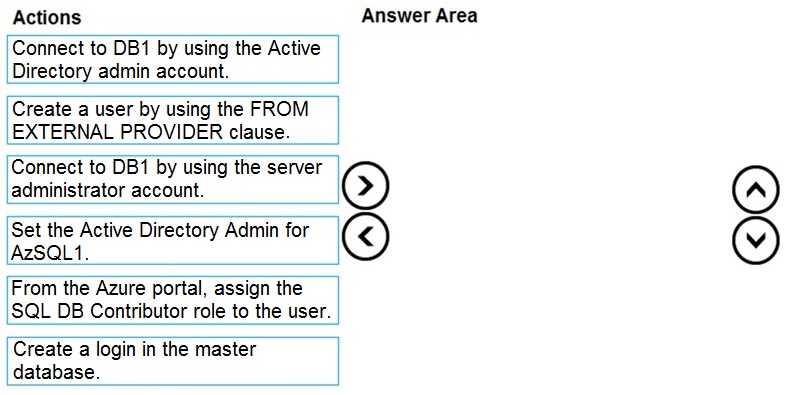
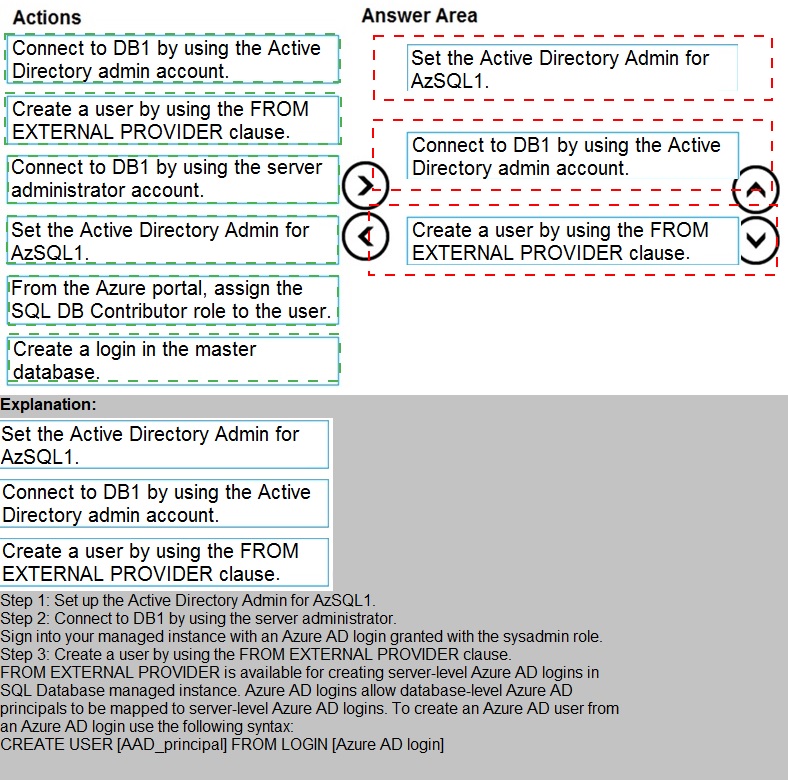
You have a new Azure SQL database named DB1 on an Azure SQL server named AzSQL1. The only user who was created is the server administrator. You need to create a contained database user in DB1 who will use Azure Active Directory(Azure AD) for authentication. Which three actions should you perform in sequence? To answer, move the appropriate actions from the list of actions to the answer area and arrange them in the correct order
Show answerHide answer
Explanation
Question 42Choose 1
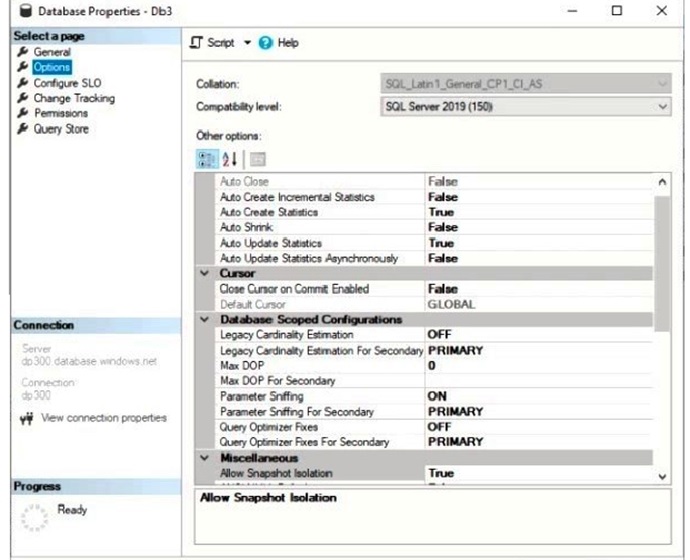
You have an Azure SQL database named DB3. You need to provide a user named DevUser with the ability to view the properties of DB3 from Microsoft SQL Server Management Studio (SSMS) as shown in the exhibit. (Click the Exhibit tab.) Which Transact-SQL command should you run?
Show answerHide answer
Correct answer: CGRANT VIEW DATABASE STATE TO DevUser
Explanation
Explanation:
The exhibits displays Database [State] properties.
To query a dynamic management view or function requires SELECT permission on object
and VIEW SERVER STATE or VIEW DATABASE STATE permission.
You have a new Azure SQL database. The database contains a column that stores
confidential information.
You need to track each time values from the column are returned in a query. The tracking
information must be
stored for 365 days from the date the query was executed.
Which three actions should you perform? Each correct answer presents part of the
solution.
NOTE: Each correct selection is worth one point.
Show answerHide answer
Correct answer: A, C, DTurn on auditing and write audit logs to an Azure Storage account.
Turn on Advanced Data Security for the Azure SQL server.
Apply sensitivity labels named Highly Confidential to the column.
Explanation
Explanation:
C: Advanced Data Security (ADS) is a unified package for advanced SQL security capabilities. ADS is available for Azure SQL Database, Azure SQL Managed Instance, and Azure Synapse Analytics. It includes functionality for discovering and classifying sensitive data D: You can apply sensitivity-classification labels persistently to columns by using new metadata attributes that have been added to the SQL Server database engine. This metadata can then be used for advanced, sensitivity-based auditing and protection scenarios. A: An important aspect of the information-protection paradigm is the ability to monitor access to sensitive data. Azure SQL Auditing has been enhanced to include a new field in the audit log called data_sensitivity_information. This field logs the sensitivity classifications (labels) of the data that was returned by a query. Here's an example:
Question 44Choose 1
You need to recommend an availability strategy for an Azure SQL database. The strategy
must meet the
following requirements:
Support failovers that do not require client applications to change their connection
strings.
Replicate the database to a secondary Azure region.
Support failover to the secondary region.
What should you include in the recommendation?
Show answerHide answer
Correct answer: Dgeo-replication
Explanation
Explanation:
Active geo-replication is an Azure SQL Database feature that allows you to create readable
secondary databases of individual databases on a server in the same or different data
center (region).
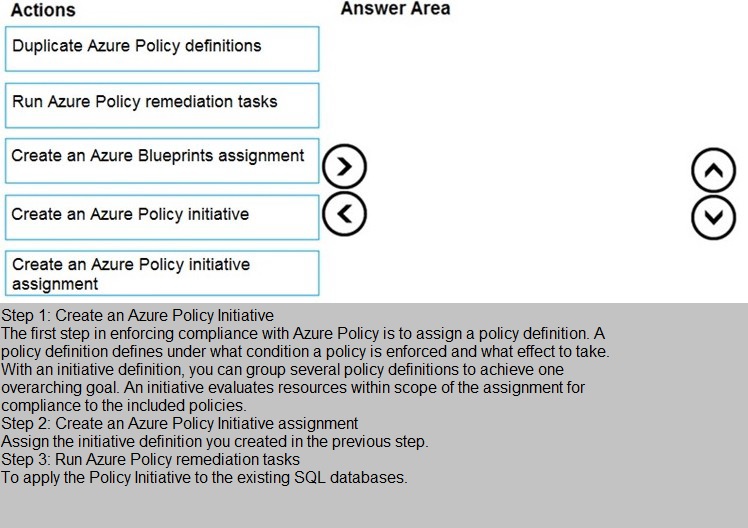
You need to apply 20 built-in Azure Policy definitions to all new and existing Azure SQL Database deployments in an Azure subscription. The solution must minimize administrative effort. Which three actions should you perform in sequence? To answer, move the appropriate actions from the list of actions to the answer area and arrange them in the correct order.
Show answerHide answer
Explanation
Question 46Choose 1
You deploy a database to an Azure SQL Database managed instance.
D18912E1457D5D1DDCBD40AB3BF70D5D
You need to prevent read queries from blocking queries that are trying to write to the
database.
Which database option should set?
Show answerHide answer
Correct answer: DREAD_COMMITTED_SNAPSHOT to ON
Explanation
Explanation:
In SQL Server, you can also minimize locking contention while protecting transactions from
dirty reads of uncommitted data modifications using either:
The READ COMMITTED isolation level with theREAD_COMMITTED_SNAPSHOT database option set to ON.
The SNAPSHOT isolation level.
If READ_COMMITTED_SNAPSHOT is set to ON (the default on SQL Azure Database),
the Database Engine uses row versioning to present each statement with a transactionally
consistent snapshot of the data as it existed at the start of the statement. Locks are not
used to protect the data from updates by other transactions.
You have 40 Azure SQL databases, each for a different customer. All the databases reside
on the same Azure SQL Database server.
You need to ensure that each customer can only connect to and access their respective
database.
Which two actions should you perform? Each correct answer presents part of the solution.
NOTE: Each correct selection is worth one point.
Show answerHide answer
Correct answer: B, CCreate users in each database.
Configure the database firewall.
Explanation
Explanation:
Manage database access by adding users to the database, or allowing user access with
secure connection strings.
Database-level firewall rules only apply to individual databases
You have 10 Azure virtual machines that have SQL Server installed.
You need to implement a backup strategy to ensure that you can restore specific
databases to other SQL
Server instances. The solution must provide centralized management of the backups.
What should you include in the backup strategy?
Show answerHide answer
Correct answer: BAzure Backup
Explanation
Explanation:
Azure Backup provides an Enterprise class backup capability for SQL Server on Azure
VMs. All backups are stored and managed in a Recovery Services vault. There are several
advantages that this solution provides, especially for Enterprises.
You have an Azure SQL database that contains a table named factSales. FactSales contains the columns shown in the following table. FactSales has 6 billion rows and is loaded nightly by using a batch process. Which type of compression provides the greatest space reduction for the database?
Show answerHide answer
Correct answer: Dcolumnstore archival compression
Explanation
Explanation:
Columnstore tables and indexes are always stored with columnstore compression. You can
further reduce the size of columnstore data by configuring an additional compression called
archival compression.
Note: Columnstore — The columnstore index is also logically organized as a table with
rows and columns, but the data is physically stored in a column-wise data format.
Note: This question is part of a series of questions that present the same scenario.
Each question in the series contains a unique solution that might meet the stated
goals. Some question sets might have more than one correct solution, while others
might not have a correct solution.
After you answer a question in this section, you will NOT be able to return to it. As a
result, these questions will not appear in the review screen.
You have two Azure SQL Database servers named Server1 and Server2. Each server
contains an Azure SQL database named Database1.
You need to restore Database1 from Server1 to Server2. The solution must replace the
existing Database1 on Server2.
Solution: From Microsoft SQL Server Management Studio (SSMS), you rename Database1
on Server2 as Database2. From the Azure portal, you create a new database on Server2
by restoring the backup of Database1 from Server1, and then you delete Database2.
Does this meet the goal?
Show answerHide answer
Correct answer: BNo
Full mock exam
Sit the DP-300 exam before exam day
Full-length mocks with the same number of questions and the same time limit as the real DP-300 exam. Every attempt draws a new set of questions from the full bank, so you can keep going until you pass comfortably.
 Which Transact-SQL command should you run?