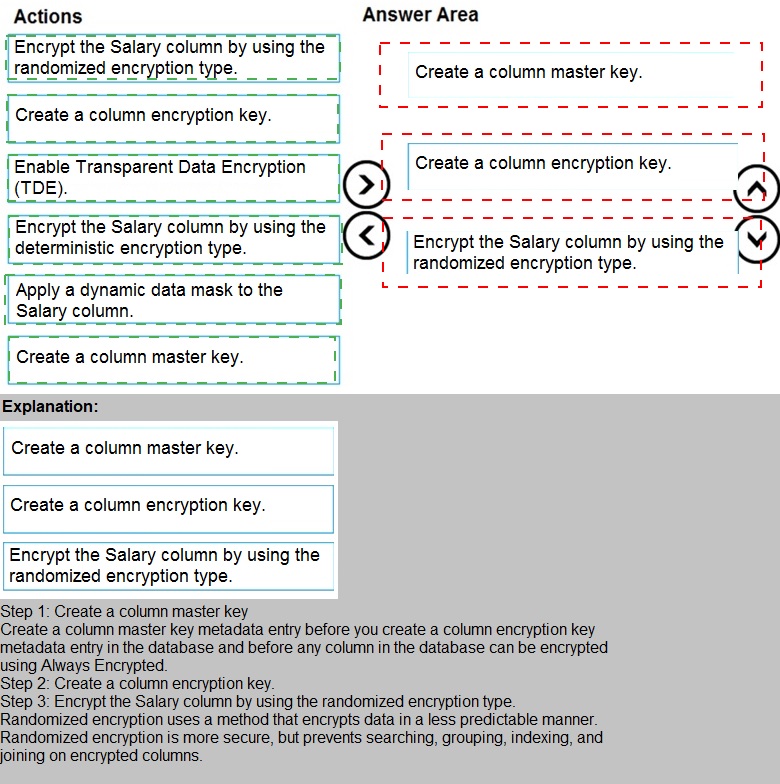
You have an Azure SQL database that contains a table named Employees. Employees contains a column named Salary. You need to encrypt the Salary column. The solution must prevent database administrators from reading the data in the Salary column and must provide the most secure encryption. Which three actions should you perform in sequence? To answer, move the appropriate actions from the list of actions to the answer area and arrange them in the correct order.
Show answerHide answer
Explanation
Question 32
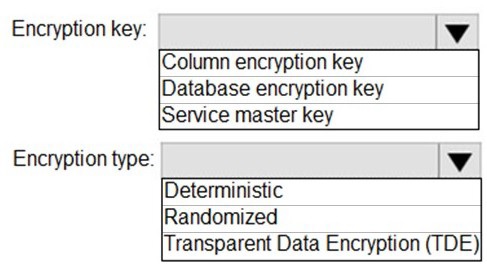
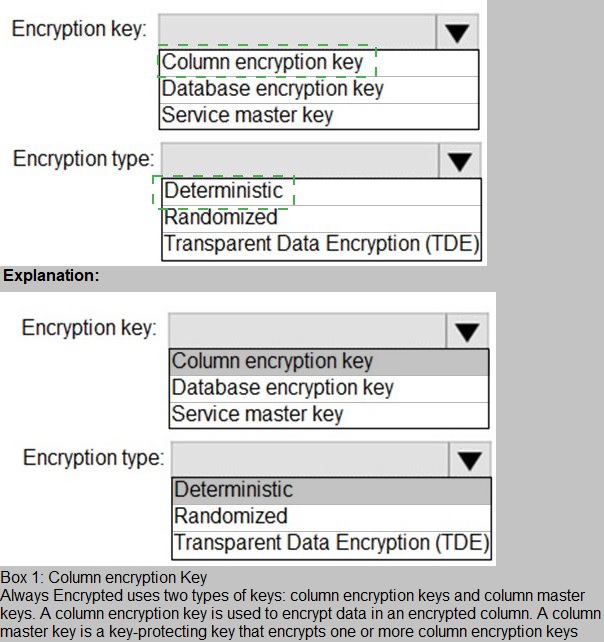
You have an Azure SQL database named DB1 that contains two tables named Table1 and Table2. Both tables contain a column named a Column1. Column1 is used for joins by an application named App1. You need to protect the contents of Column1 at rest, in transit, and in use. How should you protect the contents of Column1? To answer, select the appropriate options in the answer area. NOTE: Each correct selection is worth one point
Show answerHide answer
Explanation
Question 33Choose 3
You have 20 Azure SQL databases provisioned by using the vCore purchasing model. You plan to create an Azure SQL Database elastic pool and add the 20 databases. Which three metrics should you use to size the elastic pool to meet the demands of your workload? Each correct answer presents part of the solution. NOTE: Each correct selection is worth one point.
Show answerHide answer
Correct answer: A, C, Etotal size of all the databases
number of concurrently peaking databases * peak CPU utilization per database
total number of databases * average CPU utilization per database
Explanation
Explanation:
CE: Estimate the vCores needed for the pool as follows:
For vCore-based purchasing model: MAX(utilization per DB>, A: Estimate the storage space needed for the pool by adding the number of bytes needed
for all the databases in the pool.
You have an Azure SQL database. The database contains a table that uses a columnstore index and is accessed infrequently. You enable columnstore archival compression. What are two possible results of the configuration? Each correct answer presents acomplete solution. NOTE: Each correct selection is worth one point.
Show answerHide answer
Correct answer: B, EQueries that use the index will retrieve fewer data pages.
Queries that use the index will consume more CPU resources.
Explanation
Explanation:
For rowstore tables and indexes, use the data compression feature to help reduce the size of the database. In addition to saving space, data compression can help improve performance of I/O intensive workloads because the data is stored in fewer pages and queries need to read fewer pages from disk. Use columnstore archival compression to further reduce the data size for situations when you can afford extra time and CPU resources to store and retrieve the data.
Question 35Choose 2
You have SQL Server on an Azure virtual machine that contains a database named DB1. You have an application that queries DB1 to generate a sales report. You need to see the parameter values from the last time the query was executed. Which two actions should you perform? Each correct answer presents part of the solution. NOTE: Each correct selection is worth one point.
Show answerHide answer
Correct answer: A, CEnable Last_Query_Plan_Stats in the master database
Enable Last_Query_Plan_Stats in DB1
Question 36Choose 1
You have an on-premises app named App1 that stores data in an on-premises Microsoft
SQL Server 2016 database named DB1.
You plan to deploy additional instances of App1 to separate Azure regions. Each region will
have a separate instance of App1 and DB1. The separate instances of DB1 will sync by
using Azure SQL Data Sync.
You need to recommend a database service for the deployment. The solution must
minimize administrative effort.
What should you include in the recommendation?
Show answerHide answer
Correct answer: BAzure SQL Database single database
Question 37Choose 1
You have an Azure SQL database named DB1.
You need to ensure that DB1 will support automatic failover without data loss if a
datacenter fails. The solution must minimize costs.
Which deployment option and pricing tier should you configure?
Show answerHide answer
Correct answer: AAzure SQL Database Premium
Explanation
Explanation:
By default, the cluster of nodes for the premium availability model is created in the same
datacenter. With the introduction of Azure Availability Zones, SQL Database can place
different replicas of the Business Critical database to different availability zones in the
same region. To eliminate a single point of failure, the control ring is also duplicated across
multiple zones as three gateway rings (GW). The routing to a specific gateway ring is
controlled by Azure Traffic Manager (ATM). Because the zone redundant configuration in
the Premium or Business Critical service tiers does not create additional database
redundancy, you can enable it at no extra cost. By selecting a zone redundant
configuration, you can make your Premium or Business Critical databases resilient to a
much larger set of failures, including catastrophic datacenter outages, without any changes
to the application logic. You can also convert any existing Premium or Business Critical
databases or pools to the zone redundant configuration.
You have an Azure SQL database named DB1. You run a query while connected to DB1.
You review the actual execution plan for the query, and you add an index to a table
referenced by the query.
You need to compare the previous actual execution plan for the query to the Live Query
Statistics.
What should you do first in Microsoft SQL Server Management Studio (SSMS)?
Show answerHide answer
Correct answer: CSave the actual execution plan.
Explanation
Explanation:
The Plan Comparison menu option allows side-by-side comparison of two different
execution plans, for easier identification of similarities and changes that explain the
different behaviors for all the reasons stated above. This option can compare between:
Two previously saved execution plan files (.sqlplan extension).
One active execution plan and one previously saved query execution plan.
Two selected query plans in Query Store
Question 39Choose 2
You receive numerous alerts from Azure Monitor for an Azure SQL database.
You need to reduce the number of alerts. You must only receive alerts if there is a
significant change in usage patterns for an extended periodWhich two actions should you perform? Each correct answer presents part of the solution.
NOTE: Each correct selection is worth one point.
Show answerHide answer
Correct answer: B, DSet the Alert logic threshold to Dynamic
Set Threshold Sensitivity to Low
Question 40Choose 1
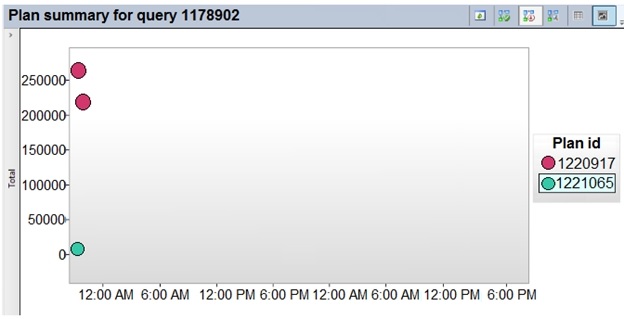
You have SQL Server on an Azure virtual machine that contains a database named DB1. You view a plan summary that shows the duration in milliseconds of each execution of query 1178902 as shown in the following exhibit: What should you do to ensure that the query uses the execution plan which executes in the least amount of time?
Show answerHide answer
Correct answer: CForce the query execution plan for plan 1220917.
Full mock exam
Sit the DP-300 exam before exam day
Full-length mocks with the same number of questions and the same time limit as the real DP-300 exam. Every attempt draws a new set of questions from the full bank, so you can keep going until you pass comfortably.