Note: This question is part of a series of questions that present the same scenario. Each question in the series contains a unique solution that might meet the stated goals. Some question sets might have more than one correct solution, while others might not have a correct solution. After you answer a question in this section, you will NOT be able to return to it. As a result, these questions will not appear in the review screen. You have an Azure SQL database named Sales. You need to implement disaster recovery for Sales to meet the following requirements: During normal operations, provide at least two readable copies of Sales. Ensure that Sales remains available if a datacenter fails. Solution: You deploy an Azure SQL database that uses the General Purpose service tier and failover groups. Does this meet the goal?
Show answerHide answer
Correct answer: BNo
Explanation
Explanation: Instead deploy an Azure SQL database that uses the Business Critical service tier and Availability Zones. Note: Premium and Business Critical service tiers leverage the Premium availability model, which integrates compute resources (sqlservr.exe process) and storage (locally attached SSD) on a single node. High availability is achieved by replicating both compute and storage to additional nodes creating a three to four-node cluster. By default, the cluster of nodes for the premium availability model is created in the same datacenter. With the introduction of Azure Availability Zones, SQL Database can place different replicas of the Business Critical database to different availability zones in the same region. To eliminate a single point of failure, the control ring is also duplicated across multiple zones as three gateway rings (GW). Reference: https://docs.microsoft.com/en-us/azure/azure-sql/database/high-availability-sla
Question 22Choose 1
You have an Azure SQL Database server named sqlsrv1 that hosts 10 Azure SQL databases. The databases perform slower than expected. You need to identify whether the performance issue relates to the use of tempdb on sqlsrv1. What should you do?
The diagnostics log outputs tempDB contention details. You can use the information as the
starting point for troubleshooting.
You can use the Intelligent Insights performance diagnostics log of Azure SQL Database to
troubleshoot performance issues.
Note: This question is part of a series of questions that present the same scenario. Each question in the series contains a unique solution that might meet the stated goals. Some question sets might have more than one correct solution, while others might not have a correct solution. After you answer a question in this section, you will NOT be able to return to it. As a result, these questions will not appear in the review screen. You have two Azure SQL Database servers named Server1 and Server2. Each server contains an Azure SQL database named Database1. You need to restore Database1 from Server1 to Server2. The solution must replace the existing Database1 on Server2. Solution: From the Azure portal, you delete Database1 from Server2, and then you create a new database on Server2 by using the backup of Database1 from Server1. Does this meet the goal?
Show answerHide answer
Correct answer: BNo
Explanation
Explanation:
Instead restore Database1 from Server1 to the Server2 by using the RESTORE Transact-
SQL command and the REPLACE option.
Note: REPLACE should be used rarely and only after careful consideration. Restore
normally prevents accidentally overwriting a database with a different database. If the
database specified in a RESTORE statement already exists on the current server and the
specified database family GUID differs from the database family GUID recorded in the
backup set, the database is not restored. This is an important safeguard.
You have an Azure SQL database. Users report that the executions of a stored procedure are slower than usual. You suspect that a regressed query is causing the performance issue. You need to view the query execution plan to verify whether a regressed query is causing the issue. The solution must minimize effort. What should you use?
Show answerHide answer
Correct answer: CQuery Store in Microsoft SQL Server Management Studio (SSMS)
Explanation
Explanation: Use the Query Store Page in SQL Server Management Studio. Query performance regressions caused by execution plan changes can be non-trivial and time consuming to resolve. Since the Query Store retains multiple execution plans per query, it can enforce policies to direct the Query Processor to use a specific execution plan for a query. This is referred to as plan forcing. Plan forcing in Query Store is provided by using a mechanism similar to the USE PLAN query hint, but it does not require any change in user applications. Plan forcing can resolve a query performance regression caused by a plan change in a very short period of time. Reference: https://docs.microsoft.com/en-us/sql/relational-databases/performance/monitoringperformance- by-using-the-query-store
Question 25
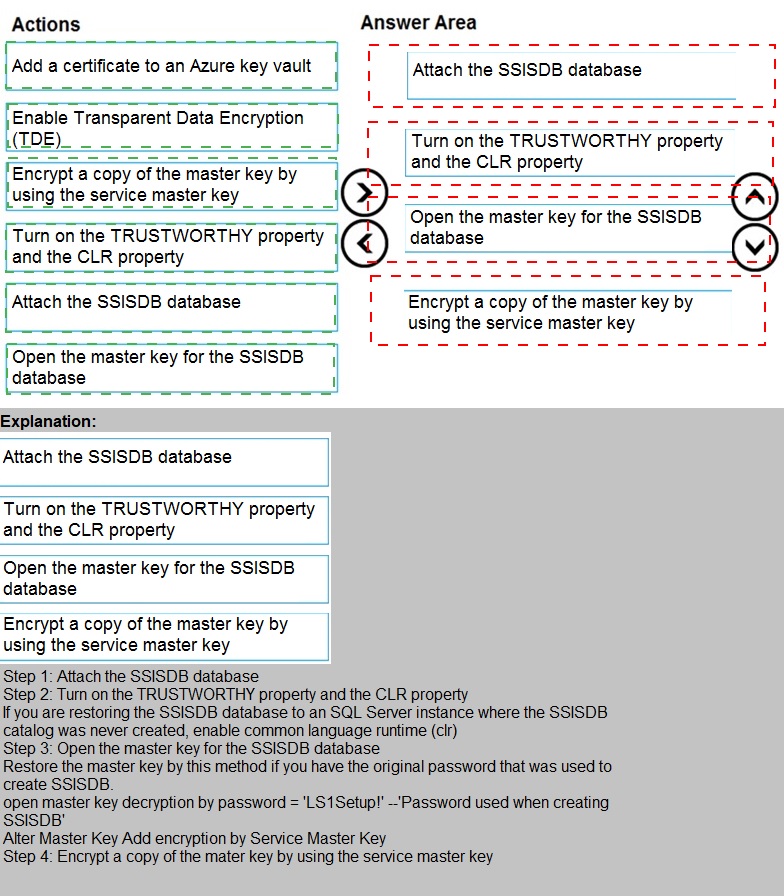
You have SQL Server 2019 on an Azure virtual machine that contains an SSISDB database. A recent failure causes the master database to be lost. You discover that all Microsoft SQL Server integration Services (SSIS) packages fail to run on the virtual machine. Which four actions should you perform in sequence to resolve the issue? To answer, move the appropriate actions from the list of actions to the answer area and arrange them in the correct.
Show answerHide answer
Explanation
Question 26
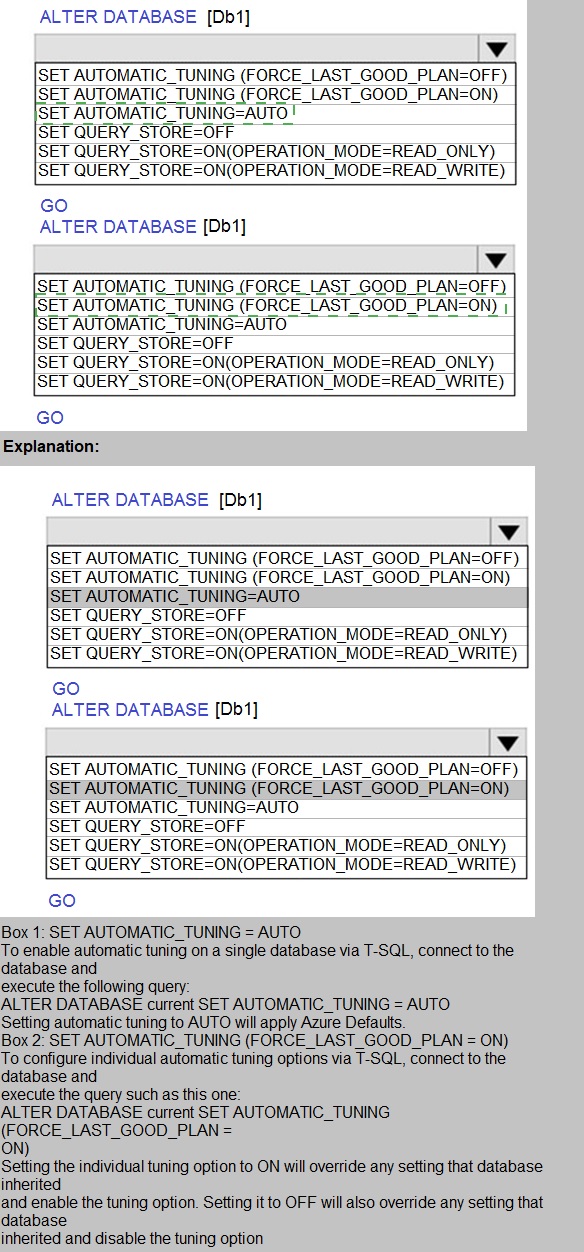
You have SQL Server on an Azure virtual machine that contains a database named Db1. You need to enable automatic tuning for Db1. How should you complete the statements? To answer, select the appropriate answer in the answer area. NOTE: Each correct selection is worth one point.
Show answerHide answer
Explanation
Question 27Choose 1
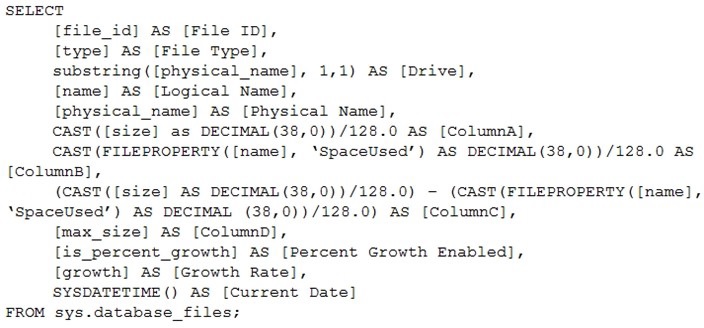
You have the following Transact-SQL query Which column returned by the query represents the free space in each file?
Show answerHide answer
Correct answer: CColumnC
Explanation
Explanation: Example: Free space for the file in the below query result set will be returned by the FreeSpaceMB column. SELECT DB_NAME() AS DbName, name AS FileName, type_desc, size/128.0 AS CurrentSizeMB, size/128.0 - CAST(FILEPROPERTY(name, 'SpaceUsed') AS INT)/128.0 AS FreeSpaceMB FROM sys.database_files WHERE type IN (0,1); Reference: https://www.sqlshack.com/how-to-determine-free-space-and-file-size-for-sql-serverdatabases/ You have an Azure SQL database. You identify a long running query. You need to identify which operation in the query is causing the performance issue. What should
Question 28Choose 1
You have an Azure SQL database.
You identify a long running query.
You need to identify which operation in the query is causing the performance issue.
What should you use to display the query execution plan in Microsoft SQL Server
Management Studio (SSMS)?
Show answerHide answer
Correct answer: Can actual execution plan
Explanation
Explanation: To include an execution plan for a query during execution 1. On the SQL Server Management Studio toolbar, click Database Engine Query. You can also open an existing query and display the estimated execution plan by clicking the Open File toolbar button and locating the existing query. 2. Enter the query for which you would like to display the actual execution plan. 3. On the Query menu, click Include Actual Execution Plan or click the Include Actual Execution Plan toolbar button. Note: Actual execution plans are generated after the Transact-SQL queries or batches execute. Because of this, an actual execution plan contains runtime information, such as actual resource usage metrics and runtime warnings (if any). The execution plan that is generated displays the actual query execution plan that the SQL Server Database Engine used to execute the queries. Reference: https://docs.microsoft.com/en-us/sql/relational-databases/performance/display-an-actualexecution-plan
Question 29Choose 1
You plan to move two 100-GB databases to Azure.You need to dynamically scale resources consumption based on workloads. The solution must minimize downtime during scaling operations. What should you use?
Show answerHide answer
Correct answer: Atwo Azure SQL Databases in an elastic pool
Explanation
Explanation: Azure SQL Database elastic pools are a simple, cost-effective solution for managing and scaling multiple databases that have varying and unpredictable usage demands. The databases in an elastic pool are on a single server and share a set number of resources at a set price. Reference: https://docs.microsoft.com/en-us/azure/azure-sql/database/elastic-pool-overview
Question 30Choose 1
You have an Azure virtual machine named VM1 on a virtual network named VNet1. Outbound traffic from VM1 to the internet is blocked. You have an Azure SQL database named SqlDb1 on a logical server named SqlSrv1. You need to implement connectivity between VM1 and SqlDb1 to meet the following requirements: Ensure that all traffic to the public endpoint of SqlSrv1 is blocked. Minimize the possibility of VM1 exfiltrating data stored in SqlDb1. D18912E1457D5D1DDCBD40AB3BF70D5D What should you create on VNet1?
Show answerHide answer
Correct answer: Ca private link
Explanation
Explanation:
Azure Private Link enables you to access Azure PaaS Services (for example, Azure Storage and SQL Database) and Azure hosted customer-owned/partner services over a private endpoint in your virtual network. Traffic between your virtual network and the service travels the Microsoft backbone network. Exposing your service to the public internet is no longer necessary. Reference: https://docs.microsoft.com/en-us/azure/private-link/private-link-overview
Full mock exam
Sit the DP-300 exam before exam day
Full-length mocks with the same number of questions and the same time limit as the real DP-300 exam. Every attempt draws a new set of questions from the full bank, so you can keep going until you pass comfortably.