Microsoft certification · Exam DP-300

DP-300 Mock Exam Page 4

Administering Relational Databases on Microsoft Azure

Free DP-300 mock exam questions 31–40, each with the answer and an explanation.

20 questions · 33 minutes · free, no sign-up

Free DP-300 questions

31–40 of 97 free
Question 31
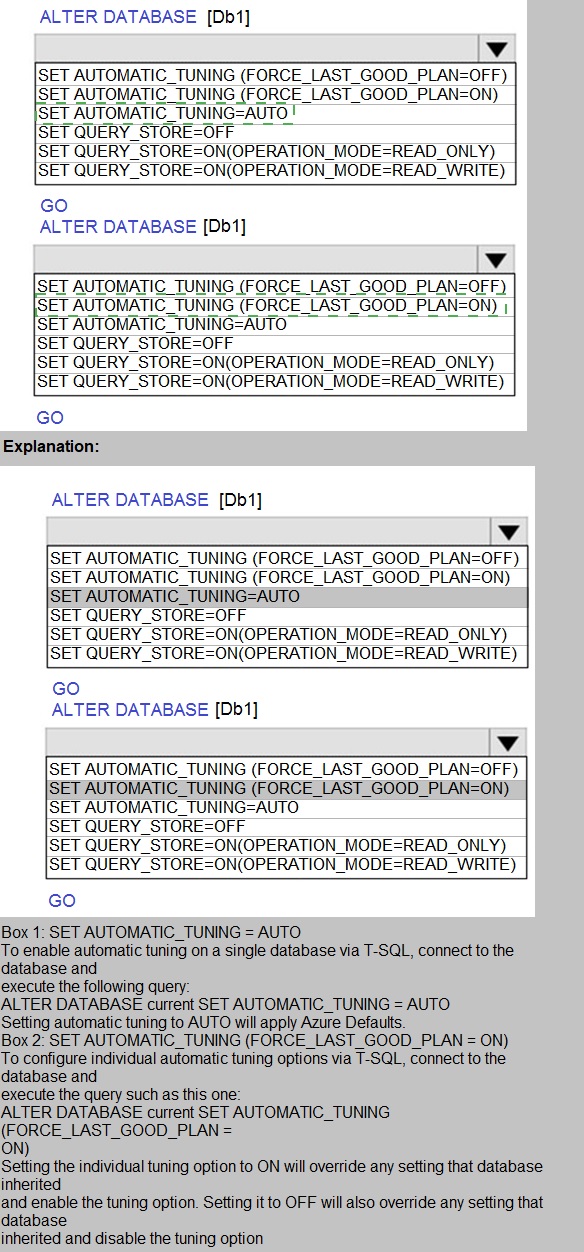
You have SQL Server on an Azure virtual machine that contains a database named Db1.
You need to enable automatic tuning for Db1.
How should you complete the statements? To answer, select the appropriate answer in the
answer area.
NOTE: Each correct selection is worth one point.
Show answerHide answer

Explanation
Question 32 Choose 1
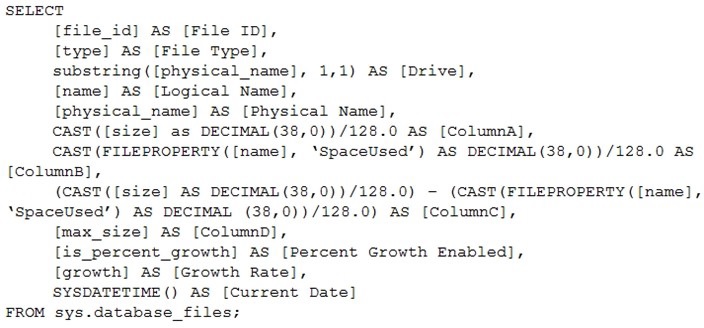
You have the following Transact-SQL query

Which column returned by the query represents the free space in each file?
Show answerHide answer

Correct answer: C ColumnC

Explanation

Explanation:
Example:
Free space for the file in the below query result set will be returned by the FreeSpaceMB
column.
SELECT DB_NAME() AS DbName,
name AS FileName,
type_desc,
size/128.0 AS CurrentSizeMB,
size/128.0 - CAST(FILEPROPERTY(name, 'SpaceUsed') AS INT)/128.0 AS FreeSpaceMB
FROM sys.database_files
WHERE type IN (0,1);
Reference:
https://www.sqlshack.com/how-to-determine-free-space-and-file-size-for-sql-serverdatabases/
You have an Azure SQL database.
You identify a long running query.
You need to identify which operation in the query is causing the performance issue.
What should

Question 33 Choose 1
You have an Azure SQL database.
You identify a long running query.
You need to identify which operation in the query is causing the performance issue.
What should you use to display the query execution plan in Microsoft SQL Server Management Studio (SSMS)?
Show answerHide answer

Correct answer: C an actual execution plan

Explanation

Explanation:
To include an execution plan for a query during execution
1. On the SQL Server Management Studio toolbar, click Database Engine Query. You can
also open an existing query and display the estimated execution plan by clicking the Open
File toolbar button and locating the existing query.
2. Enter the query for which you would like to display the actual execution plan.
3. On the Query menu, click Include Actual Execution Plan or click the Include Actual
Execution Plan toolbar button.

Note: Actual execution plans are generated after the Transact-SQL queries or batches
execute. Because of this, an actual execution plan contains runtime information, such as
actual resource usage metrics and runtime warnings (if any). The execution plan that is
generated displays the actual query execution plan that the SQL Server Database Engine
used to execute the queries.
Reference:
https://docs.microsoft.com/en-us/sql/relational-databases/performance/display-an-actualexecution-plan
Question 34 Choose 1
You plan to move two 100-GB databases to Azure.You need to dynamically scale resources consumption based on workloads. The solution
must minimize downtime during scaling operations.
What should you use?
Show answerHide answer

Correct answer: A two Azure SQL Databases in an elastic pool

Explanation

Explanation:
Azure SQL Database elastic pools are a simple, cost-effective solution for managing and
scaling multiple databases that have varying and unpredictable usage demands. The
databases in an elastic pool are on a single server and share a set number of resources at
a set price.
Reference:
https://docs.microsoft.com/en-us/azure/azure-sql/database/elastic-pool-overview
Question 35 Choose 1
You have an Azure virtual machine named VM1 on a virtual network named VNet1.
Outbound traffic from VM1 to the internet is blocked.
You have an Azure SQL database named SqlDb1 on a logical server named SqlSrv1.
You need to implement connectivity between VM1 and SqlDb1 to meet the following
requirements:
Ensure that all traffic to the public endpoint of SqlSrv1 is blocked.
Minimize the possibility of VM1 exfiltrating data stored in SqlDb1.
D18912E1457D5D1DDCBD40AB3BF70D5D
What should you create on VNet1?
Show answerHide answer

Correct answer: C a private link

Explanation

Explanation:

Azure Private Link enables you to access Azure PaaS Services (for example, Azure
Storage and SQL Database) and Azure hosted customer-owned/partner services over a
private endpoint in your virtual network.
Traffic between your virtual network and the service travels the Microsoft backbone
network. Exposing your service to the public internet is no longer necessary.
Reference:
https://docs.microsoft.com/en-us/azure/private-link/private-link-overview
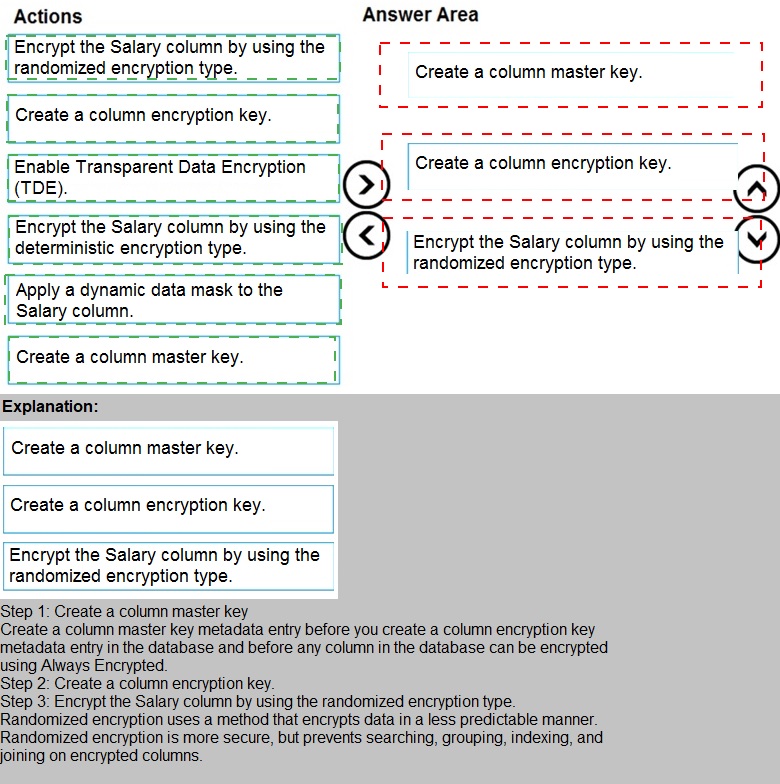
Question 36

You have an Azure SQL database that contains a table named Employees. Employees
contains a column named Salary.
You need to encrypt the Salary column. The solution must prevent database administrators
from reading the data in the Salary column and must provide the most secure encryption.
Which three actions should you perform in sequence? To answer, move the appropriate
actions from the list of actions to the answer area and arrange them in the correct order.

Show answerHide answer

Explanation

Question 37

You have an Azure SQL database named DB1 that contains two tables named Table1 and
Table2. Both tables contain a column named a Column1. Column1 is used for joins by an
application named App1.
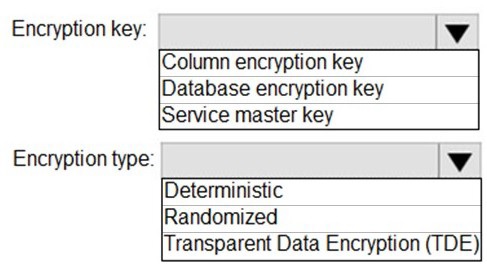
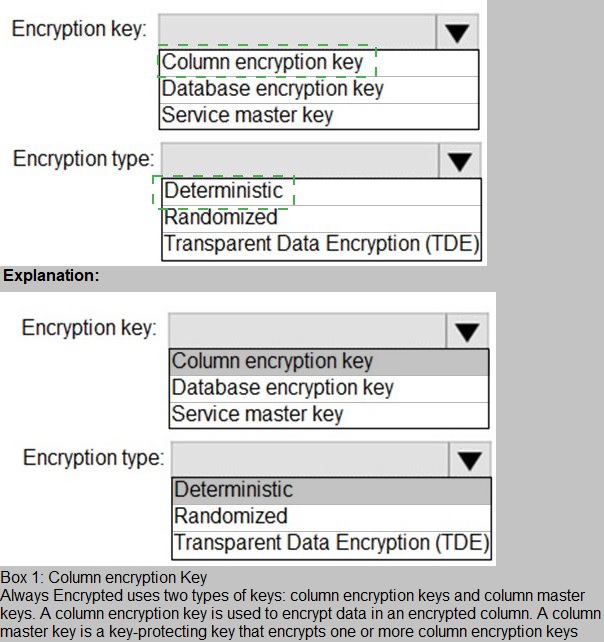
You need to protect the contents of Column1 at rest, in transit, and in use.
How should you protect the contents of Column1? To answer, select the appropriate
options in the answer area.
NOTE: Each correct selection is worth one point

Show answerHide answer

Explanation
Question 38 Choose 3
You have 20 Azure SQL databases provisioned by using the vCore purchasing model.
You plan to create an Azure SQL Database elastic pool and add the 20 databases.
Which three metrics should you use to size the elastic pool to meet the demands of your
workload? Each correct answer presents part of the solution.
NOTE: Each correct selection is worth one point.
Show answerHide answer

Correct answer: A, C, E total size of all the databases number of concurrently peaking databases * peak CPU utilization per database total number of databases * average CPU utilization per database

Explanation

Explanation:

CE: Estimate the vCores needed for the pool as follows:
For vCore-based purchasing model: MAX(utilization per DB>, A: Estimate the storage space needed for the pool by adding the number of bytes needed for all the databases in the pool.

Reference:
https://docs.microsoft.com/en-us/azure/azure-sql/database/elastic-pool-overview
Question 39 Choose 2
You have an Azure SQL database. The database contains a table that uses a columnstore
index and is accessed infrequently.
You enable columnstore archival compression.
What are two possible results of the configuration? Each correct answer presents acomplete solution.
NOTE: Each correct selection is worth one point.
Show answerHide answer

Correct answer: B, E Queries that use the index will retrieve fewer data pages. Queries that use the index will consume more CPU resources.

Explanation

Explanation:

For rowstore tables and indexes, use the data compression feature to help reduce the size
of the database. In addition to saving space, data compression can help improve
performance of I/O intensive workloads because the data is stored in fewer pages and
queries need to read fewer pages from disk.
Use columnstore archival compression to further reduce the data size for situations when
you can afford extra time and CPU resources to store and retrieve the data.
Question 40 Choose 2
You have SQL Server on an Azure virtual machine that contains a database named DB1.
You have an application that queries DB1 to generate a sales report.
You need to see the parameter values from the last time the query was executed.
Which two actions should you perform? Each correct answer presents part of the solution.
NOTE: Each correct selection is worth one point.
Show answerHide answer

Correct answer: A, C Enable Last_Query_Plan_Stats in the master database Enable Last_Query_Plan_Stats in DB1

Full mock exam

Sit the DP-300 exam before exam day

Full-length mocks with the same number of questions and the same time limit as the real DP-300 exam. Every attempt draws a new set of questions from the full bank, so you can keep going until you pass comfortably.

Get full DP-300 mock exam
  • 65questions per mock
  • 105 mintime limit
  • 334questions in the bank
  • Newmock on every attempt