Cisco certification · Exam 350-701

350-701 Mock Exam Page 21

Implementing and Operating Cisco Security Core Technologies (SCOR 350-701)

Free 350-701 mock exam questions 201–210, each with the answer and an explanation.

20 questions · 27 minutes · free, no sign-up

Free 350-701 questions

201–210 of 215 free
Question 201 Choose 1
What is the difference between a vulnerability and an exploit?
Show answerHide answer

Correct answer: B A vulnerability is a weakness that can be exploited by an attacker

Explanation

Explanation:
This question tests your understanding of fundamental cybersecurity terminology. The terms "vulnerability" and "exploit" are often used together but have distinct and specific meanings.

Let's break down the correct definitions and why the other options are incorrect:

Why Option B is Correct:
This option provides the precise and standard definition of the relationship.

Vulnerability:
This is a weakness, flaw, or bug in a system, software, process, or human factor that could potentially be used to compromise security. Examples include a software bug that allows for a buffer overflow, a misconfigured firewall rule, or a lack of employee security training.

Exploit:
This is the specific tool, technique, or code that an attacker uses to take advantage of a vulnerability. It is the method of attack. For example, a piece of malware written specifically to trigger that buffer overflow bug is the exploit.

In simple terms:
The vulnerability is the unlocked door. The exploit is the act of turning the handle and walking through it.

Why the Other Options are Incorrect:

Why Option A is Incorrect:
This statement is backwards. A vulnerability is a real, existing weakness, not a "hypothetical event." The exploit is the action taken based on that real weakness.

Why Option C is Incorrect:
This reverses the cause-and-effect relationship. An exploit does not cause a vulnerability. An exploit leverages or takes advantage of a vulnerability that already exists.

Why Option D is Incorrect:
This is also incorrect because it gets the definitions backwards and misrepresents the nature of an exploit. An exploit is a real attack method, not a "hypothetical event," and it targets a vulnerability; it does not create one.

Reference:
This is a core concept within the Security Concepts domain. Understanding the distinction between a vulnerability (the weakness), a threat (the potential for someone to cause harm), and an exploit (the method used) is foundational to all security risk management and is critical for the 350-701 SCOR exam.

Question 202 Choose 1
An engineer adds a custom detection policy to a Cisco AMP deployment and encounters issues with the configuration. The simple detection mechanism is configured, but the dashboard indicates that the hash is not 64 characters and is non-zero. What is the issue?
Show answerHide answer

Correct answer: A The engineer is attempting to upload a hash created using MD5 instead of SHA-256

Explanation

Explanation for Each Option:

A. The engineer is attempting to upload a hash created using MD5 instead of SHA-256 (Correct):
Cisco AMP’s simple detection mechanism requires hashes in SHA-256 format, which produces a 64-character hexadecimal string. MD5 generates a 32-character hash, and a non-zero length mismatch (e.g., 32 characters instead of 64) triggers the error. This indicates the use of an incompatible hash type, aligning with the issue. (Reference: Cisco AMP Custom Detection Guide, Hash Requirements.)

B. The file being uploaded is incompatible with simple detections and must use advanced detections (Incorrect):
Simple detection in Cisco AMP supports uploading hashes (e.g., SHA-256) for file identification, not entire files. The error specifies a hash length issue, not file incompatibility, and advanced detection is for more complex rules, not a requirement here, making this option incorrect. (Reference: Cisco AMP Simple vs. Advanced Detection.)

C. The hash being uploaded is part of a set in an incorrect format (Incorrect):
The error mentions a single hash not being 64 characters, not a set of hashes. While a set could have format issues, the problem is specific to the hash length, suggesting an MD5 hash rather than a formatting error, rendering this option incorrect. (Reference: Cisco AMP Bulk Hash Upload Guide.)

D. The engineer is attempting to upload a file instead of a hash (Incorrect):
The dashboard indicates a hash length issue (not 64 characters), implying a hash was uploaded, not a file. AMP’s simple detection expects a hash, and the error suggests a length mismatch (e.g., MD5), not a file upload, making this option incorrect. (Reference: Cisco AMP Detection Policy Configuration.)

Additional Notes:
Configuring custom detection policies in Cisco AMP is a key topic in the 350-701 SCOR exam under endpoint security. As of 4:19 PM PKT, October 03, 2025, SHA-256 is the required hash standard.
Question 203 Choose 1

Refer to the exhibit.

An engineer is implementing a certificate based VPN. What is the result of the existing
configuration?

Show answerHide answer

Correct answer: A

The OU of the IKEv2 peer certificate is used as the identity when matching an IKEv2
authorization policy.

Question 204 Choose 1
Which feature is leveraged by advanced antimalware capabilities to be an effective endpomt protection platform?
Show answerHide answer

Correct answer: C sandboxing

Explanation

Explanation
Modern advanced antimalware capabilities, such as those in Cisco Advanced Malware Protection (AMP) for Endpoints, rely heavily on sandboxing to be an effective Endpoint Protection Platform (EPP).

A sandbox is a secure, isolated virtual environment where suspicious files can be executed and their behavior can be analyzed without risking the host system. This is crucial for detecting sophisticated, evasive malware that signature-based detection and simple blocklists would miss.

Here's how it works as part of an advanced EPP:
A file with an unknown reputation arrives on the endpoint.

The EPP sends the file to a cloud-based sandbox (like Cisco Threat Grid).

The sandbox detonates (executes) the file and observes its actions (e.g., modifying registry keys, making network connections, dropping other files).

Based on the malicious behavior observed, a verdict (malicious/clean) is generated and shared globally.

The EPP on the endpoint can then block, quarantine, or remediate the file.

This dynamic analysis is a cornerstone of "advanced" antimalware protection.

Why the other options are incorrect:

A. big data:
While big data analytics are used in the backend to correlate threats and identify patterns across the entire customer base, it is not the primary feature leveraged on the endpoint itself for analysis. Sandboxing is the direct, actionable technology for file analysis.

B. storm centers:
This is not a standard term in cybersecurity for endpoint protection.

D. blocklisting:
Blocklisting (or denylisting) is a fundamental, reactive security control that blocks known-bad hashes, URLs, or IPs. It is a component of an EPP but is not considered an "advanced" capability. Advanced protection is defined by its ability to detect unknown and zero-day threats, which is the function of sandboxing.

Reference:
The integration of sandboxing is a key differentiator for advanced endpoint security solutions.

The Cisco AMP for Endpoints data sheet highlights its integration with Cisco Secure Malware Analytics (Threat Grid), stating it "leverages sandboxing to detonate and analyze files... to uncover hidden, evasive threats." This confirms sandboxing as the critical advanced feature.
Question 205 Choose 1

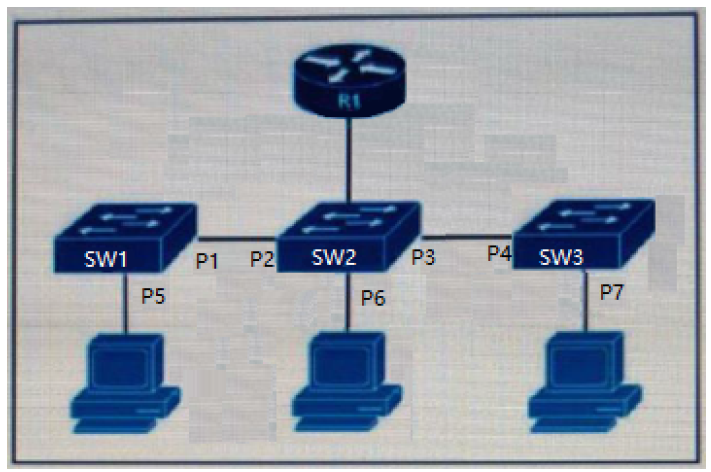
Refer to the exhibit.

The DHCP snooping database resides on router R1, and dynamic ARP inspection is
configured only on switch SW2. Which ports must be configured as untrusted so that
dynamic ARP inspection operates normally?

Show answerHide answer

Correct answer: D

P2, P3, and P6 only

Question 206 Choose 1

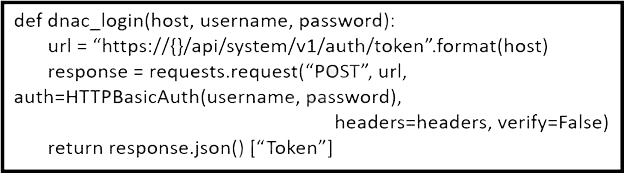
Refer to the exhibit.

What is the result of the Python script?

Show answerHide answer

Correct answer: B

It uses the POST HTTP method to obtain a token to be used for authentication

Question 207 Choose 1
An organization wants to provide visibility and to identify active threats in its network using a VM. The organization wants to extract metadata from network packet flow while ensuring that payloads are not retained or transferred outside the network. Which solution meets these requirements?
Show answerHide answer

Correct answer: B Cisco Stealthwatch Cloud PNM

Explanation

Explanation:
Let's break down the key requirements from the question:

Provide visibility and identify active threats.

Use a Virtual Machine (VM).

Extract metadata from network packet flow.

Ensure payloads are not retained or transferred outside the network.

Now, let's analyze the options:

B) Cisco Stealthwatch Cloud PNM is CORRECT. "PNM" stands for Private Network Monitoring. This is a specific deployment of Cisco Stealthwatch Cloud.

Visibility & Threat Identification:
This is the core function of Stealthwatch, which uses behavioral analytics and threat intelligence to detect threats.

Uses a VM:
The Stealthwatch Cloud PNM solution deploys a virtual collector (a VM) inside the organization's private network.

Extracts Metadata, Not Payloads:
The collector analyzes network traffic (NetFlow, IPFIX, etc.) and extracts metadata. It does not capture or store the full packet payloads.

Data Stays On-Premises:
This is the crucial differentiator. In the PNM model, the sensitive metadata remains within the organization's network on the local collector. Only security alerts, summarized reports, and anonymized statistics are sent to the cloud console. The raw flow data never leaves the premises, meeting the requirement that payloads (and their metadata) are not transferred outside

Why the other options are incorrect:

A) Cisco Umbrella Cloud is INCORRECT.
Umbrella is a cloud-based DNS-layer and secure web gateway security solution. It does not use an on-premises VM to analyze internal network packet flows. It protects users by resolving DNS requests through its cloud.

C) Cisco Stealthwatch Cloud PCM is INCORRECT.
"PCM" stands for Public Cloud Monitoring. This flavor of Stealthwatch Cloud is designed to monitor traffic within public cloud environments (like AWS, Azure), not a general on-premises private network. It does not fit the VM-on-the-private-network requirement in the same way.

D) Cisco Umbrella On-Premises is INCORRECT.
While "on-premises" sounds like it might fit, the "Cisco Umbrella" brand refers specifically to its cloud-delivered security services. There isn't a traditional on-premises VM-based version of Umbrella that performs deep network flow analysis. The core architecture of Umbrella is cloud-native.

Reference:
Cisco Stealthwatch Cloud Data Sheet (PNM): The official documentation clearly describes the PNM deployment, stating it "uses an on-premises virtual appliance (collector) to receive and analyze network flow data from your private network infrastructure" and that "raw flow records are stored locally on the collector."
Question 208 Choose 2

An administrator is configuring N I P on Cisco ASA via ASDM and needs to ensure that
rogue NTP servers cannot insert themselves as the authoritative time source Which two
steps must be taken to accomplish this task? (Choose two)

Show answerHide answer

Correct answer: C, E

Set the authentication key

Set the NTP DNS hostname

Question 209 Choose 1
Which technology provides the benefit of Layer 3 through Layer 7 innovative deep packet inspection, enabling the platform to identify and output various applications within the network traffic flows?
Show answerHide answer

Correct answer: A Cisco NBAR2

Explanation

Explanation:
The description in the question perfectly matches the core function of Cisco's Next-Generation Network-Based Application Recognition (NBAR2).

Let's break down why NBAR2 is the correct answer and the role of the other options:

A) Cisco NBAR2 is CORRECT.
NBAR2 is a deep packet inspection (DPI) engine built into Cisco IOS. Its primary purpose is to:

Perform stateful inspection of traffic from Layer 3 through Layer 7.

Identify a wide range of applications (thousands), including web applications, peer-to-peer file sharing, and cloud-based services, regardless of the port number they use.

Classify and provide visibility into network traffic flows.

This "innovative deep packet inspection" is used for creating intelligent network policies for Quality of Service (QoS), application-aware routing, and security monitoring.

Why the other options are incorrect:

B) Cisco ASAv is INCORRECT.
The Cisco Adaptive Security Virtual Appliance (ASAv) is a virtual firewall. While it performs deep packet inspection for security purposes (e.g., for its IPS module), the specific technology described in the question—focused on identifying and classifying a vast number of applications for network traffic analysis—is the dedicated function of NBAR2.

C) Account on Resolution is INCORRECT.
This appears to be a nonsensical distractor and is not a recognized Cisco technology.

D) Cisco Prime Infrastructure is INCORRECT.
Cisco Prime Infrastructure is a network management tool. It can consume and display the application information provided by NBAR2 (via Flexible NetFlow), but it is not the underlying technology that performs the deep packet inspection and application identification itself.

Reference:

Cisco IOS Configuration Guide, "NBAR2 Configuration": The official documentation describes NBAR2 as "a classification engine that recognizes a wide variety of applications, including web-based and client-server applications." It explicitly states that NBAR2 "can be used to perform deep packet inspection."

Cisco Live Presentations on NBAR2: These presentations consistently highlight NBAR2's ability to provide Layer 3-7 stateful inspection and its extensive application library as its key differentiators.
Question 210 Choose 1

Which capability is provided by application visibility and control?

Show answerHide answer

Correct answer: D

deep packet inspection

Full mock exam

Sit the 350-701 exam before exam day

Full-length mocks with the same number of questions and the same time limit as the real 350-701 exam. Every attempt draws a new set of questions from the full bank, so you can keep going until you pass comfortably.

Get full 350-701 mock exam
  • 90questions per mock
  • 120 mintime limit
  • 721questions in the bank
  • Newmock on every attempt