Cisco certification · Exam 350-701

350-701 Mock Exam Page 16

Implementing and Operating Cisco Security Core Technologies (SCOR 350-701)

Free 350-701 mock exam questions 151–160, each with the answer and an explanation.

20 questions · 27 minutes · free, no sign-up

Free 350-701 questions

151–160 of 215 free
Question 151 Choose 2

Which two capabilities does an MDM provide? (Choose two.)

Show answerHide answer

Correct answer: B, C

unified management of mobile devices, Macs, and PCs from a centralized dashboard

enforcement of device security policies from a centralized dashboard

Question 152 Choose 1
In which scenario is endpoint-based security the solution?
Show answerHide answer

Correct answer: C performing signature-based application control

Explanation

Explanation:
Endpoint-based security refers to security software installed directly on a device (like a laptop, server, or mobile phone), such as Cisco Secure Endpoint (formerly AMP for Endpoints). This software has deep visibility into the activities on that specific host.

Let's analyze why this is the correct scenario and why the others are better handled by other security tools:

Why Option C is Correct:
Signature-based application control is a classic function of endpoint protection. The security agent on the endpoint can monitor all processes and applications running on the system. It can compare these applications against a database of known malicious software signatures (or hashes) and block them from executing. Because the agent resides directly on the system where the applications run, it has the perfect vantage point to perform this control effectively.

Why the Other Options are Incorrect:

Why Option A is Incorrect:
Inspecting encrypted traffic (like HTTPS) is primarily the role of a network-based security appliance, not an endpoint agent. While an endpoint agent can see the decrypted traffic after it has been processed by the web browser on the machine, the heavy lifting of decrypting, inspecting, and re-encrypting traffic in transit is typically done by a firewall, IPS, or secure web gateway. Some endpoint agents can perform limited inspection, but it is not their primary strength.

Why Option B is Incorrect:
Device profiling and authorization is a function of network access control (NAC) systems like Cisco Identity Services Engine (ISE). ISE uses information from network infrastructure (switches, wireless controllers) and may collect data from an endpoint agent, but the final decision on profiling (identifying the device type) and granting network access (authorization) is made by the central ISE policy engine, not the endpoint security software itself.

Why Option D is Incorrect:
Inspecting a password-protected archive (like a .zip or .rar file) is extremely difficult for any security solution. A network appliance cannot inspect the contents without the password. An endpoint-based solution has a significant advantage here. It can wait for the file to reach the endpoint, and if the user enters the password to open it, the endpoint agent can then scan the now-unpacked contents for malware. However, the question asks for the scenario where endpoint security is the solution. While it's the best available solution for this problem, it's not foolproof, as it relies on the user providing the password. The most clear-cut and definitive "solution" among the options is using the endpoint for signature-based application control.

Reference:
This falls under the Endpoint Protection and Detection domain. A core capability of any Endpoint Detection and Response (EDR) or antivirus product is to control which applications can run on a host, which is fundamentally a task for software residing on that host.
Question 153 Choose 1

Which category includes DoS Attacks?

Show answerHide answer

Correct answer: C

Flood attacks

Question 154 Choose 2
What are two features of NetFlow flow monitoring? (Choose two)
Show answerHide answer

Correct answer: A, E Can track ingress and egress informationCan be used to track multicast, MPLS, or bridged traffic

Explanation

Explanation for Each Option:

A. Can track ingress and egress information (Correct):
NetFlow flow monitoring tracks both ingress (incoming) and egress (outgoing) traffic on an interface, providing detailed visibility into the direction of data flows. This is a key feature for understanding network traffic patterns, making it a correct choice. (Reference: Cisco NetFlow Configuration Guide, Ingress/Egress Tracking.)

B. Include the flow record and the flow importer (Incorrect):
While NetFlow involves flow records (data collected about flows) and a flow exporter (which sends data to a collector), the "flow importer" is not a standard term. The correct component is the flow collector, and this option misrepresents the feature, rendering it incorrect. (Reference: Cisco NetFlow Components Overview.)

C. Copies all ingress flow information to an interface (Incorrect):
NetFlow does not copy all ingress flow information to an interface; it samples and aggregates flow data based on configured parameters. This option suggests a full copy, which is inaccurate and not a feature of NetFlow, making it incorrect. (Reference: Cisco NetFlow Sampling Guide.)

D. Does not required packet sampling on interfaces (Incorrect):
NetFlow often requires packet sampling (e.g., using NetFlow sampling or sFlow) to manage high traffic volumes, especially on busy interfaces. The statement is false, as sampling is a common requirement, rendering this option incorrect. (Reference: Cisco NetFlow Sampling Configuration.)

E. Can be used to track multicast, MPLS, or bridged traffic (Correct):
NetFlow supports monitoring of multicast, MPLS (Multiprotocol Label Switching), and bridged traffic, providing visibility into these specialized traffic types. This flexibility is a valuable feature, making it a correct choice. (Reference: Cisco NetFlow Advanced Features Guide, Multicast/MPLS Support.)

Additional Notes:
Understanding NetFlow features is a key topic in the 350-701 SCOR exam under network security. As of 3:50 PM PKT, October 03, 2025, its tracking capabilities are critical for monitoring.
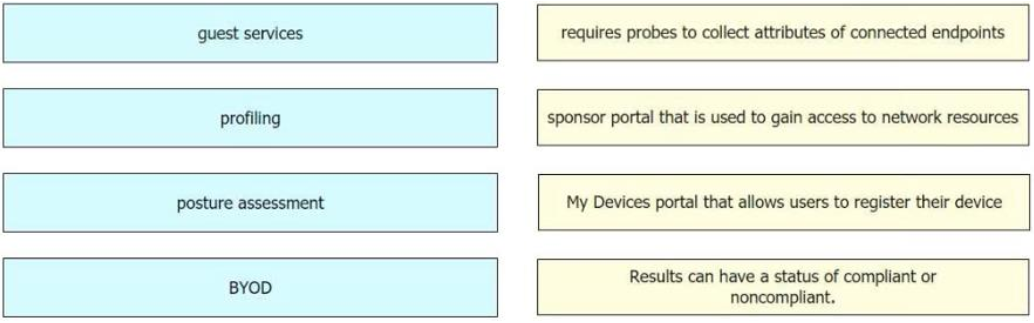
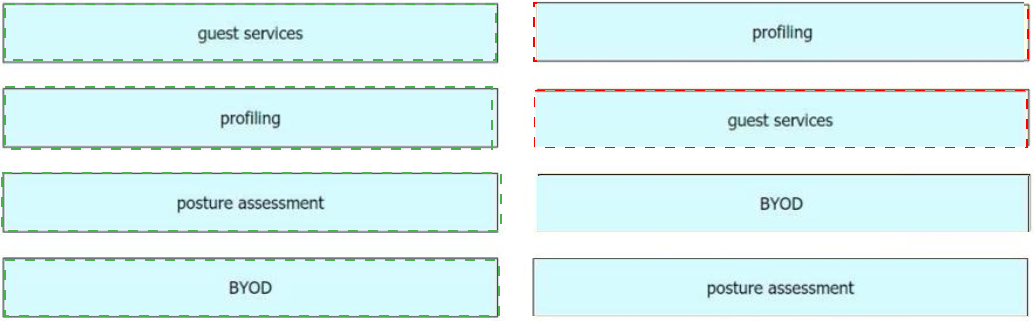
Question 155

Drag and drop the concepts from the left onto the correct descriptions on the right:

Show answerHide answer

Explanation

Question 156 Choose 2
Which two criteria must a certificate meet before the WSA uses it to decrypt application traffic? (Choose two.)
Show answerHide answer

Correct answer: B, E It must reside in the trusted store of the WSA.it must contain a SAN.

Explanation

Explanation:
For the WSA to perform SSL decryption (acting as a man-in-the-middle), it must dynamically generate a certificate for the website the user is visiting. For this to work without causing security errors in the user's browser, the certificate used to sign these dynamic certificates must meet specific criteria.

Let's break down why B and E are correct:

B) It must reside in the trusted store of the WSA.
This is CORRECT. The WSA needs the root Certificate Authority (CA) certificate or the intermediate CA certificate to sign the dynamically generated certificates it presents to users. This signing certificate must be installed in the WSA's local trusted certificate store so it can be used for this purpose.

E) It must contain a SAN. This is CORRECT.
A Subject Alternative Name (SAN) is a critical extension in an X.509 certificate that allows a single certificate to secure multiple domain names. Modern browsers require the SAN field to match the domain name being accessed. If the WSA's signing certificate does not have a SAN, the dynamically generated certificates it creates will be missing this field, causing browsers to display certificate warnings and block the connection.

Why the other options are incorrect:

A) It must include the current date. This is INCORRECT.
While it is a fundamental requirement for any valid certificate to be within its validity period (not before/not after dates), this is a generic requirement for all certificates, not a specific criterion for the WSA's decryption certificate.

C) It must reside in the trusted store of the endpoint.
This is a tricky one but is INCORRECT in the context of what the question is asking. The certificate that must be in the endpoint's trusted store is the Root CA certificate that issued the WSA's signing certificate. The question asks about the certificate the WSA uses, which is the signing certificate (often an intermediate CA). The trust chain must ultimately lead to a root CA trusted by the endpoint, but the specific certificate the WSA uses does not itself need to be in the endpoint's store.

D) It must have been signed by an internal CA.
This is INCORRECT. While it is a very common and recommended practice to use an internally managed CA for this purpose (for security and control), it is not a strict technical requirement. The WSA can use a certificate from a public CA. However, this is highly discouraged for security and practical reasons (a public CA would not issue a certificate for another entity's domain).

Reference:
Cisco WSA AsyncOS Administration Guide for Web Security (SSL Decryption Chapter): The configuration guide for enabling SSL decryption explicitly states the requirement to upload a CA certificate and private key to the WSA and emphasizes that the certificate must contain X.509 v3 extensions, specifically the Subject Alternative Name (SAN) field, to be compatible with modern browsers.
Question 157 Choose 1

An engineer is trying to decide between using L2TP or GRE over IPsec for their site-to-site
VPN implementation. What must be un solution?

Show answerHide answer

Correct answer: D

GRE over IPsec cannot be used as a standalone protocol, and L2TP can.

Question 158 Choose 1

What is the process In DevSecOps where all changes In the central code repository are
merged and synchronized?

Show answerHide answer

Correct answer: C

CI

Question 159 Choose 2
Which two parameters are used to prevent a data breach in the cloud? (Choose two.)
Show answerHide answer

Correct answer: A, B DLP solutionsstrong user authentication

Explanation

Explanation for Each Option:

A. DLP solutions (Correct):
Data Loss Prevention (DLP) solutions monitor, detect, and prevent unauthorized data exfiltration from the cloud by enforcing policies on sensitive data (e.g., PII, financial records). This directly mitigates data breaches by controlling data movement, making it a key parameter. (Reference: Cisco Secure Cloud DLP Features.)

B. strong user authentication (Correct):
Strong user authentication, such as multifactor authentication (MFA), ensures only authorized users access cloud resources. By reducing the risk of credential-based attacks (e.g., phishing), it prevents unauthorized access that could lead to data breaches, making it an essential parameter. (Reference: Cisco Cloud Security Best Practices, MFA.)

C. encryption (Incorrect):
Encryption protects data at rest and in transit, enhancing security, but it is a protective measure rather than a preventive parameter against breaches. If access is already compromised, encryption alone cannot stop data exfiltration, making it a supporting rather than primary factor. (Reference: Cisco Cloud Encryption Guide.)

D. complex cloud-based web proxies (Incorrect):
Complex cloud-based web proxies (e.g., for filtering or caching) improve performance and security but are not specifically designed to prevent data breaches. They address web traffic management, not direct data loss prevention or access control, rendering this option less relevant. (Reference: Cisco Umbrella Proxy Features.)

E. antispoofing programs (Incorrect):
Antispoofing programs prevent IP spoofing in network attacks (e.g., DDoS), which is valuable for network security but not a primary measure against cloud data breaches. They do not address insider threats or data exfiltration, making this option incorrect for the context. (Reference: Cisco Secure Firewall Antispoofing.)

Additional Notes:
Preventing cloud data breaches is a key topic in the 350-701 SCOR exam under cloud security. As of 12:30 PM PKT, October 03, 2025, DLP and authentication are critical defenses.
Question 160 Choose 1

Using Cisco Cognitive Threat Analytics, which platform automatically blocks risky sites, and
test unknown sites for hidden advanced threats before allowing users to click them?

Show answerHide answer

Correct answer: C

Cisco Web Security Appliance

Full mock exam

Sit the 350-701 exam before exam day

Full-length mocks with the same number of questions and the same time limit as the real 350-701 exam. Every attempt draws a new set of questions from the full bank, so you can keep going until you pass comfortably.

Get full 350-701 mock exam
  • 90questions per mock
  • 120 mintime limit
  • 721questions in the bank
  • Newmock on every attempt