Cisco certification · Exam 350-701

350-701 Mock Exam Page 20

Implementing and Operating Cisco Security Core Technologies (SCOR 350-701)

Free 350-701 mock exam questions 191–200, each with the answer and an explanation.

20 questions · 27 minutes · free, no sign-up

Free 350-701 questions

191–200 of 215 free
Question 191 Choose 1
When choosing an algorithm to us, what should be considered about Diffie Hellman and RSA for key establishment?
Show answerHide answer

Correct answer: D DH is on asymmetric key establishment algorithm intended to output symmetric keys

Explanation

Explanation for Each Option:

A. RSA is an asymmetric key establishment algorithm intended to output symmetric keys (Incorrect):
RSA (Rivest-Shamir-Adleman) is an asymmetric algorithm used for encryption, digital signatures, and key exchange, but it does not inherently output symmetric keys. It is typically used to securely exchange a symmetric key, not to generate one directly, making this option incorrect. (Reference: Cisco NGE Cryptographic Algorithms, RSA Usage.)

B. RSA is a symmetric key establishment algorithm intended to output asymmetric keys (Incorrect):
RSA is an asymmetric algorithm, not symmetric, and it does not output asymmetric keys. It generates a public-private key pair for asymmetric cryptography, not a key establishment process for symmetric keys, rendering this option incorrect. (Reference: Cisco RSA Configuration Guide.)

C. DH is a symmetric key establishment algorithm intended to output asymmetric keys (Incorrect):
Diffie-Hellman (DH) is an asymmetric key establishment protocol that enables two parties to establish a shared secret (symmetric key) over an insecure channel. It does not output asymmetric keys, making this option incorrect. (Reference: Cisco DH Key Exchange Overview.)

D. DH is an asymmetric key establishment algorithm intended to output symmetric keys (Correct):
Diffie-Hellman (DH) is an asymmetric key establishment algorithm that allows two parties to derive a shared symmetric key (e.g., for use in AES) without exchanging the key directly. This aligns with its purpose in secure key exchange, making it the correct choice. (Reference: Cisco NGE Diffie-Hellman Guide.)

Additional Notes:
Choosing key establishment algorithms is a key topic in the 350-701 SCOR exam under network security. As of 5:06 PM PKT, October 03, 2025, DH’s role in symmetric key generation is critical.
Question 192

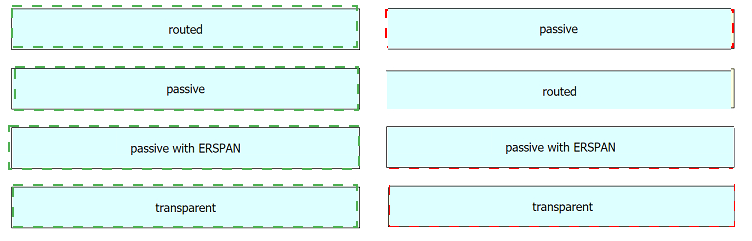
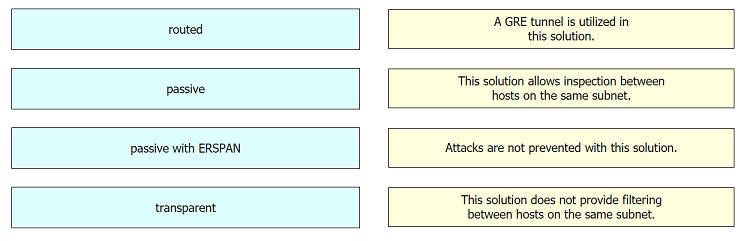
Drag and drop the deployment models from the left onto the explanations on the right.

Show answerHide answer

Explanation

Question 193 Choose 1
What is the term for when an endpoint is associated to a provisioning WLAN that is shared with guest access, and the same guest portal is used as the BYOD portal?
Show answerHide answer

Correct answer: C dual-SSID BYOD

Explanation

Explanation for Each Option:

A. single-SSID BYOD (Incorrect):
Single-SSID BYOD refers to a configuration where a single wireless network (SSID) is used for both employee and BYOD onboarding, typically with separate authentication and provisioning processes. It does not involve sharing a guest access WLAN or portal, making this option incorrect. (Reference: Cisco BYOD Design Guide, Single-SSID.)

B. multichannel GUI (Incorrect):
Multichannel GUI is not a recognized term in the context of Cisco wireless or BYOD deployments. It suggests a user interface concept, not a specific endpoint association or portal-sharing configuration, rendering this option incorrect. (Reference: Cisco Wireless Controller GUI Overview.)

C. dual-SSID BYOD (Correct):
Dual-SSID BYOD involves associating endpoints to a provisioning WLAN that is shared with guest access, using the same guest portal for both BYOD onboarding and guest access. This configuration leverages two SSIDs (e.g., one for provisioning/guest, another for corporate) with a unified portal, aligning with the description. (Reference: Cisco BYOD Dual-SSID Deployment Guide.)

D. streamlined access (Incorrect):
Streamlined access is a general term that might imply simplified onboarding but is not a specific Cisco term for sharing a provisioning WLAN with guest access using the same portal. It lacks the dual-SSID context, making this option incorrect. (Reference: Cisco ISE Streamlined Access Features.)

Additional Notes:
Configuring BYOD with dual-SSID is a key topic in the 350-701 SCOR exam under endpoint security. As of 4:49 PM PKT, October 07, 2025, it enhances guest and device management.
Question 194 Choose 1

Which security solution protects users leveraging DNS-layer security?

Show answerHide answer

Correct answer: C

Cisco Umbrella

Question 195 Choose 1
When a Cisco WSA checks a web request, what occurs if it is unable to match a userdefined policy?
Show answerHide answer

Correct answer: B It applies the global policy

Explanation

Explanation for Each Option:

A. It blocks the request (Incorrect):
When a Cisco Web Security Appliance (WSA) cannot match a user-defined policy to a web request, it does not automatically block the request. Blocking requires an explicit deny rule or a default policy set to block, which is not the default behavior when no user-defined policy matches, making this option incorrect. (Reference: Cisco WSA Access Policies Guide.)

B. It applies the global policy (Correct):
In Cisco WSA, if a web request does not match a user-defined policy (e.g., based on URL, user, or group), the appliance falls back to the global policy. The global policy serves as the default set of rules applied to all traffic unless overridden by a more specific policy, aligning with the standard behavior. (Reference: Cisco WSA Policy Configuration Guide, Global Policy.)

C. It applies the next identification profile policy (Incorrect):
Identification profile policies are used to determine user identity (e.g., via LDAP or AD), not to define access or filtering rules. If no user-defined policy matches, the WSA does not proceed to the next identification profile; it resorts to the global policy for access decisions, rendering this option incorrect. (Reference: Cisco WSA Identity Policies Guide.)

D. It applies the advanced policy (Incorrect):
"Advanced policy" is not a specific policy type in Cisco WSA terminology. Policies are categorized as access, decryption, or HTTPS policies, with the global policy acting as the default. There is no automatic fallback to an "advanced policy" when a user-defined policy fails to match, making this option invalid. (Reference: Cisco WSA Policy Types Overview.)

Additional Notes:
Understanding WSA policy enforcement is a key topic in the 350-701 SCOR exam under content security. As of 02:20 PM PKT, October 02, 2025, the global policy is the default fallback. For details, refer to the Cisco Secure Web Appliance Administration Guide (cisco.com) and the 350-701 Exam Blueprint (Section 3.0 Security Concepts).
Question 196 Choose 1
Which Cisco DNA Center Intent API action is used to retrieve the number of devices known to a DNA Center?
Show answerHide answer

Correct answer: A GET https://fqdnOrlPofDnaCenterPlatform/dna/intent/api/v1/network-device/count

Explanation

Explanation:
The key requirement in the question is to retrieve the number of devices. The Cisco DNA Center Intent API provides specific, purpose-built endpoints to efficiently get the information you need.

A) is CORRECT. The endpoint /dna/intent/api/v1/network-device/count is specifically designed to return a count of network devices.
This is the most efficient way to get just the number, as the API response will be a small JSON object containing the count, without the overhead of returning the entire list of device details.

Why the other options are incorrect:

B) GET https://fqdnOrlPofDnaCenterPlatform/dna/intent/api/v1/network-device is INCORRECT.
This endpoint returns the full list of all network devices and their detailed properties. To get the count, you would have to retrieve all this data and then calculate the size of the returned list, which is very inefficient.

C) GET https://fqdnOrlPofDnaCenterPlatform/dna/intent/api/v1/networkdevice?parameter1=value¶meter2=value&.... is INCORRECT.
While you can use query parameters with the main /network-device endpoint to filter the list, it still returns a list of devices, not a direct count. You would still need to process the list to find the number of items.

D) GET https://fqdnOrlPofDnaCenterPlatform/dna/intent/api/v1/networkdevice/startIndex/recordsToReturn is INCORRECT.
This is not a standard DNA Center API endpoint for counting. It appears to be a distractor based on a pagination pattern, but the correct endpoint for pagination uses query parameters like offset and limit.

Reference:
Cisco DNA Center Platform API Documentation: The official API reference for the Intent API clearly lists the GET /dna/intent/api/v1/network-device/count endpoint, describing its purpose as "Returns the count of network devices."
Question 197 Choose 1
What is the purpose of the Cisco Endpoint loC feature?
Show answerHide answer

Correct answer: C lt is an incident response tool 6W

Explanation

Explanation for Each Option:

A. It provides stealth threat prevention (Incorrect):
Cisco Endpoint IoC (Indicators of Compromise) is not designed for stealth threat prevention. Prevention is handled by features like AMP’s exploit prevention, while IoC focuses on identifying and responding to existing threats, making this option incorrect. (Reference: Cisco AMP Threat Prevention Guide.)

B. It is a signature-based engine (Incorrect):
IoC in Cisco Endpoint Security (e.g., AMP for Endpoints) relies on indicators (e.g., file hashes, IP addresses) rather than a traditional signature-based engine, which detects known patterns. IoC is more about response than real-time signature matching, rendering this option incorrect. (Reference: Cisco AMP IoC Overview.)

C. It is an incident response tool (Correct):
The Cisco Endpoint IoC feature is an incident response tool that allows security teams to identify and act on indicators of compromise (e.g., malicious files, network activity) post-infection. It enables investigation and remediation, aligning with its purpose as a response mechanism. (Reference: Cisco AMP Incident Response Guide, IoC Usage.)

D. It provides precompromise detection (Incorrect):
Precompromise detection focuses on preventing attacks before they occur (e.g., via EPP features). IoC is designed for post-compromise analysis and response, not proactive detection, making this option incorrect. (Reference: Cisco AMP Precompromise Features.)

Additional Notes:
Understanding Endpoint IoC is a key topic in the 350-701 SCOR exam under endpoint security. As of 5:08 PM PKT, October 03, 2025, it enhances incident response.
Question 198 Choose 1
What is an advantage of the Cisco Umbrella roaming client?
Show answerHide answer

Correct answer: B visibility into IP-based threats by tunneling suspicious IP connections

Explanation

Explanation:
The Cisco Umbrella roaming client is a lightweight agent installed on endpoints (laptops, mobile devices) that provides security policy enforcement anywhere the device roams, not just on the corporate network.

Let's break down why B is the correct answer and the role of the other options:

B) visibility into IP-based threats by tunneling suspicious IP connections is CORRECT.
This is a key feature called Intelligent Proxy. When the roaming client identifies a connection to a suspicious or high-risk domain (based on Umbrella's threat intelligence), it can automatically route that specific connection through an Umbrella secure web gateway for full inspection and filtering. This provides deep visibility and protection for risky traffic even when the user is at a coffee shop or home, without tunneling all of their traffic.

Why the other options are incorrect:

A) the ability to see all traffic without requiring TLS decryption is INCORRECT.
No security solution can "see all traffic" without TLS decryption. Encrypted HTTPS traffic remains encrypted. The Umbrella roaming client provides security at the DNS layer for all traffic and can use the Intelligent Proxy for deeper inspection of some HTTP traffic, but it cannot see inside encrypted TLS sessions without a decryption certificate deployed to the endpoint.

C) the ability to dynamically categorize traffic to previously uncategorized sites is INCORRECT.
While Umbrella does dynamically categorize some new sites, this is a function of the Umbrella cloud service and its global intelligence, not a unique advantage of the roaming client. The client enforces the policies based on these categorizations.

D) visibility into traffic that is destined to sites within the office environment is INCORRECT.
This is the opposite of its purpose. The roaming client is designed for off-network protection. For traffic inside the office environment, you would typically use the organization's on-premises security appliances or direct traffic through the Umbrella SIG. The client often has a setting to bypass tunneling for local/internal domains.

Reference:

Cisco Umbrella Roaming Client Datasheet: The official documentation highlights the client's ability to "enforce security anywhere" and specifically describes the "Intelligent Proxy" feature that "automatically redirects risky DNS requests to a proxy for full transaction inspection."

Cisco Umbrella Deployment Guides: These guides explain that the roaming client provides layered security: DNS-layer security for all requests, with the added layer of the Intelligent Proxy for risky domains to block more threats.
Question 199 Choose 1
A network engineer must configure a Cisco ESA to prompt users to enter two forms of information before gaining access The Cisco ESA must also join a cluster machine using preshared keys What must be configured to meet these requirements?
Show answerHide answer

Correct answer: A Enable two-factor authentication through a RADIUS server and then join the cluster by using the Cisco ESA CLI.

Explanation

Explanation
This question combines two distinct configuration tasks on the Cisco Email Security Appliance (ESA): administrative access and cluster management.

Requirement 1:
"Prompt users to enter two forms of information before gaining access."
This refers to Two-Factor Authentication (2FA) for administrators logging into the ESA (either via GUI or CLI).
The Cisco ESA does not have a built-in, native 2FA system. To achieve this, it must integrate with an external authentication server.
The ESA supports using RADIUS as the external authentication protocol for this purpose. By configuring the ESA to use a RADIUS server (which can then be linked to a 2FA provider like Duo Security or Cisco Duo), it can enforce the requirement for a password (first factor) and a time-based token or push notification (second factor).

Requirement 2:
"Join a cluster machine using preshared keys."
This refers to forming an AsyncOS cluster with other ESAs for centralized management and reporting.
The process of joining a cluster, including the initial configuration and the input of the preshared key (PSK), is performed through the Command Line Interface (CLI) of the ESA. The GUI is not used for this specific cluster-joining operation.


Therefore, the correct procedure is to first set up the 2FA via RADIUS in the GUI or CLI, and then use the specific CLI commands to join the cluster with the PSK.

Detailed Breakdown of Incorrect Options:

B. Enable two-factor authentication through a RADIUS server and then join the cluster by using the Cisco ESA GUI

Why it is incorrect:
While the first part (2FA via RADIUS) is correct, the second part is not. You cannot join an ESA to a cluster using the GUI. This is a CLI-only operation. The GUI is used for managing the cluster after it has been formed.

C. Enable two-factor authentication through a TACACS+ server and then join the cluster by using the Cisco ESA GUI

Why it is incorrect:
This option is wrong on both counts.
The Cisco ESA uses RADIUS, not TACACS+, for its external administrative authentication that can support 2FA.
As explained above, joining a cluster is done via the CLI, not the GUI.

D. Enable two-factor authentication through a TACACS+ server and then join the cluster by using the Cisco ESA CLI

Why it is incorrect:
This option correctly identifies using the CLI to join the cluster but incorrectly specifies TACACS+ as the protocol for 2FA. The ESA's external authentication for administrators is designed for RADIUS integration. TACACS+ is not a supported protocol for this function on the ESA.

Reference and Key Context:

Cisco ESA Administration Guide - Administrative Access:
The documentation for configuring external authentication explicitly covers RADIUS integration for administrative logins.

Cisco ESA Administration Guide - Clustering:
The procedure for "Joining a Cluster" is clearly outlined as a series of CLI commands (clusterconfig, joincluster, entering the PSK, etc.). The guide states that you must use the CLI for this task.

Key Takeaway:
For the exam, remember these two key facts about Cisco ESA:
2FA for Admin Access: Implemented by integrating with an external RADIUS server.
Cluster Formation: The act of joining a cluster with a preshared key is performed exclusively through the CLI.
Question 200 Choose 1
An engineer integrates Cisco FMC and Cisco ISE using pxGrid Which role is assigned for Cisco FMC?
Show answerHide answer

Correct answer: A client

Explanation

Explanation
This question tests the understanding of the roles within the Cisco Platform Exchange Grid (pxGrid) framework. pxGrid is a publish-subscribe communication bus where different systems share information.

The roles are defined as follows:

pxGrid Client:
A system that consumes (subscribes to) information from the pxGrid framework. It can also publish its own data for others to use.

pxGrid Server/Controller:
This is the central broker that manages the entire pxGrid ecosystem. Cisco ISE always acts as the pxGrid server/controller. It facilitates the connection and data exchange between all the clients.

In the integration between Cisco FMC and Cisco ISE:
Cisco ISE is the pxGrid Server. It holds the authoritative data on user and endpoint identity.

Cisco FMC acts as a pxGrid Client. It connects to the ISE pxGrid server to subscribe to and consume context information (like user-to-IP mappings, endpoint profiles, and security group tags). FMC uses this information to create more dynamic and identity-aware firewall policies.

Why the other options are incorrect:

B. server:
This role is exclusively filled by Cisco ISE (or in some cases, a dedicated pxGrid node in the ISE network). FMC cannot be the pxGrid server.

C. controller:
This is another term for the pxGrid server, which is ISE.

D. publisher:
While a pxGrid client can publish data, this is not its primary role in this specific integration. In the FMC-ISE integration, FMC's primary function is to be a subscriber (a type of client) to the identity data that ISE publishes. The term "client" encompasses this subscriber role.

Reference:
The roles in a pxGrid integration are defined in the Cisco ISE and FMC configuration guides.

As per the Cisco Firepower Management Center Configuration Guide for ISE Integration:

"The Firepower System acts as a pxGrid client... The pxGrid server (ISE) provides the Firepower System with... context information."
Full mock exam

Sit the 350-701 exam before exam day

Full-length mocks with the same number of questions and the same time limit as the real 350-701 exam. Every attempt draws a new set of questions from the full bank, so you can keep going until you pass comfortably.

Get full 350-701 mock exam
  • 90questions per mock
  • 120 mintime limit
  • 721questions in the bank
  • Newmock on every attempt