Cisco certification · Exam 350-701

350-701 Mock Exam

Implementing and Operating Cisco Security Core Technologies (SCOR 350-701)

Free 350-701 questions on Topic 3: Exam Pool C, each with the answer and an explanation.

20 questions · 27 minutes · free, no sign-up

Topic 3: Exam Pool C questions

1–10 of 100 free
Question 1 Choose 1

Which benefit does DMVPN provide over GETVPN?

Show answerHide answer

Correct answer: D

DMVPN can be used over the public Internet, and GETVPN requires a private network

Question 2 Choose 1

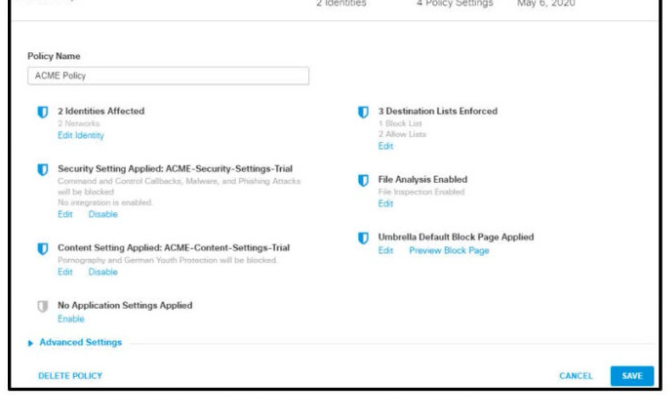
Refer to the exhibit.

How does Cisco Umbrella manage traffic that is directed toward risky domains?

Show answerHide answer

Correct answer: B

Traffic is managed by the security settings and blocked

Explanation

Explanation:
The key to this question is understanding the distinction between different blocking and inspection methods within Cisco Umbrella. The configuration shows that specific security settings are enabled.

Let's analyze the provided configuration:
The policy applies "ACME-Security-Settings-Trial", which includes protection against "Malware, and Phishing Attacks".

Crucially, it also shows that "File Analysis Enabled" is active.

Here's why A is the correct answer:

A) Traffic is proxied through the intelligent proxy is CORRECT.
For Umbrella to perform File Analysis, it must do more than just block a domain at the DNS level. When a request is made to a domain categorized as risky (but not definitively malicious enough for a simple DNS block), Umbrella's Intelligent Proxy is triggered. This service:

Intercepts the HTTP/HTTPS connection to the risky domain.

Can buffer and inspect the files being downloaded in real-time.

Uses advanced sandboxing and analysis to determine if the file is malicious.

Will only block the transfer if the file is confirmed to be malicious.

This provides a much higher level of security than a simple block page, as it allows for the inspection of potentially unknown threats.

Why the other options are incorrect:

B) Traffic is managed by the security settings and blocked.
This is partially true but incomplete. Umbrella does use security settings to block traffic at the DNS layer for known-bad domains. However, for "risky" domains that require file analysis, a simple block is not the action taken; instead, the traffic is proxied for deeper inspection. The presence of "File Analysis Enabled" indicates the more advanced proxying action.

C) Traffic is managed by the application settings, unhandled and allowed.
This is INCORRECT. The policy clearly has security settings applied to handle this traffic. "Unhandled and allowed" would be the default behavior if no policy matched, which is not the case here.

D) Traffic is allowed but logged.
This is INCORRECT. While logging occurs, the primary action for risky domains with file analysis enabled is not simple "allowance." It is active inspection via the proxy, which may still result in the content being blocked if it's found to be malicious.

Reference:
Cisco Umbrella Administration Guide, "File Inspection": The official documentation explains that when file inspection is enabled, "Umbrella uses a proxy to inspect files for threats as they are being downloaded."

Cisco Umbrella Data Sheet, "Intelligent Proxy": This feature is described as providing "full transaction inspection for risky requests" that goes beyond DNS-layer security.
Question 3 Choose 1

An organization wants to use Cisco FTD or Cisco ASA devices. Specific URLs must be
blocked from being
accessed via the firewall which requires that the administrator input the bad URL
categories that the
organization wants blocked into the access policy. Which solution should be used to meet
this requirement?

Show answerHide answer

Correct answer: C

Cisco FTD because it includes URL filtering in the access control policy capabilities,
whereas Cisco ASA does not

Question 4 Choose 1
Which RADIUS feature provides a mechanism to change the AAA attributes of a session after it is authenticated?
Show answerHide answer

Correct answer: D CoA

Explanation

Explanation for Each Option:

A. Authorization (Incorrect):
Authorization in RADIUS determines what a user or device can do after authentication, based on attributes sent in the initial Access-Accept packet. It does not provide a mechanism to change session attributes post-authentication, making this option incorrect. (Reference: Cisco IOS RADIUS Authorization Guide.)

B. Accounting (Incorrect):
Accounting in RADIUS tracks and logs session activities (e.g., start, stop, data usage) but does not allow modification of session attributes after authentication. Its focus is on monitoring, not dynamic changes, rendering this option incorrect. (Reference: Cisco IOS RADIUS Accounting Configuration.)

C. Authentication (Incorrect):
Authentication in RADIUS verifies a user’s identity using credentials (e.g., username/password) during the initial session setup. It does not support altering session attributes after the session is established, making this option unsuitable. (Reference: Cisco IOS RADIUS Authentication Guide.)

D. CoA (Correct):
Change of Authorization (CoA) is a RADIUS feature that allows dynamic modification of a session’s AAA attributes (e.g., VLAN, QoS, access level) after authentication. The RADIUS server (e.g., Cisco ISE) sends a CoA message to the network device to update the session, meeting the requirement. (Reference: Cisco ISE CoA Configuration Guide.)

Additional Notes:
Understanding RADIUS features like CoA is a key topic in the 350-701 SCOR exam under endpoint security. As of 3:25 PM PKT, October 03, 2025, CoA enhances session flexibility.
Question 5 Choose 2

What are two functionalities of northbound and southbound APIs within Cisco SDN
architecture? (Choose two.)

Show answerHide answer

Correct answer: C, D

Northbound APIs utilize RESTful API methods such as GET, POST, and DELETE.

Southbound APIs utilize CLI, SNMP, and RESTCONF.

Question 6 Choose 1

Which technology should be used to help prevent an attacker from stealing usernames and
passwords of users within an organization?

Show answerHide answer

Correct answer: D

multifactor authentication

Question 7 Choose 1

Which solution supports high availability in routed or transparent mode as well as in northbound and southbound deployments?

Show answerHide answer

Correct answer: B

Cisco FTD with Cisco FMC

Question 8 Choose 1

What is a difference between GETVPN and IPsec?

Show answerHide answer

Correct answer: B

GETVPN provides key management and security association management

Question 9 Choose 1
Which industry standard is used to integrate Cisco ISE and pxGrid to each other and with other interoperable security platforms?
Show answerHide answer

Correct answer: B IETF

Explanation

Explanation for Each Option:

A. IEEE (Incorrect):
The Institute of Electrical and Electronics Engineers (IEEE) develops standards for networking technologies, such as 802.1X for port-based authentication. However, it is not the industry standard used for integrating Cisco ISE and pxGrid with other security platforms; this role is fulfilled by IETF protocols, making this option incorrect. (Reference: IEEE 802 Standards Overview.)

B. IETF (Correct):
The Internet Engineering Task Force (IETF) provides the industry standards, such as XMPP (Extensible Messaging and Presence Protocol), used by Cisco’s Platform Exchange Grid (pxGrid) to integrate Cisco Identity Services Engine (ISE) with other interoperable security platforms. This standard enables secure, real-time data sharing, aligning with the integration requirement. (Reference: Cisco pxGrid Datasheet, IETF XMPP RFC 6120.)

C. NIST (Incorrect):
The National Institute of Standards and Technology (NIST) develops guidelines and frameworks (e.g., NIST SP 800-53) for cybersecurity best practices, but it does not provide the specific protocols (like XMPP) used for integrating Cisco ISE and pxGrid with other platforms. Its role is advisory, not standard-setting for this context, making this option incorrect. (Reference: NIST Cybersecurity Framework.)

D. ANSI (Incorrect):
The American National Standards Institute (ANSI) oversees the creation of voluntary consensus standards across industries, but it does not directly provide the networking or security protocols (e.g., XMPP) required for Cisco ISE and pxGrid integration. This function falls under IETF’s purview, rendering this option unsuitable. (Reference: ANSI Standards Overview.)

Additional Notes:
Integration standards for pxGrid are a key topic in the 350-701 SCOR exam under network security. As of 11:30 AM PKT, October 02, 2025, IETF standards remain the foundation. For details, refer to the Cisco pxGrid User Guide (cisco.com) and the 350-701 Exam Blueprint (Section 2.0 Endpoint Security).
Question 10 Choose 1
Which CLI command is used to enable URL filtering support for shortened URLs on the Cisco ESA?
Show answerHide answer

Correct answer: D websecurity config

Explanation

Explanation
On the Cisco Secure Email Gateway (formerly Cisco ESA), the ability to scan and filter within shortened URLs (like those from bit.ly, t.co, etc.) is an advanced feature of the Web Interaction Tracking (also known as URL Rewriting) service.

The standard websecurityconfig command controls the base-level settings for Web Interaction Tracking, such as enabling/disabling the feature and defining the base policy (e.g., "rewrite all URLs").

The websecurityadvancedconfig command is used to access a subset of more granular and specific settings related to this service. One of these specific settings is the control over shortened URLs.

Within the websecurityadvancedconfig menu, you will find the option to enable or disable the scanning of shortened URLs. By enabling this, the ESA will "expand" or "dereference" the shortened link when it is found in an email, check the final destination URL against the defined URL filtering policies, and then block or rewrite it based on the final destination's reputation and category.

Detailed Breakdown of Incorrect Options:

A. outbreakconfig

Why it is incorrect:
The outbreakconfig command is used to configure settings related to the Virus Outbreak Filters (VOF). This feature deals with identifying and blocking new, emerging malware threats based on real-time intelligence from Cisco Talos. It is focused on malicious file attachments and executables, not on the filtering of URLs found within an email body.

B. websecurityconfig

Why it is incorrect:
While this command is the main entry point for enabling the core URL rewriting and filtering feature, it does not contain the specific toggle for handling shortened URLs. The websecurityconfig menu handles global on/off states, logging, and general rewrite actions, but the advanced settings for short URLs, link wrap length, and other specific behaviors are found in the separate websecurityadvancedconfig menu.

C. webadvancedconfig:

Why it is incorrect:
This is a distractor option. The correct and exact command name on the Cisco ESA CLI is websecurityadvancedconfig, not webadvancedconfig. The CLI is very specific, and the inclusion of "security" in the command is critical.

Reference and Verification:
You can verify this command hierarchy on a Cisco ESA via the CLI:
Enter the websecurityconfig menu to see the base settings.
Exit that menu and enter the websecurityadvancedconfig menu. Here you will find options similar to the following (exact wording may vary by AsyncOS version):
Expand shortened URLs -> This is the specific setting the question refers to.
Wrap links longer than [X] characters

Key Takeaway:
For the exam, remember that "advanced" configuration tasks for the web filtering (URL rewriting) feature require the websecurityadvancedconfig command. Controlling the behavior of shortened URLs is a classic example of an "advanced" setting beyond the simple on/off switch provided by websecurityconfig.
Full mock exam

Sit the 350-701 exam before exam day

Full-length mocks with the same number of questions and the same time limit as the real 350-701 exam. Every attempt draws a new set of questions from the full bank, so you can keep going until you pass comfortably.

Get full 350-701 mock exam
  • 90questions per mock
  • 120 mintime limit
  • 721questions in the bank
  • Newmock on every attempt