Cisco certification · Exam 350-701

350-701 Mock Exam Page 19

Implementing and Operating Cisco Security Core Technologies (SCOR 350-701)

Free 350-701 mock exam questions 181–190, each with the answer and an explanation.

20 questions · 27 minutes · free, no sign-up

Free 350-701 questions

181–190 of 215 free
Question 181 Choose 1
What is a benefit of using GET VPN over FlexVPN within a VPN deployment?
Show answerHide answer

Correct answer: B GET VPN natively supports MPLS and private IP networks

Explanation

Explanation:
Group Encrypted Transport VPN (GET VPN) is designed for a specific use case: securing multicast and unicast traffic over a trusted, private WAN core, such as MPLS or private IP networks.

B) GET VPN natively supports MPLS and private IP networks is CORRECT.
This is the core benefit and design goal of GET VPN. In a traditional IPsec VPN, tunnels are built between the edges of the network, which can break the native routing and multicast capabilities of the underlying WAN. GET VPN operates differently:

It encrypts the payload but leaves the original IP headers intact.

This allows the traffic to be routed natively across the MPLS or private IP cloud.

It preserves multicast functionality because the original multicast group addresses are still visible to the network core.

Why the other options are incorrect:

A) GET VPN supports Remote Access VPNs is INCORRECT.
GET VPN is strictly a site-to-site technology. FlexVPN, on the other hand, is a unified VPN solution that supports both site-to-site and remote access (client-based) VPNs.

C) GET VPN uses multiple security associations for connections is INCORRECT.
This is a characteristic of many VPNs and is not a unique benefit of GET VPN. In fact, a key feature of GET VPN is its use of a Group Security Association (GSA), which is a single, shared security association for the entire group, simplifying key management.

D) GET VPN interoperates with non-Cisco devices is INCORRECT.
GET VPN is a Cisco-proprietary technology. FlexVPN, which is based on IKEv2, has much better interoperability with non-Cisco devices that support standard IKEv2.

Reference:
Cisco GET VPN Design and Implementation Guides: These guides consistently highlight the technology's purpose of providing "end-to-end data confidentiality in a native mode" for "enterprise WANs built on a private IP or MPLS infrastructure."
Question 182 Choose 1

Refer to the exhibit.

What does this Python script accomplish?

Show answerHide answer

Correct answer: C

lt authenticates to a Cisco ISE server using the username of ersad

Question 183 Choose 1

What is the process of performing automated static and dynamic analysis of files against
preloaded
behavioral indicators for threat analysis?

Show answerHide answer

Correct answer: C

advanced sandboxing

Question 184 Choose 1

An organization is implementing AAA for their users. They need to ensure that
authorization is verified for every command that is being entered by the network
administrator. Which protocol must be configured in order to provide this capability?

Show answerHide answer

Correct answer: C

RADIUS

Question 185 Choose 1
Cisco SensorBase gaihers threat information from a variety of Cisco products and services
and performs analytics to find patterns on threats Which term describes this process?
Show answerHide answer

Correct answer: B

consumption

Explanation

Explanation for Each Option:

A. deployment (Incorrect):
Deployment refers to the process of installing, configuring, or rolling out Cisco products and services, such as sensors or security appliances, across a network. While Cisco SensorBase relies on data from deployed devices, the term does not describe the analytical process of gathering threat information and identifying patterns, making this option incorrect for the described scenario. (Reference: Cisco Security Solutions Overview, Deployment Strategies.)

B. consumption (Correct):
Consumption in this context refers to the process by which Cisco SensorBase collects and analyzes threat data from various Cisco products and services, such as firewalls, IPS, and web gateways. It processes this data to detect patterns and generate actionable threat intelligence, which is then used to enhance security. This aligns with the analytics and pattern-finding described. (Reference: Cisco SensorBase Data Sheet, Threat Intelligence.)

C. authoring (Incorrect):
Authoring typically involves creating or writing content, such as security policies, signatures, or documentation. Cisco SensorBase does not focus on creating threat data from scratch but rather aggregates and analyzes existing data from Cisco devices. This term is unrelated to the analytics and pattern recognition process, making it an incorrect choice. (Reference: Cisco SecureX Overview, Policy Authoring.)

D. sharing (Incorrect):
Sharing implies distributing or exchanging threat intelligence with other systems, partners, or users, which Cisco SensorBase may do after analysis. However, the question focuses on the internal process of gathering data and performing analytics to find patterns, not the subsequent distribution. Thus, sharing describes an outcome, not the core process, making this option incorrect. (Reference: Cisco Threat Intelligence Sharing, Collaboration.)

Additional Notes:
Cisco SensorBase is a cloud-based threat intelligence system covered in the 350-701 SCOR exam under network security and threat intelligence. As of 04:18 PM PKT, October 01, 2025, it remains a key component of Cisco’s security ecosystem. For more details, refer to the Cisco SensorBase Data Sheet (cisco.com) and the 350-701 Exam Blueprint (Section 1.0 Security Concepts). More questions?
Question 186 Choose 1
Based on the NIST 800-145 guide, which cloud architecture may be owned, managed, and operated by one or more of the organizations in the community, a third party, or some combination of them, and it may exist on or off premises?
Show answerHide answer

Correct answer: D community cloud

Explanation

Explanation
The NIST Special Publication 800-145, "The NIST Definition of Cloud Computing," provides standardized definitions for the essential characteristics and service models of cloud computing. It specifically defines four deployment models: Public, Private, Community, and Hybrid.

Let's break down the definition in the question and compare it to the NIST definitions:

"owned, managed, and operated by one or more of the organizations in the community, a third party, or some combination of them":This is the key differentiator for a community cloud. The infrastructure is shared by several organizations that have a shared concern (e.g., mission, security requirements, policy, compliance considerations). This shared infrastructure can be managed by the organizations themselves or outsourced to a third party.

"may exist on or off premises":A community cloud is not defined by its physical location. It could be hosted on the premises of one of the community members or at a third-party data center.

Why the other options are incorrect:

A. Hybrid Cloud:
A hybrid cloud is a composition of two or more distinct cloud infrastructures (private, community, or public) that remain unique entities but are bound together by standardized or proprietary technology that enables data and application portability. The question describes a single, shared infrastructure for a specific community, not a combination of multiple ones.

B. Private Cloud:
The private cloud infrastructure is provisioned for exclusive use by a single organization. It may be owned, managed, and operated by the organization, a third party, or some combination, but it is not shared with other organizations in a community.

C. Public Cloud:
The public cloud infrastructure is provisioned for open use by the general public. It is owned, managed, and operated by a business, academic, or government organization, and it exists on the premises of the cloud provider.

Reference
This definition is taken directly from the NIST Special Publication 800-145, "The NIST Definition of Cloud Computing."

The official NIST definition for a Community Cloud is:

"The cloud infrastructure is provisioned for exclusive use by a specific community of consumers from organizations that have shared concerns (e.g., mission, security requirements, policy, and compliance considerations). It may be owned, managed, and operated by one or more of the organizations in the community, a third party, or some combination of them, and it may exist on or off premises."
Question 187

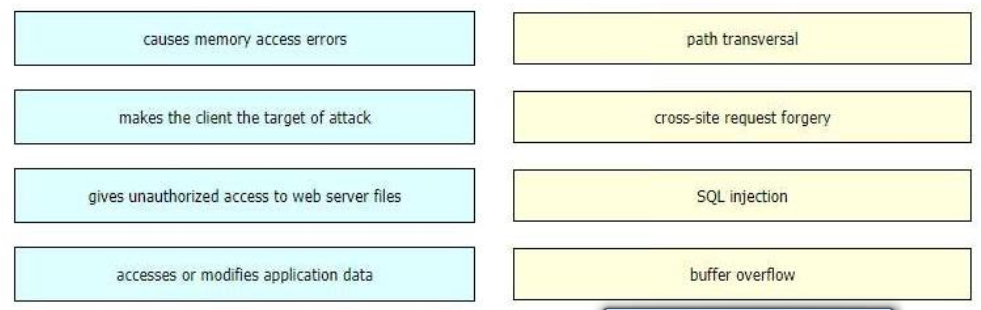
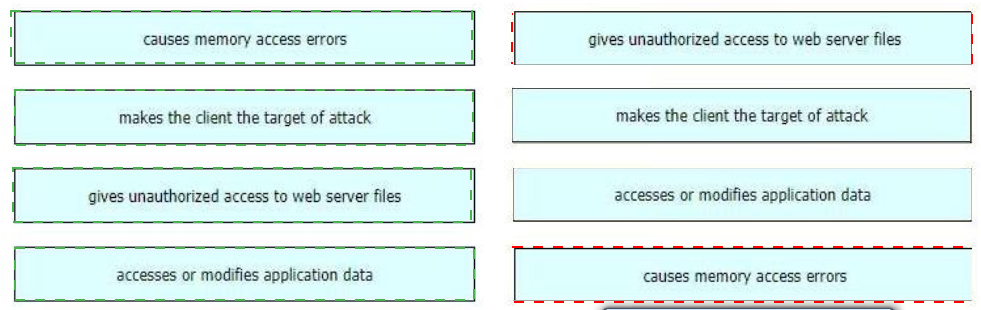
Drag and drop the exploits from the left onto the type of security vulnerability on the right.

Show answerHide answer

Explanation

Question 188 Choose 1

What is a benefit of using Cisco Umbrella?

Show answerHide answer

Correct answer: B

Attacks can be mitigated before the application connection occurs

Question 189 Choose 1

Which Cisco security solution determines if an endpoint has the latest OS updates and
patches installed on the system?

Show answerHide answer

Correct answer: D

Security Posture Assessment Service

Question 190 Choose 1
Refer to the exhibit. When creating an access rule for URL filtering, a network engineer adds certain categories and individual URLs to block. What is the result of the configuration?
Show answerHide answer

Correct answer: B Only URLs for botnets with a reputation score of 3 will be blocked

Explanation

Explanation for Each Option:

A. Only URLs for botnets with reputation scores of 1-3 will be blocked (Incorrect):
The configuration likely specifies a single reputation score (e.g., 3) for botnet category blocking, as indicated by the question’s context of adding specific categories and URLs. Without evidence of a range (1-3), this option assumes a broader scope not supported by typical URL filtering rules, making it incorrect. (Reference: Cisco Umbrella Admin Guide, Reputation Scoring.)

B. Only URLs for botnets with a reputation score of 3 will be blocked (Correct):
In Cisco URL filtering solutions (e.g., Umbrella or Secure Web Gateway), reputation scores are assigned to categorize risk levels (e.g., 1-5, with 3 often indicating moderate risk like botnets). Adding a botnet category with a specific score (e.g., 3) blocks only those URLs matching that exact reputation score, aligning with the configuration intent. (Reference: Cisco Secure Web Gateway Configuration Guide, URL Filtering.)

C. Only URLs for botnets with reputation scores of 3-5 will be blocked (Incorrect):
A range like 3-5 would require explicit configuration to block multiple reputation levels, which is not implied by adding "certain categories and individual URLs." URL filtering typically applies to specific categories or scores unless a range is defined, making this assumption of a broader range incorrect. (Reference: Cisco Umbrella Policy Management Documentation.)

D. Only URLs for botnets with a reputation score of 3 will be allowed while the rest will be blocked (Incorrect):
The action of adding categories and URLs to block suggests a deny policy. Allowing only score 3 URLs while blocking others would require an explicit allow rule, which contradicts the intent of blocking specific categories. This misinterprets the configuration’s deny-focused purpose. (Reference: Cisco URL Filtering Best Practices.)

Additional Notes:
URL filtering configuration is a key topic in the 350-701 SCOR exam under content security. As of 10:10 AM PKT, October 02, 2025, reputation-based blocking remains a standard practice. Since the exhibit is unavailable, the answer assumes a typical Cisco URL filtering setup (e.g., Umbrella) with a specific reputation score. For details, refer to the Cisco Umbrella Admin Guide (umbrella.cisco.com) and the 350-701 Exam Blueprint (Section 3.0 Security Concepts).

Note:
The exhibit is not provided, so the explanation assumes a standard configuration where a specific reputation score (e.g., 3) is set for the botnet category, a common practice in Cisco URL filtering tools.
Full mock exam

Sit the 350-701 exam before exam day

Full-length mocks with the same number of questions and the same time limit as the real 350-701 exam. Every attempt draws a new set of questions from the full bank, so you can keep going until you pass comfortably.

Get full 350-701 mock exam
  • 90questions per mock
  • 120 mintime limit
  • 721questions in the bank
  • Newmock on every attempt