CompTIA certification · Exam SK0-005

SK0-005 Mock Exam Page 10

CompTIA Server+

Free SK0-005 mock exam questions 91–100, each with the answer and an explanation.

20 questions · 20 minutes · free, no sign-up

Free SK0-005 questions

91–100 of 146 free
Question 91 Choose 1
Which of the following would MOST likely be part of the user authentication process when implementing SAML across multiple applications?
Show answerHide answer

Correct answer: A SSO

Explanation

Explanation

SAML (Security Assertion Markup Language) is an XML-based standard used to exchange authentication and authorization data between an Identity Provider (IdP) and Service Providers (SPs) — typically to enable Single Sign-On (SSO) across multiple applications.

SSO is the core purpose of SAML:

User authenticates once to the IdP (e.g., Okta, Azure AD, Ping Identity).
IdP issues a SAML assertion (token).
User accesses multiple applications without re-logging in.

Thus, SSO is the most likely component of the user authentication process when implementing SAML.

Why the others are not correct:

B. LDAP
Used for directory lookups (e.g., user attributes). Can be a backend to the IdP, but not part of the SAML exchange itself.

C. TACACS
Cisco protocol for device administration (AAA), not web/application SSO. No relation to SAML.

D. MFA
Enhances initial authentication at the IdP. It may be used before SAML assertion is issued, but MFA is not part of the SAML protocol — it’s an optional pre-step.

Reference
CompTIA Server+ SK0-005 Exam Objectives

5.3 – Explain the role of authentication and authorization in security → Includes SAML and SSO as federation/authentication methods.

Final Answer: A. SSO
It is the primary outcome and integral part of implementing SAML across applications.
Question 92 Choose 1
Users have noticed a server is performing below Baseline expectations. While diagnosing me server, an administrator discovers disk drive performance has degraded. The administrator checks the diagnostics on the RAID controller and sees the battery on me controller has gone bad. Which of the following is causing the poor performance on the RAID array?
Show answerHide answer

Correct answer: A The controller has disabled the write cache.

Explanation

Explanation:

A. The controller has disabled the write cache. This is the correct and most direct cause of the performance degradation.

Role of the Battery:
The battery (or flash-backed write cache - BBWC/FBWC) on a RAID controller is a critical component. Its primary job is to protect data in the controller's volatile write cache in the event of a power failure. It provides enough power to flush the contents of the cache down to the non-volatile drives, ensuring no data in transit is lost.

Fail-Safe Behavior:
When the controller's battery fails or is discharged, it enters a fail-safe mode. To prevent data loss (since it can no longer guarantee the safety of cached writes), the controller will automatically disable the write-back cache and revert to a much slower write-through cache mode.

Performance Impact:
In write-back cache mode, the controller acknowledges a write operation as soon as the data is in its fast cache, before it's physically written to the disks. This is very fast. In write-through mode, the controller must wait for the data to be physically written to the slower disks before acknowledging the write, which causes a significant performance penalty, exactly matching the symptom of "degraded disk drive performance."

Why the other options are incorrect:

B. The controller cannot use all the available channels.
A failed battery does not affect the physical data channels between the controller and the drives. The drives are still connected and communicating.

C. The drive array is corrupt.
A bad battery does not cause corruption. In fact, its fail-safe behavior of disabling the cache is specifically designed to prevent corruption by ensuring all writes are committed to disk immediately. The array should be intact, just slow.

D. The controller has lost its configuration.
The RAID configuration is stored in non-volatile memory (NVRAM) on the controller, not maintained by the battery. A bad battery will not cause the controller to lose its configuration.

Reference:
This is a classic scenario covered under CompTIA Server+ SK0-005 Objective 3.1, "Given a scenario, perform server hardware maintenance," and general storage administration knowledge. Understanding the critical role of the RAID controller cache and its battery is essential for troubleshooting performance issues in high-end servers. Replacing a failed battery is a standard maintenance task to restore performance.
Question 93 Choose 2
A server has experienced several component failures. To minimize downtime, the server administrator wants to replace the components while the server is running. Which of the following can MOST likely be swapped out while the server is still running? (Select TWO).
Show answerHide answer

Correct answer: A, C The power supplyThe hard drive

Explanation

Explanation:

Many enterprise-grade servers are designed with hot-swappable components — parts that can be replaced without shutting down the system. The most common hot-swappable components are power supplies and storage drives, as they’re built for redundancy and continuous uptime.

A. The power supply

Enterprise servers often have redundant power supplies.
If one fails, the other continues to provide power, allowing the faulty unit to be replaced while the server is still running — ensuring no downtime.

C. The hard drive

In servers with RAID arrays or hot-swap drive bays, individual hard drives can also be replaced on the fly.
The array continues running using redundancy (like RAID 1, 5, or 6), and the replaced drive is automatically rebuilt after insertion.

Why the Other Options Are Incorrect:

B. The CPU:
Cannot be replaced while the server is powered on — requires full shutdown and reinstallation.

D. The GPU:
Not hot-swappable; removal under power could cause hardware damage.

E. The cache:
Integrated into the CPU or motherboard — not a removable or serviceable part.

F. The RAM:
Typically not hot-swappable unless using specialized systems that support memory hot-add (rare in standard servers).

Reference:
CompTIA Server+ SK0-005 Exam Objectives, Domain 4.2: “Given a scenario, apply server troubleshooting and maintenance procedures.”

Dell PowerEdge / HPE ProLiant Documentation: Hot-plug Power Supply and Hot-swap Drive Support.

NIST SP 800-94: High Availability and Redundancy Concepts.

In summary:
The components that can most likely be replaced while the server is running are the Power Supply (A) and Hard Drive (C).
Question 94 Choose 2
Which of the following are measures that should be taken when a data breach occurs?
(Select TWO).
Show answerHide answer

Correct answer: B, E Disclose the incident.Identify the exploited vulnerability.

Explanation

Explanation

B. Disclose the incident

This is a legal and ethical requirement in most jurisdictions (e.g., GDPR, HIPAA, various state laws). Timely disclosure (or notification) must be made to regulatory bodies and, most importantly, the affected individuals.
It protects the affected individuals by giving them an opportunity to take mitigating steps (like changing passwords or setting up credit monitoring) and helps the organization manage its legal and reputational risk through transparency.

E. Identify the exploited vulnerability

This is a core component of the Eradication and Remediation phases of incident response. You must pinpoint the root cause (the hole the attacker used) to patch it and prevent the attacker from simply coming back the same way.
The system cannot be considered secure or brought back online until the exploited vulnerability is correctly identified and closed.

Analysis of Other Options

A. Restore the data from backup:
This is part of the Recovery phase, which comes after the breach has been contained, the threat has been eradicated, and the root cause (vulnerability) has been fixed. Restoring data before fixing the vulnerability just puts the clean data back onto a compromised system.

C. Disable unnecessary ports:
This is a good proactive security measure to prevent future breaches and can be a part of Containment (isolating the affected system), but it's not the primary, universally required step like Disclosure or identifying the exploit. The specific exploited vector might not have been an open port.

D. Run an antivirus scan:
This is a step in Eradication but is often insufficient, as advanced attacks bypass standard antivirus. The more crucial step is forensic analysis to find the root cause (E), not just surface-level malware.

F. Move the data to a different location:
This is generally ineffective and can hinder the forensic investigation. The focus should be on isolating (Containment) and securing the compromised environment, not just moving the data to another potentially insecure location.

Reference
CompTIA Server+ SK0-005 Exam Objectives
5.4 – Given a scenario, apply appropriate security controls for servers → Includes incident response procedures: identification, containment, disclosure, eradication.
NIST SP 800-61 – Computer Security Incident Handling Guide
Key steps: Detection → Analysis → Containment → Eradication → Recovery → Post-incident (including disclosure and lessons learned)
Question 95
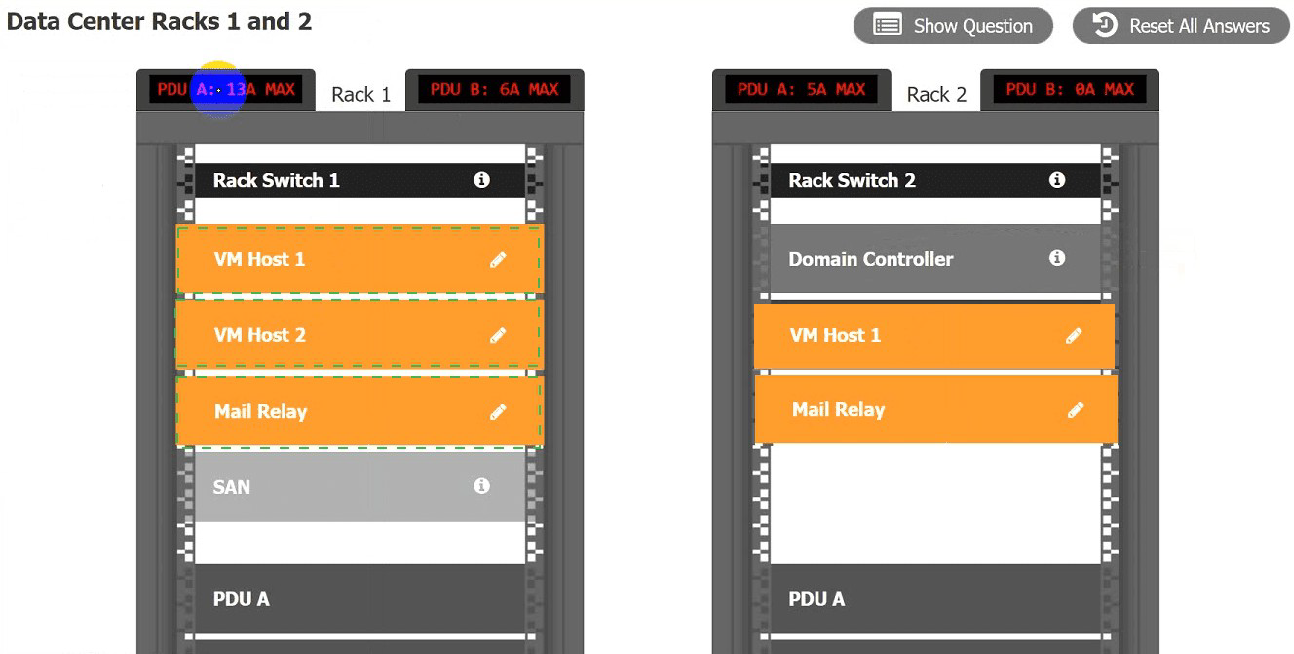
A recent power Outage caused email services to go down. A sever administrator also received alerts from the datacenter’s UPS.
After some investigation, the server administrator learned that each POU was rated at a maximum Of 12A.
INSTRUCTIONS
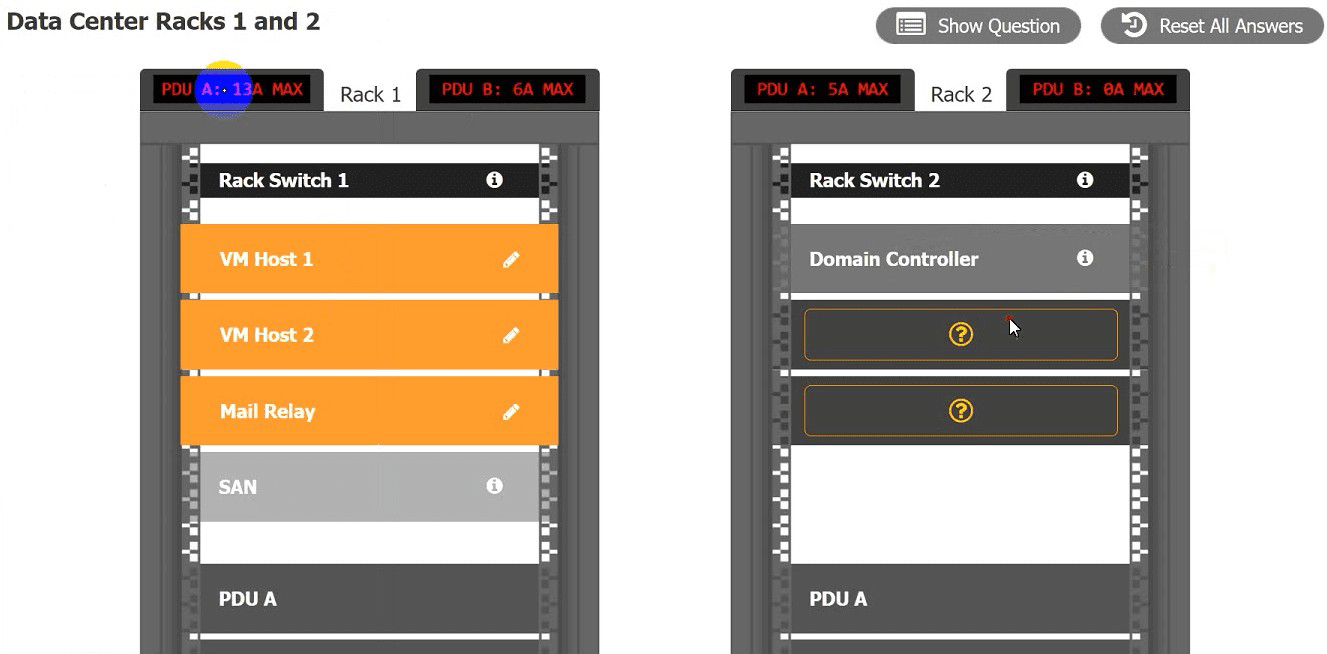
Ensure power redundancy is implemented throughout each rack and UPS alarms are resolved. Ensure the maximum potential PDU consumption does not exceed 80% or 9.6A).
a. PDU selections must be changed using the pencil icon.
b. VM Hosts 1 and 2 and Mail Relay can be moved between racks.
c. Certain devices contain additional details

Show answerHide answer

Explanation

Question 96 Choose 1
A technician needs to deploy an operating system that would optimize server resources.
Which of the following server installation methods would BEST meet this requirement?
Show answerHide answer

Correct answer: C Core

Question 97 Choose 1
Which of the following can be used to map a network drive to a user profile?
Show answerHide answer

Correct answer: C Login script

Explanation

Explanation:

In enterprise Windows environments, login scripts are the established and supported method for automatically mapping network drives to a user’s profile during logon. These scripts execute in the user’s security context immediately after authentication, allowing administrators to dynamically assign drive letters based on user identity, group membership, departmental OU, or other Active Directory attributes.

Login scripts are typically written in batch (.bat), PowerShell (.ps1), or legacy VBScript (.vbs) and can be deployed via:

Group Policy Objects (GPO):
User Configuration → Policies → Windows Settings → Scripts (Logon/Logoff) → Logon
User Account Properties in Active Directory Users and Computers:
Profile tab → Logon script field

Practical Example (Batch Login Script):

batch@echo off
:: Map departmental shared drive if user is in Sales group
net use S: \\CorpFS01\Sales /persistent:yes

:: Map personal home drive using username variable
net use H: \\CorpFS02\Users\%username% /persistent:yes

:: Conditional mapping using IFMEMBER (legacy tool)
IFMEMBER "Finance Users"
net use F: \\FinanceFS\SecureData /persistent:yes

This ensures consistent, repeatable drive mappings across all domain-joined workstations without manual intervention.

Why the other options are incorrect:

A. System service
System services run under privileged accounts like Local System, Local Service, or Network Service and start at boot time—before any user logs in. They operate outside the interactive user session and cannot access or modify the user’s desktop environment, including drive mappings. Attempting to map a drive via a service would make it available only to the service account, not the logged-on user.

B. Network service
This is a predefined low-privilege service account in Windows, not a tool or mechanism for configuration. It is used by services (e.g., IIS, SQL Server) to access network resources securely. It has no capability to execute user logon actions or map drives to user profiles.

D. Kickstart script
A Kickstart script (.ks file) is part of the Anaconda installer used in Red Hat Enterprise Linux (RHEL), CentOS, and Fedora for automated OS deployment. It defines partitioning, package selection, and post-install tasks during system provisioning—not user logon processes. It is completely unrelated to Windows networking or drive mapping.

Reference:
CompTIA Server+ SK0-005 Objectives – 2.3 “Given a scenario, configure user access to server resources” (login scripts).
Microsoft Docs – “Assign logon scripts to users or groups” (Group Policy > User Configuration > Policies > Windows Settings > Scripts > Logon).
Question 98 Choose 1
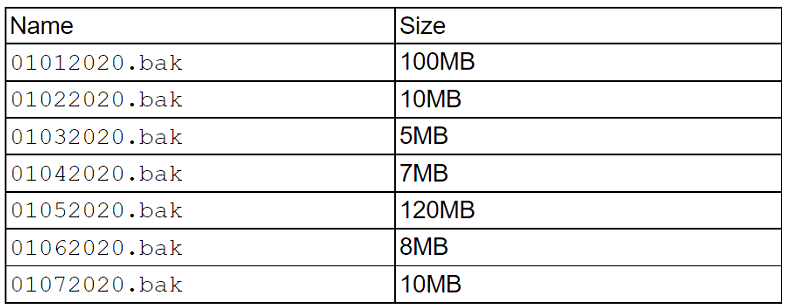
A technician needs to restore data from a backup. The technician has these files in the backup inventory:

Which of the following backup types is being used if the file 01062020.bak requires another file to restore data?
Show answerHide answer

Correct answer: B Incremental

Explanation

Explanation

The backup type being used is B. Incremental because it requires another file (specifically, the last full backup and potentially other incremental files) to fully restore the data.
An Incremental backup only captures the data that has changed since the last backup of any type (either a full backup or the previous incremental backup).
Because each incremental file (like 01062020.bak) contains only a small "slice" of the changes, it cannot be used alone to restore the entire system or dataset to the point in time it was taken.
Restoration from an incremental backup set requires the initial full backup (the base) PLUS all subsequent incremental backups applied sequentially, up to the desired restore point. This is why the technician noted that 01062020.bak "requires another file to restore data."

Incorrect Options

A. Full

A Full backup contains a complete copy of all the data at the time it was created. It is the only backup type that can be restored entirely on its own, without requiring any other backup files.

C. Snapshot

A Snapshot is a point-in-time reference (like a freeze-frame) of a virtual machine or a volume's file system, typically storing only the differences from the base image. While a snapshot is dependent on a base image, it is a feature of virtual environments or file systems (like ZFS) and not a traditional file-based backup type that fits the .bak extension and the described dependency chain as closely as an incremental backup does.

D. Differential

A Differential backup is dependent on another file, but only one other file:
the last full backup. A differential backup captures all changes since the last full backup.
To restore from a differential set, you only need the most recent full backup and the most recent differential backup. It does not require all previous differential or incremental files, unlike the incremental method.
Question 99 Choose 2
An administrator is deploying a new secure web server. The only administration method that is permitted is to connect via RDP. Which of the following ports should be allowed?
(Select TWO).
Show answerHide answer

Correct answer: D, F 4433389

Explanation

Explanation

The question specifies two requirements for the server:

It must be a secure web server.
The only permitted administration method is RDP.
Therefore, the firewall must allow traffic for both the secure web service and the RDP administration access.

D. 443 (Secure Web Server):
Port 443 is the standard, well-known port for HTTPS (Hypertext Transfer Protocol Secure). This is the protocol used for a secure web server, typically using TLS/SSL encryption.

F. 3389 (RDP Administration):
Port 3389 is the standard, well-known port for the Remote Desktop Protocol (RDP), which is required to fulfill the administrative access requirement.

Why the others are incorrect:

A. 53:
Used for DNS (Domain Name System). Essential for network function, but not required specifically for RDP or the secure web service itself.

B. 80:
Used for HTTP (non-secure web traffic). This is explicitly not needed for a secure web server, which uses 443.

C. 389:
Used for LDAP (Lightweight Directory Access Protocol). Used for directory services, but not required for RDP or the web server function itself.

E. 45:
Not a standard, well-known port for common server services.

G. 8080:
A common alternative/proxy port for web traffic, but 443 is the standard for a secure server.

Reference
This question relates to the Server Networking and Server Security domains of the CompTIA Server+ (SK0-005) exam, specifically the knowledge of well-known ports and security best practices:
Domain 2.0: Server Security (Configuring firewalls/security groups).
Domain 4.0: Troubleshooting (Diagnosing network connectivity based on ports).

Key Ports:
TCP 443 (HTTPS): Secure communication.
TCP 3389 (RDP): Remote Windows server administration.
Question 100 Choose 1
Which of the following cloud models is BEST described as running workloads on resources that are owned by the company and hosted in a company-owned data center, as well as on rented servers in another company's data center?
Show answerHide answer

Correct answer: B Hybrid

Explanation

Explanation

The scenario explicitly describes two environments:

Company-owned resources in a company-owned data center → private cloud.
Rented servers in another company’s data center → public cloud (e.g., AWS, Azure, GCP).
Running workloads across both = hybrid cloud.

Why the other options are incorrect:

A. Private
Only uses company-owned and company-hosted resources. Does not include rented external servers.

C. Community
A shared cloud infrastructure for a specific group (e.g., government agencies, universities). Not defined by ownership or rental — irrelevant here.

D. Public
Only uses third-party rented resources (e.g., AWS EC2). Does not include on-premises company-owned systems.

B. Hybrid (Correct)
Definition:
Integration of on-premises (private) and public cloud services, with orchestration between them.

Reference:
CompTIA Server+ SK0-005 Official Study Guide Chapter 7: Cloud Computing “Hybrid cloud: A combination of private cloud (on-premises) and public cloud services.”

CompTIA Server+ Exam Objectives (SK0-005) 1.4 Compare and contrast cloud computing concepts.
Hybrid: “Uses both on-premises and off-premises (public cloud) resources.”

NIST Special Publication 800-145
“The hybrid cloud infrastructure is a composition of two or more distinct cloud infrastructures (private, community, or public) that remain unique entities but are bound together.”
Full mock exam

Sit the SK0-005 exam before exam day

Full-length mocks with the same number of questions and the same time limit as the real SK0-005 exam. Every attempt draws a new set of questions from the full bank, so you can keep going until you pass comfortably.

Get full SK0-005 mock exam
  • 90questions per mock
  • 90 mintime limit
  • 493questions in the bank
  • Newmock on every attempt