You need to recommend a strategy for routing internet-bound traffic from the landing
zones. The solution must meet the landing zone requirements.
What should you recommend as part of the landing zone deployment?
Show answerHide answer
Correct answer: Aservice chaining
Explanation
Explanation:
In Azure landing zone architectures, a common security requirement is to inspect all internet-bound traffic from workloads. This is typically achieved using a hub-and-spoke model where the hub VNet contains a firewall/NVA. The solution needs to ensure traffic from spoke VNets (landing zones) destined for the internet is routed through this central inspection point.
Correct Answer:
A. service chaining
Correct Option Explanation:
Service chaining is the Azure capability that enables you to direct traffic from one virtual network to a virtual appliance (like a firewall or NVA) in a different virtual network via user-defined routes (UDRs). This is the specific mechanism used to implement the "forced tunneling" requirement through a central hub. You create a UDR in the landing zone subnet with a route (e.g., 0.0.0.0/0) pointing to the IP address of the Azure Firewall or NVA in the hub VNet as the next hop, "chaining" the traffic to that service.
Incorrect Options:
B. local network gateways:
A local network gateway represents an on-premises VPN device's IP address in Azure for setting up a Site-to-Site (S2S) VPN connection. It is used for hybrid connectivity, not for routing internet traffic between Azure VNets.
C. forced tunneling:
This is the requirement or design goal (to "force" internet traffic through an inspection point), not the implementation component you deploy. Forced tunneling is achieved by deploying service chaining with UDRs. The question asks for what to deploy as part of the landing zone.
D. a VNet-to-VNet connection:
This typically refers to VNet Peering, which directly connects two VNets. While peering is needed for the hub-spoke connectivity, it alone does not force traffic through an appliance. Without UDRs (service chaining), peered traffic flows directly between VNets.
To give a definitive answer, the landing zone requirements would need to specify the intent to route internet traffic through a centralized security service. Given the options, "service chaining" is the technical implementation for that pattern.
Question 12Choose 1
A customer has a Microsoft 365 E5 subscription and an Azure subscription.
The customer wants to centrally manage security incidents, analyze log, audit activity, and
search for potential threats across all deployed services.
You need to recommend a solution for the customer. The solution must minimize costs.
What should you include in the recommendation?
Show answerHide answer
Correct answer: DMicrosoft Sentinel
Question 13Choose 1
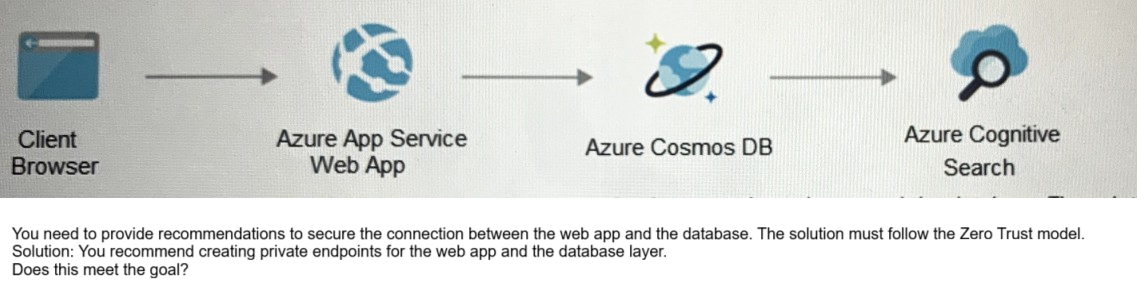
Your on-premises network contains an e-commerce web app that was developed in
Angular and Nodejs. The web app uses a MongoDB database. You plan to migrate the
web app to Azure. The solution architecture team proposes the following architecture as an
Azure landing zone.
Show answerHide answer
Correct answer: AYes
Explanation
Explanation: When using Azure-provided PaaS services (e.g., Azure Storage, Azure
Cosmos DB, or Azure Web App, use the PrivateLink connectivity option to ensure all data
exchanges are over the private IP space and the traffic never leaves the Microsoft network.
https://docs.microsoft.com/en-us/azure/cosmos-db/how-to-configure-private-endpoints
Question 14Choose 3
Your company plans to apply the Zero Trust Rapid Modernization Plan (RaMP) to its IT
environment.
You need to recommend the top three modernization areas to prioritize as part of the plan.
Which three areas should you recommend based on RaMP? Each correct answer presents part of the solution.
NOTE: Each correct selection is worth one point.
Show answerHide answer
Correct answer: A, B, Ddata, compliance, and governance
user access and productivity
modern security operations
Question 15Choose 1
You have an Azure subscription that has Microsoft Defender for Cloud enabled. You need
to enforce ISO 2700V2013 standards for the subscription. The solution must ensure that
noncompliant resources are remediated automatically.
What should you use?
You have a customer that has a Microsoft 365 subscription and uses the Free edition of
Azure Active Directory (Azure AD)
The customer plans to obtain an Azure subscription and provision several Azure resources.
You need to evaluate the customer's security environment.
What will necessitate an upgrade from the Azure AD Free edition to the Premium edition?
Show answerHide answer
Correct answer: DAzure AD Multi-Factor Authentication
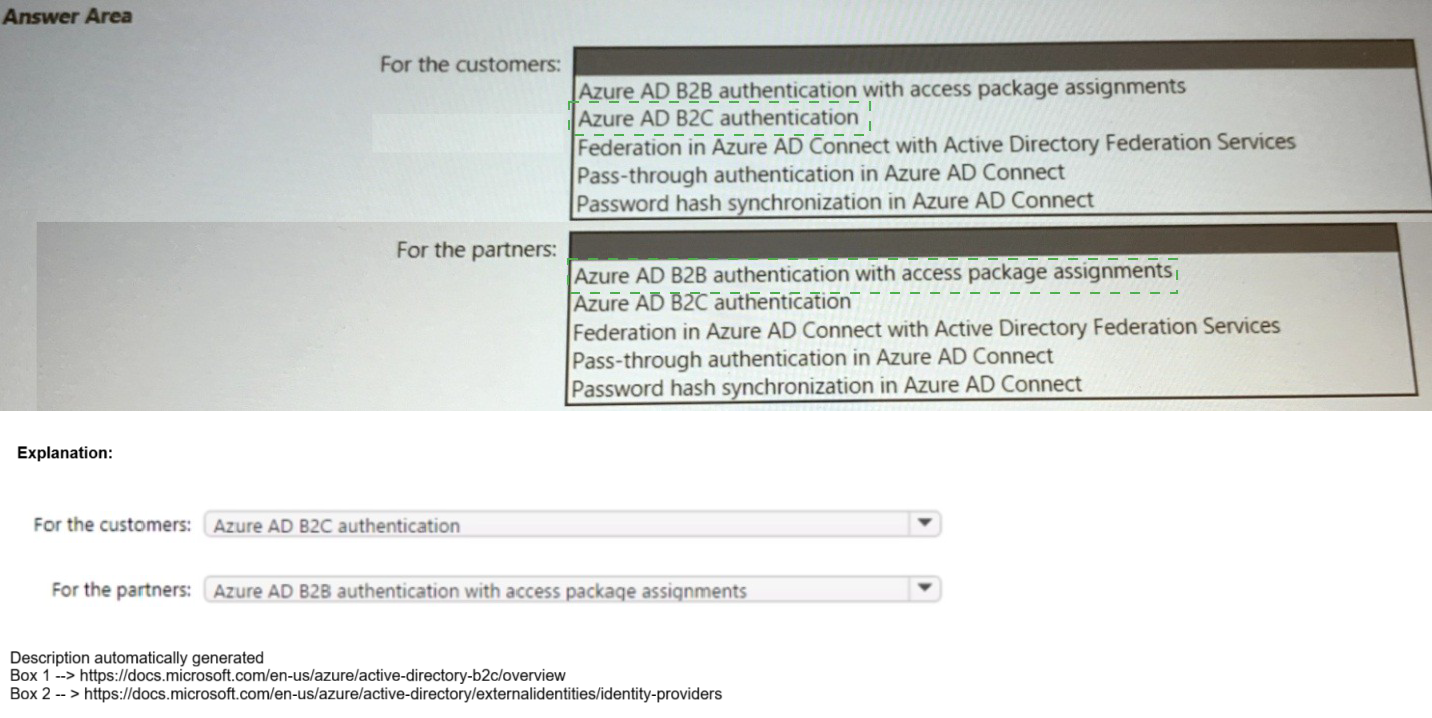
Your company has a Microsoft 365 E5 subscription, an Azure subscription, on-premises
applications, and Active Directory Domain Services (AD DS).
You need to recommend an identity security strategy that meets the following
requirements:
• Ensures that customers can use their Facebook credentials to authenticate to an Azure
App Service website
• Ensures that partner companies can access Microsoft SharePoint Online sites for the
project to which they are assigned
The solution must minimize the need to deploy additional infrastructure components. What
should you include in the recommendation? To answer, select the appropriate options in
the answer area.
NOTE: Each correct selection is worth one point.
Show answerHide answer
Explanation
Question 18Choose 2
Your company is moving a big data solution to Azure.
The company plans to use the following storage workloads:
• Azure Storage blob containers
• Azure Data Lake Storage Gen2
• Azure Storage file shares
• Azure Disk Storage
Which two storage workloads support authentication by using Azure Active Directory
(Azure AD)?
Each correct answer presents a complete solution. NOTE: Each correct selection is worth
one point.
Show answerHide answer
Correct answer: B, DAzure Storage blob containers
Azure Data Lake Storage Gen2
Your company has an on-premise network in Seattle and an Azure subscription. The onpremises
network contains a Remote Desktop server.
The company contracts a third-party development firm from France to develop and deploy
resources to the virtual machines hosted in the Azure subscription.
Currently, the firm establishes an RDP connection to the Remote Desktop server. From the
Remote Desktop connection, the firm can access the virtual machines hosted in Azure by
using custom administrative tools installed on the Remote Desktop server. All the traffic to
the Remote Desktop server is captured by a firewall, and the firewall only allows specific
connections from France to the server.
You need to recommend a modern security solution based on the Zero Trust model. The
solution must minimize latency tor developers.
Which three actions should you recommend? Each correct answer presents part of the
solution.
NOTE: Each correct selection is worth one point.
Show answerHide answer
Correct answer: B, C, DImplement Azure Firewall to restrict host pool outbound access.
Configure Azure Active Directory (Azure AD) Conditional Access with multi-factor
authentication (MFA) and named locations.
Migrate from the Remote Desktop server to Azure Virtual Desktop.
You have an Azure AD tenant that syncs with an Active Directory Domain Services {AD DS) domain. Client computers run Windows and are hybrid-joined to Azure AD.
You are designing a strategy to protect endpoints against ransomware. The strategy
follows Microsoft Security Best Practices.
You plan to remove all the domain accounts from the Administrators group on the Windows
computers.
You need to recommend a solution that will provide users with administrative access to the
Windows computers only when access is required. The solution must minimize the lateral
movement of ransomware attacks if an administrator account on a computer is
compromised.
What should you include in the recommendation?
Full-length mocks with the same number of questions and the same time limit as the real SC-100 exam. Every attempt draws a new set of questions from the full bank, so you can keep going until you pass comfortably.