Microsoft certification · Exam SC-100

SC-100 Mock Exam

Microsoft Cybersecurity Architect

Find out if you're ready for SC-100. Take the free timed mock exam and get your score in minutes, or study the free SC-100 questions below with answers and explanations.

20 questions · 33 minutes · free, no sign-up

Free SC-100 questions

1–10 of 50 free
Question 1 Choose 1
You need to recommend a solution to meet the security requirements for the InfraSec group. What should you use to delegate the access?
Show answerHide answer

Correct answer: B a custom role-based access control (RBAC) role

Explanation

Explanation:
To meet specific security requirements for the InfraSec group, the most precise and flexible way to delegate access is by creating a custom RBAC role. This allows you to:
Define exact permissions tailored to InfraSec’s operational needs (e.g., read-only access to security insights, ability to manage Defender settings, etc.)
Assign the role at the appropriate scope (subscription, resource group, or management group)
Enforce least privilege and segregation of duties, aligning with Microsoft’s Zero Trust principles
This approach is recommended when built-in roles (like Security Reader or Contributor) don’t fully meet the group’s requirements.

❌ Why the other options are incorrect:
A. Subscription:
This is a scope, not a method of delegation. You still need a role (built-in or custom) to define what access is granted.
C. Resource group:
Also a scope, not a delegation mechanism. You can assign roles at this level, but it doesn’t define what access is granted.
D. Management group:
Another scope used for organizing multiple subscriptions. It’s useful for governance, but again, you need a role to delegate access.

📚 Reference:
Azure RBAC custom roles
Best practices for RBAC
Question 2 Choose 1
You need to recommend a solution to scan the application code. The solution must meet the application development requirements. What should you include in the recommendation?
Show answerHide answer

Correct answer: B GitHub Advanced Security

Explanation

Explanation:
To scan application code for vulnerabilities, secrets, and other security issues during development, the recommended solution is GitHub Advanced Security (GHAS).

GHAS provides:
Code scanning
Uses tools like CodeQL to automatically analyze code for security vulnerabilities.
Integrates with GitHub Actions to scan code on every pull request or commit.
Secret scanning
Detects sensitive information such as API keys, credentials, and tokens embedded in the code.
Dependency review
Identifies vulnerable dependencies in project manifests (like package.json, pom.xml).
This solution meets application development requirements because it integrates directly into the development workflow, providing early detection of vulnerabilities before deployment.

Why the Other Options Are Incorrect:
A. Azure Key Vault
Used to store secrets, certificates, and keys securely, but it does not scan application code.
C. Application Insights in Azure Monitor
Used for application performance monitoring and telemetry, not code vulnerability scanning.
D. Azure DevTest Labs
Provides environments for testing and development, but does not perform security scanning of code.

Reference:
🔗 GitHub Docs: GitHub Advanced Security
Question 3
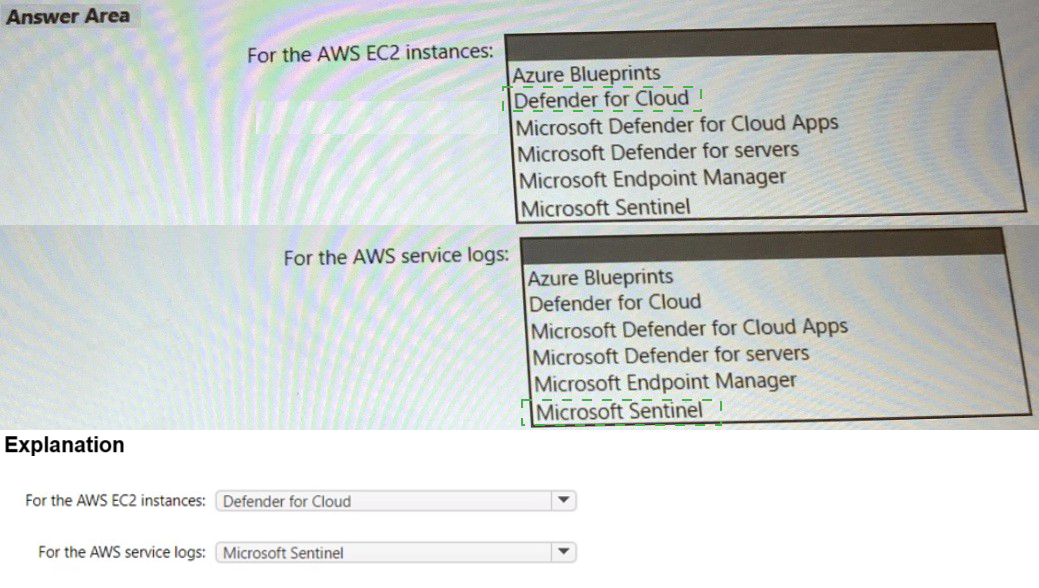
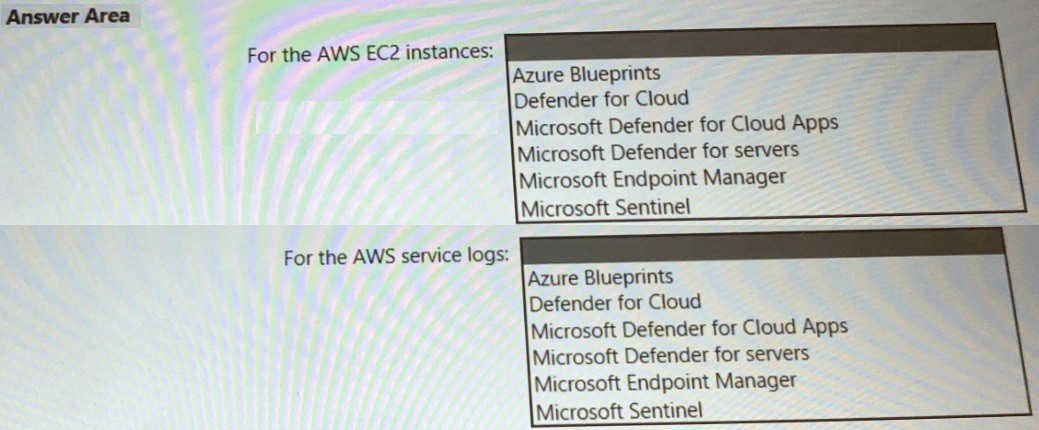
You need to recommend a solution to meet the AWS requirements.
What should you include in the recommendation? To answer, select the appropriate options in the answer area.
NOTE: Each correct selection is worth one point.
Show answerHide answer

Explanation


Explanation:
The requirement is to meet AWS security needs, which involves protecting compute resources and collecting logs for a centralized security view.

1. For the AWS EC2 instances: Microsoft Defender for servers
Reasoning:
Microsoft Defender for servers (specifically its Plan 2) is the component of Defender for Cloud that provides threat detection and advanced defenses for your Windows and Linux machines, regardless of where they are hosted. This includes:
Vulnerability Assessment:
Scans your EC2 instances for OS and software vulnerabilities.
Just-in-Time (JIT) VM Access:
Allows you to secure management ports on your EC2 instances.
Endpoint Detection and Response (EDR):
Provides advanced behavioral threat detection and investigation capabilities for the servers.
File Integrity Monitoring (FIM):
Monitors changes to critical files and registry keys. Since EC2 instances are virtual machines, Defender for servers is the direct and correct service to protect them.

2. For the AWS service logs: Microsoft Sentinel
Reasoning:
Microsoft Sentinel is a cloud-native Security Information and Event Management (SIEM) solution. Its primary function is to collect, aggregate, and analyze log data from a wide variety of sources.
It has a built-in data connector for Amazon Web Services that can pull in logs from services like AWS CloudTrail, VPC Flow Logs, and GuardDuty.
Once the logs are in Sentinel, you can use its analytics rules, workbooks, and hunting capabilities to detect threats and investigate incidents across your hybrid cloud environment (Azure and AWS). Therefore, for collecting and analyzing AWS service logs, Microsoft Sentinel is the correct recommendation.

Why the Other Options Are Incorrect:
Azure Blueprints:
This is an Azure service for deploying and governing environments using reusable artifacts called blueprints. It is not a security monitoring or threat protection tool and is not used for AWS resources.
Defender for Cloud:
While this is the overarching service, the question asks for the specific component. "Defender for servers" is the precise feature set within Defender for Cloud that protects compute instances. Selecting the broader "Defender for Cloud" is less specific than the exact product name provided in the list.
Microsoft Defender for Cloud Apps:
This is a Cloud Access Security Broker (CASB) used to discover and control access to SaaS applications (like Salesforce, Dropbox). It is not the primary tool for securing IaaS virtual machines (EC2) or ingesting raw service logs from AWS.
Microsoft Endpoint Manager (MEM):
This is a unified endpoint management (UEM) platform for managing devices (e.g., Windows 10/11, macOS, iOS, Android). It is not designed to manage server OSes in the cloud or collect cloud platform logs.

Reference:
Microsoft Learn - Microsoft Defender for servers:
Microsoft Learn - Connect AWS to Microsoft Sentinel:
Question 4
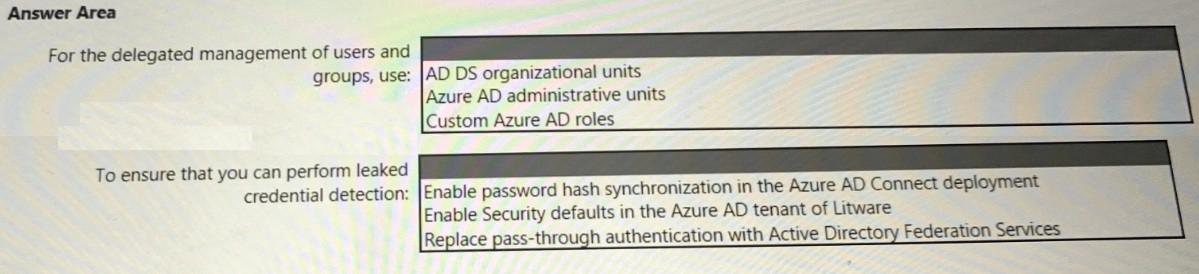
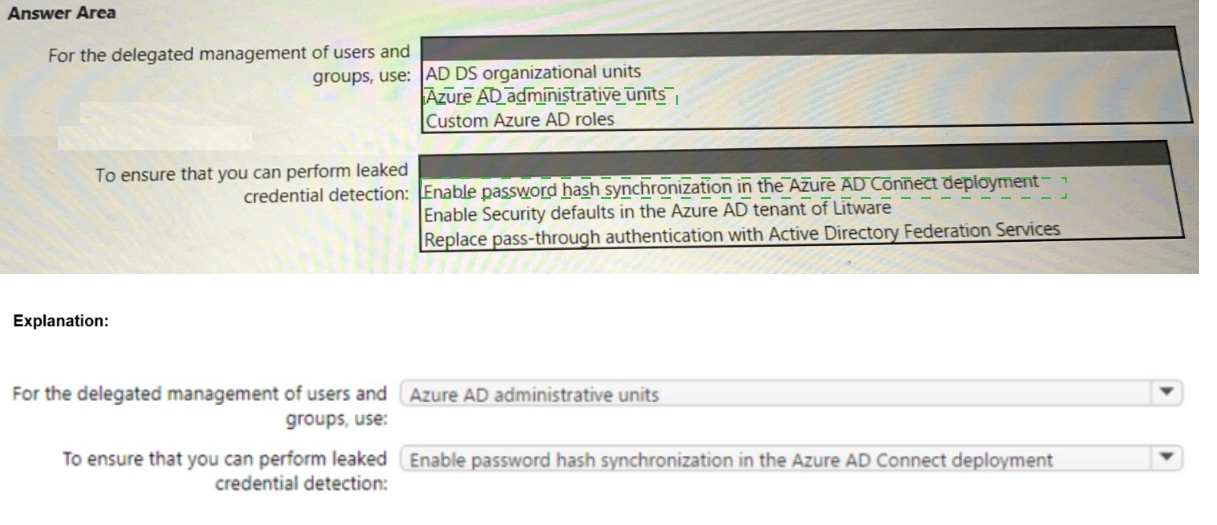
You need to recommend an identity security solution for the Azure AD tenant of Litware. The solution must meet the identity requirements and the regulatory compliance requirements.
What should you recommend? To answer, select the appropriate options in the answer area.
NOTE: Each correct selection is worth one point.
Show answerHide answer

Explanation


Explanation:
1. For the delegated management of users and groups, use: Azure AD administrative units
Reasoning:
This requirement is about delegating administrative permissions for a subset of users, which is a common need for large organizations or those with regulatory requirements for data locality/segregation.
Azure AD Administrative Units (AUs) are containers that allow you to segment your Azure AD users and groups. You can then assign a role (like User Administrator or Helpdesk Administrator) that is scoped only to a specific Administrative Unit. This allows, for example, a regional IT admin to manage users only in their region, without having global permissions.
The other options are incorrect:
AD DS organizational units:
This is for on-premises Active Directory and does not apply to delegating management within an Azure AD tenant.
Custom Azure AD roles:
While you can create custom roles, they are for defining custom permissions, not for scoping administration to a specific group of users. You would use a custom role in combination with an Administrative Unit to achieve granular delegation.

2. To ensure that you can perform leaked credential detection:
Enable password hash synchronization in the Azure AD Connect deployment
Reasoning:
Leaked credential detection is a critical feature of Azure AD Identity Protection. This service works by comparing user sign-in credentials (hashes of passwords) against a continuously updated database of known leaked credentials.
For this comparison to happen, Azure AD needs access to the password hash. Password Hash Synchronization in Azure AD Connect synchronizes a hash of the user's on-premises AD password hash to Azure AD. This is a prerequisite for leaked credential detection to function.
The other options are incorrect:
Enable Security defaults:
This enables basic security settings like requiring MFA for admins and blocking legacy authentication. It does not, by itself, enable the advanced machine learning-based leaked credential detection service.
Replace pass-through authentication with Active Directory Federation Services (AD FS): With AD FS, passwords remain on-premises and are not hashed in Azure AD. Therefore, Azure AD Identity Protection cannot perform leaked credential detection in this configuration. Enabling Password Hash Sync is actually recommended even with AD FS precisely to enable these features.

Reference:
Microsoft Learn - Administrative units in Azure Active Directory:
Microsoft Learn - What is password hash synchronization?: This document explains that PHS is required for leaked credential detection.
Question 5 Choose 1
You need to recommend a solution for securing the landing zones. The solution must meet the landing zone requirements and the business requirements. What should you configure for each landing zone?
Show answerHide answer

Correct answer: C Microsoft Defender for Cloud

Explanation

Explanation:
The primary purpose of a landing zone is to establish a secure, scalable, and well-governed foundation for hosting workloads in Azure. Microsoft Defender for Cloud is the central, Azure-native service for Cloud Security Posture Management (CSPM) and Cloud Workload Protection Platform (CWPP). It is a non-negotiable component for any production-grade landing zone because it provides continuous security assessment, compliance monitoring, and threat protection across all deployed resources from the moment they are created.

How it Meets the Requirements:
It directly fulfills the implied "landing zone requirements" for a secure baseline by providing a secure score, regulatory compliance dashboards (e.g., for NIST, ISO), and actionable recommendations to harden configurations (e.g., enabling encryption, enforcing network security rules). It meets "business requirements" by unifying security management, reducing business risk, and helping to demonstrate due diligence for compliance.

Why the Other Options Are Incorrect:
A. Azure DDoS Protection Standard:
This is a specific, high-value service for protecting public endpoints from volumetric attacks. However, it is not a foundational requirement for every landing zone. A landing zone hosting only internal, private APIs or backend services with no public IPs would not require it. It is a targeted control, not the ubiquitous security posture tool that Defender for Cloud is.
B. an Azure Private DNS Zone:
This is a core networking component for managing custom domain name resolution within a virtual network. While critical for many architectures for service discovery, it is a design choice for network architecture, not a primary security control that defines the security posture of the landing zone itself.
D. an ExpressRoute Gateway:
This component is used to connect an Azure virtual network to an on-premises network via a private ExpressRoute circuit. Its necessity is purely dependent on a specific hybrid connectivity requirement. A fully cloud-native landing zone with no on-premises dependencies would not need this gateway. It is a connectivity solution, not a security foundational service.

Reference:
Microsoft Learn - Introduction to Microsoft Defender for Cloud:
This document establishes Defender for Cloud as the central platform for security posture management and threat protection.
Microsoft Cloud Adoption Framework - Azure landing zone security governance:
This guidance explicitly positions security services like Defender for Cloud as a foundational element of a secure landing zone.
Question 6 Choose 2
Your company has an office in Seattle.
The company has two Azure virtual machine scale sets hosted on different virtual networks.
The company plans to contract developers in India.
You need to recommend a solution provide the developers with the ability to connect to the virtual machines over SSL from the Azure portal. The solution must meet the following requirements:
• Prevent exposing the public IP addresses of the virtual machines.
• Provide the ability to connect without using a VPN.
• Minimize costs.
Which two actions should you perform? Each correct answer presents part of the solution.
NOTE: Each correct selection is worth one point.
Show answerHide answer

Correct answer: A, D Deploy Azure Bastion to one virtual network. Create a hub and spoke network by using virtual network peering.

Explanation

Explanation:
The solution must enable secure developer access from India to VMs in two different Azure virtual networks without public IP exposure, VPN, or excessive cost.

A. Deploy Azure Bastion to one virtual network:
Azure Bastion provides secure RDP/SSH connectivity directly through the Azure portal over SSL (port 443), eliminating the need for public IPs on VMs. Deploying it to one network minimizes costs while providing the core service.
D. Create a hub and spoke network using VNet peering:
This enables the single Bastion host in the "hub" VNet to connect to VMs in both "spoke" VNets. VNet peering creates private connections between networks, allowing Bastion to route traffic to all VMs while maintaining a single, cost-effective deployment.

Why This Works:
No Public IPs: Bastion connects privately via the Azure backbone
No VPN: Uses native Azure networking
Portal Access: Direct SSL connection via Azure portal
Cost Optimization: Single Bastion deployment serves multiple networks
Security: All traffic remains within Azure's trusted network

Why Other Options Fail:
B. Deploy Azure Bastion to each virtual network:
While functional, this violates the "minimize costs" requirement by duplicating Bastion services unnecessarily.
C. Enable just-in-time VM access:
JIT still requires opening RDP/SSH ports and typically uses public IPs. It doesn't provide the Azure portal-based SSL connection that Bastion offers.
E. Create NAT and network rules in Azure Firewall:
This introduces unnecessary complexity and cost. It would require public IPs on the firewall and doesn't provide the seamless Azure portal integration that Bastion delivers natively.

References:
Microsoft Learn - What is Azure Bastion:
Explains how Bastion provides secure VM connectivity without public IPs
Microsoft Learn - Virtual Network Peering:
Details how VNet peering enables cross-network connectivity
Microsoft Learn - Just-in-time VM Access:
Clarifies that JIT manages port access but doesn't eliminate need for public endpoints
Question 7 Choose 1
You have a Microsoft 365 subscription that syncs with Active Directory Domain Services (AD DS). You need to define the recovery steps for a ransomware attack that encrypted data in the subscription The solution must follow Microsoft Security Best Practices.

What is the first step in the recovery plan?
Show answerHide answer

Correct answer: A Disable Microsoft OneDnve sync and Exchange ActiveSync.

Explanation

Explanation:
In a ransomware attack impacting a Microsoft 365 environment, the immediate priority is to contain the attack and prevent it from spreading to other devices or syncing encrypted files to the cloud. Following the incident response phases (Preparation, Detection, Containment, Eradication, Recovery, Lessons Learned), containment is a critical first action to limit damage.

Correct Option:

A. Disable Microsoft OneDrive sync and Exchange ActiveSync.
This is the correct first step for containment. It immediately prevents the ransomware from propagating encrypted or malicious files from the infected endpoint to your cloud storage (OneDrive) and email services (via Exchange ActiveSync). This action isolates the infection and stops the synchronization of potentially encrypted data, protecting your cloud-based backup and recovery points.

Incorrect Options:

B. Recover files to a cleaned computer or device.
This is a critical step, but it occurs later in the Recovery phase. You cannot begin safe recovery until you have first contained the threat and eradicated the malware from the environment to prevent re-infection.

C. Contact law enforcement.
While contacting relevant authorities may be part of an organization's incident response plan, it is not the first technical recovery step. The immediate technical priority is containment to minimize operational damage.

D. From Microsoft Defender for Endpoint, perform a security scan.
This action falls under the Detection and Analysis or Eradication phases. While crucial for identifying and removing the threat, the first step after detection is typically rapid Containment to stop ongoing damage before moving to deeper investigation and eradication.

Reference:
Microsoft's ransomware response best practices emphasize the "Contain" phase first. The official guidance in the Microsoft Security blog on ransomware recovery lists steps like "Disable end-user cloud sync clients" as an immediate containment action to prevent synchronization of infected files.
Question 8
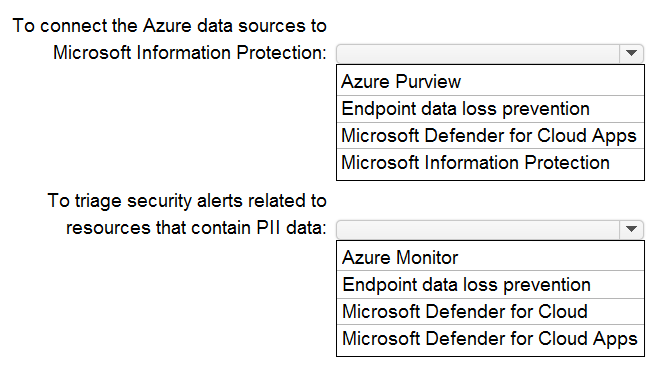
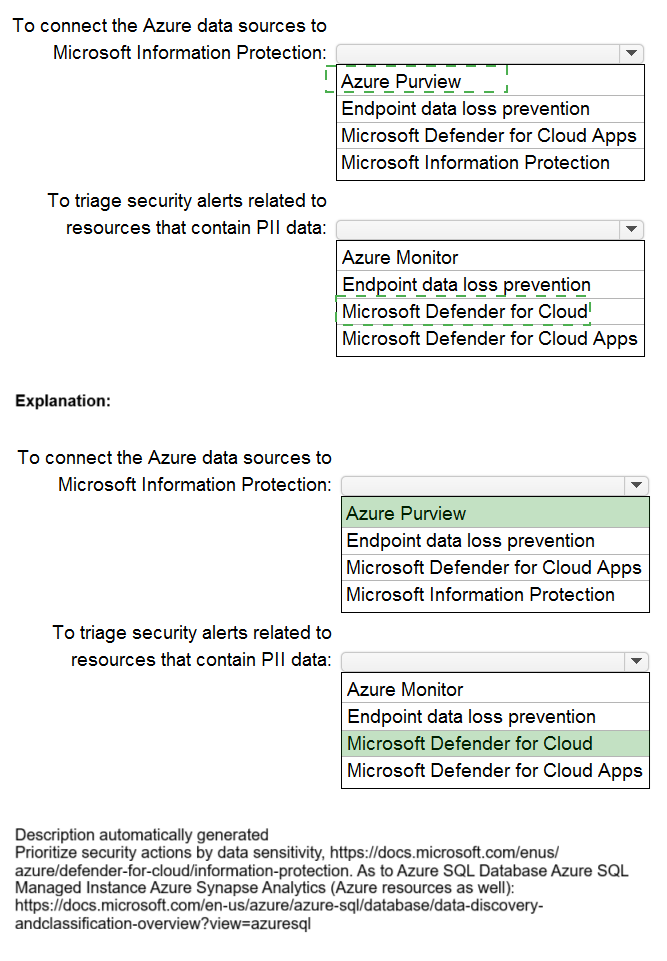
Your company is migrating data to Azure. The data contains Personally Identifiable Information (Pll). The company plans to use Microsoft Information Protection for the Pll data store in Azure. You need to recommend a solution to discover Pll data at risk in the Azure resources.
What should you include in the recommendation? To answer, select the appropriate options in the answer area.
NOTE: Each correct selection is worth one point.
Show answerHide answer

Explanation


Explanation:
The question asks for a solution to discover PII data at risk in Azure resources. This requires two integrated capabilities: 1) A data governance service to scan, classify, and label data across Azure data sources, and 2) A security posture management tool to assess the security configuration of those resources and generate alerts.

Correct Options:

Azure Purview:
This is Microsoft's unified data governance service. It is specifically designed to connect to Azure data sources (like Azure SQL, Storage, Cosmos DB), scan them to automatically discover and classify sensitive information like PII, and apply sensitivity labels from Microsoft Information Protection. It creates a data map and provides the foundational discovery of where your PII resides.

Microsoft Defender for Cloud:
This is the central tool for cloud security posture management (CSPM) and threat protection. Once Purview identifies PII, Defender for Cloud assesses the security configuration of the underlying Azure resources (e.g., storage accounts, databases) containing that data. It provides security recommendations and generates security alerts for misconfigurations or threats that put that sensitive data at risk, allowing you to prioritize and triage alerts effectively.

Incorrect Options:

Endpoint data loss prevention:
This component is part of Microsoft Purview (formerly Microsoft 365) DLP and is focused on protecting data on Windows 10/11 devices and apps, not on discovering data within Azure resources like storage accounts or databases.

Microsoft Defender for Cloud Apps:
This is a Cloud Access Security Broker (CASB) used to discover, investigate, and govern SaaS applications (like Salesforce, Dropbox). While it can integrate with Azure Purview and has some Azure resource visibility, its primary strength is not in scanning native Azure PaaS/IaaS data sources for PII classification or managing their security posture, which is the core of this scenario.

Microsoft Information Protection:
This is the overarching framework and labeling service for classifying and protecting data. While Purview uses its labels, MIP itself does not "connect to Azure data sources" to scan and discover PII; that is the role of a data scanner like Azure Purview.

Azure Monitor:
This is a service for collecting, analyzing, and acting on telemetry and logs. It is not a dedicated tool for discovering PII data within data stores or for triaging security posture alerts related to specific sensitive data classifications.
Question 9 Choose 1
Your company uses Azure Pipelines and Azure Repos to implement continuous integration and continuous deployment (CI/CD) workflows for the deployment of applications to Azure.
You are updating the deployment process to align with DevSecOps controls guidance in the Microsoft Cloud Adoption Framework for Azure.
You need to recommend a solution to ensure that all code changes are submitted by using pull requests before being deployed by the CI/CD workflow.
What should you include in the recommendation?
Show answerHide answer

Correct answer: B branch policies in Azure Repos

Explanation

Explanation:
This question focuses on enforcing DevSecOps controls within the development process before code reaches the CI/CD pipeline. The requirement is to mandate that all code changes are reviewed via a pull request (PR) before they can be merged and subsequently deployed. This is a source control and collaboration policy that must be enforced at the repository level.

Correct Option:

B. Branch policies in Azure Repos
This is the direct and correct solution. Branch policies are a feature of Git repositories in Azure Repos. You can configure policies (like requiring a minimum number of reviewers, requiring linked work items, or build validation) on critical branches like main or release. By enabling the "Require a minimum number of reviewers" and "Check for linked work items" policies, you enforce that all changes must go through a pull request meeting those criteria before they can be merged, satisfying the requirement.

Incorrect Options:

A. Custom roles in Azure Pipelines & D. Custom Azure roles
These are authorization tools, not workflow enforcement tools. Custom roles in Azure Pipelines or Azure RBAC control who can perform certain actions (e.g., trigger a pipeline, manage resources). They cannot enforce how code changes are submitted (via PR) before reaching the pipeline. A user with the right permissions could still push directly to a branch, bypassing PR.

C. Azure policies
Azure Policy is a governance tool for enforcing rules and effects on Azure resources (like VMs, storage). It operates at the Azure subscription/resource group level to ensure compliance with security, cost, or configuration standards. It cannot govern the workflow within a source code repository like Azure Repos.

Reference:
The Microsoft Cloud Adoption Framework for Azure's DevSecOps guidance explicitly recommends using branch policies to enforce code quality and review gates. The article "Enforce policies with Azure Repos" details how branch policies are the primary mechanism for requiring pull requests and reviews to protect important branches.
Question 10
You have an Active Directory Domain Services (AD DS) domain that contains a virtual desktop infrastructure (VDI). The VDI uses non-persistent images and cloned virtual machine templates. VDI devices are members of the domain.
You have an Azure subscription that contains an Azure Virtual Desktop environment. The environment contains host pools that use a custom golden image. All the Azure Virtual Desktop deployments are members of a single Azure Active Directory Domain Services (Azure AD DS) domain.
You need to recommend a solution to deploy Microsoft Defender for Endpoint to the hosts. The solution must meet the following requirements:
• Ensure that the hosts are onboarded to Defender for Endpoint during the first startup sequence.
• Ensure that the Microsoft Defender 365 portal contains a single entry for each deployed VDI host.
• Minimize administrative effort.
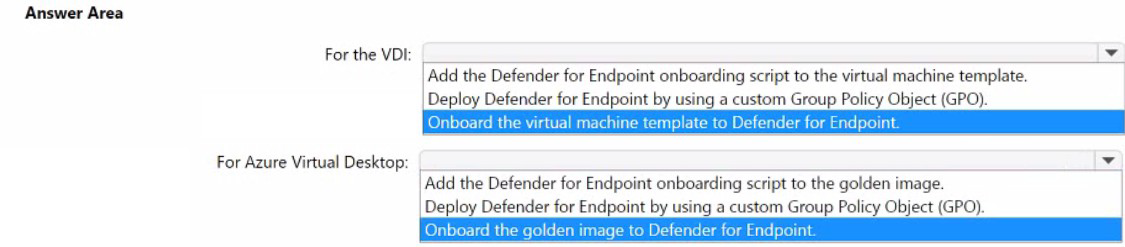
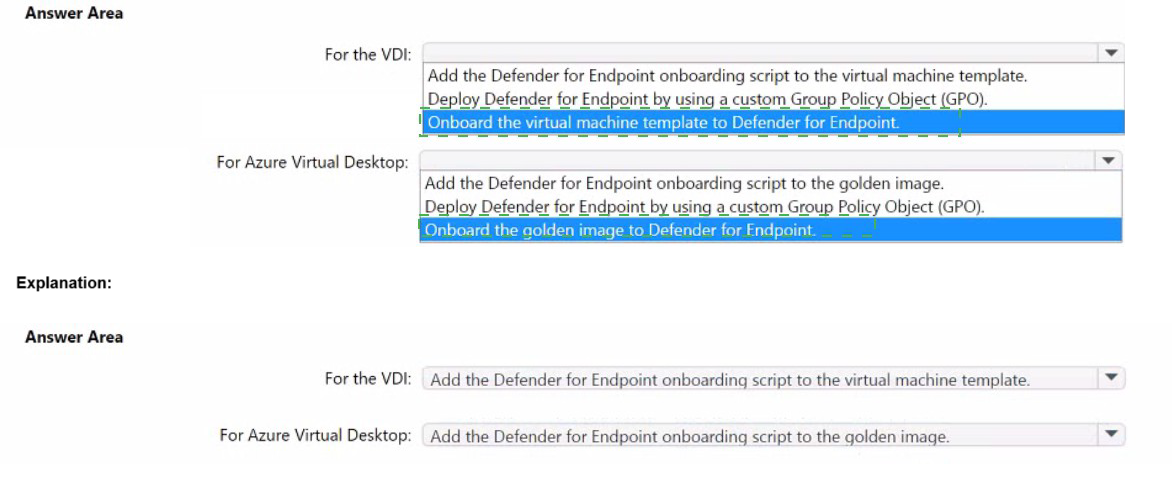
What should you recommend? To answer, select the appropriate options in the answer area.
NOTE: Each correct selection is worth one point.
Show answerHide answer

Explanation


Explanation:
The goal is to onboard non-persistent hosts to Defender for Endpoint at first startup with a single portal entry per host while minimizing effort. The key is to embed the onboarding configuration directly into the master image or template before cloning, so every new virtual machine (VM) instance is automatically onboarded with a unique device identity when it first boots.

Correct Options:
For the VDI: Add the Defender for Endpoint onboarding script to the virtual machine template.

For on-premises, non-persistent VDI using cloned templates, the most efficient method is to inject the onboarding script/package into the VM template's startup sequence (e.g., via Unattend.xml or a startup script). This ensures onboarding occurs at first boot of each cloned VM, creating a unique device record. Using a GPO would be less reliable for first-boot onboarding on non-persistent, constantly recreated VMs.

For Azure Virtual Desktop: Add the Defender for Endpoint onboarding script to the golden image.
For Azure Virtual Desktop host pools using a shared golden image, the prescribed best practice is to install the Defender for Endpoint agent and embed the onboarding script directly into the golden image itself. When new session hosts are provisioned from this image, they automatically run the script on startup, ensuring immediate onboarding.

Incorrect Options:

Deploy Defender for Endpoint by using a custom Group Policy Object (GPO).
This method is less suitable for first startup sequence onboarding, especially for non-persistent VMs. GPOs apply during periodic policy refresh cycles, which may cause a delay or failure in onboarding a short-lived VM before it is deleted. It does not guarantee immediate onboarding at first boot, which is a core requirement.

Onboard the virtual machine template / golden image to Defender for Endpoint.
You should never onboard the template/image itself. Onboarding the master image creates a single, static device identity in the Defender portal. When you clone from it, all VMs will share that same identity, causing duplicate alerts and a single entry for all deployed hosts instead of one per host. This violates the requirement for a unique entry per host and is a documented anti-pattern.

Reference:
Microsoft's official guidance for deploying Microsoft Defender for Endpoint on non-persistent VDI environments explicitly states: "Onboarding must be done in the context of the VM instance, not the image." It recommends methods like adding the onboarding script to the template for on-premises VDI and integrating it into the golden image for Azure Virtual Desktop to ensure automatic, per-device onboarding. The documentation warns against onboarding the image itself, as it leads to device duplication in the portal.
Full mock exam

Sit the SC-100 exam before exam day

Full-length mocks with the same number of questions and the same time limit as the real SC-100 exam. Every attempt draws a new set of questions from the full bank, so you can keep going until you pass comfortably.

Get full SC-100 mock exam
  • 65questions per mock
  • 105 mintime limit
  • 171questions in the bank
  • Newmock on every attempt
These SC-100 practice questions with explanations help candidates prepare for cybersecurity architect roles. Topics include zero trust strategy, security architecture design, risk management, and compliance. Each explanation provides insight into decision-making and best practices, helping learners understand complex security frameworks. This approach enhances strategic thinking and practical knowledge. By practicing these questions, candidates can improve their ability to design secure solutions and confidently handle architect-level challenges in the certification exam.


SC-100 - Microsoft Cybersecurity Architect Official Exam Blueprint and Weight:

1. Design Solutions That Align with Security Best Practices and Priorities
Official Exam Weight: 20-25%
Subtopics: Design security strategy to support business resiliency goals including identifying and prioritizing threats to business-critical assets, design solutions for business continuity and disaster recovery (BCDR) including secure backup and restore for hybrid and multicloud environments, design solutions for mitigating ransomware attacks including prioritization of BCDR and privileged access, evaluate solutions for security updates, design solutions that align with best practices for cybersecurity capabilities and controls, design solutions that align with best practices for protecting against insider external and supply chain attacks, design solutions that align with best practices for Zero Trust security including A Rapid modernization plan for Zero Trust (RaMP), design new or evaluate existing strategy for security and governance based on Microsoft Cloud Adoption Framework for Azure (CAF) and Azure Well-Architected Framework (WAF), recommend solutions for security and governance based on Microsoft Cloud Adoption Framework for Azure (CAF) and Microsoft Azure Well-Architected Framework, design solutions for implementing and governing security using Azure landing zones, design DevSecOps process that aligns with best practices in Microsoft Cloud Adoption Framework for Azure (CAF).

2. Design Security Operations, Identity, and Compliance Capabilities
Official Exam Weight: 25-30%
Subtopics: Design solution for detection and response that includes extended detection and response (XDR) and security information and event management (SIEM), design solution for centralized logging and auditing including Microsoft Purview Audit, design monitoring to support hybrid and multicloud environments, design solution for security orchestration and automated response (SOAR) including Microsoft Sentinel and Microsoft Defender XDR, design and evaluate security workflows including incident response threat hunting and incident management, design and evaluate threat detection coverage using MITRE ATT&CK matrices including Enterprise Mobile and industrial control systems (ICS), design solution for access to software as service (SaaS) platform as service (PaaS) infrastructure as service (IaaS) hybrid/on-premises and multicloud resources including identity networking and application controls, design solution for Microsoft Entra ID including hybrid and multi-cloud environments, design solution for external identities including business-to-business (B2B) and decentralized identity, design modern authentication and authorization strategy including Conditional Access continuous access evaluation risk scoring and protected actions, validate alignment of Conditional Access policies with Zero Trust strategy, specify requirements to harden Active Directory Domain Services (AD DS), design solution to manage secrets keys and certificates, design solution for assigning and delegating privileged roles using enterprise access model, evaluate security and governance of Microsoft Entra ID including Microsoft Entra Privileged Identity Management (PIM) entitlement management and access reviews, evaluate security and governance of Active Directory Domain Services (AD DS) including resilience to common attacks, design solution for securing administration of cloud tenants including SaaS and multicloud infrastructure and platforms, design solution for cloud infrastructure entitlement management, evaluate access review management solution, design solution for secure workstations for privileged access including remote access, translate compliance requirements into security controls, design solution to address compliance requirements using Microsoft Purview, design solution to address privacy requirements including Microsoft Priva, design Azure Policy solutions to address security and compliance requirements, evaluate and validate alignment with regulatory standards and benchmarks using Microsoft Defender for Cloud.

3. Design Security Solutions for Infrastructure
Official Exam Weight: 25-30%
Subtopics: Evaluate security posture using Microsoft Defender for Cloud including Microsoft cloud security benchmark (MCSB), evaluate security posture using Microsoft Secure Score, design integrated security posture management solutions that include Microsoft Defender for Cloud in hybrid and multi-cloud environments, select cloud workload protection solutions in Microsoft Defender for Cloud, design solution for integrating hybrid and multicloud environments using Azure Arc, design solution for Microsoft Defender External Attack Surface Management (Defender EASM), specify requirements and priorities for posture management process that uses Microsoft Security Exposure Management attack paths attack surface reduction security insights and initiatives, specify security requirements for servers including multiple platforms and operating systems, specify security requirements for mobile devices and clients including endpoint protection hardening and configuration, specify security requirements for IoT devices and embedded systems, evaluate solutions for securing operational technology (OT) and industrial control systems (ICS) using Microsoft Defender for IoT, specify security baselines for server and client endpoints, evaluate Windows Local Administrator Password Solution (Windows LAPS) solution, specify security baselines for SaaS PaaS and IaaS services, specify security requirements for IoT workloads, specify security requirements for web workloads, specify security requirements for containers, specify security requirements for container orchestration, evaluate solutions that include Azure AI services security, evaluate network designs to align with security requirements and best practices, evaluate solutions that use Microsoft Entra Internet Access as secure web gateway, evaluate solutions that use Microsoft Entra Internet Access for Microsoft Services including cross-tenant configurations, evaluate solutions that use Microsoft Entra Private Access.

4. Design Security Solutions for Applications and Data
Official Exam Weight: 20-25%
Subtopics: Evaluate security posture for productivity and collaboration workloads using metrics including Microsoft Secure Score, evaluate solutions that include Microsoft Defender for Office 365 and Microsoft Defender for Cloud Apps, evaluate device management solutions that include Microsoft Intune, evaluate solutions for securing data in Microsoft 365 using Microsoft Purview, evaluate data security and compliance controls in Microsoft Copilot for Microsoft 365 services, evaluate security posture of existing application portfolios, evaluate threats to business-critical applications using threat modeling, design and implement full lifecycle strategy for application security, design and implement standards and practices for securing application development process, map technologies to application security requirements, design solution for workload identities to authenticate and access Azure resources, design solution for API management and security, design solutions that secure applications using Azure Web Application Firewall (WAF), evaluate solutions for data discovery and classification, specify priorities for mitigating threats to data, evaluate solutions for encryption of data at rest and in transit including Azure Key Vault and infrastructure encryption, design security solution for data in Azure workloads including Azure SQL Azure Synapse Analytics and Azure Cosmos DB, design security solution for data in Azure Storage, design security solution that includes Microsoft Defender for Storage and Microsoft Defender for Databases.
Domain Title Exam Weight
1 Design Solutions That Align with Security Best Practices and Priorities 20-25%
2 Design Security Operations, Identity, and Compliance Capabilities 25-30%
3 Design Security Solutions for Infrastructure 25-30%
4 Design Security Solutions for Applications and Data 20-25%

Results That Speak for Themselves


Preparing for Microsoft Certified: Cybersecurity Architect Expert became far more strategic with MSmcqs.com. The SC-100 practice exam covered zero trust, governance, and enterprise security architecture scenarios.
Hannah Cohen | Israel