CompTIA certification · Exam PK0-005

PK0-005 Mock Exam Page 14

CompTIA Project+

Free PK0-005 mock exam questions 131–138, each with the answer and an explanation.

20 questions · 20 minutes · free, no sign-up

Free PK0-005 questions

131–138 of 138 free
Question 131 Choose 1
In order to complete a major project deliverable, very specialized resources are required for some tasks. The PM failed to take into consideration during planning that the required resources would be available for fewer hours than required. Which of the following should the PM do first to make schedule changes?
Show answerHide answer

Correct answer: B Perform an impact analysis.

Explanation

Explanation:

When the project manager discovers that required resources are available for fewer hours than planned, this will affect the project schedule. Before making any changes to the project plan, the project manager must first analyze the impact of the issue.

An impact analysis helps determine:
How the schedule will be affected
Whether cost or scope will change
What alternative solutions might exist (e.g., reallocating resources, adjusting timelines)

This analysis provides the information needed to decide the best corrective action and to support any formal change request if necessary.

Why the Other Options Are Incorrect
A. Add a new risk
While the issue might become a risk, adding a risk does not address the immediate scheduling problem.

C. Escalate to the sponsor
Escalation should occur only after the project manager has analyzed the impact and identified possible solutions.

D. Raise a change request
A change request may eventually be needed, but the project manager should first perform an impact analysis to justify any change.

Reference
CompTIA Project+ PK0-005 – Change Management / Schedule Management
Question 132 Choose 1

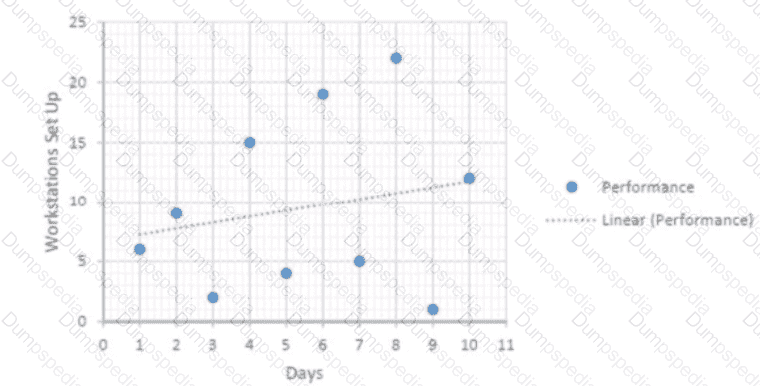
An IT intern was assigned to set up workstations as part of a project. The IT intern was very careful to do the task well and initially referred to notes while performing the task. By the end of the two-week rotation, the IT intern no longer needed the notes and completed more set-ups in less time. Which of the following MOST likely represents the observed relationship in this scenario?

Show answerHide answer

Correct answer: C

Explanation

Option C shows a graph that most likely represents the observed relationship in this scenario. The graph shows a learning curve, which is a graphical representation of the relationship between a learner’s performance on a task and the number of attempts or time required to complete the task. The learning curve theory proposes that a learner’s efficiency in a task improves over time the more the learner performs the task. In this case, the IT intern was able to complete more set-ups in less time as they gained more experience and proficiency over the two-week rotation12

Question 133 Choose 1

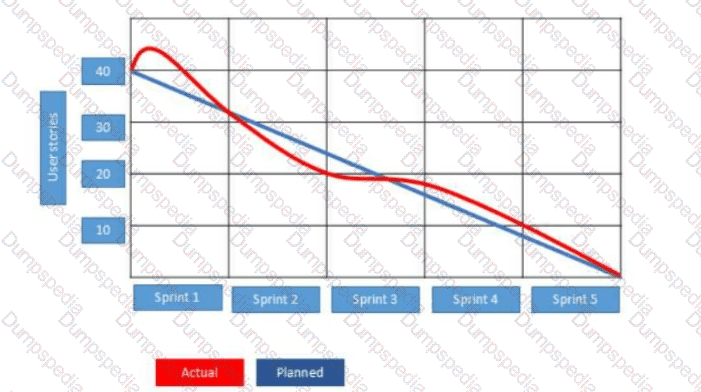
Given the information in the chart,

which of the following techniques should the project manager use to improve the project schedule in Sprint 1?

Show answerHide answer

Correct answer: B Crashing

Explanation

Crashing is the correct answer because the burndown chart shows that, during Sprint 1, the actual remaining work is above the planned line. This means the team is behind the expected schedule and has completed fewer user stories than planned. Crashing is a schedule compression technique used when a project manager needs to shorten the schedule by adding resources, increasing effort, or applying additional support to critical work. Validating is used to confirm that deliverables meet acceptance criteria, but it does not directly improve the schedule. Training may improve team capability over time, but it is not the immediate schedule compression technique shown by the scenario. Avoiding is a risk response strategy and does not address schedule recovery.

Question 134 Choose 1

Which of the following can be inferred?

Show answerHide answer

Correct answer: C Task B needs to be finished before task C starts.

Explanation

The only option that can be reliably inferred in a typical project chart/diagram context (e.g., a network diagram or dependency view) is a dependency relationship—specifically that Task B must finish before Task C can start (a Finish-to-Start relationship). In CompTIA Project+ objectives, dependency management is a core scheduling concept: identifying predecessors/successors and understanding how sequencing drives the schedule. Inference about task ordering is exactly what dependency visuals are designed to communicate.

The other options require information that is not inherently inferable without additional data. “Completed on time” (A) would require schedule baseline vs. forecast/critical path analysis. “Task D must be reworked” (B) would require quality/validation results or defect/issue information. “Over budget and behind schedule” (D) would require performance metrics such as EVM or cost/schedule variance and cannot be concluded solely from a dependency relationship.

So, the best inference is the sequencing rule: B must be completed before C begins, which is a fundamental scheduling/dependency concept emphasized in Project+ planning and schedule control practices.

Question 135 Choose 1

An external developer working on a project at an hourly rate provides an invoice at the end of a month for 80 hours spent on a project. The project manager realizes that there were no tasks assigned to this developer last month. Which of the following actions should the project manager take first?

Show answerHide answer

Correct answer: C Request the developer provide justification.

Explanation

The project manager should first request justification from the developer because the invoice must be validated before approval, rejection, or escalation. In project procurement and vendor management, invoices should be checked against assigned work, timesheets, deliverables, contract terms, purchase orders, and approvals. Since no tasks were assigned, there may be an error, unrecorded work, emergency support, misunderstanding, or unauthorized billing. Asking for justification creates a factual basis for the next decision and protects the project from paying unsupported costs. Declining the invoice immediately may be premature if legitimate work was performed but not properly documented. Escalating to the steering committee should occur only after initial verification fails or a material dispute exists. Consulting other developers is indirect and less appropriate as the first step.

Question 136 Choose 1

Which of the following does a commercial, off-the-shelf system usually require?

Show answerHide answer

Correct answer: C Minimal customization

Explanation

A commercial, off-the-shelf system, often called a COTS solution, is a ready-made product purchased from a vendor rather than built from scratch. Because it is already designed, tested, packaged, and supported by the vendor, it usually requires only minimal customization to meet business needs. A project manager should expect configuration, integration, user setup, training, and limited tailoring, but heavy customization can increase cost, schedule risk, maintenance complexity, and vendor-support limitations. Cloud infrastructure may be used for some COTS products, but it is not always required. A privacy assessment may be required depending on the data handled, but not universally. A dedicated IP address is a technical requirement that depends on architecture and security design, not on COTS itself.

Question 137 Choose 1

During a steering committee meeting, members of the meeting decide to implement several proposed suggestions. Which of the following documents should be updated first as a result of this decision?

Show answerHide answer

Correct answer: C Change log

Explanation

The change log should be updated first because the steering committee has decided to implement proposed suggestions, which means approved or pending changes must be formally recorded. A change log provides traceability for change requests, approvals, impacts, implementation status, owners, and dates. Updating it first ensures the project has an auditable record before related project documents are revised. The Gantt chart may need updates later if the changes affect schedule activities or milestones. The task board may also be revised if team work items change. The risk log is used for uncertain future events, not approved scope or execution changes. Proper change documentation supports governance, prevents confusion, and helps stakeholders understand why the project plan, schedule, budget, or scope may be adjusted.

Question 138 Choose 1

Which of the following is available after a project closes and the solution is handed over to the business team and put into production?

Show answerHide answer

Correct answer: A Post-implementation support

Explanation

Post-implementation support is the best answer because it occurs after the project solution has been transitioned to operations or the business team. In the closing and transition stages, the project team ensures deliverables are accepted, documentation is handed over, resources are released, and support arrangements are available so the production team can operate the solution successfully. User acceptance testing and performance testing normally occur before final deployment or acceptance, not after project closure. Audits and inspections may occur during or after a project, but they are not the normal operational service available once the solution is in production. Post-implementation support helps address defects, user questions, stabilization issues, and knowledge-transfer gaps after handoff.

That's the last free question

You've seen the free 30% (138 of 460 questions). Full access unlocks every question and full-length PK0-005 mock exams (90 questions, 90 minutes), a different mock on every attempt.

Unlock full mock exam
Full mock exam

Sit the PK0-005 exam before exam day

Full-length mocks with the same number of questions and the same time limit as the real PK0-005 exam. Every attempt draws a new set of questions from the full bank, so you can keep going until you pass comfortably.

Get full PK0-005 mock exam
  • 90questions per mock
  • 90 mintime limit
  • 460questions in the bank
  • Newmock on every attempt