Refer to the exhibit.
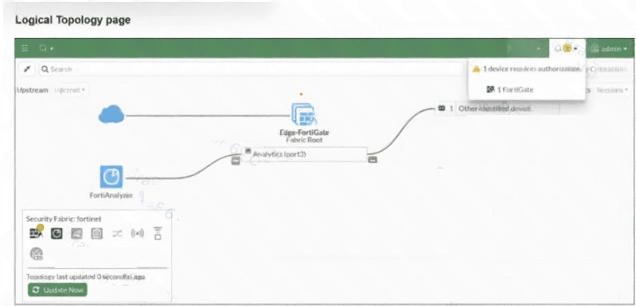
A Logical Topology page of a FortiGate device is shown. Your OT company wants to gain visibility into the network. You decide to implement device detection with the Security Fabric. Based on the exhibit, which statement is correct? (Choose one answer)
A Logical Topology page of a FortiGate device is shown. Your OT company wants to gain visibility into the network. You decide to implement device detection with the Security Fabric. Based on the exhibit, which statement is correct? (Choose one answer)
Show answerHide answer
Correct answer: B The other identified device must be authorized on the root FortiGate.
Explanation
Explanation:The exhibit shows a Logical Topology page of a FortiGate device with Security Fabric enabled. The display indicates "1 device resolution authorization..." and "1 Other client-side domain." This suggests that an unauthorized device has been detected in the network. For the Security Fabric to fully recognize and integrate this device, it must be authorized on the root FortiGate. Device authorization allows the Security Fabric to trust, monitor, and manage the device as part of the fabric topology. Without authorization, the device is recognized but not fully integrated.
❌ Why Other Options Are Incorrect:
A. Device Detection is enabled on the other identified device.
– The exhibit shows that an "other identified device" exists, but there is no indication of Device Detection being enabled on that device itself. Device Detection is a feature of the FortiGate, not a property of the detected devices.
C. The other identified device must be authorized on FortiAnalyzer.
– FortiAnalyzer is used for logging and reporting, not for device authorization within the Security Fabric. Authorization is performed on the root FortiGate, which serves as the primary device in the Security Fabric.
D. Device Detection is enabled on port3.
– The exhibit does not mention port3, nor does it provide any information about which specific interfaces have Device Detection enabled. The topology page does not indicate any port-specific settings.
📚 References:
* FortiOS 7.6 Administration Guide – Security Fabric – Explains that detected devices must be authorized on the root FortiGate for full integration.