Fortinet certification · Exam NSE5_FWB_AD-8.0

NSE5_FWB_AD-8.0 Mock Exam

Fortinet NSE 5 - FortiWeb 8.0 Administrator

Free NSE5_FWB_AD-8.0 questions on Web Application and API Security, each with the answer and an explanation.

9 questions · 17 minutes · free, no sign-up

Web Application and API Security questions

1–5 of 5 free
Question 1 Choose 1
A third-party penetration test reveals that users can bypass login controls through a mobile API. Your current FortiWeb configuration includes zero trust network access (ZTNA) profiles and cookie security, but API protection and client management are not enabled. The security team asks you to recommend the most effective way to close this gap. Which FortiWeb adjustment would best prevent future unauthorized API access?
Show answerHide answer

Correct answer: B Enable API protection and client management to enforce identity checks on mobile API traffic.

Explanation

Explanation:

The vulnerability described (bypassing login controls through a mobile API) is fundamentally an identity and authentication issue. Mobile clients can be authenticated using JSON Web Tokens (JWT), a standard (RFC 7519) for transmitting authentication information between parties . FortiWeb's Mobile API Protection module directly addresses this by validating whether the request carries a valid JWT token header and taking appropriate action when the token is missing or invalid . To further restrict access, API Gateway features enable API key verification, allowing you to create API users and groups and verify that the key belongs to a valid user . This ensures only authenticated, authorized mobile clients can access the API.

❌ Why Other Options Are Ineffective

A. Switch to reverse-proxy mode:
Changing the deployment mode is a topological adjustment. While it can provide authentication offloading features , it is not the direct solution to enforcing JWT token validation or API client identity checks . It addresses how traffic is processed, not the missing authentication logic itself.

C. Replace ZTNA with bot protection:
While Bot Protection is vital for mitigating malicious automation (e.g., scraping, credential stuffing) , the core issue is unauthorized access via a valid mobile application, not distinguishing human users from bots. Bot protection would not enforce identity checks for legitimate mobile clients.

D. Log only API traffic:
Logging is a passive function. It provides visibility into unauthorized access attempts but does not actively prevent them, leaving the vulnerability unpatched.
Question 2 Choose 3
A FortiWeb administrator wants to create a machine learning (ML)-based bot detection system. Which three actions must the administrator take to build and activate this ML model? (Choose three.)
Show answerHide answer

Correct answer: A, B, D Collect traffic samples for training. Verify the model manually on test data only. Build the detection model using collected data.

Explanation

Explanation:

To build and activate the ML bot detection model, the administrator must oversee a process that involves three distinct stages, not perform manual algorithmic analysis. The system handles the complex computations automatically .

A. Collect traffic samples for training.
This is the essential first stage. The system gathers samples of user behavior, splitting them into a training set (75%) and a testing set (25%) to build and validate the model .

B. Verify the model manually on test data only.
While this option's phrasing is slightly imprecise, it correctly identifies the model building stage. During this phase, the system automatically uses the testing sample set to verify the model's accuracy. The administrator's manual action is to initiate this build process and then review the resulting accuracy metrics (Training Accuracy, Cross-Validation Value, Testing Accuracy) to decide if the model is valid .

D. Build the detection model using collected data.
This describes the core of the model building stage. Using the collected samples, the system employs the Support Vector Machine (SVM) algorithm to self-learn user behavior profiles and constructs the mathematical detection model .

Why other options are incorrect:

C. Apply Bayesian analysis to the model output.
This is incorrect. FortiWeb's bot detection uses the SVM algorithm, not Bayesian analysis .

References:

Fortinet Documentation: "FortiWeb uses SVM (Support Vector Machine) algorithm to build up the bot detection model" .

The official process is defined as having three stages: sample collecting, model building, and model running
Question 3 Choose 1
A FortiWeb administrator sees the following request:
GET /api/v1/data HTTP/1.1
Host: example.com
Authorization: ApiKey abc123def456
The API key belongs to a user in group B who is authorized to access only /api/v1/reports.
What should the administrator do to prevent this unauthorized access?
Show answerHide answer

Correct answer: A Restrict access to /api/v1/data using user group–based access control.

Explanation

Explanation:

This scenario represents a classic Broken Object Level Authorization (BOLA) or unauthorized privilege escalation attempt at the API layer. The user possesses a valid credential (a legitimate API key), but they are attempting to access a resource path (/api/v1/data) that they do not have the authorization to view, as their group (Group B) is strictly restricted to /api/v1/reports.

Why Choice A is correct: FortiWeb provides granular API Gateway and Web Access Control capabilities. To remediate this, the administrator should implement User Group-Based Access Control (or Role-Based Access Control). By mapping API keys to specific user groups and binding those groups to precise URL protection rules/path matches, FortiWeb can validate not just that the API key is valid, but that the identity tied to that key has the explicit privilege to execute the requested HTTP method on that specific URI path.

Why the other options are incorrect:

B is incorrect because blocking the endpoint for all user groups would cause a denial of service for legitimate users (e.g., administrative groups or Group A users) who actually require access to /api/v1/data.

C is incorrect because arbitrarily moving the user to a higher-privileged group violates the security principle of least privilege. If the user is only supposed to see reports, they should not be granted access to raw data.

D is incorrect because allowing all valid API keys to access any endpoint completely eliminates authorization controls, leaving the API vulnerable to data exposure.

Reference

FortiWeb 8.0 Administration Guide: API Protection > API Access Control / User-Group Based Authentication

Section Overview: Configuring Access Control Rules allows administrators to define path-based permissions and map them to specific authenticated User Groups or API protection profiles to enforce strict authorization boundaries.
Question 4 Choose 1
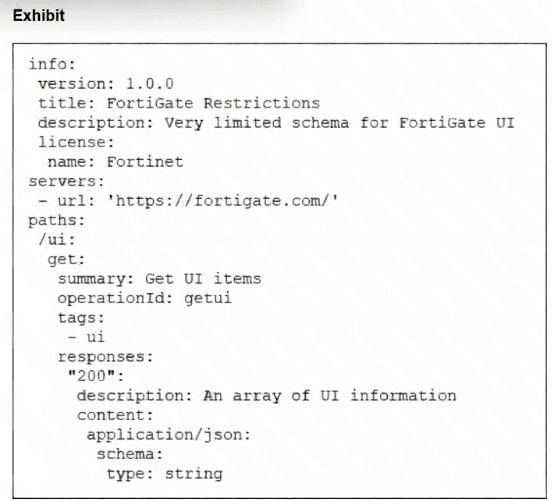
Refer to the exhibit.

What does the exhibit show?
Show answerHide answer

Correct answer: D An API schema file.

Explanation

Explanation:

The exhibit shows an OpenAPI Specification (formerly known as Swagger) document written in YAML format. This is a standard machine-readable schema file used to define, document, and describe RESTful API endpoints, their parameters, authentication requirements, and expected responses.

Key indicators in the file confirm this:
openapi: 3.0.1 – Explicitly declares this as an OpenAPI 3.0.0+ specification.
info: – Contains metadata about the API (title, description, version).
servers: – Defines the base URL where the API is hosted (https://fortigate.com/).
paths: – Maps out the available endpoint (/uri) and its HTTP method (get), along with operation details, tags, and response structures.

This file is use responses: – Describes the expected HTTP response codes and content types (e.g., 200 OK with application/json).

This file is used by tools like Swagger UI or Postman to generate interactive API documentation and client SDKs. It is not a live response, a UI interface, or a CLI command output.

❌ Why Other Options Are Incorrect

A. The FortiGate UI interface in HTML. – Incorrect. This is a structured YAML file, not an HTML document. It describes an API, not a graphical user interface.

B. A sample response returned by the FortiGate API at https://fortigate.com/ui. – Incorrect. The file defines the structure of a response, not an actual response payload. A live response would contain data like {"data": "ui_info"}, not a schema definition.

C. The result of a show ui details command on a FortiWeb server. – Incorrect. FortiWeb CLI commands produce text-based output in a tabular or key-value format, not an OpenAPI YAML specification.

📚 Reference

OpenAPI Specification (OAS) – The file format shown is the industry standard for describing RESTful APIs, as defined by the OpenAPI Initiative.
Question 5 Choose 1
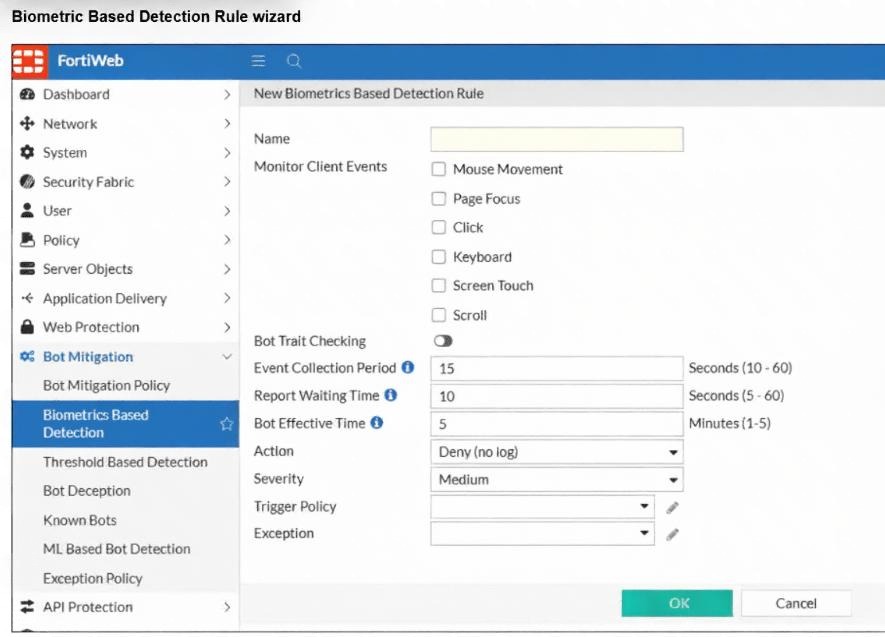
Refer to the exhibit.

You are a FortiWeb administrator reviewing the biometrics-based detection rule shown in the exhibit. Your goal is to configure a rule that detects bots that avoid typical human interactions like using a mouse or clicking. You also want to log the detection event and apply a high-severity alert. Based on the current configuration, which settings should you change to meet this goal?
Show answerHide answer

Correct answer: C Select Mouse Movement and Click , change the action to Alert , and set the severity to High .

Explanation

✅ Explanation

The administrator's goal has three specific requirements:
Detect bots that avoid human interactions – The rule must monitor the client events that typical human users perform. Mouse Movement and Click are the most fundamental human interactions. Bots that lack genuine user input will not generate these events, triggering the detection rule. Selecting these options correctly identifies the intended bot behavior.

Log the detection event – The current Action is set to Deny (no log), which means the detection is blocked but no log entry is generated. To meet the logging requirement, the administrator must change the action to Alert. The Alert action generates a log entry without blocking the request, or optionally, the administrator could set it to Deny with logging enabled. However, among the given options, Alert is the correct choice to fulfill the logging requirement. Apply a high-severity alert – The current Severity is set to Medium. The administrator must change this to High to meet the requirement for a high-severity alert. This ensures the event is properly prioritized in logs and monitoring systems.

❌ Why Other Options Are Incorrect

A. Select Screen Touch and Page Focus, set severity to Low, and keep action as Deny (no log).
Screen Touch and Page Focus are not the primary human interactions targeted for bot detection; Mouse Movement and Click are more relevant.
Severity Low and Deny (no log) fail to meet both the high-severity alert and logging requirements.

B. Select Keyboard and Scroll, change action to Alert, and set severity to High.
While this option correctly changes Action to Alert and Severity to High, the selected client events (Keyboard and Scroll) are less reliable indicators. Many legitimate automated scripts (e.g., API clients or headless browsers) may trigger these events, while bots that simply scrape content may never generate keyboard or scroll events. Mouse Movement and Click are more definitive for detecting non-human interaction.

D. Do not select any client events to monitor, enable Bot Trait Checking, keep the current severity, and keep action as Deny (no log).
Selecting no client events renders the rule ineffective, as there is no behavioral trigger.
Keeping Severity as Medium and Action as Deny (no log) fails both the high-severity and logging objectives.

📚 Reference

FortiWeb 8.0 Administrator Guide – Bot Mitigation: Biometrics-Based Detection rules monitor client-side events like mouse movement, clicks, keyboard inputs, and scrolling to differentiate human users from automated bots. The detection action can be set to Alert (log only), Deny (block with log), or Deny (no log) (block without logging). Severity levels (Low, Medium, High) are used for alert prioritization in SIEM and log analysis workflows.

That's the last free question in Web Application and API Security

You've seen the free 30% (5 of 17 questions). Full access unlocks every question and full-length NSE5_FWB_AD-8.0 mock exams (40 questions, 75 minutes), a different mock on every attempt.

Unlock full mock exam
Full mock exam

Sit the NSE5_FWB_AD-8.0 exam before exam day

Full-length mocks with the same number of questions and the same time limit as the real NSE5_FWB_AD-8.0 exam. Every attempt draws a new set of questions from the full bank, so you can keep going until you pass comfortably.

Get full NSE5_FWB_AD-8.0 mock exam
  • 40questions per mock
  • 75 mintime limit
  • 36questions in the bank
  • Newmock on every attempt