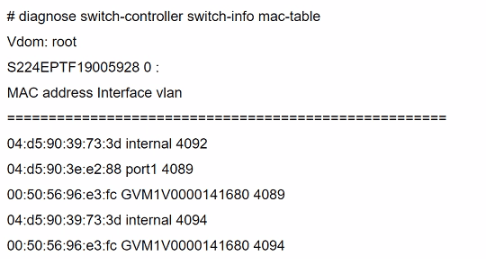
Refer to the exhibit.
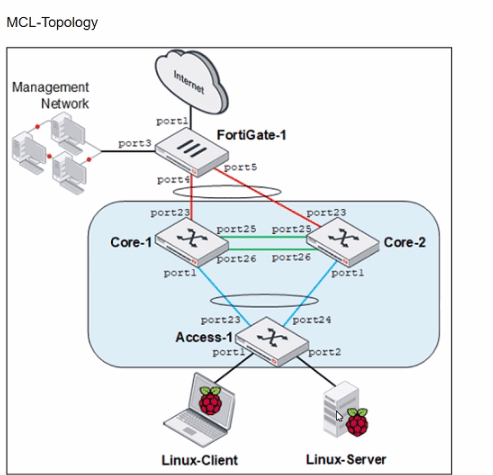
Core-1 and Access-1 are managed and authorized by FortiGate-1. which uses port4 as the FortiLink interface. After FortiGate authorizes and manages Core-2. Port1 status becomes STP discarding.
Why is port1 in the discarding state?
Core-1 and Access-1 are managed and authorized by FortiGate-1. which uses port4 as the FortiLink interface. After FortiGate authorizes and manages Core-2. Port1 status becomes STP discarding.
Why is port1 in the discarding state?
Show answerHide answer
Correct answer: B Core-1 and Core-2 do not have MCLAG configuration.
Explanation
Explanation:When Core-1 and Core-2 are both authorized by the FortiGate but are not configured as a Multi-Chassis Link Aggregation Group (MCLAG) peer, they operate as independent switches. The connections between Core-1, Core-2, and Access-1 create a Layer 2 loop. Spanning Tree Protocol (STP) detects this loop and places one of the redundant ports into a discarding state to prevent broadcast storms. MCLAG is specifically designed to eliminate STP blocking in this topology by allowing two switches to appear as a single logical device.
Correct Option:
B. Core-1 and Core-2 do not have MCLAG configuration.
STP Loop Prevention: Without MCLAG, Core-1 and Core-2 are seen as separate STP bridges. The redundant links to Access-1 form a loop, forcing STP to block one path (port1 on Core-2) .
MCLAG Purpose: Configuring MCLAG between the cores would make them act as a single logical switch, eliminating the STP loop and allowing both uplinks to remain active for redundancy and bandwidth .
Incorrect Option:
A. port1 on Core-2 is discarding only management traffic.
STP discarding state applies to all data traffic on that port, not just management traffic. The port is blocked at Layer 2 to prevent loops.
C. Access-1 is the root bridge and can only have one root port.
While Access-1 may have only one root port, the discarding state on Core-2's port1 is a direct result of the loop created by the lack of MCLAG between the cores, not simply because Access-1 is the root.
D. Core-2 has the lowest bridge priority.
If Core-2 had the lowest bridge priority, it would be the root bridge. However, the root bridge does not typically discard its own ports; it is the non-root bridges that block redundant paths. The primary issue is the missing MCLAG configuration.
Reference:
Fortinet Document Library: FortiSwitchOS Administration Guide (7.4.x/8.0.0), "MCLAG" section, which states MCLAG eliminates STP delays and provides node-level redundancy .