Juniper certification · Exam JN0-106

JN0-106 Mock Exam

Junos - Associate (JNCIA-Junos) Junos OS 21.2

Find out if you're ready for JN0-106. Take the free timed mock exam and get your score in minutes, or study the free JN0-106 questions below with answers and explanations.

20 questions · 28 minutes · free, no sign-up

Free JN0-106 questions

1–10 of 25 free
Question 1 Choose 2
Which two statements accurately describe the relationship between the routing table and the forwarding table on a Junos device? (Choose two.)
Show answerHide answer

Correct answer: B, C The routing table selects the best route based on routing information.The forwarding table is built from the routing table.

Explanation

Explanation:
In Junos OS, the routing table (RIB) is control-plane based, selects the best routes, and then populates the forwarding table (FIB) in the data plane for fast packet switching. The FIB is a derivative of the RIB, optimized for high-speed lookups.

Correct Option:

B: The routing table selects the best route based on routing information.
The routing table runs routing protocols (OSPF, BGP, static) and applies route preferences to select the single active, best path to each destination. This occurs in the control plane before any forwarding decision.

C: The forwarding table is built from the routing table.
Once the routing table determines the active routes, it exports them to the forwarding table (FIB). The FIB resides in the Packet Forwarding Engine (PFE) for efficient, high-speed packet forwarding.

Incorrect Option:

A: The routing table resides in the data plane for fast lookups.
The routing table resides in the control plane (Routing Engine), not the data plane. The data plane uses the forwarding table for fast lookups, while the routing table focuses on route learning and selection.

D: The routing table is built from the forwarding table.
This is backward. The routing table is built from routing protocols and static configurations; the forwarding table is a subset of the routing table’s active routes, optimized for forwarding. The forwarding table does not build the routing table.

Reference:
Juniper TechLibrary – “Routing Tables and Forwarding Tables Overview” (Junos OS Evolved or Junos OS documentation): The routing table (RIB) selects active routes; the forwarding table (FIB) is derived from the RIB and used by the PFE for packet forwarding.
Question 2 Choose 1
What is the main function of the forwarding table on a Junos device?
Show answerHide answer

Correct answer: A It contains only active routes used to forward packets through the PFE.

Explanation

Explanation:
The forwarding table (FIB) resides in the Packet Forwarding Engine (PFE) and contains only the active, best routes selected by the routing table. Its main function is to enable high‑speed packet forwarding without involving the control plane.

Correct Option:

A: It contains only active routes used to forward packets through the PFE.
The forwarding table is a subset of the routing table, holding only the optimal active routes. The PFE uses this table to make fast forwarding decisions for every packet, without consulting the Routing Engine.

Incorrect Option:

B: It advertises routes to neighboring routers.
Route advertisement is a function of routing protocols (OSPF, BGP, etc.) managed by the routing table and protocol daemons, not the forwarding table. The forwarding table has no role in control‑plane operations like advertisements.

C: It stores all learned routes from routing protocols.
All learned routes are stored in the routing table, not the forwarding table. The forwarding table receives only the active, selected routes from the routing table, not every learned route.

D: It determines the best route based on route preference.
Route selection and preference calculation are performed by the routing table in the control plane. The forwarding table simply uses the already‑selected best routes; it does not perform any route selection logic.

Reference:
Juniper TechLibrary – “Understanding the Forwarding Table”: The forwarding table is installed in the PFE and contains only active routes from the routing table, used for actual packet forwarding.
Question 3 Choose 1
How are the Routing Engine and the Packet Forwarding Engine components connected?
Show answerHide answer

Correct answer: D They use an internal Ethernet link.

Explanation

Explanation:
In Junos devices, the Routing Engine (RE) and Packet Forwarding Engine (PFE) communicate over an internal 100 Mbps or 1 Gbps Ethernet link. This control plane to data plane connection is used for exchanging routing tables, forwarding tables, statistics, and exception packets.

Correct Option:

D: They use an internal Ethernet link.
The RE and PFE are connected via an internal Ethernet interface (often called fxp0, em0, or internal fabric). The RE sends forwarding tables to the PFE and receives exception packets, monitoring data, and statistics over this dedicated internal link.

Incorrect Option:

A: They use shared memory access.
Shared memory is not used between RE and PFE because they are independent processing units. Shared memory typically exists within a single processor or system, not across separate components.

B: They use external breakout cables.
No external cables connect the RE to the PFE. Both components reside inside the chassis and communicate via internal backplane or dedicated Ethernet links, not external physical cables.

C: They use an MPLS connection.
MPLS is a forwarding mechanism for data packets, not a control plane interconnect. The RE and PFE do not use MPLS to communicate with each other; MPLS operates on data traffic passing through the PFE.

Reference:
Juniper TechLibrary – "Routing Engine and Packet Forwarding Engine Communication": The RE and PFE communicate over an internal Ethernet link that carries control traffic, forwarding tables, and monitoring statistics.
Question 4 Choose 2
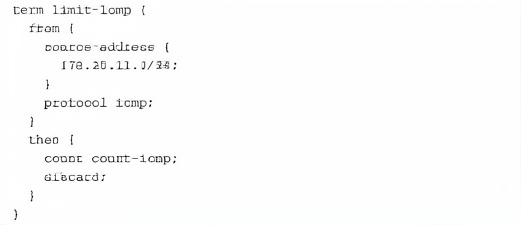
Click the Exhibit button.


Referring to the exhibit, which two actions will occur when a packet matches the firewall filter? (Choose two.)
Show answerHide answer

Correct answer: A, B A counter will be incremented.The packet will be discarded.

Explanation

Explanation:
The firewall filter term limit-icmp matches ICMP packets from source network 172.25.11.0/24. The then clause executes two actions: count count-icmp increments a counter, and discard silently drops the packet without sending any error notification.

Correct Option:

A: A counter will be incremented.
The count count-icmp action explicitly instructs the device to increment the counter named count-icmp each time a packet matches all conditions in the from statement. This is used for monitoring and statistics.

B: The packet will be discarded.
The discard action silently drops the matching packet. The packet is not forwarded to its destination, and no further processing occurs. No ICMP error message is generated unless explicitly configured.

Incorrect Option:

C: The packet will be forwarded.
This is incorrect because the discard action overrides any implicit accept behavior. The packet is dropped immediately after counting, so it never reaches the forwarding stage.

D: An ICMP destination unreachable message will be returned.
The discard action performs a silent drop. To send an ICMP unreachable message, you would need to use reject instead of discard. The discard action does not generate any notification to the source.

Reference:
Juniper TechLibrary – "Firewall Filter Term Actions": The count action increments a named counter; discard silently drops the packet without sending any ICMP error message. For ICMP notifications, use the reject action.
Question 5 Choose 2
Which two statements are examples of exception traffic? (Choose two.)
Show answerHide answer

Correct answer: A, B An IP packet with the Router Alert option set in the IP options field.SSH traffic to the local Junos OS device.

Explanation

Explanation:
Exception traffic in Junos refers to packets that cannot be processed entirely within the Packet Forwarding Engine (PFE) and must be sent to the Routing Engine (RE) for further handling. This includes packets destined to the RE itself (management traffic) and packets requiring special processing like IP options.

Correct Option:

A: An IP packet with the Router Alert option set in the IP options field.
IP packets with options (including Router Alert) cannot be fast-forwarded by the PFE and are treated as exception traffic. They are punted to the RE for processing, as the PFE cannot parse complex IP options at line rate.

B: SSH traffic to the local Junos OS device.
Any traffic destined to the device's own IP addresses (management traffic such as SSH, telnet, SNMP, or NETCONF) is exception traffic. The PFE forwards these packets to the RE because the RE is the ultimate destination.

Incorrect Option:

C: An IP packet that has the IP precedence CoS bits of 111 in the ToS field.
CoS bits (DSCP/IP Precedence) do not cause exception handling. The PFE can classify and forward such packets based on CoS settings without involving the RE, as long as the packet is transit traffic.

D: SSH traffic to a remote server on the Internet.
SSH traffic that transits the device (destined for a remote server) is normal transit traffic. It is processed by the PFE and forwarded out the appropriate interface without being sent to the RE.

Reference:
Juniper TechLibrary – "Exception Traffic": Exception traffic includes packets destined to the Routing Engine (e.g., management protocols) and packets requiring special processing such as IP options, fragmented packets, or TTL expiry.
Question 6 Choose 1
Which statement about class of service (CoS) in a network is correct?
Show answerHide answer

Correct answer: B CoS prioritizes certain types of traffic during congestion.

Explanation

Explanation:
Class of Service (CoS) in networking manages bandwidth allocation and traffic prioritization. During network congestion, CoS identifies critical traffic (e.g., voice, video) and gives it preferential treatment over less sensitive traffic (e.g., email, file transfers), ensuring quality of service for important applications.

Correct Option:

B: CoS prioritizes certain types of traffic during congestion.
This is the core function of CoS. Using classification, queuing, and scheduling mechanisms, CoS ensures that high-priority traffic (like real-time voice) is forwarded before low-priority traffic (like web browsing) when link congestion occurs.

Incorrect Option:

A: CoS encrypts traffic to secure data across the network.
Encryption is a security function handled by protocols like IPsec, SSL/TLS, or MACsec. CoS does not provide encryption; it only deals with traffic prioritization and bandwidth management.

C: CoS assigns IP addresses dynamically to optimize routing.
Dynamic IP address assignment is performed by DHCP (Dynamic Host Configuration Protocol), not by CoS. CoS operates on already-assigned IP packets and does not affect addressing.

D: CoS prevents broadcast storms by segmenting VLANs.
Broadcast storm prevention is achieved through VLAN segmentation, spanning-tree protocols, or storm control features. CoS does not segment VLANs or prevent broadcast storms; it prioritizes traffic within existing network segments.

Reference:
Juniper TechLibrary – "Class of Service Overview": CoS provides mechanisms to prioritize certain types of traffic when network congestion occurs, ensuring that critical applications receive the required bandwidth and latency treatment.
Question 7 Choose 2
Which two statements describe the result when you enter ? at the command-line prompt? (Choose two.)
Show answerHide answer

Correct answer: A, D It lists the available commands and options.It displays summary information about the commands and options.

Explanation

Explanation:
In Junos OS CLI, typing ? (question mark) at the command-line prompt activates context-sensitive help. It lists all available commands, statements, or options at the current hierarchy level and provides a summary of their functions without executing any command.

Correct Option:

A: It lists the available commands and options.
The ? displays all possible completions for the current input context, including commands, options, and variables. This helps users discover syntax without consulting external documentation.

D: It displays summary information about the commands and options.
Alongside listing available commands and options, the ? output includes a brief one-line description or summary for each item, explaining what the command or option does.

Incorrect Option:

B: It lists tips for the help menu.
Junos ? does not provide meta‑tips about the help system itself. Tips or help usage instructions are typically obtained through commands like help or help reference, not through the ? operator.

C: It displays help about a text string contained in a statement.
Searching for a text string within statements is done using help grep or help reference . The ? only shows completions for the current word or position, not searching across statement contents.

Reference:
Juniper TechLibrary – "CLI Tips and Tools" (Junos OS Operational Mode): Using ? at the CLI prompt displays a list of available commands, options, and a brief description for each, providing context‑sensitive help.
Question 8 Choose 1
You are creating a new user account on your Junos device. The user must be able to validate the routing table and interface statistics but should not be able to make any configuration changes. In this scenario, which permission flag would satisfy this requirement?
Show answerHide answer

Correct answer: C view

Explanation

Explanation:
In Junos OS, user permissions are controlled by class flags. The view permission flag allows read-only access to operational commands, including viewing the routing table and interface statistics, while completely blocking any configuration changes.

Correct Option:

C: view
The view flag provides read-only access to show, monitor, and help commands. Users can display routing tables (show route), interface statistics (show interfaces), and other operational data but cannot enter configuration mode or modify any device settings.

Incorrect Option:

A: configure
The configure flag explicitly grants access to configuration mode and the ability to modify the device's configuration. This would violate the requirement of preventing configuration changes.

B: all
The all flag grants superuser access with full read and write privileges, including configuration changes, file operations, and all operational commands. This exceeds the required permissions.

D: network
The network flag controls access to routing protocols and network-level operations. While it may allow viewing some routing information, it is not designed as a read-only permission and could potentially allow certain network-level changes depending on other flags assigned.

Reference:
Juniper TechLibrary – "Login Classes and Permission Flags": The view permission flag restricts users to operational mode commands without configuration or maintenance capabilities, ideal for monitoring roles.
Question 9 Choose 1
You are creating a new user account using a predefined login class on a Junos device. The account should be able to run operational mode commands such as show interfaces and ping, but should not be allowed to change or commit configuration. Which login class should you assign to this user?
Show answerHide answer

Correct answer: D operator

Explanation

Explanation:
Junos OS provides predefined login classes with specific permission sets. The operator class allows users to execute operational mode commands (show, ping, monitor, etc.) for monitoring and troubleshooting but explicitly denies access to configuration mode and commit operations.

Correct Option:

D: operator
The operator class is designed for network monitoring staff. It grants permissions for operational commands (show, ping, traceroute, monitor) and troubleshooting tools, but has no configuration or commit privileges. This matches the requirement exactly.

Incorrect Option:

A: maintenance
The maintenance class allows users to perform system maintenance tasks including clearing logs, restarting processes, and some diagnostic commands. However, it may also permit certain configuration-level changes and file manipulations.

B: read-only
There is no predefined read-only class in standard Junos. The closest is the view permission flag or custom class. The default class for read‑only access is typically operator or a custom view class.

C: super-user
The super-user class provides full, unrestricted access including configuration mode, commit operations, file system access, and all operational commands. This would violate the requirement of preventing configuration changes.

Reference:
Juniper TechLibrary – "Understanding Predefined Login Classes": The operator class provides permissions to run operational commands for monitoring and diagnosis but cannot change the configuration.
Question 10 Choose 1
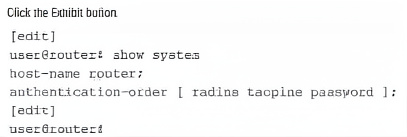
Exhibit:


You have configured multiple authentication methods on your Junos device, including RADIUS, TACACS+, and local user accounts. A user attempts to log in, but the RADIUS server is unavailable. Referring to the exhibit, which statement is correct?
Show answerHide answer

Correct answer: D Junos attempts the next configured authentication method.

Explanation

Explanation:
The authentication-order statement defines the sequence in which Junos checks authentication methods. In the exhibit, the order is RADIUS first, then TACACS+, then local password. When RADIUS is unavailable (timeout or no response), Junos automatically proceeds to the next configured method.

Correct Option:

D: Junos attempts the next configured authentication method.
With authentication-order [ radius tacplus password ], if RADIUS servers are unreachable or do not respond, Junos moves to TACACS+. If TACACS+ also fails, it falls back to the local password database. This ensures continued access even if an external server is down.

Incorrect Option:

A: The user is prompted to select a different authentication method.
Junos does not prompt the user to choose a method. The authentication order is system‑defined and automatic. The user simply provides credentials; the system tries each method sequentially.

B: The login attempt fails immediately.
The login attempt does not fail immediately when RADIUS is unavailable. Junos only fails after exhausting all configured authentication methods in the specified order.

C: Junos will continue to attempt to authenticate with the RADIUS server until it responds.
Junos does not retry the same unreachable server indefinitely for a single login attempt. It respects the timeout and then moves to the next method in the list.

Reference:
Juniper TechLibrary – "Authentication Order": Junos attempts authentication methods in the order specified. If a method is unavailable, the system proceeds to the next method in the list.
Full mock exam

Sit the JN0-106 exam before exam day

Full-length mocks with the same number of questions and the same time limit as the real JN0-106 exam. Every attempt draws a new set of questions from the full bank, so you can keep going until you pass comfortably.

Get full JN0-106 mock exam
  • 65questions per mock
  • 90 mintime limit
  • 94questions in the bank
  • Newmock on every attempt