Juniper certification · Exam JN0-106

JN0-106 Mock Exam

Junos - Associate (JNCIA-Junos) Junos OS 21.2

Free JN0-106 questions on Routing Fundamentals, each with the answer and an explanation.

20 questions · 28 minutes · free, no sign-up

Routing Fundamentals questions

1–3 of 3 free
Question 1 Choose 2
Which two statements about route preference in Junos OS are correct? (Choose two.)
Show answerHide answer

Correct answer: B, C Route preference is considered after evaluating the longest prefix match.Lower route preference values indicate higher priority.

Explanation

Explanation:
Route preference (also called administrative distance) in Junos OS is a numeric value where lower values indicate higher priority. It is used to select the active route when multiple protocols provide routes to the same destination. Preference is evaluated before the longest prefix match.

Correct Option:

B: Route preference is considered after evaluating the longest prefix match.
This statement requires careful interpretation. In Junos route selection, the longest prefix match is evaluated first to find candidate routes. Among those with the same prefix length, the lowest route preference (highest priority) determines the active route. So preference is considered after prefix length is matched.

C: Lower route preference values indicate higher priority.
This is the core rule of route preference in Junos. Direct routes have preference 0, OSPF internal 10, Static 5, BGP 170 (or 20 for local preference). Lower number = more trusted = higher priority.

Incorrect Option:

A: Higher route preference values indicate higher priority.
This is the opposite of how Junos works. Higher preference values indicate lower priority (less trusted). For example, BGP (170) is less preferred than OSPF (10) unless overridden.

D: Route preference determines the forwarding table size.
The forwarding table size is determined by the number of active routes and hardware capacity, not by route preference values. Preference only affects which route becomes active but does not change the table size.

Reference:
Juniper TechLibrary – "Routing Policy, Route Preference, and Administrative Distance": Junos selects the route with the lowest preference value among routes to the same destination with the same prefix length. Preference is evaluated after longest prefix match.
Question 2 Choose 1
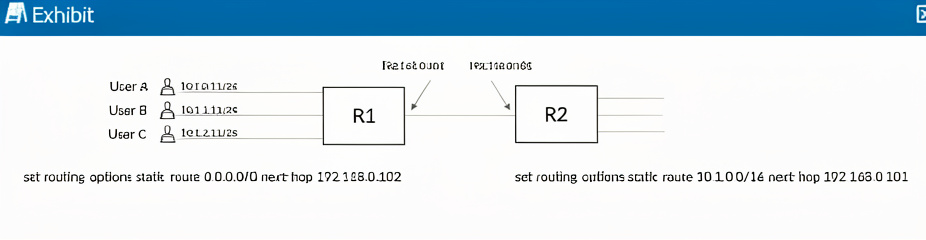
Which statement is correct about traffic flow in the network shown in the exhibit?

Show answerHide answer

Correct answer: A A routing loop can occur if one of the users sends packets to 10.1.99.1.

Explanation

Explanation:
The exhibit shows R1 with two static routes: a default route (0.0.0.0/0) pointing to R2 (192.168.0.102), and a route for 10.1.0.0/16 pointing back to R1's own interface (192.168.0.101). No route exists on R2 back to the 10.1.0.0/16 network, creating potential asymmetry and loops.

Correct Option:

A: A routing loop can occur if one of the users sends packets to 10.1.99.1.
10.1.99.1 falls within the 10.1.0.0/16 summary route on R1. R1 forwards such packets toward 192.168.0.101 (itself?), which is problematic. More importantly, if R2 receives a packet for 10.1.0.0/16 and has only a default route back to R1, a loop forms between R1 and R2.

Incorrect Option:

B: Only User A can reach destinations beyond Router R1.
All users (10.1.0.0/24, 10.1.1.0/24, 10.1.2.0/24) are within the 10.1.0.0/16 network, so R1's summary route applies to all. However, the next-hop 192.168.0.101 is likely R1's own interface, which is invalid. No user will properly reach beyond R1 without correct next-hop.

C: Router R2 will drop packets destined for user B and user C.
R2 may have a default route pointing to R1, so it would forward packets toward R1 rather than dropping them. Dropping would occur only if no route exists, but default routes often exist in such topologies.

D: Router R1 will discard all packets from all three users.
R1 will not discard packets; it will attempt to route them according to its static routes. The issue is forwarding misconfiguration (next-hop pointing to itself), not discarding.

Reference:
Juniper TechLibrary – "Static Routing and Routing Loops": A routing loop occurs when two or more routers have inconsistent routing information, causing packets to bounce between them. Invalid next-hop addresses (pointing to self) also cause forwarding failures.
Question 3 Choose 1


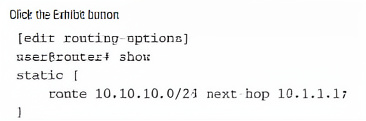
Referring to the exhibit, you are configuring a Junos router to provide connectivity to a building across town on the network 10.10.10.0/24. The next-hop router is at 10.10.1.1, which is reachable using interface ge-0/0/1. After committing the configuration in the exhibit, users report they still cannot reach the 10.10.10.0/24 network, and the route does not appear as active in the routing table. In this scenario, which statement is correct?
Show answerHide answer

Correct answer: A The next-hop address 10.1.1.1 is not directly connected or reachable through another route.

Explanation

Explanation:
A static route in Junos becomes active (appears in the routing table) only if its next-hop address is resolvable. The next-hop must be directly connected via an interface with an active IP address, or recursively reachable through an existing route. In this case, 10.1.1.1 is not in the same subnet as ge-0/0/1 (which reaches 10.10.1.1), causing resolution failure.

Correct Option:

A: The next-hop address 10.1.1.1 is not directly connected or reachable through another route.
The exhibit shows next-hop 10.1.1.1, but the description states the actual gateway is 10.10.1.1. The mismatch means the router cannot resolve 10.1.1.1 to an active interface. For the route to install, the next-hop must be directly connected or recursively resolved via another active route.

Incorrect Option:

B: Static routes must include the outgoing interface as the next hop.
Junos static routes can use either a next-hop IP address or an outgoing interface (e.g., next-hop ge-0/0/1). Using an IP address is valid and commonly used; the issue here is an incorrect or unreachable IP address.

C: The static route requires a preference value to be specified or it will not install.
Static routes have a default preference value of 5. Specifying a preference is optional and only needed to override the default for route selection purposes. Lack of a preference value does not prevent installation.

D: The static route requires the retain keyword to remain active in the routing table.
The retain keyword keeps a static route in the forwarding table even if the next-hop becomes unreachable. It is not required for normal route activation. The route fails to install due to resolution failure, not because retain is missing.

Reference:
Juniper TechLibrary – "Static Routes: Next-hop Resolution": For a static route to be installed, the next-hop address must be reachable via an active directly connected interface or resolved through an existing route in the routing table.

That's the last free question in Routing Fundamentals

You've seen the free 30% (3 of 13 questions). Full access unlocks every question and full-length JN0-106 mock exams (65 questions, 90 minutes), a different mock on every attempt.

Unlock full mock exam
Full mock exam

Sit the JN0-106 exam before exam day

Full-length mocks with the same number of questions and the same time limit as the real JN0-106 exam. Every attempt draws a new set of questions from the full bank, so you can keep going until you pass comfortably.

Get full JN0-106 mock exam
  • 65questions per mock
  • 90 mintime limit
  • 94questions in the bank
  • Newmock on every attempt