Fortinet certification · Exam FCSS_LED_AR-7.6

FCSS_LED_AR-7.6 Mock Exam

Fortinet NSE 6 - LAN Edge 7.6 Architect

Free FCSS_LED_AR-7.6 questions on FortiSwitch and LAN Edge Fundamentals, each with the answer and an explanation.

12 questions · 23 minutes · free, no sign-up

FortiSwitch and LAN Edge Fundamentals questions

1–6 of 6 free
Question 1 Choose 1
Refer to the exhibits.
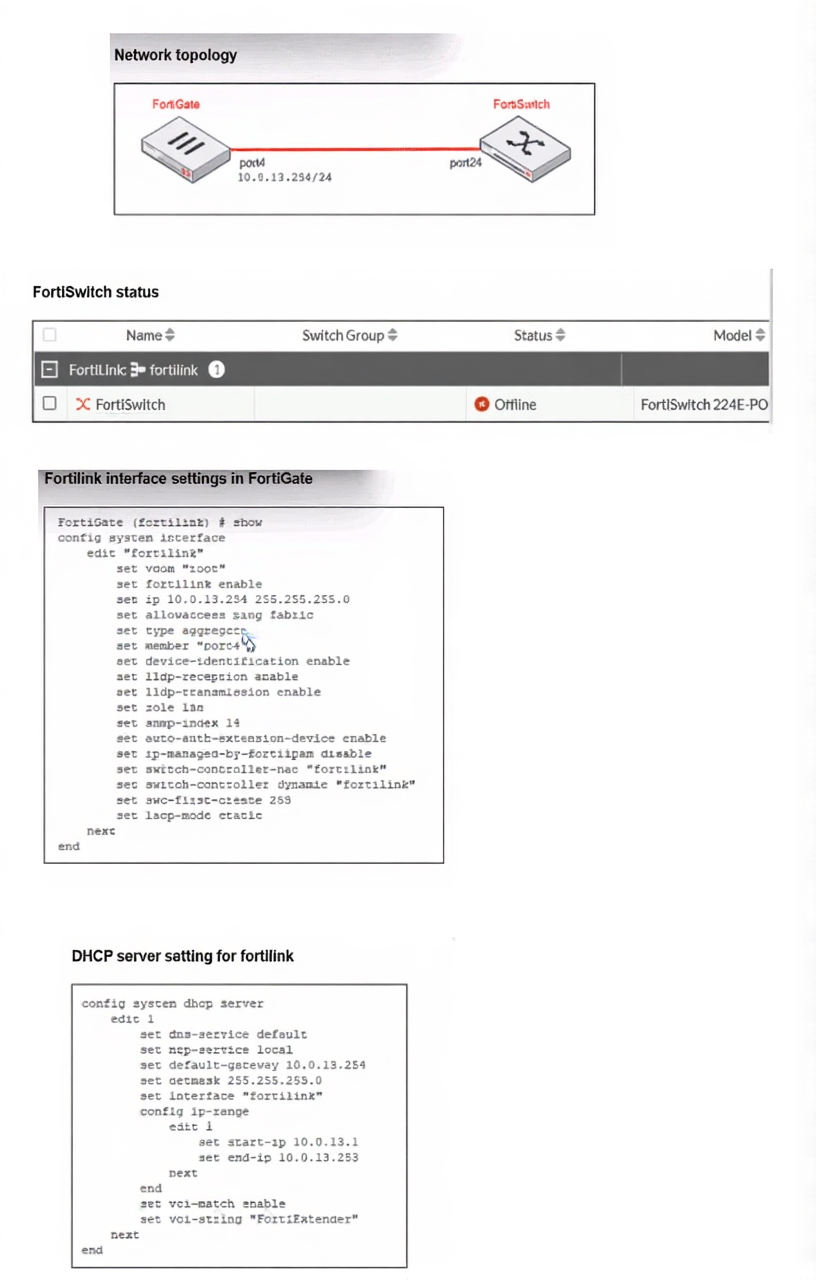


You are adding a new FortiSwitch to FortiGate for management. All necessary settings have been configured on FortiGate, but FortiSwitch remains offline. The cabling has been verified and is correctly connected.
Which misconfiguration might be preventing FortiGate from detecting FortiSwitch?
Show answerHide answer

Correct answer: D The DHCP server setting vci-string is misconfigured.

Explanation

Explanation:

This question tests knowledge of FortiLink auto-discovery requirements for FortiSwitches. When a FortiSwitch connects to a FortiGate, it sends a DHCP request containing a specific Vendor Class Identifier (VCI) string. The DHCP server on the FortiLink interface must match this string to assign an IP address and complete the discovery process.

✔️ Correct Option:

✔️ Option D: The DHCP server setting vci-string is misconfigured.
The exhibit shows the DHCP server configuration uses set vci-string "FortiEthernet". However, FortiSwitches send the VCI string FortiSwitch (or FortiSwitch ) in their DHCP requests. The mismatch prevents the DHCP server from responding, so the FortiSwitch never receives an IP address and remains offline .

❌ Incorrect options:

❌ Option A: The Fortilink interface setting ip-managed-by-fortiipam must be enabled.
This setting (ip-managed-by-fortilink in the exhibit) is used when IP addresses are managed by an external IPAM solution. It is not required for basic FortiLink discovery and DHCP assignment .

❌ Option B: The Fortilink interface has the wrong interface member.
The exhibit shows set member "port4", which is a valid physical port. If the cabling is verified correct, the member configuration is appropriate for a FortiLink aggregate interface .

❌ Option C: The Fortilink interface setting cype must be physical.
The interface type shown is type aggregate, which is correct for FortiLink when using link aggregation. FortiLink supports both physical and aggregate interface types. Changing to physical would not resolve the discovery issue .

🔧 Reference:
→ Fortinet Document Library: VCI pattern matching for DHCP assignment: Official documentation explaining that vci-match enable restricts DHCP service to only clients with matching VCI strings, and vci-string defines which strings are allowed.
Question 2 Choose 1
When the MAC address of a device is placed in quarantine on FortiSwitch, what happens to its egress traffic?
Show answerHide answer

Correct answer: A Traffic is sent to an access VLAN.

Explanation

Explanation:

This question tests understanding of FortiSwitch quarantine behavior in NAC deployments. When a device is quarantined based on its MAC address, FortiSwitch redirects its traffic to a specific VLAN to limit network access until the device meets security compliance requirements.

🟢 Correct Option:

A. Traffic is sent to an access VLAN
Quarantined devices are placed in a restricted access VLAN, often called a quarantine VLAN. All egress traffic from the device is redirected to this VLAN, preventing full network access while allowing remediation or onboarding procedures.

🔴 Incorrect options:

B. Traffic is assigned to the native VLAN
The native VLAN is used for untagged traffic but does not control quarantine behavior. Placing quarantined devices in the native VLAN would bypass policy enforcement.

C. Traffic is sent as untagged traffic
Traffic tagging does not determine quarantine; FortiSwitch uses VLAN assignment to isolate devices. Untagged traffic alone does not enforce restricted access.

D. Traffic is sent to an allowed VLAN
“Allowed VLAN” implies full network access. Quarantined devices are explicitly isolated, so traffic is not forwarded to standard allowed VLANs.

🔧 Reference:
→ Fortinet FortiSwitch NAC Quarantine Behavior
Confirms that quarantined MAC addresses are redirected to a designated access VLAN to restrict network access until compliance is met.
Question 3 Choose 3
Refer to the exhibits.


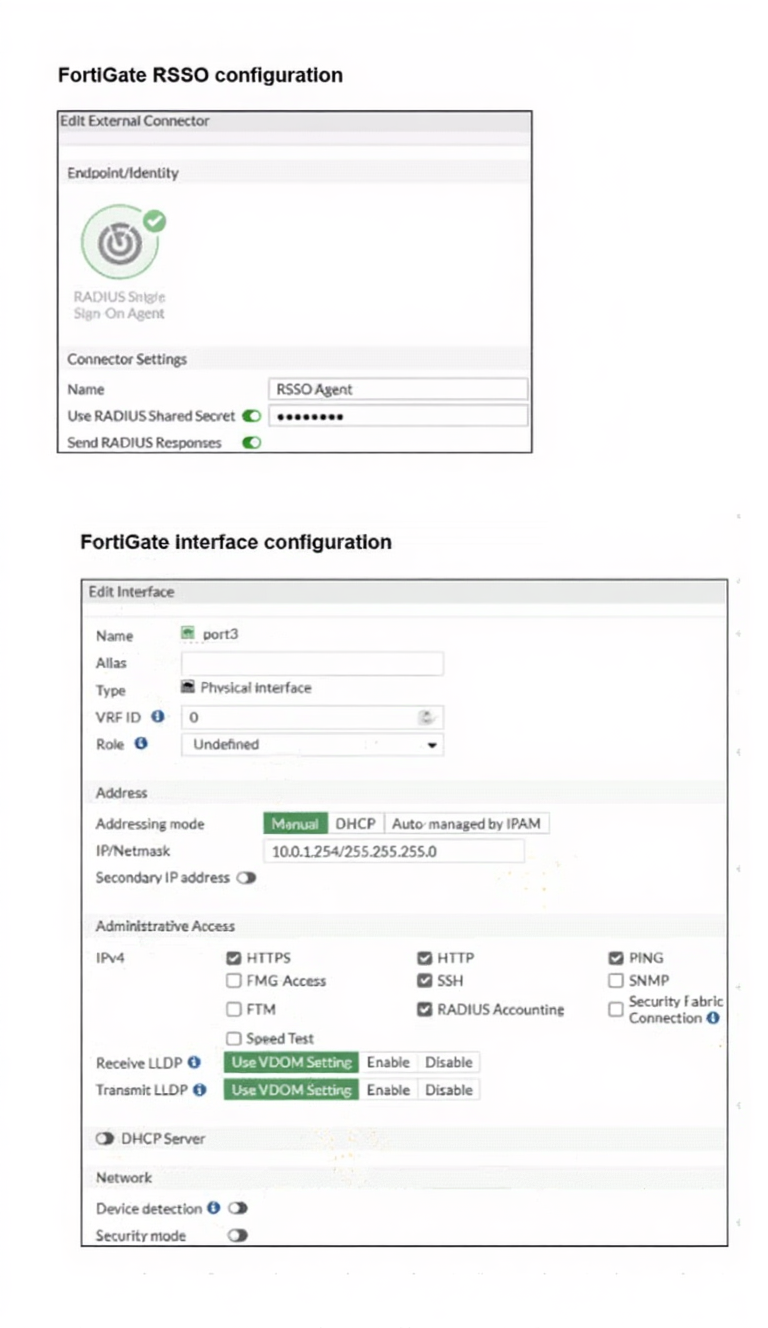
Examine the FortiGate RSSO configuration shown in the exhibit. FortiGate is set up to use RSSO for user authentication. It is currently receiving RADIUS accounting messages through port3. The incoming RADIUS accounting messages contain the username in the User- Name attribute and group membership in the Class attribute. You must ensure that the users are authenticated through these RADIUS accounting messages and accurately mapped to their respective RSSO user groups. Which three critical configurations must you implement on the FortiGate device? (Choose three.)
Show answerHide answer

Correct answer: A, D, E The RADIUS Attribute Value setting configured for an RSSO user group should match the class RADIUS attribute value in the RADIUS accounting message. The sso-attribute CLI setting in the RSSO agent configuration should be set to Class. The rsso-endpoint-attribute CLI setting in the RSSO agent configuration should be set to User-Name.

Explanation

Explanation:

This scenario involves configuring FortiGate as a RADIUS Single Sign-On (RSSO) collector. When FortiGate receives RADIUS accounting messages, it must be told exactly which attributes contain the user's identity and their group membership to create a valid login session.

✅ Correct Options:

A. The RADIUS Attribute Value setting configured for an RSSO user group should match the class RADIUS attribute value in the RADIUS accounting message.
For RSSO to function, the "User Group" defined on the FortiGate must have a specific "RADIUS Attribute Value" string. When the RADIUS packet arrives, FortiGate compares the value found in the designated group attribute against this string; if they match, the user is placed into that local RSSO group.

D. The sso-attribute CLI setting in the RSSO agent configuration should be set to Class.
By default, FortiGate may look for group information in different attributes. Since the prompt specifies that group membership is sent in the Class attribute, you must explicitly configure the sso-attribute to "Class" in the CLI so the RSSO agent knows where to extract group data.

E. The rsso-endpoint-attribute CLI setting in the RSSO agent configuration should be set to User-Name.
The rsso-endpoint-attribute defines which attribute in the RADIUS packet represents the user's unique identifier (the endpoint). Since the prompt states the username is in the User-Name attribute, this setting must be explicitly mapped to ensure the session is tied to the correct person.

❌ Incorrect options:

B. RSSO user groups should be assigned to all firewall policies.
While RSSO groups must be used in relevant policies to enforce access control, they do not need to be assigned to "all" firewall policies. This is a design choice, not a technical requirement for the authentication and mapping process to function.

C. Device detection and Security Fabric Connection should be enabled on port3.
The exhibit shows that RADIUS Accounting is already enabled on port3, which allows the interface to listen for the packets. Device detection and Security Fabric Connection are used for asset identification and fabric telemetry, respectively, and are not required for processing RSSO accounting messages.

🔧 Reference:
→ FortiGate RSSO Configuration Guide
This documentation confirms that sso-attribute and rsso-endpoint-attribute are the primary CLI settings used to map RADIUS accounting fields to FSSO/RSSO sessions.
Question 4 Choose 2
A conference center wireless network provides guest access through a captive portal, allowing unregistered users to self-register and connect to the network. The IT team has been tasked with updating the existing configuration to enforce captive portal authentication over a secure HTTPS connection. Which two steps should the administrator take to implement this change? (Choose two.)
Show answerHide answer

Correct answer: A, D Enable HTTP redirect in the user authentication settings.Update the captive portal URL to use HTTPS on FortiGate and FortiAuthenticator.

Explanation

Explanation:

This question addresses the security requirements for guest access via a captive portal. By transitioning from HTTP to HTTPS, the administrator ensures that the exchange of user credentials and self-registration data is encrypted, protecting the network from credential sniffing.

✔️ Correct Options:

✅ A. Enable HTTP redirect in the user authentication settings.
Enabling HTTP redirect is a critical step that allows the FortiGate to catch unencrypted web requests from guests and automatically redirect them to the secure portal. This ensures that users do not encounter "page not found" errors when trying to access the login page.

✅ D. Update the captive portal URL to use HTTPS on FortiGate and FortiAuthenticator.
To enforce encryption, the Captive Portal URL must be explicitly configured with the https:// prefix. This change must be consistent across the FortiGate enforcement point and the FortiAuthenticator portal host to maintain a valid and secure redirection flow.

❌ Incorrect options:

❌ B. Create a new SSID with the HTTPS captive portal URL.
Creating a new SSID is an unnecessary administrative overhead. Captive portal settings are attributes of the existing SSID’s security profile or the interface it is mapped to; therefore, the current SSID can simply be modified to support the HTTPS URL without creating a new network.

❌ C. Disable HTTP administrative access on the guest SSID to enforce HTTPS connection.
Administrative access settings (HTTP, HTTPS, SSH) control how an administrator manages the FortiGate device through that specific interface. These settings are entirely separate from the guest traffic plane and have no impact on the captive portal's authentication protocol for end-users.

🔧 Reference:
→ Captive Portal Authentication
This official Fortinet documentation confirms that securing a captive portal involves configuring the redirect logic and updating the portal URL to use the HTTPS protocol.
Question 5 Choose 2
You are setting up a captive portal to provide Wi-Fi access for visitors. To simplify the process, your team wants visitors to authenticate using their existing social media accounts instead of creating new accounts or entering credentials manually. Which two actions are required to enable this functionality? (Choose two.)
Show answerHide answer

Correct answer: A, E Set up a remote open authorization (OAuth) server for each selected social media platform.Configure the social login profiles for the supported platforms.

Explanation

Explanation:

This question tests Fortinet captive portal configuration for visitor Wi-Fi using social media authentication. It evaluates understanding of OAuth integration with FortiAuthenticator to enable seamless login via existing social accounts, avoiding manual credential creation.

✅ Correct Option:

Option A. Set up a remote open authorization (OAuth) server for each selected social media platform.
Setting up remote OAuth servers for platforms like LinkedIn/Facebook provides Client ID/Secret credentials. FortiAuthenticator uses these to redirect users for social authentication during captive portal login, completing the OAuth flow successfully.

Option E. Configure the social login profiles for the supported platforms.
Configuring social login profiles on FortiAuthenticator enables specific platforms, sets login button visibility on the splash page, defines user group assignment, and controls session timeouts for authenticated social media visitors.

❌ Incorrect options:

Option B. Configure only the email login option because a social media login cannot be used with captive portals.
Email login is a separate authentication method. Social media login via OAuth is fully supported on FortiAuthenticator captive portals and appears alongside other login options on the visitor splash page.

Option C. Enable Account Login as the authentication type and configure a remote LDAP server.
Remote LDAP servers handle enterprise directory authentication, not social media platforms which use OAuth 2.0 protocols. LDAP is incompatible with public social login providers like Twitter or LinkedIn.

Option D. Set up the FortiAuthenticator internal database as the primary source for user credentials.
FortiAuthenticator's internal database stores locally created users or imports social login attributes post-authentication, but OAuth providers remain the primary credential validation source during the login process.

🔧 Reference:
→ Create the Smart Connect profile
Confirms OAuth server setup and social login profile configuration steps for captive portals.
Question 6 Choose 1
Why is it critical to maintain NTP synchronization between FortiGate and FortiSwitch when FortiLink is configured?
Show answerHide answer

Correct answer: C To ensure accurate time for logs, authentication, and event correlation

Explanation

Explanation:

This question explores the foundational requirement of time synchronization in a managed network fabric. When a FortiGate manages a FortiSwitch via FortiLink, they operate as a single logical entity; therefore, any discrepancy in their internal clocks can lead to significant failures in security auditing, secure communication, and automated network response.

✅ Correct Option:

C. To ensure accurate time for logs, authentication, and event correlation
In a FortiLink environment, the FortiGate acts as the central management point. If the FortiSwitch and FortiGate are not synchronized via NTP, logs generated by the switch will have different timestamps than those on the FortiGate, making it impossible to accurately reconstruct a sequence of network events. Furthermore, security protocols like 802.1X authentication and certificate validation rely heavily on precise timing to determine if credentials or sessions are still valid for the security fabric.

❌ Incorrect options:

A. To facilitate synchronization of firmware updates across devices
Firmware synchronization is a functional process handled by the FortiLink protocol's image management system. While the FortiGate pushes the firmware to the switch, this is a version-control and file-transfer task. The success of the update depends on connectivity and compatibility rather than the real-time clock alignment between the two devices.

B. To allow FortiSwitch to communicate with other FortiSwitch devices in the network
Inter-switch communication, such as forming trunks or participating in Spanning Tree Protocol (STP), is a Layer 2 or Layer 3 networking function. These protocols rely on frame headers, MAC addresses, and priority values to establish paths. NTP is a management-plane service and does not dictate the basic data-plane connectivity between switches.

D. To allow FortiSwitch to function in standalone mode if FortiGate becomes unavailable
If a FortiSwitch loses its connection to the FortiGate, its ability to function independently is determined by its saved local configuration and boot settings. NTP synchronization with a missing FortiGate would not assist the switch in standalone operations; in fact, a standalone switch would likely need its own independent NTP source to maintain accurate logs.

🔧 Reference:
→ Configuring NTP for FortiLink
This official documentation confirms that NTP is essential for maintaining the integrity of the security fabric, ensuring that all managed switches report time-accurate data back to the FortiGate.

That's the last free question in FortiSwitch and LAN Edge Fundamentals

You've seen the free 30% (6 of 23 questions). Full access unlocks every question and full-length FCSS_LED_AR-7.6 mock exams (40 questions, 75 minutes), a different mock on every attempt.

Unlock full mock exam
Full mock exam

Sit the FCSS_LED_AR-7.6 exam before exam day

Full-length mocks with the same number of questions and the same time limit as the real FCSS_LED_AR-7.6 exam. Every attempt draws a new set of questions from the full bank, so you can keep going until you pass comfortably.

Get full FCSS_LED_AR-7.6 mock exam
  • 40questions per mock
  • 75 mintime limit
  • 45questions in the bank
  • Newmock on every attempt