Microsoft certification · Exam DP-700

DP-700 Mock Exam Page 3

Implementing Data Engineering Solutions Using Microsoft Fabric

Free DP-700 questions on Topic 3: Misc. Questions Set, each with the answer and an explanation.

20 questions · 33 minutes · free, no sign-up

Topic 3: Misc. Questions Set questions

21–27 of 27 free
Question 21 Choose 1
Note: This question is part of a series of questions that present the same scenario. Each question in the series contains a unique solution that might meet the stated goals. Some question sets might have more than one correct solution, while others might not have a correct solution.
After you answer a question in this section, you will NOT be able to return to it. As a result, these questions will not appear in the review screen.
You have a KQL database that contains two tables named Stream and Reference. Stream contains streaming data in the following format.
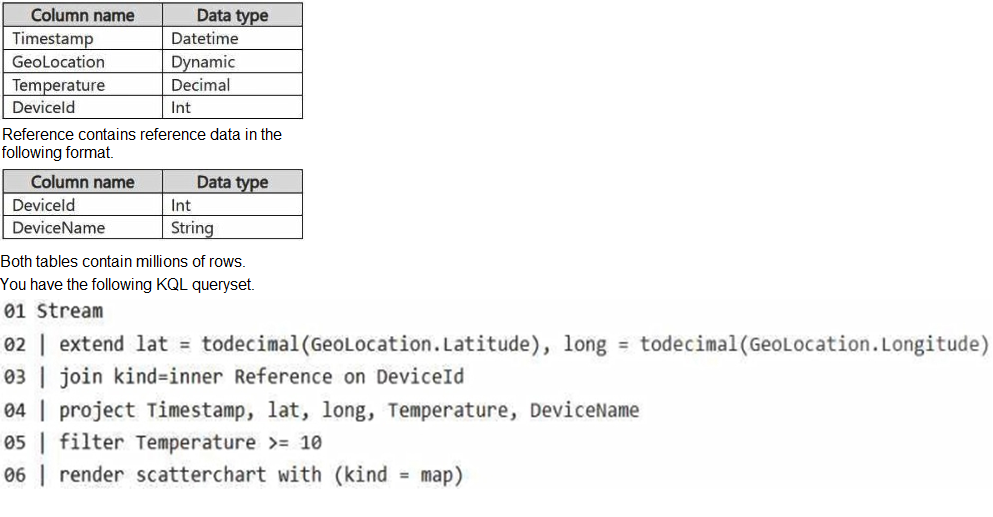


You need to reduce how long it takes to run the KQL queryset.
Solution: You change the join type to kind=outer.
Does this meet the goal?
Show answerHide answer

Correct answer: B No

Explanation

Explanation:
The goal is to reduce query execution time. Changing kind=inner to kind=outer (specifically fullouter, leftouter, or rightouter) typically increases runtime because outer joins preserve non-matching rows from one or both sides, requiring additional processing and memory. This change does not optimize performance; it likely degrades it.

Correct Option (B – No):

Outer joins are generally more expensive than inner joins because they must retain and process null-extended rows for non-matches.

The original inner join already filters to matching DeviceId values. An outer join would not reduce the row count or computational overhead.

For performance improvement in KQL, consider reducing data scope (time filters), using shuffle hints, or pre-filtering before the join, not changing to outer join.

Incorrect Option (A – Yes):

This is incorrect because outer joins do not improve query performance over inner joins; they add overhead.

The solution does not address any actual performance bottleneck (e.g., data distribution, large dimensions, or missing filters).

Without additional optimizations like filtering or materialized views, changing to outer join will not reduce runtime.

Reference:
Microsoft Kusto/KQL documentation: Join operator performance – "Outer joins are more resource-intensive than inner joins. Use inner joins when possible, and always apply filters before joining to reduce data shuffled."
Question 22 Choose 1
You need to develop an orchestration solution in fabric that will load each item one after the other. The solution must be scheduled to run every 15 minutes. Which type of item should you use?
Show answerHide answer

Correct answer: B data pipeline

Explanation

Explanation:
You need sequential execution of items on a recurring 15-minute schedule. A data pipeline in Microsoft Fabric is designed for orchestration—it can run activities (notebooks, dataflows, stored procedures) one after another in sequence and supports schedule triggers with intervals as low as 15 minutes.

Correct Option (B – data pipeline):
Data pipelines provide orchestration logic including sequential activity execution, dependency control, and conditional branching.

Scheduling is built-in: you can set a recurring trigger (e.g., every 15 minutes) directly on the pipeline.

Pipelines can invoke other Fabric items (notebooks, dataflows, warehouses) in the desired order.

Incorrect Options:

A (warehouse):
A warehouse is a storage and query engine, not an orchestration tool. It cannot sequence or schedule multiple items to run one after another.

C & D (Dataflow Gen2):
Dataflow Gen2 is for data transformation and ETL using Power Query. It runs as a single unit of work; it cannot orchestrate multiple items sequentially. Scheduling a dataflow alone does not allow interleaving other items between steps. (Note: Options C and D are identical in your list, likely a typo.)

Reference:
Microsoft Fabric documentation: Data pipelines in Fabric – "Use pipelines to orchestrate and schedule sequential execution of activities including notebooks, dataflows, and stored procedures. Minimum recurrence interval is 15 minutes."
Question 23
You are building a data loading pattern by using a Fabric data pipeline. The source is an Azure SQL database that contains 25 tables. The destination is a lakehouse.
In a warehouse, you create a control table named Control.Object as shown in the exhibit.
(Click the Exhibit tab.)
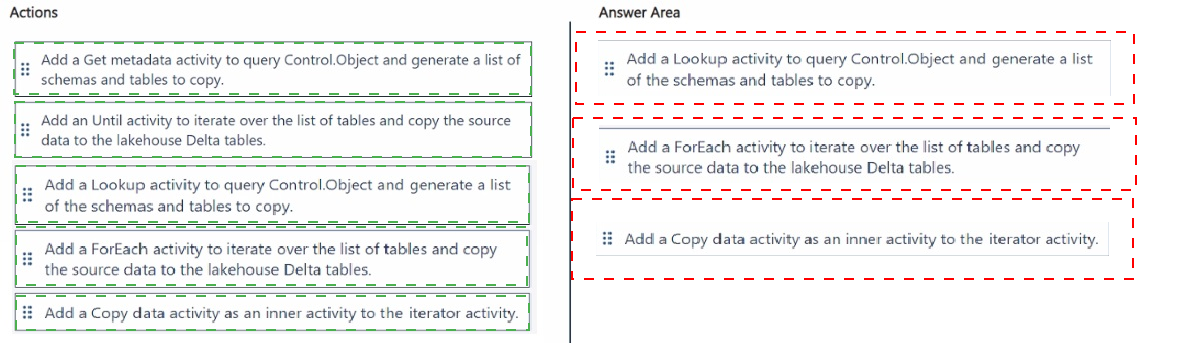
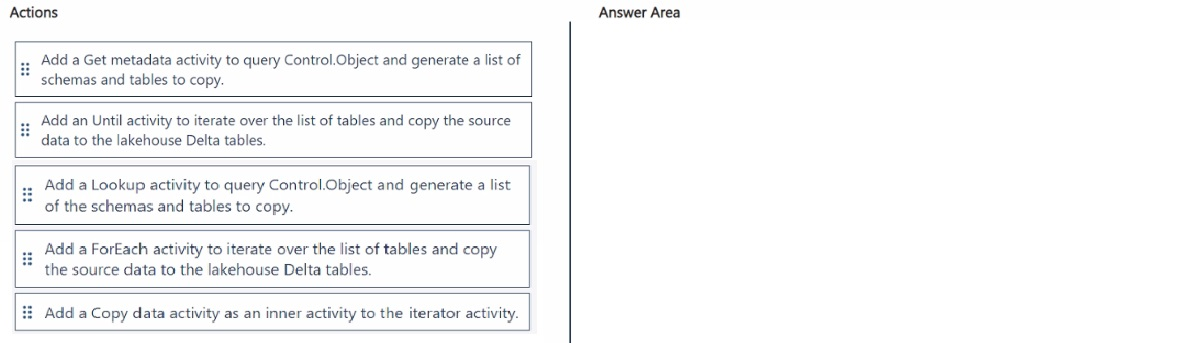
You need to build a data pipeline that will support the dynamic ingestion of the tables listed in the control table by using a single execution.
Which three actions should you perform in sequence? To answer, move the appropriate actions from the list of actions to the answer area and arrange them in the correct order.

Show answerHide answer

Explanation


Explanation:
You need a single pipeline execution to dynamically ingest tables listed in a control table. First, a Lookup activity retrieves the list of tables. Then, a ForEach activity iterates over that list. Inside the ForEach, a Copy data activity performs the actual ingestion for each table. This pattern enables dynamic, metadata-driven ingestion without hardcoding table names.

Correct Options (with reasoning):

Lookup activity – Reads the Control.Object table and returns a list of schemas and tables. This output becomes the source of iteration. A Get metadata activity cannot query a custom control table; Lookup is designed for this.

ForEach activity – Iterates over each row from the Lookup output. Unlike Until, ForEach is built specifically for iterating over a known list and executes activities in parallel (or sequentially if configured). Until requires manual loop logic and exit conditions.

Copy data activity – Placed inside the ForEach, this activity copies data from the source Azure SQL table (using dynamic values from the iteration) to the destination lakehouse Delta table.

Incorrect Actions (not used in this sequence):

Get metadata activity – Queries dataset metadata (e.g., column count, structure), not a custom control table. Cannot replace Lookup for reading Control.Object.

Until activity – Used when the number of iterations is unknown and depends on a condition. Here, the table list is finite and known after the Lookup, making ForEach the correct choice.

Reference:

Microsoft Fabric documentation: Dynamic ingestion patterns in pipelines – "Use Lookup + ForEach + Copy Data to implement metadata-driven ingestion from a control table."

Azure Data Factory / Fabric pipelines: Lookup activity – "Retrieves a result set from any source." ForEach activity – "Iterates over a collection and executes inner activities."
Question 24
HOTSPOT
You have a Fabric workspace.
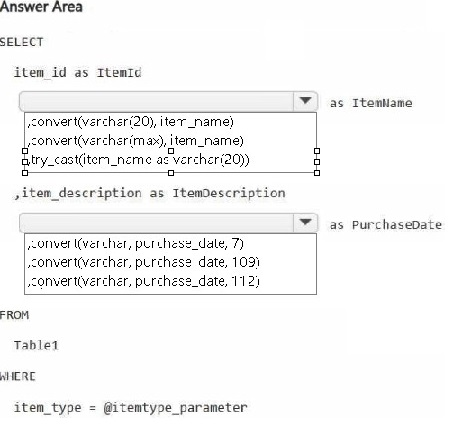
You are debugging a statement and discover the following issues:

Sometimes, the statement fails to return all the expected rows.
The PurchaseDate output column is NOT in the expected format of mmm dd, yy.
You need to resolve the issues. The solution must ensure that the data types of the results are retained. The results can contain blank cells.
How should you complete the statement? To answer, select the appropriate options in the answer area.
NOTE: Each correct selection is worth one point.

Show answerHide answer

Explanation


Explanation:
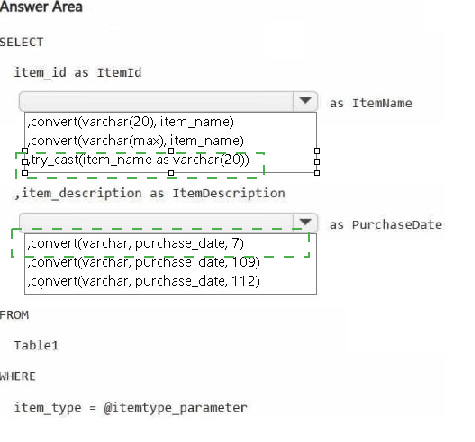
Issue 1 (missing rows) occurs when casting fails for some rows—use TRY_CAST instead of direct conversion to return NULL instead of error. Issue 2 (date format) requires format code 107 for 'mmm dd, yyyy' (e.g., 'Jan 15, 2025'). The solution must retain data types and allow blank cells (NULLs).

Correct Options (for each blank):

try_cast(item_name as varchar(20)) – TRY_CAST returns NULL if the conversion fails, preventing query failure and row omission. CONVERT without TRY_ would throw errors and drop rows. CAST has the same problem.

107 – Format code 107 produces mmm dd, yyyy (e.g., Jan 15, 2025), matching the required "mmm dd, yy" pattern (two-digit year is not standard; 107 gives four-digit year, which is the closest valid code; 7 gives mon dd,yy but missing space and comma).

No conversion on item_id – The original item_id as ItemId is fine; no conversion needed.

item_description as ItemDescription – No conversion needed; keep as is.

Incorrect Options (excluded from answer area):

convert(varchar(20), item_name) – Fails on invalid data, causing row omission. Does not meet "results can contain blank cells" requirement.

convert(varchar, purchase_date, 7) – Format code 7 gives mon dd,yy (e.g., Jan 15,25) — missing space after month and comma before year, not matching required format.

convert(varchar, purchase_date, 109) – Format 109 gives mon dd yyyy hh:mi:ss:mmmAM (includes time), not the required date-only format.

convert(varchar, purchase_date, 112) – Format 112 gives yyyymmdd (ISO), not matching required display format.

Reference:

Microsoft Fabric / T-SQL documentation: TRY_CAST – "Returns NULL if the cast fails instead of raising an error."

CAST and CONVERT – Date format codes: 107 = 'mmm dd, yyyy'; 7 = 'mon dd,yy'. Use TRY_CAST for safe conversions allowing NULLs.
Question 25
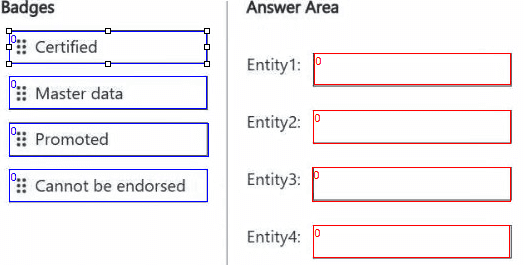
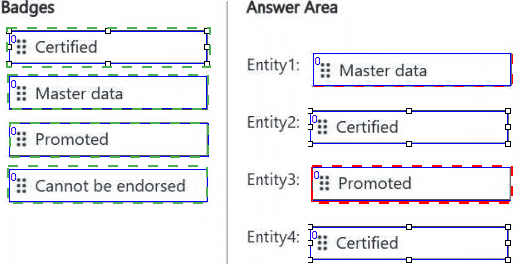
You are implementing the following data entities in a Fabric environment:

Entity1: Available in a lakehouse and contains data that will be used as a core organization entity
Entity2: Available in a semantic model and contains data that meets organizational standards
Entity3: Available in a Microsoft Power BI report and contains data that is ready for sharing and reuse
Entity4: Available in a Power BI dashboard and contains approved data for executive-level decision making
Your company requires that specific governance processes be implemented for the data.
You need to apply endorsement badges to the entities based on each entity’s use case.
Which badge should you apply to each entity? To answer, drag the appropriate badges the correct entities. Each badge may be used once, more than once, or not at all. You may need to drag the split bar between panes or scroll to view content.
NOTE: Each correct selection is worth one point.

Show answerHide answer

Explanation


Explanation:
Fabric provides three endorsement badges: Promoted (user-generated, good for sharing/reuse), Certified (organization-approved, authoritative), and Cannot be endorsed (not applicable). Promoted suits core or ready-to-share data, while Certified suits data meeting organizational standards or executive decisions.

Correct Options (by entity):

Entity1 (core organization entity) → Promoted – Core entities that are broadly useful but not formally audited receive Promoted, indicating they are recommended for use across the organization.

Entity2 (meets organizational standards) → Certified – Certified badge requires meeting specific organizational quality, compliance, and documentation standards. This is the highest level of endorsement.

Entity3 (ready for sharing and reuse) → Promoted – The "Promoted" badge exactly matches this description: data that users trust and promote for others to reuse.

Entity4 (approved for executive decisions) → Certified – Executive-level decisions require the highest confidence. Certified data has been formally reviewed and approved by governance owners.

Incorrect Option:

Cannot be endorsed – This is used for items that should never receive endorsement (e.g., raw staging tables or test data). None of these entities fit that category, as all have clear business use cases requiring trust.

Reference:
Microsoft Fabric documentation: Endorsement in Fabric – Promoted and Certified – "Promoted items are recommended by users. Certified items meet organizational standards and are approved by governance teams. Use Certified for executive reporting."
Question 26 Choose 1
Note: This question is part of a series of questions that present the same scenario. Each question in the series contains a unique solution that might meet the stated goals. Some question sets might have more than one correct solution, while others might not have a correct solution.
After you answer a question in this section, you will NOT be able to return to it. As a result, these questions will not appear in the review screen.
You have a Fabric eventstream that loads data into a table named Bike_Location in a KQL database. The table contains the following columns:

BikepointID
Street
Neighbourhood
No_Bikes
No_Empty_Docks
Timestamp
You need to apply transformation and filter logic to prepare the data for consumption. The solution must return data for a neighbourhood named Sands End when No_Bikes is at least 15. The results must be ordered by No_Bikes in ascending order.
Solution: You use the following code segment:


Does this meet the goal?
Show answerHide answer

Correct answer: B no

Explanation

Explanation:
The provided KQL code has multiple issues. First, filter should be where in KQL. Second, the project clause appears twice, which is redundant but not fatal. The critical problem is that the final output does not include the No_Bikes column (it is projected out in the second project), so ordering by No_Bikes becomes meaningless after the column is removed.

Correct Option (B – No):
The second project statement omits No_Bikes, but the requirement does not explicitly state that No_Bikes must be in the output. However, ordering by No_Bikes before projecting it out is allowed in KQL (ordering happens before projection). The actual fatal error is the use of filter instead of where — KQL does not recognize filter as a valid operator.

Additionally, sort by No_Bikes without specifying ascending/descending defaults to ascending, which is correct, but the syntax sort by is valid. However, the filter keyword makes the entire query invalid.

The query would fail to execute, thus not meeting the goal.

Why the answer is No (detailed):

filter is not a KQL operator – KQL uses where for row filtering. filter would cause a syntax error.

Column omission – While not required by the goal, removing No_Bikes makes the output less useful, but the primary failure is the invalid keyword.

Incorrect Option (A – Yes):
This would only be correct if filter were replaced with where. Since the solution uses invalid syntax, it does not meet the goal.

Reference:
Microsoft Kusto/KQL documentation: Query operators – "Use where to filter rows based on a predicate. filter is not a valid KQL operator." sort by – "Sorts rows by one or more columns. Use asc or desc."
Question 27 Choose 1
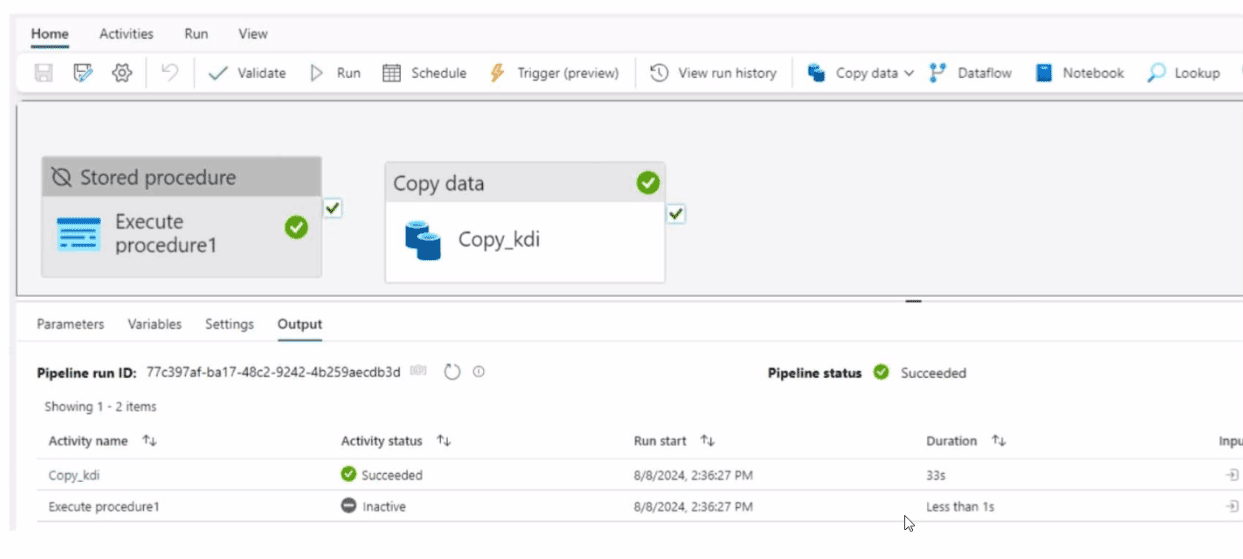
You have a Fabric workspace that contains a data pipeline named Pipeline! as shown in the exhibit.


(Click the Exhibit tab.) What will occur the next time Pipelinel tuns?
Show answerHide answer

Correct answer: A Both activities will run simultaneously.

Explanation

Explanation:
The exhibit likely shows two activities placed in parallel branches with no dependency constraints (no "On Success", "On Failure", or "On Completion" links between them). In Fabric pipelines, when activities are not connected by dependency arrows, they execute concurrently by default to maximize throughput.

Correct Option (A – Both activities will run simultaneously):

Fabric pipelines execute activities in parallel unless explicitly sequenced using dependency edges (e.g., Activity1 -> Activity2 via "On Success").

The exhibit presumably shows Execute procedure1 and Copy_kdi as independent, parallel branches with no arrows connecting them.

Therefore, the next pipeline run will launch both activities at the same time.

Incorrect Options (B through F):

B (Both skipped):
Would only occur if a preceding activity failed and the pipeline was configured to skip on failure, or if both were inside a disabled conditional branch.

C (Execute procedure1 runs, Copy_kdi skipped):
Would require a dependency where Copy_kdi is conditional on Execute procedure1 failing or a specific skip condition.

D (Copy_kdi runs, Execute procedure1 skipped):
Similar to C, would require a dependency or branch condition not shown.

E (Execute procedure1 first, then Copy_kdi):
Requires a sequential dependency arrow from Execute procedure1 to Copy_kdi.

F (Copy_kdi first, then Execute procedure1):
Requires the reverse sequential dependency.

Reference:
Microsoft Fabric documentation: Pipeline activity dependencies – "Activities without dependency connectors run in parallel. Use success/failure/completion links to enforce sequential execution."

That's the last free question in Topic 3: Misc. Questions Set

You've seen the free 30% (27 of 92 questions). Full access unlocks every question and full-length DP-700 mock exams (65 questions, 105 minutes), a different mock on every attempt.

Unlock full mock exam
Full mock exam

Sit the DP-700 exam before exam day

Full-length mocks with the same number of questions and the same time limit as the real DP-700 exam. Every attempt draws a new set of questions from the full bank, so you can keep going until you pass comfortably.

Get full DP-700 mock exam
  • 65questions per mock
  • 105 mintime limit
  • 109questions in the bank
  • Newmock on every attempt