Microsoft certification · Exam DP-700

DP-700 Mock Exam

Implementing Data Engineering Solutions Using Microsoft Fabric

Free DP-700 questions on Topic 1: Contoso, Ltd, each with the answer and an explanation.

20 questions · 33 minutes · free, no sign-up

Topic 1: Contoso, Ltd questions

1–3 of 3 free
Question 1
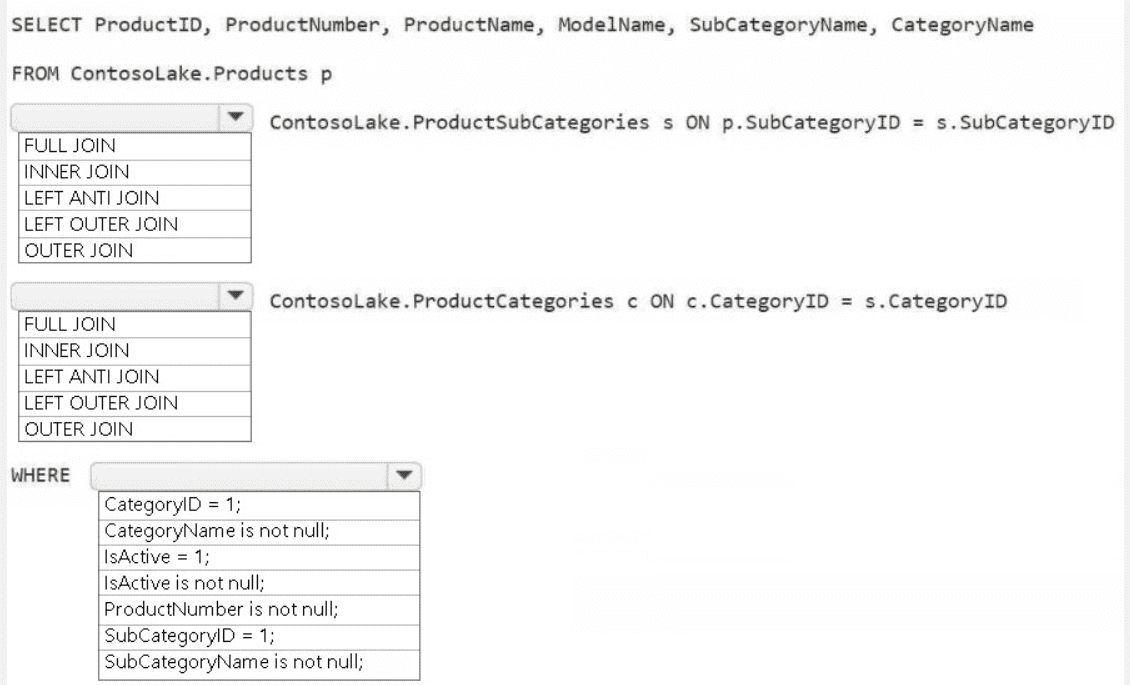
You need to create the product dimension.
How should you complete the Apache Spark SQL code? To answer, select the appropriate options in the answer area.
NOTE: Each correct selection is worth one point.
Show answerHide answer

Explanation

Summary:
This question involves building a product dimension table by joining multiple source tables. The goal is to select the correct JOIN types and WHERE clause filters to create a clean, complete list of products, likely for a data warehouse. The logic must ensure we get all relevant products while handling potential missing relationships correctly.

Correct Option Explanations

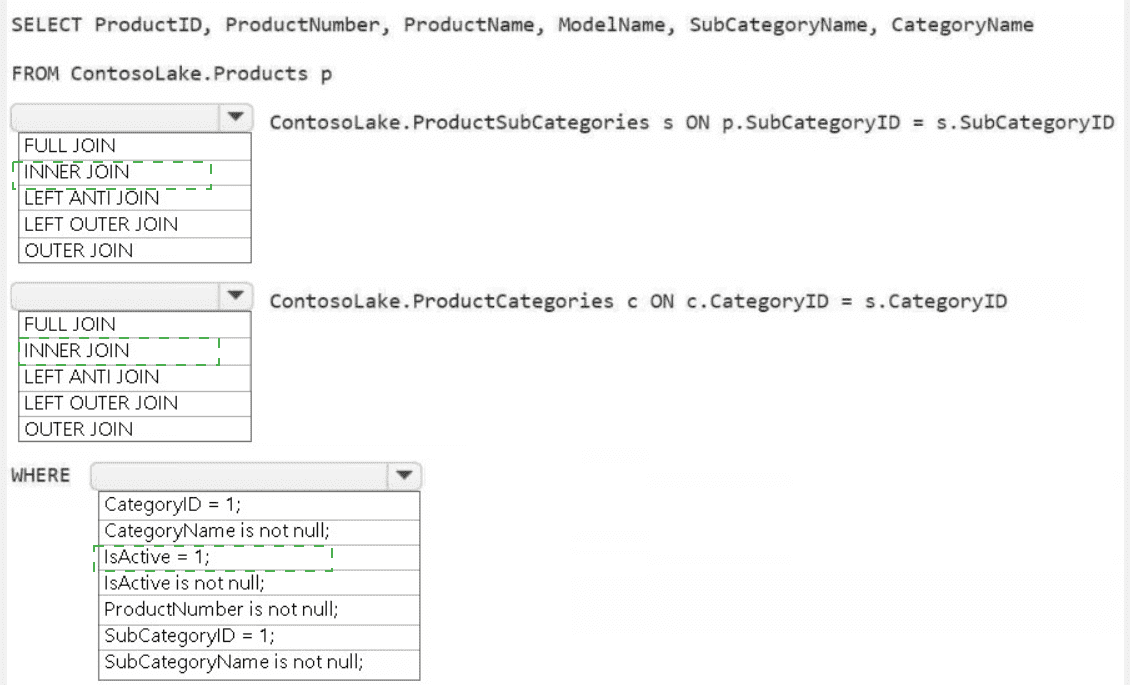
1. First JOIN Type: LEFT OUTER JOIN
The product dimension must be based on all available products from the Products table (p). Using a LEFT OUTER JOIN to the ProductSubCategories table (s) ensures that every product is included in the result, even if it has a missing or invalid SubCategoryID. An INNER JOIN would incorrectly exclude any products without a valid subcategory.

2. Second JOIN Type: LEFT OUTER JOIN
The same logic applies for joining to the ProductCategories table (c). The join is performed from the already-outer-joined subcategory table. Using another LEFT OUTER JOIN guarantees that the final result includes all products from the first join, even if their corresponding subcategory has a missing or invalid link to a category.

3. WHERE Clause: IsActive = 1 AND ProductNumber is not null
IsActive = 1: A common business rule for a dimension is to only include currently active records. This filter selects only active products.

ProductNumber is not null: This is a data quality filter. A product key like ProductNumber should never be null in a well-formed dimension table. This ensures referential integrity and clean data.

The other options are incorrect:
Filtering on specific CategoryID or SubCategoryID values (e.g., = 1) is too restrictive.

Filtering on CategoryName is not null or SubCategoryName is not null would defeat the purpose of the outer joins, as it would remove the products with missing categories that we deliberately included.

Reference:
Microsoft Official Documentation: JOIN (Databricks SQL) - This explains the different join types available in Spark SQL, which is the engine used by Fabric.
Question 2 Choose 2
You need to populate the MAR1 data in the bronze layer.
Which two types of activities should you include in the pipeline? Each correct answer presents part of the solution.
NOTE: Each correct selection is worth one point.
Show answerHide answer

Correct answer: A, B ForEachCopy data

Explanation

Summary:
This question involves designing a data pipeline to ingest data into the "bronze layer" of a Medallion Architecture in Microsoft Fabric. The bronze layer is the raw data landing zone. The source is specified as "MAR1," which is a common abbreviation for the Microsoft Azure Resources REST API. To populate this data, the pipeline must first call an API to get a list of resources and then copy the detailed data for each resource.

Correct Options:

A. ForEach
A ForEach activity is a looping container in a pipeline. When ingesting from an API like MAR1, a common pattern is to first get a list of all resources (e.g., a list of subscription IDs or resource IDs) and then use a ForEach loop to iterate over that list. Inside the loop, another activity (like the Copy Data activity) would be executed for each item to retrieve the specific details for that resource. This allows for efficient and organized processing of multiple entities.

B. Copy data
The Copy Data activity is the primary workhorse for moving data in Azure Data Factory and Fabric pipelines. It can connect to a vast array of sources and sinks. In this scenario, it would be used to connect to the MAR1 API (likely using a REST or HTTP connector as the source) and copy the raw, unaltered JSON response directly into the bronze layer of the lakehouse (the sink). This activity is essential for performing the actual data movement.

Incorrect Options:

C. WebHook
A WebHook activity is used to call an endpoint and pass a callback URL, which that endpoint will later use to notify the pipeline of an event (like a long-running job completing). It is designed for asynchronous, event-driven workflows. For a straightforward data ingestion task from an API, the synchronous Copy Data activity is the direct and correct choice, not a WebHook.

D. Stored procedure
A Stored procedure activity is used to execute a stored procedure in a relational database like Azure SQL Database or Synapse Analytics. Since the source is the MAR1 API (a REST endpoint) and not a relational database, this activity is not applicable for the data retrieval part of this task. It might be used later in the data processing lifecycle but not for the initial bronze layer ingestion from an API.

Reference:
Microsoft Official Documentation: Copy data using the Copy Data activity

Microsoft Official Documentation: ForEach activity in Azure Data Factory
Question 3 Choose 1
You need to ensure that the data analysts can access the gold layer lakehouse.
What should you do?
Show answerHide answer

Correct answer: C Share the lakehouse with the DataAnalysts group and grant the Read all SQL Endpoint data permission.

Explanation

Summary:
This question focuses on granting appropriate permissions for data access within the Fabric platform. The goal is to allow data analysts to access the "gold layer" lakehouse, which contains refined, business-ready data. Analysts typically need to query this data using SQL to build reports or perform analysis. The solution must provide the necessary permissions for this read-only SQL query access without granting unnecessary administrative or write capabilities.

Correct Option:

C. Share the lakehouse with the DataAnalysts group and grant the Read all SQL Endpoint data permission.
Every Fabric lakehouse automatically comes with a SQL analytics endpoint. This endpoint provides a T-SQL interface for querying the data. Granting the "Read all SQL Endpoint data" permission through the Share function is the precise and recommended way to enable data analysts to run SQL queries against the gold layer data. It provides direct, read-only access, which is the standard requirement for this user persona.

Incorrect Options:

A. Add the DataAnalyst group to the Viewer role for WorkspaceA.
While a Viewer role grants read access to the entire workspace, it is a broader and less secure permission than necessary. It allows viewing all items, their properties, and their SQL endpoints. However, using the granular Share feature for the specific lakehouse is a more modern and precise security practice. It follows the principle of least privilege by giving access only to the needed resource (the lakehouse), not the entire workspace.

B. Share the lakehouse with the DataAnalysts group and grant the Build reports on the default semantic model permission.
This permission is for connecting Power BI Desktop to the default semantic model of the lakehouse to build reports. While analysts might do this eventually, it does not grant them the ability to directly query the data via SQL for their own analysis, profiling, or ad-hoc exploration in tools like SQL Server Management Studio (SSMS) or Azure Data Studio. The question's primary intent is for direct data access, not just report building.

D. Share the lakehouse with the DataAnalysts group and grant the Read all Apache Spark permission.
This permission allows users to read data from the lakehouse using Spark notebooks and Spark SQL. This is more suited to data engineers and data scientists who work in a Spark/PySpark environment. Data analysts are far more likely to use the familiar T-SQL language via the SQL endpoint, making this the less optimal and less user-friendly choice for the stated goal.

Reference:
Microsoft Official Documentation: Share a lakehouse or warehouse in Microsoft Fabric

That's the last free question in Topic 1: Contoso, Ltd

You've seen the free 30% (3 of 10 questions). Full access unlocks every question and full-length DP-700 mock exams (65 questions, 105 minutes), a different mock on every attempt.

Unlock full mock exam
Full mock exam

Sit the DP-700 exam before exam day

Full-length mocks with the same number of questions and the same time limit as the real DP-700 exam. Every attempt draws a new set of questions from the full bank, so you can keep going until you pass comfortably.

Get full DP-700 mock exam
  • 65questions per mock
  • 105 mintime limit
  • 109questions in the bank
  • Newmock on every attempt