You need to ensure that the authors can see only their respective sales data.
How should you complete the statement? To answer, drag the appropriate values the correct targets. Each value may be used once, more than once, or not at all. You may need to drag the split bar between panes or scroll to view content
NOTE: Each correct selection is worth one point.
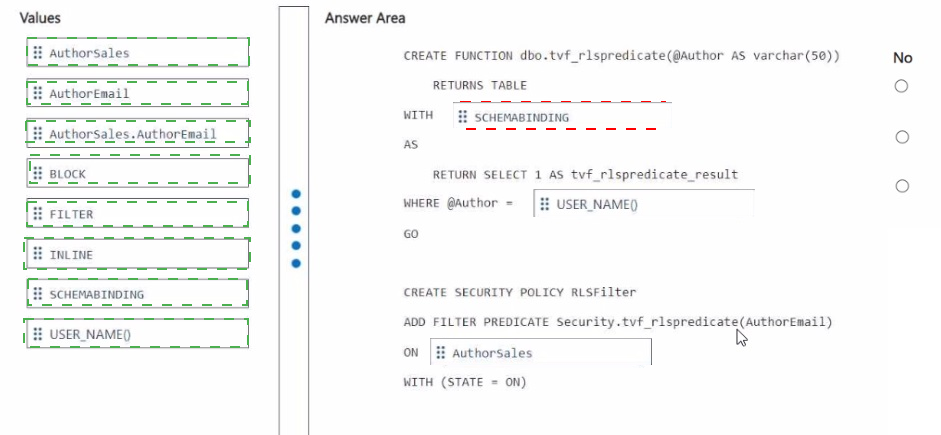
How should you complete the statement? To answer, drag the appropriate values the correct targets. Each value may be used once, more than once, or not at all. You may need to drag the split bar between panes or scroll to view content
NOTE: Each correct selection is worth one point.
Show answerHide answer
Explanation
Summary:
This question involves implementing Row-Level Security (RLS) in a Fabric Warehouse or SQL database to restrict data access. The goal is to ensure authors can only see their own sales records. The solution requires creating a security policy that uses an inline table-valued function as a filter predicate. This function compares a column in the table (the author's email) to the current user's context.
Correct Option Explanations
1. SCHEMABINDING
This clause is required in the function creation. It binds the function to the schema of the objects it references, which in this case is the Authorsales table. This prevents the underlying table schema from being altered in a way that would break the security policy, ensuring the integrity of the RLS implementation.
2. USER_NAME()
This is a system function that returns the name of the current database user. In the context of the RLS function, USER_NAME() will return the identity of the author who is executing a query. The WHERE clause @Author = USER_NAME() is the core logic that filters the rows, ensuring that only rows where the AuthorEmail column matches the current user's name are returned.
3. FILTER
In the CREATE SECURITY POLICY statement, you must specify the type of predicate. A FILTER predicate silently filters the rows that can be selected, updated, or deleted from the base table. This is the correct type for this requirement, as it prevents authors from seeing other authors' sales data during SELECT operations.
4. dbo.Authorsales
This is the fully qualified name (schema and table) of the table on which the security policy is being applied. The security policy and its filter predicate must be applied to the correct table containing the sensitive data (Authorsales) and the column used for filtering (AuthorEmail).
Incorrect Option Explanations
BLOCK:
A BLOCK predicate is used to prevent write operations (INSERT, UPDATE, DELETE) that would violate a rule. The requirement is about filtering data that can be seen, which is the purpose of a FILTER predicate, not a BLOCK predicate.
INLINE:
This is not a valid keyword for RLS predicates in T-SQL. Inline table-valued functions are defined differently, and the INLINE clause is not used in this context for creating the security policy.
Authorsales.AuthorEmail:
While this specifies the column, the ADD FILTER PREDICATE syntax requires the function name followed by the column name in parentheses, not the fully qualified table.column name. The correct syntax is dbo.tvf_rlspredicate(AuthorEmail).
Reference:
Microsoft Official Documentation: Row-Level Security