Microsoft certification · Exam DP-700

DP-700 Mock Exam

Implementing Data Engineering Solutions Using Microsoft Fabric

Find out if you're ready for DP-700. Take the free timed mock exam and get your score in minutes, or study the free DP-700 questions below with answers and explanations.

20 questions · 33 minutes · free, no sign-up

Free DP-700 questions

1–10 of 32 free
Question 1
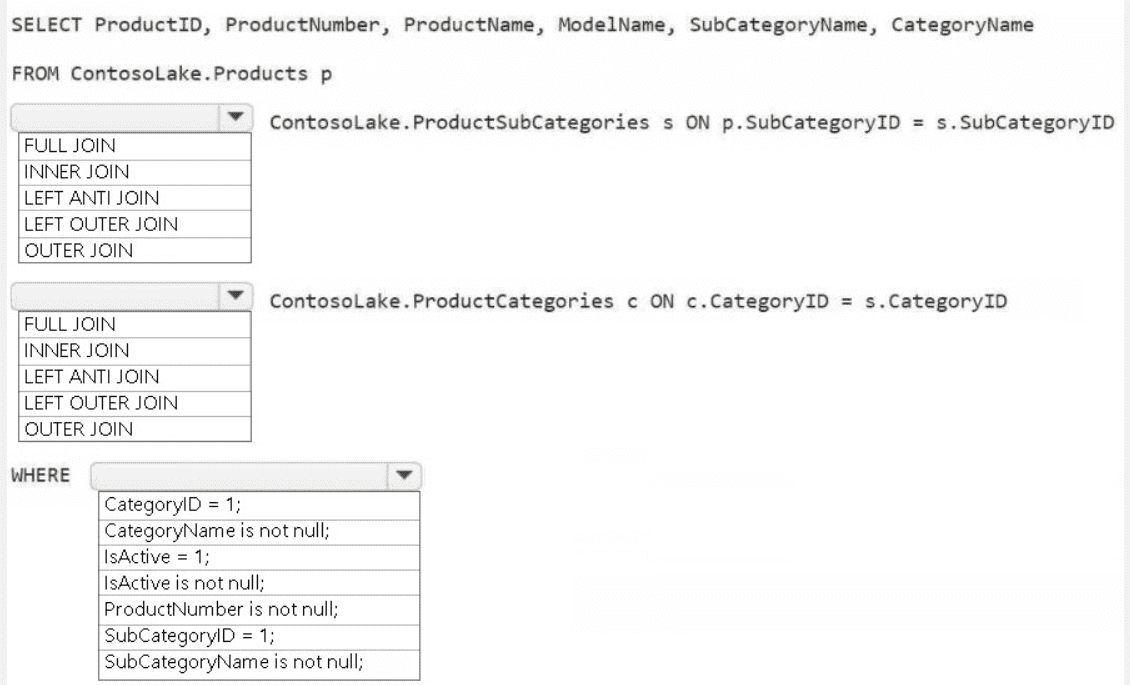
You need to create the product dimension.
How should you complete the Apache Spark SQL code? To answer, select the appropriate options in the answer area.
NOTE: Each correct selection is worth one point.
Show answerHide answer

Explanation

Summary:
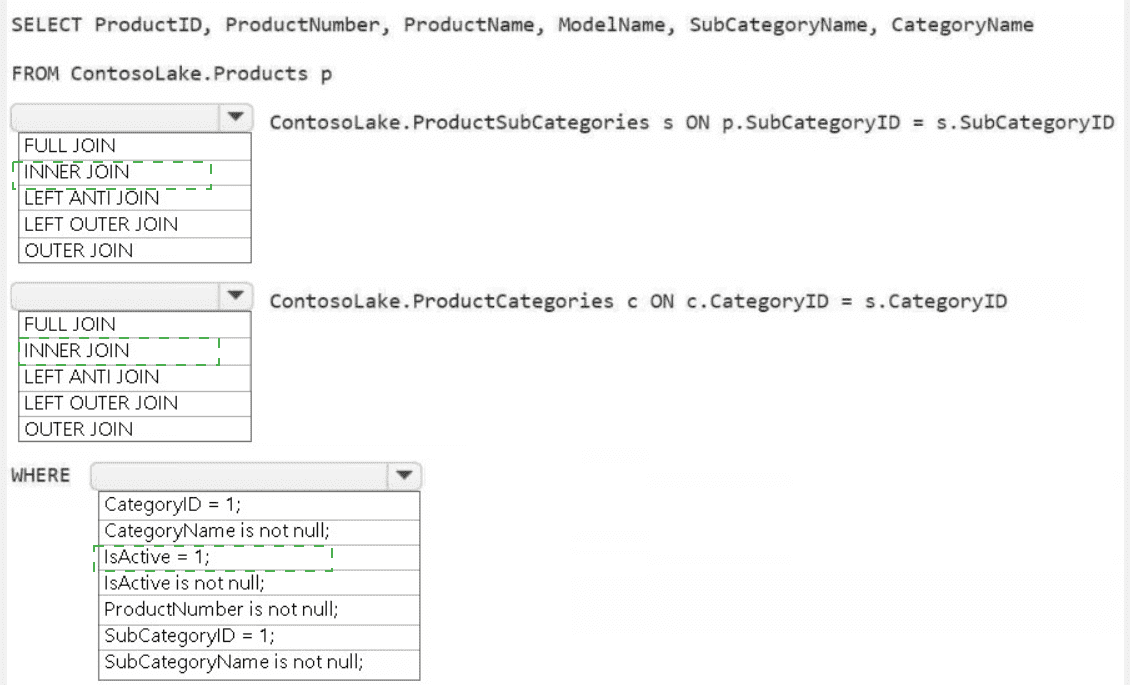
This question involves building a product dimension table by joining multiple source tables. The goal is to select the correct JOIN types and WHERE clause filters to create a clean, complete list of products, likely for a data warehouse. The logic must ensure we get all relevant products while handling potential missing relationships correctly.

Correct Option Explanations

1. First JOIN Type: LEFT OUTER JOIN
The product dimension must be based on all available products from the Products table (p). Using a LEFT OUTER JOIN to the ProductSubCategories table (s) ensures that every product is included in the result, even if it has a missing or invalid SubCategoryID. An INNER JOIN would incorrectly exclude any products without a valid subcategory.

2. Second JOIN Type: LEFT OUTER JOIN
The same logic applies for joining to the ProductCategories table (c). The join is performed from the already-outer-joined subcategory table. Using another LEFT OUTER JOIN guarantees that the final result includes all products from the first join, even if their corresponding subcategory has a missing or invalid link to a category.

3. WHERE Clause: IsActive = 1 AND ProductNumber is not null
IsActive = 1: A common business rule for a dimension is to only include currently active records. This filter selects only active products.

ProductNumber is not null: This is a data quality filter. A product key like ProductNumber should never be null in a well-formed dimension table. This ensures referential integrity and clean data.

The other options are incorrect:
Filtering on specific CategoryID or SubCategoryID values (e.g., = 1) is too restrictive.

Filtering on CategoryName is not null or SubCategoryName is not null would defeat the purpose of the outer joins, as it would remove the products with missing categories that we deliberately included.

Reference:
Microsoft Official Documentation: JOIN (Databricks SQL) - This explains the different join types available in Spark SQL, which is the engine used by Fabric.
Question 2 Choose 2
You need to populate the MAR1 data in the bronze layer.
Which two types of activities should you include in the pipeline? Each correct answer presents part of the solution.
NOTE: Each correct selection is worth one point.
Show answerHide answer

Correct answer: A, B ForEachCopy data

Explanation

Summary:
This question involves designing a data pipeline to ingest data into the "bronze layer" of a Medallion Architecture in Microsoft Fabric. The bronze layer is the raw data landing zone. The source is specified as "MAR1," which is a common abbreviation for the Microsoft Azure Resources REST API. To populate this data, the pipeline must first call an API to get a list of resources and then copy the detailed data for each resource.

Correct Options:

A. ForEach
A ForEach activity is a looping container in a pipeline. When ingesting from an API like MAR1, a common pattern is to first get a list of all resources (e.g., a list of subscription IDs or resource IDs) and then use a ForEach loop to iterate over that list. Inside the loop, another activity (like the Copy Data activity) would be executed for each item to retrieve the specific details for that resource. This allows for efficient and organized processing of multiple entities.

B. Copy data
The Copy Data activity is the primary workhorse for moving data in Azure Data Factory and Fabric pipelines. It can connect to a vast array of sources and sinks. In this scenario, it would be used to connect to the MAR1 API (likely using a REST or HTTP connector as the source) and copy the raw, unaltered JSON response directly into the bronze layer of the lakehouse (the sink). This activity is essential for performing the actual data movement.

Incorrect Options:

C. WebHook
A WebHook activity is used to call an endpoint and pass a callback URL, which that endpoint will later use to notify the pipeline of an event (like a long-running job completing). It is designed for asynchronous, event-driven workflows. For a straightforward data ingestion task from an API, the synchronous Copy Data activity is the direct and correct choice, not a WebHook.

D. Stored procedure
A Stored procedure activity is used to execute a stored procedure in a relational database like Azure SQL Database or Synapse Analytics. Since the source is the MAR1 API (a REST endpoint) and not a relational database, this activity is not applicable for the data retrieval part of this task. It might be used later in the data processing lifecycle but not for the initial bronze layer ingestion from an API.

Reference:
Microsoft Official Documentation: Copy data using the Copy Data activity

Microsoft Official Documentation: ForEach activity in Azure Data Factory
Question 3 Choose 1
You need to ensure that the data analysts can access the gold layer lakehouse.
What should you do?
Show answerHide answer

Correct answer: C Share the lakehouse with the DataAnalysts group and grant the Read all SQL Endpoint data permission.

Explanation

Summary:
This question focuses on granting appropriate permissions for data access within the Fabric platform. The goal is to allow data analysts to access the "gold layer" lakehouse, which contains refined, business-ready data. Analysts typically need to query this data using SQL to build reports or perform analysis. The solution must provide the necessary permissions for this read-only SQL query access without granting unnecessary administrative or write capabilities.

Correct Option:

C. Share the lakehouse with the DataAnalysts group and grant the Read all SQL Endpoint data permission.
Every Fabric lakehouse automatically comes with a SQL analytics endpoint. This endpoint provides a T-SQL interface for querying the data. Granting the "Read all SQL Endpoint data" permission through the Share function is the precise and recommended way to enable data analysts to run SQL queries against the gold layer data. It provides direct, read-only access, which is the standard requirement for this user persona.

Incorrect Options:

A. Add the DataAnalyst group to the Viewer role for WorkspaceA.
While a Viewer role grants read access to the entire workspace, it is a broader and less secure permission than necessary. It allows viewing all items, their properties, and their SQL endpoints. However, using the granular Share feature for the specific lakehouse is a more modern and precise security practice. It follows the principle of least privilege by giving access only to the needed resource (the lakehouse), not the entire workspace.

B. Share the lakehouse with the DataAnalysts group and grant the Build reports on the default semantic model permission.
This permission is for connecting Power BI Desktop to the default semantic model of the lakehouse to build reports. While analysts might do this eventually, it does not grant them the ability to directly query the data via SQL for their own analysis, profiling, or ad-hoc exploration in tools like SQL Server Management Studio (SSMS) or Azure Data Studio. The question's primary intent is for direct data access, not just report building.

D. Share the lakehouse with the DataAnalysts group and grant the Read all Apache Spark permission.
This permission allows users to read data from the lakehouse using Spark notebooks and Spark SQL. This is more suited to data engineers and data scientists who work in a Spark/PySpark environment. Data analysts are far more likely to use the familiar T-SQL language via the SQL endpoint, making this the less optimal and less user-friendly choice for the stated goal.

Reference:
Microsoft Official Documentation: Share a lakehouse or warehouse in Microsoft Fabric
Question 4
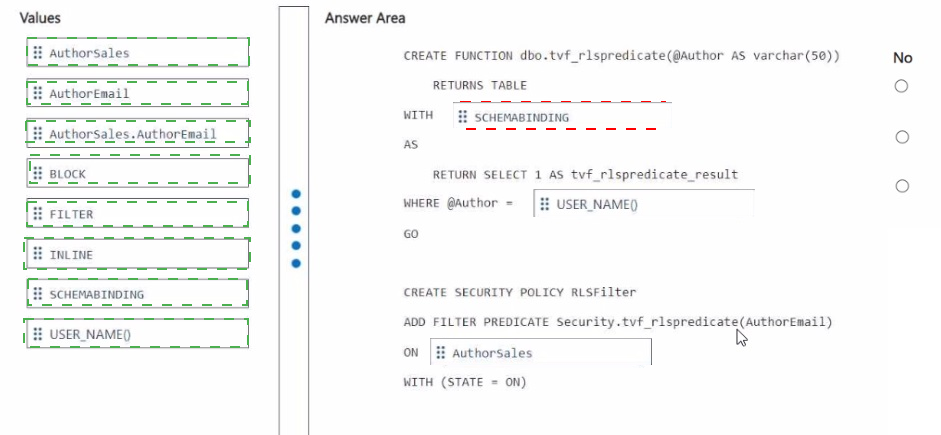
You need to ensure that the authors can see only their respective sales data.
How should you complete the statement? To answer, drag the appropriate values the correct targets. Each value may be used once, more than once, or not at all. You may need to drag the split bar between panes or scroll to view content
NOTE: Each correct selection is worth one point.

Show answerHide answer

Explanation


Summary:
This question involves implementing Row-Level Security (RLS) in a Fabric Warehouse or SQL database to restrict data access. The goal is to ensure authors can only see their own sales records. The solution requires creating a security policy that uses an inline table-valued function as a filter predicate. This function compares a column in the table (the author's email) to the current user's context.

Correct Option Explanations

1. SCHEMABINDING
This clause is required in the function creation. It binds the function to the schema of the objects it references, which in this case is the Authorsales table. This prevents the underlying table schema from being altered in a way that would break the security policy, ensuring the integrity of the RLS implementation.

2. USER_NAME()
This is a system function that returns the name of the current database user. In the context of the RLS function, USER_NAME() will return the identity of the author who is executing a query. The WHERE clause @Author = USER_NAME() is the core logic that filters the rows, ensuring that only rows where the AuthorEmail column matches the current user's name are returned.

3. FILTER
In the CREATE SECURITY POLICY statement, you must specify the type of predicate. A FILTER predicate silently filters the rows that can be selected, updated, or deleted from the base table. This is the correct type for this requirement, as it prevents authors from seeing other authors' sales data during SELECT operations.

4. dbo.Authorsales
This is the fully qualified name (schema and table) of the table on which the security policy is being applied. The security policy and its filter predicate must be applied to the correct table containing the sensitive data (Authorsales) and the column used for filtering (AuthorEmail).

Incorrect Option Explanations

BLOCK:
A BLOCK predicate is used to prevent write operations (INSERT, UPDATE, DELETE) that would violate a rule. The requirement is about filtering data that can be seen, which is the purpose of a FILTER predicate, not a BLOCK predicate.

INLINE:
This is not a valid keyword for RLS predicates in T-SQL. Inline table-valued functions are defined differently, and the INLINE clause is not used in this context for creating the security policy.

Authorsales.AuthorEmail:
While this specifies the column, the ADD FILTER PREDICATE syntax requires the function name followed by the column name in parentheses, not the fully qualified table.column name. The correct syntax is dbo.tvf_rlspredicate(AuthorEmail).

Reference:
Microsoft Official Documentation: Row-Level Security
Question 5 Choose 1
You need to resolve the sales data issue. The solution must minimize the amount of data transferred.
What should you do?
Show answerHide answer

Correct answer: E Configure incremental refresh for the dataflow. Set Refresh rows from the past to 1 Month.

Explanation

Summary:
This question addresses a performance issue in a dataflow, specifically related to the volume of data being processed. The core requirement is to minimize the amount of data transferred and processed during each refresh. The most effective way to achieve this is by implementing incremental refresh, which only loads new or changed data instead of the entire dataset every time.

Correct Option:

E. Configure incremental refresh for the dataflow. Set Refresh rows from the past to 1 Month.
Incremental refresh is the feature designed specifically to solve this problem. It significantly reduces data transfer and processing time by first performing a full initial load, and then subsequently loading only data that has changed within a defined period.

The key configuration is "Refresh rows from the past," which determines the range of historical data queried during a refresh. Setting this to 1 Month means the dataflow will only fetch and process data from the last 30 days. This is the most balanced approach, ensuring recent data is updated while minimizing the data volume, as it processes less data than a 1-year window (Option D).

Incorrect Options:

A. Split the dataflow into two dataflows.
While splitting a dataflow can help with organization or manageability, it does not inherently reduce the amount of data being transferred from the source system. Both dataflows would still need to query the source, potentially transferring the same or even a larger total volume of data.

B. Configure scheduled refresh for the dataflow.
Scheduled refresh determines when the dataflow runs (e.g., daily, hourly), but it does not change how much data is processed during each run. A scheduled refresh would still pull the entire dataset unless combined with incremental refresh.

C. Configure incremental refresh for the dataflow. Set Store rows from the past to 1 Month.
istorical data is kept in the destination (e.g., the lakehouse). It does not control the amount of data queried from the source. To minimize data transfer, you must reduce the source query range using "Refresh rows from the past".

D. Configure incremental refresh for the dataflow. Set Refresh rows from the past to 1 Year.
This is on the right track by using incremental refresh. However, setting the refresh period to 1 Year will still transfer a significantly larger amount of data in each refresh cycle compared to a 1-month window. To "minimize the amount of data transferred," the 1-month period is the more optimal and conservative choice.

Reference:
Microsoft Official Documentation: Incremental refresh in Power BI and Fabric Dataflows Gen2
Question 6 Choose 1
You have an Azure event hub. Each event contains the following fields:
BikepointID
Street
Neighbourhood
Latitude
Longitude
No_Bikes
No_Empty_Docks
You need to ingest the events. The solution must only retain events that have a Neighbourhood value of Chelsea, and then store the retained events in a Fabric lakehouse. What should you use?
Show answerHide answer

Correct answer: B an eventstream

Explanation

Summary:
This question involves real-time data ingestion from Azure Event Hubs into a Fabric lakehouse with a specific filtering requirement. The solution needs to connect to the event hub, filter events based on a condition (Neighbourhood == 'Chelsea'), and write the results to the lakehouse. This requires a service capable of handling streaming data and applying transformation logic in near real-time.

Correct Option:

B. an eventstream
An eventstream in Fabric is a dedicated service for ingesting, transforming, and routing real-time event data. It has a built-in connector for Azure Event Hubs. You can add a Filter transformation operator directly within the eventstream to retain only events where Neighbourhood equals "Chelsea". Finally, you can route the filtered output to a lakehouse destination. This provides a low-code, UI-driven solution that perfectly meets all the stated requirements.

Incorrect Options:

A. a KQL queryset
A KQL queryset is used to query data that is already stored in a KQL database within Fabric. It is not a data ingestion tool and cannot natively read directly from an Azure Event Hub to land data into a lakehouse. Its role is analysis, not ETL/ELT.

C. a streaming dataset
A streaming dataset in Fabric is primarily a destination for data that will be used in Power BI real-time dashboards. It is not designed for transforming and storing raw event data in a lakehouse for broader data engineering purposes. It lacks the transformation capabilities (like filtering) needed before storage.

D. Apache Spark Structured Streaming
While this is a technically feasible option using code in a notebook, it is not the best answer. An eventstream provides the same underlying capability but through a managed, low-code interface that is simpler to configure and manage for a straightforward filter-and-store task. The question does not specify a requirement for custom code, so the platform-native, no-code tool (eventstream) is the preferred solution.

Reference:
Microsoft Official Documentation: What is eventstream in Microsoft Fabric?
Question 7
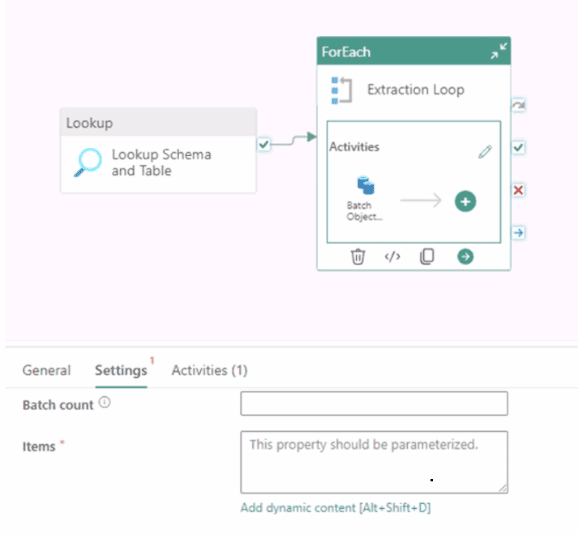
You are building a data orchestration pattern by using a Fabric data pipeline named Dynamic Data Copy as shown in the exhibit. (Click the Exhibit tab.)


Dynamic Data Copy does NOT use parametrization.
You need to configure the ForEach activity to receive the list of tables to be copied.
How should you complete the pipeline expression? To answer, select the appropriate options in the answer area.
NOTE: Each correct selection is worth one point.

Show answerHide answer

Explanation


Summary:
This question involves configuring a Fabric Data Factory pipeline. A Lookup activity is used to retrieve a list of objects (schemas and tables), and a ForEach activity is needed to loop over that list. The Lookup activity's result is stored in its output, and the ForEach activity must be configured to consume this output correctly to iterate through each item in the list.

Correct Option Explanations
@activity('Lookup Schema and Table').output.value

This is the correct expression to retrieve the list of items for the ForEach loop.

activity('Lookup Schema and Table') references the preceding Lookup activity by its name.

.output accesses the result set produced by that activity.

.value is the specific property that contains the array (list) of records returned by the Lookup. The ForEach activity requires an array to iterate over, making .value the necessary final part of the expression.

Incorrect Option Explanations

Other output properties:

output:
This refers to the entire output object of the Lookup activity, which includes metadata like execution count and status, not just the data array. The ForEach activity cannot iterate over this full object.

output.count:
This property returns a single integer representing the number of records in the result set. It is a scalar value, not an array, so it cannot be used for iterating through individual items.

output.pipelineReturnValue:
This is not a standard property of a Lookup activity's output. It might be used in other contexts, such as the return value of an Execute Pipeline activity, but not for the result set of a Lookup.

Activity Names:
Batch Object Copy, Dynamic Data Copy, Extraction Loop: These are the names of other activities or the pipeline itself. The expression must reference the specific Lookup activity that produces the list, which is named Lookup Schema and Table.

Reference:
Microsoft Official Documentation: Lookup activity in Azure Data Factory and Azure Synapse Analytics

Microsoft Official Documentation: ForEach activity in Azure Data Factory
Question 8 Choose 1
You have a Fabric workspace that contains a warehouse named Warehouse1.
While monitoring Warehouse1, you discover that query performance has degraded during the last 60 minutes.
You need to isolate all the queries that were run during the last 60 minutes. The results must include the username of the users that submitted the queries and the query statements. What should you use?
Show answerHide answer

Correct answer: B views from the queryinsights schema

Explanation

Summary:
This question requires detailed, query-level diagnostics for a Fabric Warehouse to troubleshoot a specific performance degradation. You need to identify the exact queries, who ran them, and their text within a precise time window. This requires accessing historical query execution logs with rich metadata, not just high-level resource metrics.

Correct Option:

B. views from the queryinsights schema
The queryinsights schema in a Fabric Warehouse contains a set of dynamic management views (DMVs) designed specifically for this purpose. The queryinsights.exec_requests_history view stores a detailed history of executed queries, including columns like login_name (for the username), command (for the query statement), and submit_time/end_time. You can query this view with a WHERE filter (e.g., WHERE submit_time >= DATEADD(minute, -60, GETDATE())) to isolate all queries from the last 60 minutes, meeting all requirements precisely.

Incorrect Options:

A. the Microsoft Fabric Capacity Metrics app
This Power BI app provides high-level, capacity-wide metrics about resource consumption (e.g., CU/s usage, active operations). It is excellent for monitoring overall capacity health and spend but does not provide the granular, query-level details like the specific query text and the username of the person who submitted it.

C. Query activity
"Query activity" is a general term and not a specific tool within the Fabric admin portal. While there might be a monitoring section showing active or recent queries, the queryinsights DMVs offer a more powerful, flexible, and query-based approach to retrieve and filter the exact historical data needed for this investigation.

D. the sys.dm_exec_requests dynamic management view
The sys.dm_exec_requests DMV is used in SQL Server and Azure SQL Database to view currently executing requests. It does not show a history of queries that have already completed. Since the performance issue occurred over the last 60 minutes and many queries have likely finished, this DMV will not provide the necessary historical data.

Reference:
Microsoft Official Documentation: Query Insights dynamic management views (DMVs)
Question 9 Choose 1
You have a Fabric warehouse named DW1 that loads data by using a data pipeline named Pipeline1. Pipeline1 uses a Copy data activity with a dynamic SQL source. Pipeline1 is scheduled to run every 15 minutes.
You discover that Pipeline1 keeps failing.
You need to identify which SQL query was executed when the pipeline failed.
What should you do?
Show answerHide answer

Correct answer: B From Monitoring hub, select the latest failed run of Pipeline1, and then view the input JSON.

Explanation

Summary:
This question involves debugging a failing data pipeline in Fabric. The pipeline uses a dynamic SQL source, meaning the exact SQL query being executed is defined at runtime, likely via a parameter or expression. When a pipeline fails, the Monitoring hub provides detailed run history, including the specific input parameters and values passed to each activity, which is essential for replicating and diagnosing the failure.

Correct Option:

B. From Monitoring hub, select the latest failed run of Pipeline1, and then view the input JSON.
The Monitoring hub is the central place to inspect pipeline run history. For a failed run, you can drill into the details of the failed activity (in this case, the Copy data activity). The Input JSON shows the configuration of the activity at the time of the run. Since the source is dynamic SQL, the exact query that was executed—constructed from parameters and expressions—will be visible in this input payload. This allows you to see the problematic SQL command that caused the failure.

Incorrect Options:

A. From Monitoring hub, select the latest failed run of Pipeline1, and then view the output JSON.
The Output JSON of a failed activity typically contains error messages, codes, and stack traces. While this is crucial for understanding why the query failed (e.g., a syntax error or timeout), it usually does not contain the full, executed SQL command. The input is where the source definition, including the dynamic query, is stored.

C. From Real-time hub, select Fabric events, and then review the details of Microsoft.Fabric.ItemReadFailed.

D. From Real-time hub, select Fabric events, and then review the details of Microsoft. Fabric.ItemUpdateFailed.
The Real-time hub and Fabric events are used for event-driven architectures and auditing high-level workspace activities. Events like ItemReadFailed or ItemUpdateFailed are too granular and general for this task. They might indicate that a pipeline run failed but will not provide the detailed, activity-level input information (like the dynamic SQL query) needed to diagnose this specific data movement error.

Reference:
Microsoft Official Documentation: Monitor pipeline runs in Microsoft Fabric
Question 10 Choose 3
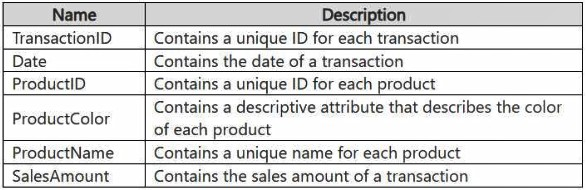
You have a Fabric workspace that contains a lakehouse named Lakehouse1. Data is ingested into Lakehouse1 as one flat table. The table contains the following columns.


You plan to load the data into a dimensional model and implement a star schema. From the original flat table, you create two tables named FactSales and DimProduct. You will track changes in DimProduct.
You need to prepare the data.
Which three columns should you include in the DimProduct table? Each correct answer presents part of the solution.
NOTE: Each correct selection is worth one point.
Show answerHide answer

Correct answer: B, C, F ProductNameProductColorProductID

Explanation

Summary:
This question tests your understanding of the star schema dimensional model. A star schema consists of fact tables (containing business measurements and foreign keys) and dimension tables (containing descriptive context). The DimProduct table is a dimension table, so it must contain the descriptive attributes about products. It must also include the business key (ProductID) to uniquely identify a product and to serve as the join key for the FactSales table.

Correct Options:

B. ProductName
This is a descriptive attribute of a product. In a dimension table, you include all the descriptive fields that users will want to filter by or group by when analyzing the facts. ProductName is a core descriptive property of a product entity.

C. ProductColor
Similar to ProductName, ProductColor is a descriptive attribute that provides context about the product. It belongs in the dimension table so analysts can slice sales data by product color.

F. ProductID
This is the primary key for the DimProduct dimension table. It uniquely identifies each product. This same ProductID will appear as a foreign key in the FactSales table to create the relationship between facts and the product dimension. It is essential for both the table's structure and for joining the tables.

Incorrect Options:

A. Date
Date is a key business context, but it belongs in its own dimension table, DimDate. It would be a foreign key in the FactSales table, not in the DimProduct table.

D. TransactionID
TransactionID is a unique identifier for a sales transaction. This is a measure or event identifier and is the natural primary key for the FactSales table. It does not describe a product and has no place in the DimProduct dimension.

E. SalesAmount
SalesAmount is a numerical measurement of a business event (a sale). This is a classic fact or measure and must be stored in the FactSales table. Placing it in a dimension table would violate the principles of a star schema.

Reference:
Microsoft Official Documentation: Dimensional modeling - While this link is for Power BI, the concepts of star schema and dimensional modeling are universal across data warehousing, including Fabric.
Full mock exam

Sit the DP-700 exam before exam day

Full-length mocks with the same number of questions and the same time limit as the real DP-700 exam. Every attempt draws a new set of questions from the full bank, so you can keep going until you pass comfortably.

Get full DP-700 mock exam
  • 65questions per mock
  • 105 mintime limit
  • 109questions in the bank
  • Newmock on every attempt
These DP-700 practice questions with detailed explanations help candidates learn data engineering concepts within Microsoft Fabric. Topics include data ingestion, transformation, pipelines, and performance optimization. Each question is followed by a clear explanation that helps learners understand how data workflows are designed and implemented. This approach supports deeper learning rather than memorization. By practicing regularly, candidates can improve their technical understanding, identify knowledge gaps, and gain confidence in building data solutions using Microsoft Fabric while preparing effectively for the certification exam.

DP-700 - Implementing Data Engineering Solutions Using Microsoft Fabric Official Exam Blueprint and Weight:

1. Implement and Manage an Analytics Solution:
Official Exam Weight: 30-35%
Subtopics: Configure Spark workspace settings, configure domain workspace settings, configure OneLake workspace settings, configure data workflow workspace settings, configure version control, implement database projects, create and configure deployment pipelines, implement workspace-level access controls, implement item-level access controls, implement row-level column-level object-level and folder/file-level access controls, implement dynamic data masking, apply sensitivity labels to items, endorse items, implement and use workspace logging, configure and implement OneLake security, choose between Dataflow Gen2 pipeline and notebook, design and implement schedules and event-based triggers, implement orchestration patterns with notebooks and pipelines including parameters and dynamic expressions.

2. Ingest and Transform Data:
Official Exam Weight: 30-35%
Subtopics: Design and implement full and incremental data loads, prepare data for loading into dimensional model, design and implement loading pattern for streaming data, choose appropriate data store, choose between dataflows notebooks KQL and T-SQL for data transformation, create and manage shortcuts to data, implement mirroring, ingest data using pipelines, ingest data using continuous integration from OneLake, transform data using Power Query (M) PySpark SQL and KQL, denormalize data, group and aggregate data, handle duplicate missing and late-arriving data, choose appropriate streaming engine, choose between native storage mirrored storage or shortcuts in Real-Time Intelligence, choose between accelerated shortcuts and non-accelerated shortcuts in Real-Time Intelligence, process data using eventstreams, process data using Spark structured streaming, process data using KQL, create windowing functions.

3. Monitor and Optimize an Analytics Solution:
Official Exam Weight: 30-35%
Subtopics: Monitor data ingestion, monitor data transformation, monitor semantic model refresh, configure alerts, identify and resolve pipeline errors, identify and resolve dataflow errors, identify and resolve notebook errors, identify and resolve eventhouse errors, identify and resolve eventstream errors, identify and resolve T-SQL errors, identify and resolve Shortcut errors, optimize lakehouse table, optimize pipeline, optimize data warehouse, optimize eventstreams and eventhouses, optimize Spark performance, optimize query performance.

Domain Title Exam Weight
1 Implement and Manage an Analytics Solution 30-35%
2 Ingest and Transform Data 30-35%
3 Monitor and Optimize an Analytics Solution 30-35%

Pre-Exam Guide: DP-700 – Microsoft Fabric Data Engineering


Core Exam Focus


The DP-700 validates your ability to design, implement, and operationalize data engineering solutions using Microsoft Fabric. This is Microsoft’s modern, unified platform—not just another Azure service. You must understand end-to-end workflows, from data ingestion to transformation, orchestration, and monitoring within the Fabric ecosystem.

Key Fabric Concepts to Master


OneLake & Lakehouses: Understand OneLake as Fabric’s centralized, unified storage layer (based on Azure Data Lake Storage Gen2). Know how to create and manage Lakehouses (default storage is in Delta Parquet format) and understand their relationship with SQL Endpoints and semantic models.

Notebooks & Spark: You must be proficient in using Fabric Notebooks (Python, PySpark, Spark SQL) for large-scale data transformations. Know how to configure Spark sessions and optimize performance.

Data Pipelines & Dataflows: Be able to build and schedule data pipelines using the Fabric pipeline tool. Know when to use Dataflow Gen2 (low-code transformations) vs. Spark notebooks (code-first).

Orchestration with Data Factory: Understand how to create and monitor workflows to sequence and manage activities (pipelines, notebooks, Spark jobs) within Fabric.

Monitoring & Observability: Familiarize yourself with Fabric Monitoring Hub to track pipeline runs, Spark application performance, and troubleshoot failures.

Critical Skills to Demonstrate


Data Ingestion: Load data from various sources (files, Azure SQL, streaming) into Lakehouses or Data Warehouses.
Transformation: Use PySpark/SQL to clean, join, and aggregate data. Know how to work with Delta tables (time travel, OPTIMIZE, VACUUM).
Data Warehousing: Understand the Fabric Data Warehouse (native T-SQL experience, separation from Lakehouse).
Security & Governance: Implement shortcuts for data access without duplication, manage workspace roles, and understand data lineage.

Preparation Strategy


Hands-On Practice is Mandatory: Use a Fabric Trial Capacity to build real solutions. The exam is scenario-heavy and assumes practical experience.
Know the Terminology: Distinguish between Fabric items (Lakehouse, Warehouse, Notebook) and their specific purposes.
Focus on Integration: The Implementing Data Engineering Solutions Using Microsoft Fabric exam tests how these components work together—e.g., loading data via pipeline into a Lakehouse, transforming with a notebook, and serving via a Warehouse.

The DP-700 demands a platform-level understanding rather than isolated tool knowledge. Your ability to navigate Fabric’s unified architecture and choose the right component for each job is key to passing. Prioritize hands-on labs over theory.

Real Stories From Real Customers


Preparing for Microsoft Certified: Fabric Data Engineer Associate became efficient with MSmcqs. DP-700 practice test clearly explained data pipelines, transformation, and analytics workflows.
Isabella Romano | Italy