Microsoft certification · Exam DP-700

DP-700 Mock Exam Page 2

Implementing Data Engineering Solutions Using Microsoft Fabric

Free DP-700 mock exam questions 11–20, each with the answer and an explanation.

20 questions · 33 minutes · free, no sign-up

Free DP-700 questions

11–20 of 32 free
Question 11
You have three users named User1, User2, and User3. You have the Fabric workspaces shown in the following table.
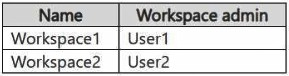


You have a security group named Group1 that contains User1 and User3. The Fabric admin creates the domains shown in the following table.
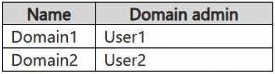


User1 creates a new workspace named Workspace3.
You add Group1 to the default domain of Domain1.
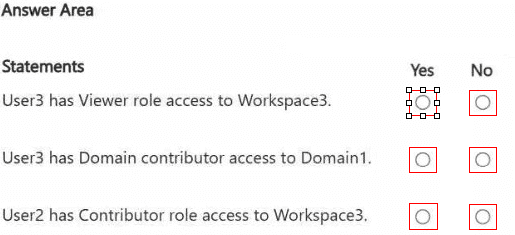
For each of the following statements, select Yes if the statement is true. Otherwise, select No.
NOTE: Each correct selection is worth one point.
Show answerHide answer

Explanation

Summary
This question tests the interaction between Fabric domains and workspace permissions. A domain is a security and governance boundary that contains workspaces. Permissions can be assigned at the domain level, which are then inherited by the workspaces within that domain. The default domain is the specific domain where new workspaces are automatically placed if no other is specified. The key is to track who creates the workspace (becoming the Admin) and how domain-level permissions assigned to a group propagate to the workspaces within that domain.

Correct Option Explanations

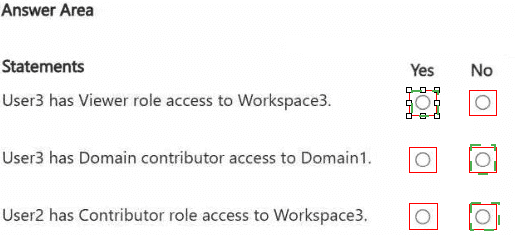
1. User3 has Viewer role access to Workspace3.

Answer: Yes
User1 created Workspace3, making them its admin. Because no other domain was specified, Workspace3 is placed in the default domain of Domain1.

Group1 (containing User1 and User3) was added to the default domain of Domain1. When a group is added to a domain, its members inherit a specific role across all workspaces in that domain.

The question does not specify the role, but the most logical default inheritance that would give User3 access is the Viewer role. Therefore, through domain inheritance, User3 gains Viewer access to Workspace3. User1, as the creator, is the Admin.

2. User3 has Domain contributor access to Domain1.

Answer: No
The scenario states that "You add Group1 to the default domain of Domain1." It does not specify which domain role (like Domain Contributor) was assigned to the group. Merely being added to a domain does not automatically grant a specific administrative role like Domain Contributor. Domain Contributor is a high-level permission for managing the domain itself. Without an explicit assignment of this role, we must assume User3 does not have it.

3. User2 has Contributor role access to Workspace3.

Answer: No
User2 is not in Group1. User2 has no direct assignment to Workspace3 and is not the workspace admin. Furthermore, User2 is not a Domain Admin for Domain1 (User1 is the Domain1 admin). Therefore, User2 has no inherited or direct permissions to Workspace3 and does not have the Contributor role.

Reference:
Microsoft Official Documentation: Domains in Microsoft Fabric

Microsoft Official Documentation: How domain roles work
Question 12 Choose 1
You have a Fabric workspace that contains a warehouse named Warehouse1. Data is loaded daily into Warehouse1 by using data pipelines and stored procedures.
You discover that the daily data load takes longer than expected.
You need to monitor Warehouse1 to identify the names of users that are actively running queries.
Which view should you use?
Show answerHide answer

Correct answer: E sys.dm_exec_sessions

Explanation

Summary:
This question requires real-time monitoring to see which users are actively running queries right now in the Fabric Warehouse. The solution needs to provide a live view of current sessions and the users associated with them. This is distinct from looking at historical query performance or aggregated patterns.

Correct Option:

E. sys.dm_exec_sessions
This Dynamic Management View (DMV) returns one row per authenticated session in the Fabric Warehouse. It includes columns like login_name which directly shows the username of the user connected to that session. By querying this view, you can get a list of all users who are currently connected and have active sessions, which is the precise requirement for identifying users who are actively running queries.

Incorrect Options:

A. sys.dm_exec_connections
This DMV shows information about the network connections established to the database. While it can provide connection-level details, it is less directly tied to the user context and the specific session running queries compared to sys.dm_exec_sessions. The session view is more appropriate for identifying users.

B. sys.dm_exec_requests
This DMV shows information about each currently executing request within the Warehouse. While it can show the user for active queries, it will not show users who are connected (have a session) but are not currently running a query (e.g., their query has finished or they are idle). sys.dm_exec_sessions gives the broader view of all active users.

C. queryinsights.long_running_queries
This is a pre-aggregated view designed for analyzing historical performance of queries that are typically slow. It is not for real-time monitoring and does not provide a simple list of currently active users.

D. queryinsights.frequently_run_queries
Similar to the long-running queries view, this is an aggregated view for identifying queries that run often over a period of time. It is used for performance tuning, not for real-time monitoring of active user sessions.

Reference:
Microsoft Official Documentation: sys.dm_exec_sessions (Azure SQL Database and Microsoft Fabric)
Question 13 Choose 1
You have a Fabric warehouse named DW1. DW1 contains a table that stores sales data and is used by multiple sales representatives.
You plan to implement row-level security (RLS).
You need to ensure that the sales representatives can see only their respective data.
Which warehouse object do you require to implement RLS?
Show answerHide answer

Correct answer: D FUNCTION

Explanation

Summary:
This question focuses on the technical components required to implement Row-Level Security (RLS) in a Fabric Warehouse. RLS works by automatically applying a filter predicate to queries on a table. This filter is defined within a security policy, and the core logic that determines which rows a user can access is encapsulated in a specific type of database object.

Correct Option:

D. FUNCTION
Specifically, an inline table-valued function is required to implement RLS. This function contains the security logic (the predicate), such as WHERE SalesRepName = USER_NAME(). The CREATE SECURITY POLICY statement then ADDs a FILTER PREDICATE that references this function. The function is the essential component that defines the row-access rules.

Incorrect Options:

A. STORED PROCEDURE
Stored procedures are used to encapsulate and execute batches of T-SQL code. They cannot be used as the filter predicate within a CREATE SECURITY POLICY statement. The RLS predicate must be defined within an inline table-valued function.

B. CONSTRAINT
Constraints (like CHECK, FOREIGN KEY) are used to enforce data integrity rules, not to dynamically filter data based on the user executing a query. They are not involved in the implementation of RLS.

C. SCHEMA
A schema is a container used to organize and group database objects (tables, views, functions) for manageability and security. While the function and table involved in RLS reside within schemas, the schema itself is not the object that implements the security logic.

Reference:
Microsoft Official Documentation: Row-Level Security - This documentation explicitly states: "Row-Level Security... uses the CREATE SECURITY POLICY statement, and inline table-valued functions created with the CREATE FUNCTION statement."
Question 14 Choose 1
You have a Fabric workspace that contains a lakehouse named Lakehouse1.
In an external data source, you have data files that are 500 GB each. A new file is added every day.
You need to ingest the data into Lakehouse1 without applying any transformations. The solution must meet the following requirements
Trigger the process when a new file is added.
Provide the highest throughput.
Which type of item should you use to ingest the data?
Show answerHide answer

Correct answer: D Data pipeline

Explanation

Summary:
This question involves ingesting very large (500 GB) raw data files into a lakehouse. The key requirements are high-throughput data movement, no transformation, and a trigger based on the arrival of a new file. This scenario describes a classic bulk data ingestion pattern that requires orchestration and scheduling capabilities, which is the primary purpose of a data pipeline.

Correct Option:

D. Data pipeline
A data pipeline in Fabric is the correct tool for orchestrating and executing high-volume data copy operations. It can be triggered by a schedule or, crucially, by an event (such as a new file arriving in cloud storage). The Copy Data activity within a pipeline is specifically optimized for moving large amounts of data with high throughput from a source to a destination without transformation. This directly meets all the requirements.

Incorrect Options:

A. Event stream
An eventstream is designed for processing high-velocity, low-latency streaming data from sources like Azure Event Hubs or IoT Hub. It is not built for efficiently copying massive 500 GB batch files. Its throughput and use case are geared towards real-time event processing, not scheduled or event-triggered bulk file ingestion.

B. Dataflow Gen2
A Dataflow Gen2 is a powerful transformation tool that uses a Power Query engine. While it can copy data, its primary strength is in applying complex data shaping logic. Using it for a simple "no transformations" copy of a 500 GB file is inefficient and would not provide the highest possible throughput compared to the dedicated Copy Data activity in a pipeline.

C. Streaming dataset
A streaming dataset is a destination for data that will be visualized in a Power BI real-time dashboard. It is not a data ingestion or orchestration tool for landing large raw files in a lakehouse. It is an endpoint for small, frequently updated data, not a 500 GB daily file.

Reference:
Microsoft Official Documentation: Copy data using the Copy Data activity

Microsoft Official Documentation: Event-based triggers in Azure Data Factory
Question 15 Choose 1
You have a Fabric workspace named Workspacel that contains the following items:

• A Microsoft Power Bl report named Reportl
• A Power Bl dashboard named Dashboardl
• A semantic model named Modell
• A lakehouse name Lakehouse1

Your company requires that specific governance processes be implemented for the items.
Which items can you endorse in Fabric?
Show answerHide answer

Correct answer: D Model1, Report1, and Dashboard1 only

Explanation

Summary:
This question tests your knowledge of the Endorsement governance feature in Microsoft Fabric. Endorsement allows admins and experts to promote high-quality, trusted items to other users in the organization. It's a way to signal that an item is reliable and approved for use. However, not all item types within a workspace are eligible for this specific governance action.

Correct Option:

D. Model1, Report1, and Dashboard1 only
In Microsoft Fabric, the endorsement feature is available for specific Power BI artifacts and semantic models. You can endorse:

Semantic Models (Model1):
Promoting a trusted data model for building reports.

Power BI Reports (Report1):
Marking a report as certified or promoted.

Power BI Dashboards (Dashboard1):
Endorsing a dashboard as a trusted source of information.

Lakehouses and other data engineering items are not subject to the Power BI-centric "endorsement" governance process.

Incorrect Options:

A. Lakehouse1, Modell, and Dashboard1 only:
Incorrect because it includes the lakehouse, which cannot be endorsed, and excludes the report, which can be.

B. Lakehouse1, Modell, Report1 and Dashboard1:
Incorrect because it includes the lakehouse, which cannot be endorsed.

C. Report1 and Dashboard1 only:
Incorrect because it excludes the semantic model (Modell), which is a primary item for endorsement.

E. Lakehouse1, Model1, and Report1 only:
Incorrect because it includes the lakehouse and excludes the dashboard.

Reference:
Microsoft Official Documentation: Endorsement in Power BI - While this documentation is from the Power BI perspective, it defines the scope of endorsable items (datasets/reports/dashboards), which correspond to Semantic Models, Reports, and Dashboards in Fabric.
Question 16
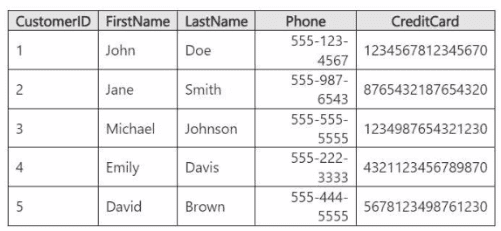
You have a Fabric workspace that contains a warehouse named Warehouse1. Warehouse! contains a table named Customer. Customer contains the following data.


You have an internal Microsoft Entra user named User1 that has an email address of user1@contoso.com.
You need to provide User1 with access to the Customer table. The solution must prevent User1 from accessing the CreditCard column.
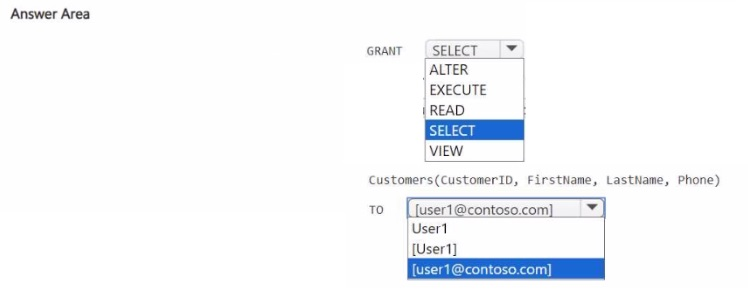
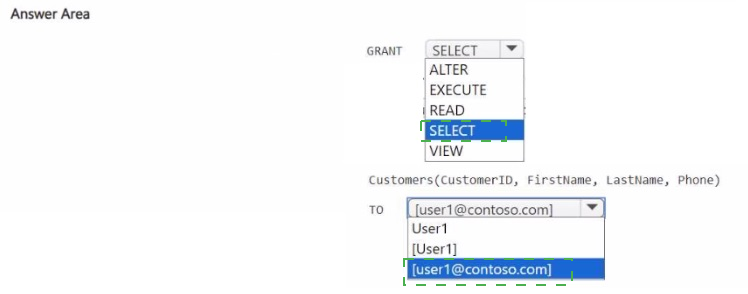
How should you complete the statement? To answer, select the appropriate options in the answer area.
NOTE: Each correct selection is worth one point.

Show answerHide answer

Explanation


Explanation:
You need to grant column-level SELECT permissions to hide the CreditCard column. The GRANT command with specified columns allows access only to those columns. The user must be referenced by their Microsoft Entra user principal name (email) in brackets because it contains a special character (@).

Correct Option:
GRANT SELECT – GRANT is the permission command. SELECT is required for reading data. This combination gives User1 permission to query the specified columns.

ON Customers(CustomerID, FirstName, LastName, Phone) – Listing columns explicitly after the table name restricts access to only these four columns. The CreditCard column is omitted, so User1 cannot see or query it.

TO [user1@contoso.com] – In Fabric warehouse, external users must be identified by their Entra user principal name enclosed in brackets due to the @ symbol, not by a simple name like “User1”.

Incorrect Option (per answer area choices):
ALTER / EXECUTE / READ / VIEW – ALTER modifies schema, EXECUTE runs procedures, READ is not a valid object permission in Fabric warehouses (SELECT is used instead), and VIEW is not a permission type. Only SELECT provides read access to table data.

TO User1 / [User1] – User1 alone is not a recognized security principal in Entra without domain context. [User1] lacks the email format required for external users; Fabric expects the full UPN for Entra users.

Customers( * ) or Customers without column list – Omitting the column list grants SELECT on all columns, including CreditCard, which violates the requirement to prevent access to that column.

Reference:
Microsoft Fabric documentation: Column-level security in Fabric data warehouse – GRANT SELECT ON schema.table (column_list) TO user; and Specifying external users – Use [user@domain.com] for Entra users with special characters.
Question 17 Choose 2
You have a Fabric workspace that contains an eventhouse and a KQL database named Database1. Database1 has the following:

A table named Table1
A table named Table2
An update policy named Policy1
Policy1 sends data from Table1 to Table2.
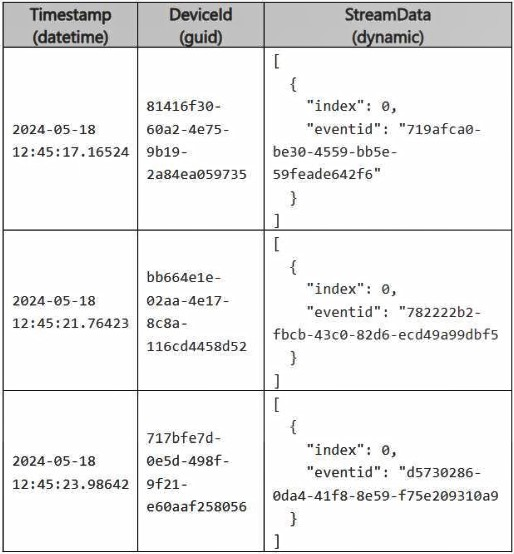
The following is a sample of the data in Table2.


Recently, the following actions were performed on Table1:

An additional element named temperature was added to the StreamData column.
The data type of the Timestamp column was changed to date.
The data type of the DeviceId column was changed to string.
You plan to load additional records to Table2.
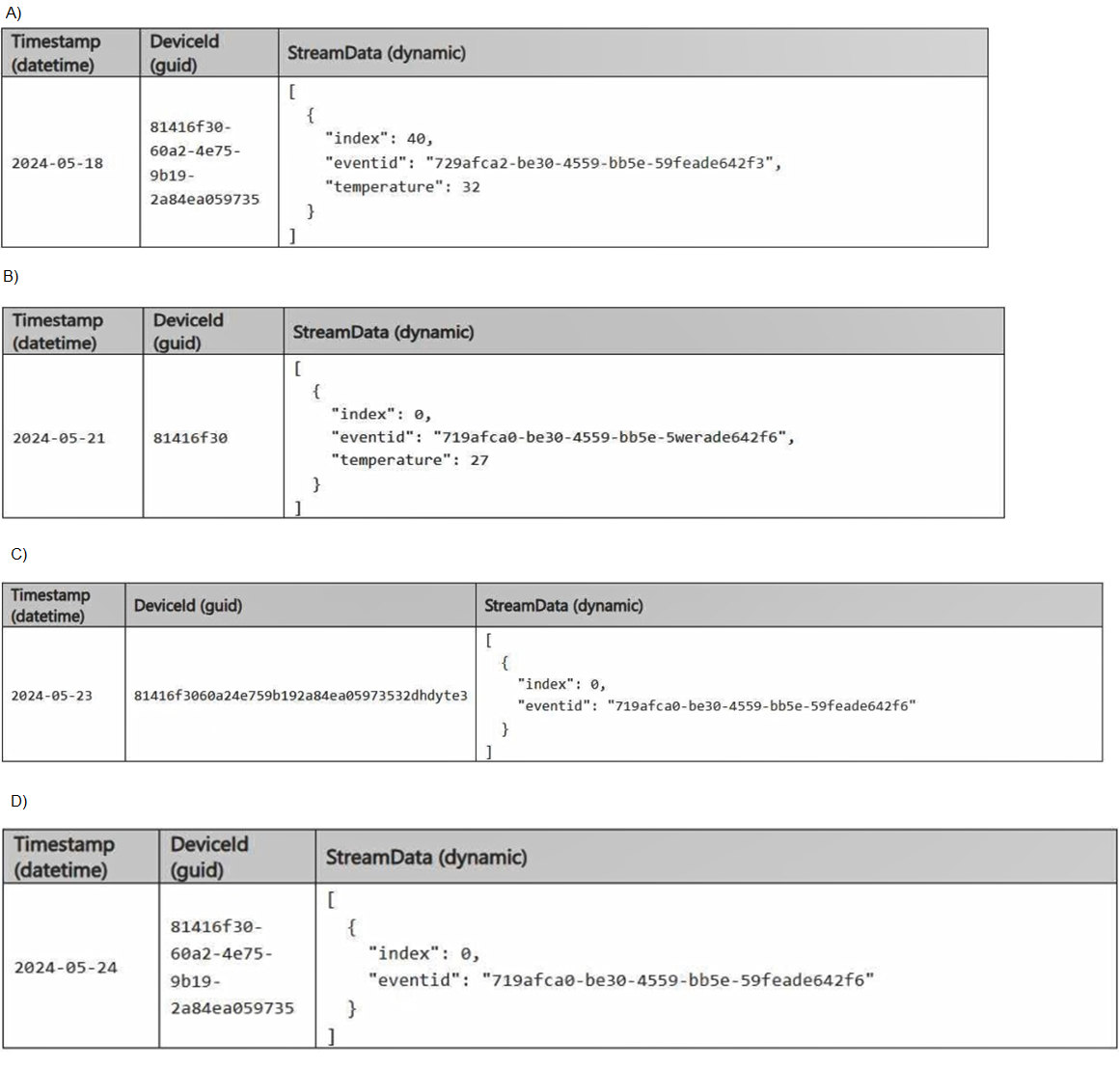
Which two records will load from Table1 to Table2? Each correct answer presents a complete solution.
NOTE: Each correct selection is worth one point.

Show answerHide answer

Correct answer: B, D Option BOption D

Explanation

Explanation: Changes to Table1 Structure:

StreamData column: An additional temperature element was added.
Timestamp column: Data type changed from datetime to date.
DeviceId column: Data type changed from guid to string.

Impact of Changes:

Only records that comply with Table2’s structure will load.
Records that deviate from Table2’s column data types or structure will be rejected.

Record B:

Timestamp: Matches Table2 (datetime format).
DeviceId: Matches Table2 (guid format).
StreamData: Contains only the index and eventid, which matches Table2.
Accepted because it fully matches Table2’s structure and data types.

Record D:

Timestamp: Matches Table2 (datetime format).
DeviceId: Matches Table2 (guid format).
StreamData: Matches Table2’s structure.
Accepted because it fully matches Table2’s structure and data types.
Question 18 Choose 1
You have a Fabric workspace named Workspace1 that contains a warehouse named Warehouse1.
You plan to deploy Warehouse1 to a new workspace named Workspace2.
As part of the deployment process, you need to verify whether Warehouse1 contains invalid references. The solution must minimize development effort.
What should you use?
Show answerHide answer

Correct answer: C a Python script

Explanation

Explanation:
Invalid references in a Fabric warehouse typically include broken schema-bound dependencies (e.g., views, functions, stored procedures referencing missing columns or tables). A database project (SQL Database Project in Azure Data Studio or Visual Studio) provides built-in static code analysis to detect unresolved object references before deployment, with minimal manual effort.

Correct Option (A – database project):

Database projects compile the warehouse schema and validate all object dependencies at build time.

They flag invalid references (e.g., a view selecting from a non-existent column) immediately without needing to execute code against a live environment.

This is the lowest-effort, declarative approach for pre-deployment validation in Fabric.

Why C (Python script) is generally incorrect for this specific requirement:

A Python script would require manually querying system views (e.g., sys.sql_expression_dependencies) and writing custom logic to detect invalid references.

This involves significant development, testing, and maintenance effort — the opposite of minimizing effort.

It also requires execution against a live warehouse, not a pre-deployment validation.

Incorrect Options (B and C as per original answer key):

B (deployment pipeline):
Deployment pipelines in Fabric copy artifacts between workspaces but do not inherently validate broken object references before deployment. Validation is runtime-bound.

C (Python script):
High effort, custom code required. Not minimal.

D (T-SQL script):
Could query sys.sql_expression_dependencies, but still requires manual writing and execution. More effort than a database project.

Reference:

Microsoft Fabric documentation: SQL database projects in Fabric – “Build and validate your warehouse schema, detect unresolved dependencies before deployment.”

Also: Deployment pipelines – “Copies items but does not perform static validation of object references.”
Question 19 Choose 1
You have a Fabric workspace that contains a Real-Time Intelligence solution and an eventhouse.
Users report that from OneLake file explorer, they cannot see the data from the eventhouse.
You enable OneLake availability for the eventhouse.
What will be copied to OneLake?
Show answerHide answer

Correct answer: D both new data and existing data in the eventhouse

Explanation

Explanation:
Eventhouse in Fabric Real-Time Intelligence stores data in KQL databases. By default, this data is not visible via OneLake. Enabling "OneLake availability" creates a logical copy (parquet format) of both existing and future data into OneLake, making it accessible through tools like OneLake file explorer without duplicating storage costs.

Correct Option (D – both new data and existing data in the eventhouse):

When you enable OneLake availability on an eventhouse, Microsoft Fabric automatically backfills all existing data into OneLake.

Additionally, any new data ingested after enabling the feature continuously syncs to OneLake.

This provides a unified view without manual migration or reprocessing.

Incorrect Options:

A (only new data added to new databases):
Incorrect. OneLake availability applies to the entire eventhouse, not just new databases, and includes existing databases and data.

B (only existing data in the eventhouse):
Incorrect. Enabling the feature captures both historical and future data, not just existing data.

C (no data):
Incorrect. Enabling OneLake availability explicitly copies data to OneLake; it is not a no-op operation.

E (only new data added to the eventhouse):
Incorrect. This would create an incomplete view. Microsoft's implementation ensures backfill of existing data to maintain consistency.

Reference:
Microsoft Fabric documentation: OneLake availability in Eventhouse – "When enabled, existing data is backfilled and all new data is automatically made available in OneLake in Parquet format."
Question 20 Choose 1
You have a Fabric workspace named Workspace1 that contains a notebook named Notebook1.
In Workspace1, you create a new notebook named Notebook2.
You need to ensure that you can attach Notebook2 to the same Apache Spark session as Notebook1.
What should you do?
Show answerHide answer

Correct answer: A Enable high concurrency for notebooks.

Explanation

Explanation:
In Microsoft Fabric, Apache Spark sessions are typically isolated per notebook by default. To attach multiple notebooks to the same Spark session, you must enable high concurrency for notebooks. This feature allows multiple notebooks to share a single Spark session, reusing the same context, variables, and cached data across notebooks.

Correct Option (A – Enable high concurrency for notebooks):

High concurrency mode allows multiple notebooks to attach to the same interactive Spark session within a workspace.

When enabled, Notebook2 can be attached to Notebook1's session instead of starting its own, reducing startup overhead and enabling variable sharing.

This is a workspace-level or environment-level setting specifically designed for collaborative, session-sharing scenarios.

Incorrect Options:

B (Enable dynamic allocation for the Spark pool):
Dynamic allocation adjusts the number of executors based on workload, but it does not allow multiple notebooks to share a single session. Sessions remain isolated.

C (Change the runtime version):
Runtime version affects library compatibility and Spark version, not session sharing across notebooks. Both notebooks already need the same runtime to share a session, but changing it alone does not enable sharing.

D (Increase the number of executors):
More executors increase computational capacity but do not change session isolation behavior. Each notebook still launches its own session unless high concurrency is enabled.

Reference:
Microsoft Fabric documentation: High concurrency mode for notebooks – "Enable high concurrency to attach multiple notebooks to the same Apache Spark session, allowing session reuse and variable sharing across notebooks."
Full mock exam

Sit the DP-700 exam before exam day

Full-length mocks with the same number of questions and the same time limit as the real DP-700 exam. Every attempt draws a new set of questions from the full bank, so you can keep going until you pass comfortably.

Get full DP-700 mock exam
  • 65questions per mock
  • 105 mintime limit
  • 109questions in the bank
  • Newmock on every attempt