A nurse is providing care to a patient diagnosed with abdominal compartment syndrome.
The nurse should recognize the patient is most at risk for developing
Explanation: Abdominal compartment syndrome (ACS) involves increased intraabdominal
pressure, which can significantly impact various body systems. One of the major
concerns is its effect on respiratory function, leading to increased peak inspiratory
pressure. This happens because the elevated pressure in the abdomen can push up
against the diaphragm, making it harder for the lungs to expand during inhalation.
Increased urine output is unlikely as ACS usually leads to decreased renal perfusion and
output. Increased preload and decreased intracranial pressure are not typically associated
with ACS. References: = CCRN Exam Handbook, AACN Adult CCRN Certification Review
Course
Question 12Choose 1
Which of the following is a late finding in hypovolemic shock?
Show answerHide answer
Correct answer: Dhypotension
Explanation
Explanation:
Hypotension, or low blood pressure, is a late finding in hypovolemic shock, which means
that it occurs when the condition has progressed to a severe stage. Hypotension indicates
that the body’s compensatory mechanisms, such as vasoconstriction, tachycardia, and
increased cardiac output, have failed to maintain adequate perfusion and oxygen delivery
to the vital organs. Hypotension is a sign of impending circulatory collapse and organ
failure, and requires immediate intervention to restore blood volume and blood pressure.
Hypotension is usually defined as a systolic blood pressure below 90 mmHg or a mean
arterial pressure below 65 mmHg1.
Question 13Choose 1
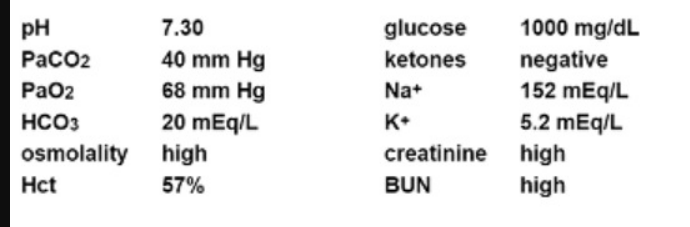
An unconscious patient presents with the following laboratory values:
Appropriate management of this patient should include
Show answerHide answer
Correct answer: AIV hydration.
Explanation
Explanation: The laboratory values indicate hyperosmolar hyperglycemic state (HHS),
characterized by high glucose levels, high osmolality, and dehydration. The primary
management includes aggressive IV hydration to correct dehydration and improve
circulation. Hemodialysis and intubation are not immediate priorities unless there are other
indications, and osmotic diuresis is not appropriate in this context. References: = CCRN
Exam Handbook and AACN's Certification Review Course materials.
Question 14Choose 1
The most appropriate therapy for carboxyhemoglobinemia is
Show answerHide answer
Correct answer: A100% O2 administration.
Explanation
Explanation: The most appropriate therapy for carboxyhemoglobinemia, which is carbon
monoxide poisoning, is the administration of 100% oxygen. This treatment helps to
displace carbon monoxide from hemoglobin, allowing oxygen to bind to hemoglobin and be
transported to tissues more effectively. High-flow oxygen can significantly reduce the halflife
of carboxyhemoglobin, facilitating faster recovery.References: = CCRN Exam
Handbook, page 30
Question 15Choose 1
Which of the following are physiologic effects of pulmonary contusion?
Show answerHide answer
Correct answer: Cincreased airway resistance and decreased gas diffusion
Explanation
Explanation: Pulmonary contusion leads to damage to lung parenchyma, resulting in
alveolar hemorrhage and edema. This causes increased airway resistance and decreased
gas diffusion due to the inflammatory response and accumulation of fluid within the alveoli,
impairing effective gas exchange and reducing lung compliance.References: = CCRN
Exam Handbook, page 40
Question 16Choose 1
A patient is experiencing lower left quadrant pain with guarding, as well as abdominal
distention and rigidity. KUB reveals free air in the abdominal
cavity. Vital signs are:
BP76/40
HR130
RR32
T101.7° F (38.7°C)
A nurse would suspect
Show answerHide answer
Correct answer: Aperforated bowel.
Explanation
Explanation: The clinical presentation of lower left quadrant pain with guarding, abdominal
distention, rigidity, and free air in the abdominal cavity on a KUB (kidney, ureter, and bladder) radiograph strongly suggests a perforated bowel. The presence of free air
indicates that there is a breach in the gastrointestinal tract, allowing air to escape into the
peritoneal cavity. The patient's vital signs, including hypotension (BP 76/40), tachycardia
(HR 130), tachypnea (RR 32), and fever (T 101.7°F), are consistent with sepsis and shock,
which are common complications of bowel perforation. References: CCRN Exam
Handbook, AACN, page 30, section on Gastrointestinal.
Question 17Choose 1
A nurse admits a patient awaiting surgery for an unstable pelvic fracture following a fall in
which no other injuries were sustained. The nurse should prioritize
Show answerHide answer
Correct answer: Cplacement of a binder across the patient's hips.
Explanation
Explanation: In the context of an unstable pelvic fracture, placing a binder across the
patient's hips is crucial to stabilize the fracture and reduce the risk of further internal
bleeding and damage. This intervention helps in temporarily stabilizing the pelvis until
definitive surgical treatment can be performed. Transporting the patient for an MRI is not
the immediate priority, as the primary goal is to stabilize the patient. Type and
crossmatching PRBCs are important but should follow immediate stabilization measures.
Administering a sedative to reduce movement can be considered, but it is not the top
priority over physical stabilization of the fracture. References: = CCRN Exam Handbook,
AACN Adult CCRN Certification Review Course
Question 18Choose 1
An older adult patient has been in the unit for 60 hours. The patient has received
benzodiazepines for agitation, opioids for persistent pain, and bronchodilators. The patient
reports that there is too much noise, and they cannot get peace and quiet. The nurse
should evaluate for
Show answerHide answer
Correct answer: Asleep disturbances.
Explanation
Explanation: The patient who has been in the unit for 60 hours and reports agitation, noise
disturbances, and an inability to get peace and quiet may be experiencing sleep
disturbances. Factors such as the ICU environment, frequent interventions, and the
medications being administered (e.g., benzodiazepines, opioids, and bronchodilators) can
significantly disrupt sleep patterns, leading to further agitation and delirium. Addressing the
patient's sleep hygiene and implementing measures to promote rest can be
beneficial. References: = CCRN Exam Handbook, page 52
Question 19Choose 1
During the monthly code team review, it is noted that regulators have been consistently
missing from the O2 tanks. Which of the following is a nurse's best action?
Show answerHide answer
Correct answer: BInform the nurse manager of the need for more regulators.
Explanation
Explanation: The absence of regulators from O2 tanks is a serious issue that can affect
patient care1. The nurse manager is in a position to address this problem effectively by
ensuring the availability of necessary equipment2. Therefore, the best action would be to
inform the nurse manager of the need for more regulators123. While documenting the
issue and reporting to the shift supervisor are important, they do not directly address the
problem. Forming a task force could be helpful, but it might take more time to implement
solutions23.
Question 20Choose 1
A patient underwent bariatric surgery for weight loss 3 days ago. The patient appears
anxious, restless, and reports increased abdominal pain over the last 24 hours. The nurse
palpates mild subcutaneous crepitus over the neck. Vital signs are:
BP 106/64
HR 128
RR 27
T 100.4° F (38°C)
Which action should the nurse anticipate?
Show answerHide answer
Correct answer: DPrepare the patient for surgery.
Explanation
Explanation: The signs and symptoms described in the patient post-bariatric surgery,
including anxiety, restlessness, increased abdominal pain, and subcutaneous crepitus over
the neck, suggest a potential anastomotic leak, which is a surgical emergency. Given the
vital signs indicating possible sepsis or shock (elevated heart rate, increased respiratory
rate, and fever), immediate surgical intervention is likely required to repair the leak and
prevent further complications. References: CCRN Exam Handbook, AACN, page 30,
section on GI surgical emergencies.
Full mock exam
Sit the CCRN-Adult exam before exam day
Full-length mocks with the same number of questions and the same time limit as the real CCRN-Adult exam. Every attempt draws a new set of questions from the full bank, so you can keep going until you pass comfortably.