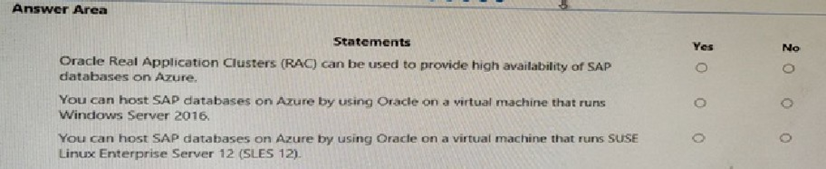
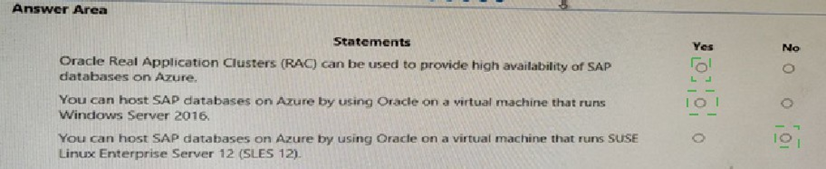
You plan to deploy an SAP landscape on Azure that will use SAP HANA on Azure (Large Instances). You need to ensure that outbound traffic from the application tier can flow network virtual appliances (NVAs)only to the database tier. What should you use?
Show answerHide answer
Correct answer: C application security groups
Explanation
Explanation:The requirement is to enforce a micro-segmentation rule where traffic from all VMs in the "application tier" is allowed only to the "database tier," and must flow through Network Virtual Appliances (NVAs) for inspection. The key is to create a rule that automatically applies to any VM based on its application role, not its specific IP address, and to direct that traffic through a specific network path (the NVA). This requires a combination of two features.
Correct Option:
C. Application Security Groups (ASGs) are a critical component of the solution, but alone they are not sufficient.
Analysis: ASGs allow you to group VMs by their application role (e.g., "SAP-AppServers", "SAP-HANA-DB"). You can then use these ASGs as the source or destination in Network Security Group (NSG) rules. This fulfills the "ensure traffic can flow... only to the database tier" part in a scalable, IP-agnostic way.
However, forcing traffic through an NVA requires User-Defined Routes (UDRs). A UDR on the application tier's subnet with a next-hop to the NVA's IP would direct all traffic (including that destined for the DB tier) to the NVA first.
Therefore, the complete solution requires B (NSGs with ASGs) and A (UDRs directing traffic to NVAs). Since the question asks for a single answer and Application Security Groups are the specific feature that enables the identity-based rule for the application tier, it is the best choice among the options, though the full implementation requires NSGs and UDRs as well.
Incorrect Option:
A. Network Virtual Appliances (NVAs):
NVAs are the device that inspects the traffic, but they do not, by themselves, ensure that all outbound app tier traffic flows through them. That enforcement is done via User-Defined Routes (UDRs) applied to the subnet.
B. Network Security Groups (NSGs):
NSGs are for allow/deny traffic rules (stateful firewall). While you need NSGs to create the allow rule from the app tier ASG to the DB tier ASG, NSGs cannot force traffic to take a specific route through an NVA. Route enforcement is the function of UDRs.
D. Azure Firewall:
This is a managed NVA and could serve as the central inspection point. However, similar to option A, simply deploying Azure Firewall does not ensure traffic is routed through it; you still need UDRs. Furthermore, it is not the specific feature that enables grouping VMs by application role for rule creation.
Reference:
Microsoft Learn, "Best practices for network security," recommends using Application Security Groups to define fine-grained network security policies based on workloads, combined with User-Defined Routes for forced tunneling and traffic inspection scenarios—exactly the pattern for a secure SAP tiered architecture.