Microsoft certification · Exam AZ-120

AZ-120 Mock Exam

Planning and Administering Microsoft Azure for SAP Workloads (beta)

Free AZ-120 questions on Topic 1: Litware, inc Case Study, each with the answer and an explanation.

20 questions · 33 minutes · free, no sign-up

Topic 1: Litware, inc Case Study questions

1–2 of 2 free
Question 1
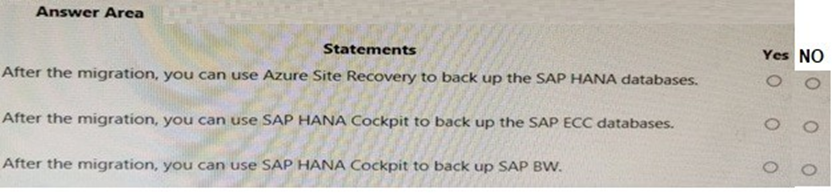
For each of the following statements, select Yes if the statement is true. Otherwise, select No.

NOTE: Each correct selection is worth one point.
Show answerHide answer

Explanation


Explanation:
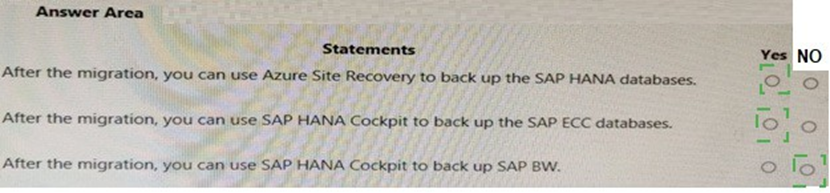
This question tests your knowledge of the correct backup tools for different SAP database components after a migration to Azure. The key distinction is that SAP HANA Cockpit is a tool designed specifically for managing SAP HANA databases. You must evaluate each statement against the compatibility of the tool with the database type and the correct use of Azure Site Recovery (ASR).

Correct Option:

Statement 1 (After the migration, you can use Azure Site Recovery to back up the SAP HANA databases.): No.
Azure Site Recovery (ASR) is a disaster recovery service for replication and failover of entire VMs/applications. It is not a granular backup solution for databases. For SAP HANA database backups, you must use native HANA tools (Backint to Azure Blob) or Azure Backup for SAP HANA.

Statement 2 (After the migration, you can use SAP HANA Cockpit to back up the SAP ECC databases.): No.
SAP HANA Cockpit only manages SAP HANA databases. SAP ECC (ERP Central Component) typically runs on databases like SAP ASE, Db2, or Oracle. Therefore, you cannot use a HANA-specific tool to back up a non-HANA database.

Statement 3 (After the migration, you can use SAP HANA Cockpit to back up SAP BW.): Yes.
This statement is true only if the SAP BW (Business Warehouse) system is running on the SAP HANA database (BW/4HANA or Suite on HANA). The SAP HANA Cockpit is the correct management tool for performing backups of the underlying HANA database for such workloads.

Incorrect Option:

Incorrect selections would be:
Marking Statement 1 as "Yes" (confusing ASR with backup), or Statement 2 as "Yes" (using a HANA tool for a non-HANA DB), or Statement 3 as "No" (not recognizing that modern SAP BW runs on HANA).

Statement 1: ASR is for DR, not for operational database backups/restores.

Statement 2: Tool-database mismatch; ECC requires its native database tools.

Statement 3: For SAP BW on HANA, HANA Cockpit is the appropriate tool.

Reference:
Microsoft Learn, "Backup and restore overview for SAP HANA on Azure VMs," which details the native HANA backup process and integration with Azure Backup, not ASR. SAP documentation on SAP HANA Cockpit, which specifies it is for administering SAP HANA databases.
Question 2

For each of the following statements, select Yes if the statement is true. Otherwise, select No.

NOTE: Each correct selection is worth one point.

Show answerHide answer

Explanation


Explanation:
This question tests your understanding of the appropriate tools for protecting different SAP components on Azure. It's crucial to distinguish between disaster recovery (Azure Site Recovery) and granular backup, and to know which management tools apply to specific database types (HANA vs. non-HANA).

Correct Option:

Statement 1:
No. Azure Site Recovery is designed for disaster recovery by replicating entire virtual machines. It is not a tool for performing application-consistent backups of a database like SAP HANA, which require native HANA tools or Azure Backup for SAP HANA.

Statement 2:
No. SAP HANA Cockpit is a management console exclusively for SAP HANA databases. SAP ECC is an application that can run on various databases (like Oracle, Db2, or SQL Server). You cannot use a HANA tool to back up a non-HANA database instance.

Statement 3:
Yes (Conditional). This statement is true if the SAP BW (Business Warehouse) system is running on the SAP HANA database (e.g., BW/4HANA). In that scenario, SAP HANA Cockpit is the correct tool for managing and backing up the underlying HANA database.
Incorrect Option:

Incorrect for Statement 1:
Selecting "Yes" confuses the purpose of ASR. It provides VM-level replication for DR, not point-in-time database backup and restore capabilities needed for operational recovery.

Incorrect for Statement 2:
Selecting "Yes" shows a misunderstanding of SAP architecture. ECC and its database are separate entities; the database type dictates the backup tool (e.g., RMAN for Oracle), not the SAP application layer.

Incorrect for Statement 3:
Selecting "No" would be incorrect for a modern SAP BW on HANA deployment. It fails to recognize that the backup target is the HANA database, for which HANA Cockpit is a primary management interface.

Reference:
Microsoft Learn, "What is Azure Site Recovery?" - clarifies ASR is for disaster recovery, not granular backup.

SAP documentation on SAP HANA Cockpit, confirming its scope is limited to SAP HANA database administration.

That's the last free question in Topic 1: Litware, inc Case Study

You've seen the free 30% (2 of 8 questions). Full access unlocks every question and full-length AZ-120 mock exams (65 questions, 105 minutes), a different mock on every attempt.

Unlock full mock exam
Full mock exam

Sit the AZ-120 exam before exam day

Full-length mocks with the same number of questions and the same time limit as the real AZ-120 exam. Every attempt draws a new set of questions from the full bank, so you can keep going until you pass comfortably.

Get full AZ-120 mock exam
  • 65questions per mock
  • 105 mintime limit
  • 218questions in the bank
  • Newmock on every attempt