Which statement describes the outcome when the trust boundary is defined at the Cisco IP
phone?
Show answerHide answer
Correct answer: D
Packets of Ethernet frames are not remarked at the access layer switch.
Explanation
ExplanationThe correct answer is D. Packets or Ethernet frames are not remarked at the access layer switch.
When the trust boundary is defined at the Cisco IP phone, the phone marks voice traffic with appropriate QoS values, and the connected access switch trusts those markings rather than reclassifying or remarking them under its normal trust configuration. This helps preserve voice prioritization across the network. The access switch may still remark traffic if an explicit QoS policy overrides the trusted markings.
Correct Option
D. Packets or Ethernet frames are not remarked at the access layer switch.
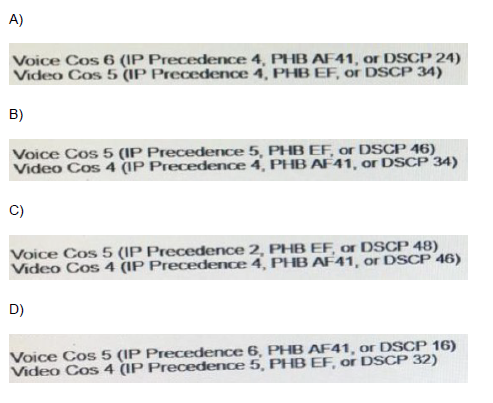
The phone is the trust boundary: QoS markings from the trusted phone are accepted by the switch. Voice traffic is commonly marked with CoS 5 and DSCP EF (46), while signaling commonly uses CoS 3 and DSCP CS3 (24). The switch can then use these markings for classification and queuing.
Incorrect Options
- A. Packets or Ethernet frames are not remarked by the IP phone:
The phone can mark its own voice traffic and may reset markings on traffic received from a connected PC.
- B. Packets or Ethernet frames are remarked at the distribution layer switch:
The trust boundary is at the phone, so remarking at the distribution layer is not the defining outcome.
- C. Packets or Ethernet frames are remarked at the access layer switch:
This would describe a different trust model, in which the access switch classifies or remarks incoming traffic instead of trusting the phone's markings.
Reference
- Cisco, Borderless Campus QoS Design Guide