Cisco certification · Exam 350-801

350-801 Mock Exam Page 12

Implementing Cisco Collaboration Core Technologies (350-801 CLCOR)

Free 350-801 mock exam questions 111–120, each with the answer and an explanation.

20 questions · 27 minutes · free, no sign-up

Free 350-801 questions

111–120 of 162 free
Question 111 Choose 1

What is a software-based media resource that is provided by the Cisco IP Voice Streaming
Application?

Show answerHide answer

Correct answer: C

annunciator

Explanation

Explanation
Cisco Unified Communications Manager (CUCM) uses the ! wildcard in variable-length route patterns to match one or more digits. For international calls, a pattern such as 9.011! can match numbers of different lengths. However, CUCM cannot know when the caller has finished dialing, so it waits for the interdigit timer to expire. Cisco recommends adding a second route pattern ending with # so callers can explicitly indicate the end of dialing.

Correct Option

C. Create a second route pattern followed by the # wildcard.
For example, configure 9.011!# alongside 9.011!. The # acts as an end-of-dialing indicator, allowing CUCM to route the call immediately rather than waiting for the timeout.

Incorrect Options

- A. Configure a single route pattern for international calls —
A single variable-length pattern does not explicitly tell CUCM when dialing is complete.

- B. Reduce the T302 timer to less than 4 seconds —
Cisco advises not setting T302 below 4 seconds, because pauses while dialing could cause incomplete numbers to be sent.

- D. Set up all international route patterns to 0.1 —
This is not the recommended method for handling variable-length international numbers.

Reference
- Cisco Collaboration SRND — International and Variable-Length Route Patterns
Question 112 Choose 1

Which call flow matches traffic from a Mobile and Remote Access registered endpoint to
central call control?

Show answerHide answer

Correct answer: D

Endpoint > Expressway-E > Expressway-C > Cisco Unified CM

Explanation

Explanation
The correct answer is D. Endpoint → Expressway-E → Expressway-C → Cisco Unified CM. In a Cisco Mobile and Remote Access (MRA) deployment, the remote endpoint connects securely through Expressway-E, typically located in the DMZ. Traffic then traverses the Expressway-E/Expressway-C traversal pair to reach Expressway-C on the internal network. Expressway-C provides the connection to Unified CM, which handles endpoint registration and call control.

Correct Option

D. Endpoint → Expressway-E → Expressway-C → Cisco Unified CM

- Expressway-E:
Provides the external-facing entry point and secure firewall traversal for remote endpoints.

- Expressway-C: Acts as the internal traversal and collaboration gateway, communicating with Unified CM.

- Cisco Unified CM:
Provides registration, call signaling, and call control.

Incorrect Options

- A. Endpoint → Expressway-C → Cisco Unified CM:
Incorrect because it skips Expressway-E, the external-facing component used in the standard MRA traversal architecture.

- B. Endpoint → Expressway-E → Cisco Unified CM:
Incorrect because it omits Expressway-C, which provides the internal connection to Unified CM.

- C. Endpoint → Expressway-C → Expressway-E → Cisco Unified CM:
Incorrect because the traversal order is reversed, and Expressway-E does not normally connect directly to Unified CM in this architecture.

Reference
- Cisco — Mobile and Remote Access Deployment Guide
Question 113 Choose 1

Refer to the exhibit.

An engineer verifies the configured of an MGCP gateway. The commands are already
configured. Which command is necessary to enable MGCP?


Show answerHide answer

Correct answer: D

Device (config)# mgcp

Explanation

Explanation
The correct answer is D. Device(config)# mgcp.

On a Cisco IOS voice gateway, the global configuration command mgcp enables Media Gateway Control Protocol (MGCP) functionality. MGCP allows Cisco Unified Communications Manager (CUCM) to control gateway call processing and associated voice resources centrally. Since the question states that the other configuration commands are already present, the missing command is the one that enables MGCP itself.

Incorrect Options

- A. mgcp enable:
This is not the correct Cisco IOS command syntax for enabling MGCP.

- B. ccm-manager enable:
This is not the correct command. The relevant command for CUCM MGCP support is ccm-manager mgcp.

- C. com-manager active:
This is invalid syntax; it also misspells ccm-manager.

Reference
Cisco’s official MGCP Gateway Configuration Guide explicitly identifies mgcp as the command that enables the MGCP protocol.
Question 114 Choose 2

An engineer configures Cisco Unified Communications Manager to prevent toll fraud. At
which two point does the engineer block the pattern in Cisco Unified CM to complete this
task? (Choose two.)

Show answerHide answer

Correct answer: D, E

partition

CSS

Explanation

Explanation
The expected answers are D. Partition and E. CSS (Calling Search Space). Cisco Unified CM uses partitions and CSSs to control which directory numbers and call-routing patterns a device or line can access. This is a key toll-fraud prevention measure: restrict access to unauthorized international, premium-rate, or other off-net calling destinations. Cisco recommends applying the most restrictive calling privileges needed for each device or trunk.

Correct Options

- D. Partition:
A partition groups route patterns and directory numbers according to their accessibility. Place restricted or toll-prone destinations in partitions that unauthorized callers cannot access.

- E. CSS:
A CSS is a prioritized list of partitions that a calling device or line is allowed to search. Excluding a destination's partition from the effective CSS prevents the caller from reaching that destination.

Incorrect Options

- A. Route pattern:
A route pattern defines digit-matching and routing behavior. CUCM can also configure a route pattern with the Block action, so this option is relevant to blocking calls; however, it is not one of the two answers expected by this question.

- B. Translation pattern:
A translation pattern transforms dialed digits and can reroute calls. It is not the intended pair for this question.

- C. Route group:
A route group specifies gateways or trunks used to route calls. It does not provide the primary access-control mechanism based on caller privileges.

Reference
- Cisco Unified CM — Configure Partitions
Question 115 Choose 1

Which action enables Cisco MRA?

Show answerHide answer

Correct answer: C

Clients such as Cisco Jabber can use call control on Cisco UCM.

Explanation

Correct Option

C. Clients such as Cisco Jabber can use call control on Cisco UCM.
Cisco MRA enables remote clients such as Jabber to register with Unified CM and use enterprise collaboration services without requiring a VPN. Expressway provides secure traversal between the remote client and the internal collaboration infrastructure.

Incorrect Options

- A. Incorrect —
UCC Express and UCC Enterprise VPN connectivity is not the purpose of MRA.

- B. Incorrect —
MRA does not establish a conventional VPN connection to Unified CM; it uses Expressway for secure remote access.

- D. Incorrect —
This describes external business-to-business calling, not MRA's primary purpose of enabling remote endpoints to access enterprise call control.

Reference
Cisco — Mobile and Remote Access Through Cisco Expressway Deployment Guide
Question 116 Choose 1

Which datastore and protocol is used for saving back-up files within the Disaster Recovery
System of Cisco UCM?

Show answerHide answer

Correct answer: B

remote disk on the SFTP server

Explanation

Correct Option

B. Remote disk on the SFTP server
Cisco Unified CM Disaster Recovery System (DRS) stores backup files on a remote SFTP server. You configure the server address, directory path, username, and password under Disaster Recovery System → Backup → Backup Device. DRS transfers backup archives to that remote location using SFTP, typically over TCP port 22.

Incorrect Options

- A. Remote disk on a CIFS share:
CIFS/Windows shares are not the standard network backup destination for CUCM DRS.

- C. Local disk on the Cisco UCM server:
DRS is designed to archive backups to a configured remote destination, not rely on local server storage.

- D. Remote disk on an NFS share:
NFS is not the supported protocol for the standard CUCM DRS network backup destination.

Reference
Cisco — Configure and Troubleshoot CUCM Backups
Question 117 Choose 1

Which issue cause slips on a PRI?

Show answerHide answer

Correct answer: C

incorrect clock source

Explanation

Explanation
The correct answer is C. Incorrect clock source.

A Primary Rate Interface (PRI) uses synchronous T1/E1 timing. If the Cisco voice gateway and the service provider's network are not synchronized to a compatible clock source, their transmit and receive timing can drift. This causes clock slips, in which bits or blocks of bits are repeated or deleted. Slips can lead to degraded voice quality, static, and fax transmission problems.

Correct Option

C. Incorrect clock source
The gateway should normally synchronize to the clock provided by the telco. On Cisco IOS gateways, the controller's clock configuration and network clock selection must be appropriate for the PRI topology. Cisco recommends checking the show controller t1 or show controller e1 output and verifying that the clock source is derived from the line when appropriate.

Incorrect Options

- A. Incorrectly configured time zone:
A time-zone mismatch affects displayed times and logs, not physical-layer synchronization.

- B. Incorrect encapsulation:
Encapsulation relates to framing or protocol handling at other network layers; it is not the typical cause of PRI clock slips.

- D. Change in the line code:
A line-code mismatch can cause line errors, but clock-source mismatch is the best answer for slips in this question.

Reference

- Cisco — TDM Circuit DSP Clocking, Slippage and Synchronization

- Cisco — T1 Error Events Troubleshooting
Question 118 Choose 1

Which method is used to avoid toll fraud with Cisco Unified Communications Manager
calls?

Show answerHide answer

Correct answer: D

class of service

Explanation

Explanation
The correct answer is D. Class of Service (CoS).

Cisco Unified Communications Manager (CUCM) helps prevent toll fraud by assigning calling privileges according to a user's or device's class of service. This is commonly implemented through partitions and Calling Search Spaces (CSSs), which control which directory numbers and route patterns a caller can access. Restricting access to international and other unauthorized external destinations reduces the risk of fraudulent calls.

Correct Option

D. Class of Service
Class of Service defines the calling permissions available to a phone, line, or user. In CUCM, administrators implement these permissions primarily by assigning appropriate partitions and CSSs. Applying the principle of least privilege ensures that users can call only the destinations required for their roles.

Incorrect Options

- A. Call policy service:
Not the standard CUCM method identified for controlling calling privileges to prevent toll fraud.

- B. Default zone access rules:
These are associated with Cisco Expressway's zone-based call controls, rather than the primary CUCM calling-privilege mechanism.

- C. TOLLFRAUD_APP:
This is not the standard CUCM feature used to enforce calling privileges.

Reference
- Cisco Collaboration Security — Toll Fraud Mitigation
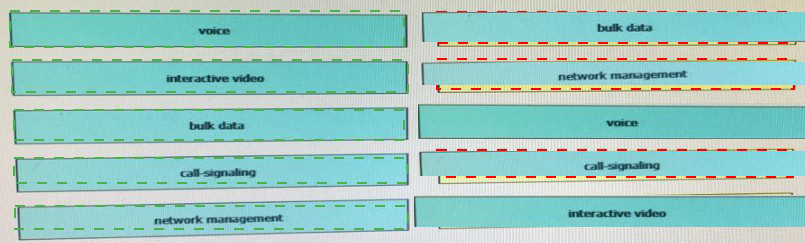
Question 119

According to the QoS Baseline Model, drag and drop the applications form the left onto the
correct per-Hop Behaviour values on the right.


Show answerHide answer

Explanation

Explanation: Voice = EF
Interactive Video = AF41
Bulk Data = AF11
Call-Signaling = AF31/CS3
Network Management = CS2
https://www.cisco.com/c/en/us/td/docs/solutions/Enterprise/WAN_and_MAN/QoS_SRND/Q
oS-SRND-Book/QoSIntro.html


According to Cisco’s QoS Baseline Model, applications are mapped to a Per-Hop Behavior (PHB) based on their latency, jitter, loss, and bandwidth requirements. For the drag-and-drop question, the key is to distinguish real-time voice and video from interactive, transactional, and best-effort data traffic.

Exam tip

Memorize the key associations:

- Voice → EF (DSCP 46)

- Interactive video → AF41 (DSCP 34)

- Bulk data → AF11 (DSCP 10)

- Call signaling → AF31 (DSCP 26) or CS3 (DSCP 24)

- Network management → CS2 (DSCP 16)
Question 120 Choose 1

A customer wants a video conference with five Cisco TelePresence IX5000 series system.
Which media resource is necessary in the design to fully utilize the immersive functions?

Show answerHide answer

Correct answer: D

Cisco meeting server

Explanation

Explanation

The correct answer is D. Cisco Meeting Server (CMS).

Cisco Meeting Server provides the conferencing infrastructure needed to host multiparty video conferences involving Cisco TelePresence IX5000 immersive systems. It supports high-quality audio, video, and content sharing while preserving the immersive experience across multiple locations. Cisco documentation confirms IX5000 compatibility with Cisco Meeting Server.

Correct Option

D. Cisco Meeting Server
CMS hosts multiparty conferences and manages the media streams between participating endpoints. This is important for five IX5000 systems because the design must support immersive video and collaboration rather than merely bridge audio calls.

Incorrect Options

- A. Software conference bridge on CUCM:
CUCM's software conference bridge is not the appropriate resource for fully immersive multiparty video conferencing.

- B. Cisco PVDM4-128:
A DSP module used for voice-processing resources, not for hosting this immersive video conference.

- C. Cisco Webex Meetings Server:
A separate conferencing platform; CMS is the intended media resource in this scenario.

Reference
- Cisco IX5000 Series Data Sheet
Full mock exam

Sit the 350-801 exam before exam day

Full-length mocks with the same number of questions and the same time limit as the real 350-801 exam. Every attempt draws a new set of questions from the full bank, so you can keep going until you pass comfortably.

Get full 350-801 mock exam
  • 90questions per mock
  • 120 mintime limit
  • 541questions in the bank
  • Newmock on every attempt