Cisco certification · Exam 350-801

350-801 Mock Exam Page 13

Implementing Cisco Collaboration Core Technologies (350-801 CLCOR)

Free 350-801 mock exam questions 121–130, each with the answer and an explanation.

20 questions · 27 minutes · free, no sign-up

Free 350-801 questions

121–130 of 162 free
Question 121 Choose 1

What is the major difference between the two possible Cisco IM and presence highavailability
modes?

Show answerHide answer

Correct answer: B

Balanced mode provides user load balancing and user failover in the event of an outage. Active/standby mode provides an always on standby node in the event of an
outage, but it does not provide load balancing.

Explanation

Explanation
The correct answer is B. Cisco IM and Presence Service supports two high-availability modes: Balanced and Active/Standby. In Balanced mode, users are distributed across both nodes in a presence redundancy group, providing load balancing during normal operation and user failover if a node becomes unavailable. In Active/Standby mode, one node serves users while the other remains available as the standby, so the pair does not balance user load across both nodes.

Correct Option

B. Balanced mode provides user load balancing and user failover in the event of an outage. Active/standby mode provides an always-on standby node in the event of an outage, but it does not provide load balancing.
Cisco's documentation explicitly describes Balanced mode as providing automatic user load balancing and failover. In Active/Standby mode, the standby node takes over when the active node fails, without automatic load balancing.

Incorrect Options

- A: Incorrect because Balanced mode supports automatic failover, not only manually initiated failovers. Active/Standby also maintains a configured standby node.

- C: Incorrect because Balanced mode does provide user load balancing.

- D: Incorrect because Active/Standby mode does not provide automatic load balancing.

Reference
Cisco — Configure Redundancy and High Availability for IM and Presence Service
Question 122 Choose 1

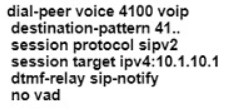
An administrator is integrating a Cisco Unity Express module to a Cisco UCME system A
test call is placed to the Cisco Unity Express pilot number, but the administrator receives a
busy signal. The dial-peer is configured as follows:

How is this issue resolved?


Show answerHide answer

Correct answer: A

The dial-peer needs to be reconfigured to support the G 711 voice codec.

Explanation

Explanation
The correct answer is A. The dial-peer needs to be reconfigured to support the G.711 voice codec.

Cisco Unity Express (CUE) supports G.711 audio streams for calls to its auto-attendant and voicemail pilot numbers. If the dial-peer uses an incompatible codec, the call may fail and return a busy signal. Configure the SIP dial-peer with codec g711ulaw or the appropriate G.711 variant supported by the deployment.

Correct Option

A. G.711 voice codec

Example configuration:

dial-peer voice 4100 voip

destination-pattern 4100

session protocol sipv2

session target ipv4:

dtmf-relay sip-notify

codec g711ulaw

no vad

Incorrect Options

- B. Enable VAD:
Incorrect. Cisco recommends disabling VAD (no vad) on the dial-peer to CUE.

- C. Change the destination pattern:
Incorrect if the existing pattern already matches the pilot number 4100. A pattern mismatch would be a separate digit-routing problem.

- D. Use H.323 instead of SIP:
Incorrect. Cisco CME uses a SIP dial-peer to route calls to the Unity Express module.

Reference
- Cisco Unity Express — System Design Considerations
Question 123 Choose 1

A Cisco Unity Connection Administrator must set a voice mailbox so that is can be
accessed form a secondary device. Which configuration on the voice mailbox makes this
change?

Show answerHide answer

Correct answer: D

Alternate Extensions

Explanation

Explanation
Cisco Unity Connection allows a user to associate additional phone numbers with their primary voice mailbox. Alternate Extensions let the system recognize a secondary device, such as a mobile phone, home phone, or another work phone, as belonging to the same user. When the secondary device calls Unity Connection, its caller ID can be matched to the user account, allowing access to the same mailbox after authentication.

Correct Option

D. Alternate Extensions
Alternate Extensions is the correct configuration. The administrator adds the secondary phone number or extension to the user's Unity Connection account. When the user calls from that number and caller ID is passed to Unity Connection, the system recognizes the number as associated with the mailbox. This also supports voicemail access and forwarding calls from the alternate device to the user's greeting.

Incorrect Options

- A. Mobile User:
Not the configuration used to associate a secondary phone number with an existing mailbox.

- B. Alternate Names:
Provides additional names by which a user can be identified in directory-related functions; it does not associate a phone number with the mailbox.

- C. Attempt Forward routing rule:
Controls call routing behavior, not the association of a secondary device with a user's mailbox.

Reference
- Cisco, Cisco Unity Connection System Administration Guide — User Settings: Alternate Extensions
Question 124 Choose 2

Which two configuration elements are part of the Cisco Unified Communications Manager
toll-fraud prevention? (Choose two.)

Show answerHide answer

Correct answer: B, C

Partition

Calling search space

Explanation

Explanation
Cisco Unified Communications Manager (CUCM) uses partitions and calling search spaces (CSSs) to restrict which directory numbers and route patterns a user or device can reach. This implements Class of Service (CoS), allowing administrators to limit access to local, national, or international PSTN calls and reduce the risk of toll fraud. Cisco recommends applying the most restrictive calling permissions necessary for each device and SIP trunk.

Correct Options

B. Partition
A partition is a logical grouping of directory numbers, route patterns, and other dial-plan elements. Administrators can separate destinations by call type or access level—for example, local, national, and international calling. Placing route patterns in separate partitions allows CUCM to control which callers can access them through their assigned CSS.

C. Calling search space
A CSS is an ordered list of partitions that determines which destinations a phone, directory number, or gateway can reach. By assigning restricted CSSs, administrators can prevent unauthorized users or incoming trunks from accessing PSTN route patterns that could enable fraudulent outbound calls.

Incorrect Options

- A. SIP trunk security profile:
Primarily controls SIP signaling security settings, such as transport and authentication-related configuration; it is not one of the two core dial-plan access-control elements expected here.

- D. SUBSCRIBE calling search space:
Controls access for applicable SIP SUBSCRIBE requests, rather than serving as the primary mechanism for restricting outbound dialing.

- E. Feature control policy:
Controls feature availability or behavior in applicable configurations; it is not the core toll-fraud dial-plan control in this question.

Reference
- Cisco, System Configuration Guide for CUCM 15 — Configure Partitions and Calling Search Spaces
Question 125 Choose 1

Refer to the exhibit.

Calls to Cisco Unity Connection are failing across Cisco Unified Border Element when
callers try to select a menu prompt. Why is this happening and how is it fixed?

Show answerHide answer

Correct answer: A

Cisco Unified Border Element is not sending any support for DTMF. DTMF configuration
must be added to the appropriate dial peer.

Explanation

Explanation
The correct answer is A. Cisco Unified Border Element is not sending any support for DTMF. DTMF configuration must be added to the appropriate dial peer.

Dual-Tone Multi-Frequency (DTMF) signals are the keypad tones callers use to navigate Cisco Unity Connection voicemail menus. CUBE VoIP dial peers do not enable DTMF relay by default, so if the appropriate relay method is not configured or negotiated between the call legs, Unity Connection may not receive the digits. Cisco supports relay methods such as RTP-NTE and SIP NOTIFY for transmitting DTMF across IP networks.

Correct Option

A. Configure DTMF relay on the appropriate dial peer.
The administrator should configure a compatible DTMF relay method on the relevant CUBE dial peer or dial peers, according to the signaling method supported by the connected systems.

Example configuration:

dial-peer voice 100 voip

dtmf-relay rtp-nte

Alternatively, SIP NOTIFY may be appropriate:

dial-peer voice 100 voip

dtmf-relay sip-notify

The correct method must be supported and negotiated end-to-end for the call.

Incorrect Options

- B. Call Handler transfer type:
Release to Switch controls how Unity Connection transfers calls; it does not resolve missing DTMF relay.

- C. G.729 and iLBC codecs:
A codec change is not the primary fix for absent DTMF signaling. DTMF relay methods are designed to preserve keypad digits across IP calls.

- D. Incorrect media IP address:
An incorrect SDP media address can cause media problems, but the described symptom—menu selections not registering—points to DTMF relay configuration.

Reference
- Cisco, Configure DTMF Relay on CUBE
Question 126 Choose 1

Which statement about Cisco Unified Communications Manager and Cisco IM and
Presence backups is true?

Show answerHide answer

Correct answer: B

Backups should be scheduled during off-peak hours to avoid system performance
issues.

Explanation

Explanation
The correct answer is B. Backups should be scheduled during off-peak hours to avoid system performance issues.

Cisco Unified Communications Manager (CUCM) and Cisco IM and Presence use the Disaster Recovery System (DRS) to back up system data. Backup operations consume system resources and can affect call processing or service performance. Cisco therefore recommends scheduling backups during off-peak hours to minimize disruption.

Correct Option

B. Backups should be scheduled during off-peak hours to avoid system performance issues.
Cisco's official administration guide explicitly cautions administrators to schedule backups during off-peak hours to avoid call-processing interruptions and service impact. Regular backups remain important for disaster recovery, system restoration, and recovery after failures or configuration loss.

Incorrect Options

- A. Backups are saved as unencrypted .tar files:
Incorrect. DRS backup files are encrypted.

- C. Backups are encrypted using the web administrator account:
Incorrect. Backup encryption relies on a randomly generated password protected using the cluster security password, not the web administrator account password.

- D. Backups are not needed for subscriber servers:
Incorrect. DRS performs cluster-level backups that include applicable subscriber nodes; subscriber data should not be assumed to be protected without backups.

Reference
- Cisco, Configuration and Administration of IM and Presence Service — Back Up the System
Question 127 Choose 1

Which action is required if an engineer wants to have Cisco Unified Communications
Manager configuration for an MGCP gateway?

Show answerHide answer

Correct answer: C

Apply the ccm-manager configuration commands to the gateway

Explanation

Explanation
The correct answer is C. Apply the ccm-manager configuration commands to the gateway.

Cisco Unified Communications Manager (CUCM) can centrally configure a supported MGCP gateway by downloading gateway-specific XML configuration files from its TFTP service. The gateway must be configured with the appropriate ccm-manager commands to enable this process. This allows CUCM to manage supported gateway settings centrally rather than requiring every configuration change to be entered manually on the gateway.

Correct Option

C. Apply the ccm-manager configuration commands to the gateway.

The relevant commands include:

ccm-manager config server

ccm-manager config

ccm-manager mgcp

mgcp

- ccm-manager config server identifies the TFTP server.

- ccm-manager config enables and triggers the centralized configuration download.

- ccm-manager mgcp enables CUCM-specific MGCP gateway support.

- mgcp enables the MGCP protocol.

These commands work together to support registration and centralized configuration, subject to the gateway platform and software requirements.

Incorrect Options

- A. Upload custom configuration to the TFTP server:
CUCM generates and distributes the supported gateway configuration; manually uploading a custom file is not the required general procedure.

- B. Configure CUCM's IP in voice service voip:
This is not the command used to enable centralized MGCP gateway configuration.

- D. Check the autoconfiguration checkbox in CUCM:
Adding the gateway in CUCM is necessary, but this option alone does not enable the gateway-side configuration download process.

Reference
- Cisco, Configuring MGCP Gateway Support for Cisco Unified Communications Manager
Question 128 Choose 1

Which attribute contains an XMPP stanza?

Show answerHide answer

Correct answer: C

type

Explanation

Explanation
The correct answer is C. type, if the question is asking which attribute an XMPP stanza contains. However, there is an important distinction: type is an attribute of a stanza, not the stanza itself. XMPP defines three stanza types: message, presence, and iq.

Correct Option

C. type
The type attribute specifies the purpose or context of an XMPP stanza. For example, an IQ stanza can use type="get", type="set", type="result", or type="error" to indicate a request, update, response, or error.

Incorrect Options

- A. iq —
A type of XMPP stanza used for structured request-response exchanges, not an attribute.

- B. message —
A type of XMPP stanza used to exchange messages, not an attribute.

- D. presence —
A type of XMPP stanza used to communicate availability and presence information, not an attribute.

Reference
- IETF, RFC 6120 — Extensible Messaging and Presence Protocol (XMPP): Core
Question 129 Choose 1

Which type of greeting in the Call Handler configuration in Cisco Unity Connection
overtimes all other greetings?

Show answerHide answer

Correct answer: C

alternate

Explanation

Explanation

The correct answer is C. Alternate.

In Cisco Unity Connection, each Call Handler can have multiple greetings for different situations, such as standard business hours, holidays, busy extensions, and internal callers. The Alternate greeting overrides all other greetings whenever it is enabled, regardless of the normal schedule or calling conditions. It is commonly used for special circumstances such as vacations, extended absences, or temporary announcements.

Correct Option

C. Alternate
The Alternate greeting takes precedence over standard, closed/off-hours, holiday, internal, and busy greetings. Administrators can also configure caller behavior while the Alternate greeting is active, such as preventing callers from skipping the greeting or leaving a message.

Incorrect Options

- A. Holidays:
Plays during designated holiday schedules but can be overridden by the Alternate greeting.

- B. Supervisory:
Not a standard Cisco Unity Connection Call Handler greeting type.

- D. Priority:
Not a standard Call Handler greeting type in Unity Connection.

Reference
- Cisco, System Administration Guide for Cisco Unity Connection 15 — Call Management
Question 130 Choose 1

Which issue can occur if QoS is not Deployed on a Cisco Collaboration architecture across
the WAN?

Show answerHide answer

Correct answer: D

Excessive jitter

Explanation

Explanation

The correct answer is D. Excessive jitter — not C.

When Quality of Service (QoS) is not deployed across the WAN, voice and video packets may compete with ordinary data traffic for bandwidth. During congestion, packets can experience variable queuing delays and packet loss, resulting in excessive jitter and degraded collaboration quality. Cisco recommends end-to-end QoS classification, prioritization, and queuing to protect real-time media traffic.

Correct Option

D. Excessive jitter
Jitter is the variation in packet arrival times. Without QoS, real-time voice packets may wait behind large data transfers or other competing traffic. This can cause choppy audio, gaps in conversations, and poor video quality. Priority queuing helps reduce variable delay and packet loss during congestion.

Incorrect Options

- A. Unexpected shutdown on Cisco Unified Communications Manager:
Missing WAN QoS does not normally cause CUCM itself to shut down.

- B. Packet fragmentation:
Fragmentation can occur because of MTU and packet-size issues, but it is not the primary problem associated with missing QoS.

- C. 403 Forbidden errors on SIP calls:
This SIP response generally indicates that a request was understood but refused; it is not a typical direct consequence of missing QoS.

Reference
- Cisco, Preferred Architecture for Cisco Collaboration — Bandwidth Management
Full mock exam

Sit the 350-801 exam before exam day

Full-length mocks with the same number of questions and the same time limit as the real 350-801 exam. Every attempt draws a new set of questions from the full bank, so you can keep going until you pass comfortably.

Get full 350-801 mock exam
  • 90questions per mock
  • 120 mintime limit
  • 541questions in the bank
  • Newmock on every attempt