Users dial a 9 before a 10-digit phone number to make an off-net call All 11 digits are sent
to the Cisco Unified Border Element before going out to the PSTN The PSTN provider
accepts only 10 digits. Which configuration is needed on the Cisco Unified Border Element
for calls to be successful?
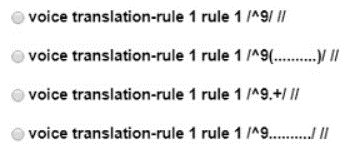
Show answerHide answer
Correct answer: A
Option A
Explanation
ExplanationThe users dial 9 followed by a 10-digit number, but the Cisco Unified Border Element (CUBE) sends all 11 digits to the PSTN provider. Since the provider accepts only 10 digits, CUBE must remove the leading 9 from the called number before forwarding the call. Cisco IOS supports this through voice translation rules and an outgoing translation profile applied to the appropriate dial peer.
Correct Option
A. Option A — assuming the exhibit's configuration matches the required leading-digit removal.
The required logic is equivalent to:
voice translation-rule 9
rule 1 /^9\(.*\)/ /\1/
!
voice translation-profile STRIP-9
translate called 9
!
dial-peer voice
translation-profile outgoing STRIP-9
For example, 92125551212 becomes 2125551212, so the PSTN receives the required 10 digits.
Incorrect Options
I can't reliably identify the exact differences among options B, C, and D without reading the configuration text in the exhibit. The correct configuration must remove only the leading 9 from the called number on the outbound CUBE dial peer.
Reference
- Cisco — Understand IOS and IOS XE Call Routing
