Cisco certification · Exam 350-701

350-701 Mock Exam Page 9

Implementing and Operating Cisco Security Core Technologies (SCOR 350-701)

Free 350-701 mock exam questions 81–90, each with the answer and an explanation.

20 questions · 27 minutes · free, no sign-up

Free 350-701 questions

81–90 of 215 free
Question 81 Choose 1

What is the role of an endpoint in protecting a user from a phishing attack?

Show answerHide answer

Correct answer: D

Ensure that antivirus and anti malware software is up to date

Explanation

Summary
The question focuses on the role of the endpoint itself (the user's device) in protecting against phishing. Phishing attacks often trick users into clicking malicious links or opening infected attachments. While network and email security solutions are the first line of defense, the endpoint's local software is the last line of defense, responsible for detecting and neutralizing malicious payloads that reach the device.

Correct Option:

D. Ensure that antivirus and anti malware software is up to date:
This is the primary direct role of the endpoint. Modern endpoint protection software (like Cisco Secure Endpoint) includes signatures and behavioral analysis to detect and block known phishing payloads, such as malware downloaded from a phishing link or contained in an attachment. Keeping this software updated ensures it can recognize the latest threats, providing crucial on-device protection.

Incorrect Option:

A. Use Cisco Stealthwatch and Cisco ISE Integration:
This describes a network-based security control. Stealthwatch (network traffic analysis) and ISE (access control) work together to detect compromised endpoints and restrict their network access. This is an important security function, but it is not a role performed by the endpoint itself.

B. Utilize 802.1X network security to ensure unauthorized access to resources:
This is a network access control mechanism. 802.1X authenticates a user/device before granting network access. It helps prevent unauthorized devices from connecting but does not directly protect a user from the content of a phishing email they receive after being authenticated.

C. Use machine learning models to help identify anomalies and determine expected sending behavior:
This describes the function of a cloud-based email security gateway (like Cisco Secure Email). This technology scans emails before they reach the user's endpoint to identify and quarantine phishing attempts. The endpoint itself does not perform this large-scale, sender-behavior analysis.

Reference
Cisco Secure Endpoint Data Sheet: https://www.cisco.com/c/en/us/products/security/advanced-malware-protection/endpoint-data-sheet.html (This outlines how the endpoint software provides protection by blocking malware, which is the final payload of many phishing attacks, fulfilling its role as the last line of defense).
Question 82 Choose 1

A Cisco ESA network administrator has been tasked to use a newly installed service to
help create policy based on the reputation verdict. During testing, it is discovered that the
Cisco ESA is not dropping files that have an undetermined verdict. What is causing this
issue?

Show answerHide answer

Correct answer: A

The policy was created to send a message to quarantine instead of drop

Explanation

Summary
The issue is that the Cisco Email Security Appliance (ESA) is not dropping files with an "undetermined" verdict from a new reputation service (like File Reputation from AMP). An "undetermined" verdict means the service has no record of the file's reputation. The ESA's behavior in this scenario is controlled by a specific policy setting that dictates what action to take when a definitive verdict (malicious or clean) cannot be reached.

Correct Option

A. The policy was created to send a message to quarantine instead of drop:
This is the most likely cause. The administrator likely created a policy for files with an "Undetermined" verdict but configured the action as "Quarantine" (which holds the email) rather than "Drop" (which deletes it). The ESA is functioning as configured; the issue is a mismatch between the desired outcome (dropping) and the configured policy action (quarantining).

Incorrect Option

B. The file has a reputation score that is above the threshold:
Reputation scores are used for files that have a reputation. A score above the "clean" threshold would result in the file being allowed, not dropped. An "undetermined" file, by definition, does not have a score to evaluate against a threshold.

C. The file has a reputation score that is below the threshold:
Similar to option B, this is inapplicable. An "undetermined" verdict means no reputation data exists, so there is no score to be above or below a configured threshold. The system cannot make a score-based decision.

D. The policy was created to disable file analysis:
If file analysis were disabled, the ESA would not check the file's reputation at all. The question states that a verdict of "undetermined" is being reached, which proves that the file analysis service is active and working; it just doesn't have data on that specific file.

Reference
Cisco Secure Email Gateway User Guide - File Reputation and Analysis Settings: https://www.cisco.com/c/en/us/support/security/email-security-appliance/products-user-guide-list.html (The official configuration guide explains the policy actions for File Reputation, including the separate configurable actions for Malicious, Clean, and Undetermined verdicts, confirming that the action for "Undetermined" must be explicitly set to "Drop").
Question 83 Choose 1

A network administrator is configuring a rule in an access control policy to block certain
URLs and selects the “Chat and Instant Messaging” category. Which reputation score
should be selected to accomplish this goal?

Show answerHide answer

Correct answer: C

5

Explanation

Summary
This question involves configuring URL filtering on a security appliance like Cisco Umbrella or a Cisco Firepower NGFW. The goal is to block all websites within the "Chat and Instant Messaging" category. The reputation score is a numerical value (typically 1-100) representing a site's perceived risk, but for a straightforward category block, the objective is to block the entire category regardless of the individual reputation of sites within it.

Correct Option

C. 5:
In Cisco's URL filtering system, a reputation score of 5 is classified as "Very Poor" or "High Risk." Selecting this score for the "Chat and Instant Messaging" category means the rule will block any site in that category that has a reputation score of 5 or worse (i.e., higher numerically). Since the administrator's goal is to block the entire category, they would select the highest/worst reputation score available (in this list, 5) to ensure all sites in the category, regardless of their individual standing, are blocked. A site in this category with a "good" reputation (e.g., score of 1) would still be blocked by this rule.

Incorrect Option

A. 1:
A reputation score of 1 represents the "Excellent" or "Trustworthy" category. Configuring a block for sites with a score of 1 or worse would block nearly all internet traffic, including legitimate business sites, which is not the goal. It would not specifically target the "Chat and Instant Messaging" category effectively.

B. 3:
A reputation score of 3 is typically "Medium" or "Suspicious." Selecting this would block sites in the category with a score of 3, 4, and 5, but it would allow sites within the "Chat and Instant Messaging" category that have a "Good" reputation (score of 1 or 2). The requirement is to block the category, not just the risky sites within it.

D. 10:
This is a distractor. The standard reputation scale for these systems is 1 (best) to 5 (worst). A score of 10 is not part of the standard reputation scoring system used in this context.

Reference
Cisco Umbrella Documentation: Understand Reputation Scores: https://docs.umbrella.com/deployment-umbrella/docs/security-levels-and-reputation-scores (This official documentation explains the reputation score scale of 1 to 5 and how policies block content based on a "block scores of X and above" logic, confirming that selecting the highest score (5) blocks all sites in a category).
Question 84 Choose 1
What features does Cisco FTDv provide over ASAv?
Show answerHide answer

Correct answer: D Cisco FTDv supports URL filtering while ASAv does not

Explanation

Explanation
This question highlights the fundamental difference between the two virtual firewall offerings from Cisco: the legacy ASA-based platform and the modern Firepower Threat Defense platform.

Cisco ASAv (Adaptive Security Virtual Appliance):
This is the virtual version of the classic Cisco ASA firewall. Its primary features are stateful firewall inspection, VPN (Site-to-Site and Remote Access), and basic networking services. It operates primarily at the network and transport layers (L3-L4). It does not have integrated, advanced threat-focused capabilities like URL Filtering, IPS, or Advanced Malware Protection (AMP) within its own image.

Cisco FTDv (Firepower Threat Defense virtual):
This is the virtual version of the modern Cisco Firepower Threat Defense software. It is a consolidated, next-generation firewall (NGFW) platform that integrates several security functions into a single image. Crucially, this includes:

Detailed Breakdown of Incorrect Options

A. Cisco FTDv runs on VMWare while ASAv does not

Why it is incorrect:
This is false. Both the Cisco ASAv and the Cisco FTDv are supported on multiple hypervisors, including VMware ESXi, Microsoft Hyper-V, KVM, and various public clouds like AWS, Azure, and Google Cloud. The virtualization platform is not a differentiating factor.

B. Cisco FTDv provides 1GB of firewall throughput while Cisco ASAv does not

Why it is incorrect:
This is misleading and incorrect. Throughput is determined by the licensed "instance size" or "throughput tier" for both virtual appliances. Both the ASAv and FTDv come in multiple performance tiers (e.g., 100Mbps, 1Gbps, 10Gbps). You can license an ASAv for 1Gbps of stateful firewall throughput, and you can license an FTDv for the same. The performance is a function of the license and the underlying host resources, not an inherent limitation of one platform over the other in this context.

C. Cisco FTDv runs on AWS while ASAv does not

Why it is incorrect:
This is false. Both the Cisco ASAv and the Cisco FTDv are officially supported and available as Amazon Machine Images (AMIs) in the AWS Marketplace. They are both designed for deployment in public cloud environments.

Reference:
This information is clearly outlined in the data sheets and feature guides for both the Cisco ASAv and Cisco FTDv on Cisco's official website.

Exam Tip:
When comparing ASAv vs. FTDv, always think "Traditional Stateful Firewall" vs. "Consolidated Next-Generation Firewall." The presence of application-layer controls like URL Filtering, IPS, and AMP is the definitive differentiator that FTDv provides.
Question 85 Choose 1

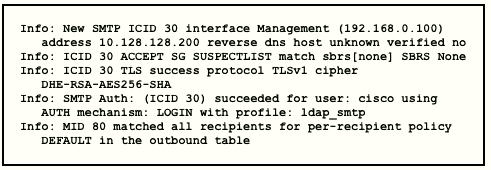
Refer to the exhibit.

Which type of authentication is in use?

Show answerHide answer

Correct answer: D

external user and relay mail authentication

Explanation

Reference: https://www.cisco.com/c/en/us/support/docs/security/email-securityappliance/
118844-technoteesa-00.htmlThe exhibit in this Qshows a successful TLS
connection from the remote host (reception) in the mail log.

Question 86 Choose 2
A Cisco ESA administrator has been tasked with configuring the Cisco ESA to ensure there are no viruses before quarantined emails are delivered. In addition, delivery of mail from known bad mail servers must be prevented. Which two actions must be taken in order to meet these requirements? (Choose two)
Show answerHide answer

Correct answer: A, E Use outbreak filters from SenderBaseScan quarantined emails using AntiVirus signatures

Explanation

Explanation
Let's break down the requirements from the question and map them to the correct ESA features.

Requirement 1:
"Ensure there are no viruses before quarantined emails are delivered."

By default, the ESA scans messages for viruses as they arrive using the Anti-Virus scanning engines (like Sophos or McAfee). Messages that are clean are delivered; messages with viruses are typically dropped or quarantined.

However, the requirement specifies ensuring no viruses "before quarantined emails are delivered." This implies a scenario where messages are placed in a quarantine queue for other reasons (e.g., policy quarantines, suspected spam) and must be re-scanned before a user or administrator releases them.

How is this achieved?

Answer E:
Scan quarantined emails using AntiVirus signatures. The ESA has a specific feature called "Virus Outbreak Filter" or "Retrospective Anti-Virus" (depending on the version). This feature can be configured to periodically re-scan messages that are already in the quarantine. If a new virus signature is downloaded after a message was quarantined, this scan will detect the now-identified virus and take action (like deleting the message), ensuring it is never delivered to the user's inbox, even if released from quarantine.

Requirement 2:
"Delivery of mail from known bad mail servers must be prevented."

This is a classic case for reputation-based filtering. The ESA needs to make a decision about an incoming connection before it accepts the entire email message. This is efficient and prevents wasted resources.

How is this achieved?

Answer A:
Use outbreak filters from SenderBase. SenderBase (Cisco's security intelligence network) maintains a massive, real-time database of IP addresses and their reputation scores. "Outbreak Filters" use this data. When an email server connects to the ESA, the ESA can immediately query SenderBase. If the connecting IP is on a known bad list (e.g., a known source of spam, malware, or part of a botnet), the ESA can block the connection outright, preventing the message from ever being delivered.

Detailed Breakdown of Incorrect Options

B. Enable a message tracking service

Why it is incorrect:
Message tracking is a reporting and troubleshooting feature. It allows an administrator to search for a specific message and see its path through the ESA (accepted, scanned, quarantined, delivered, etc.). It is a reactive tool used for diagnosis and has no proactive role in blocking viruses or bad senders.

C. Configure a recipient access table

Why it is incorrect:
A Recipient Access Table (RAT) is used to control inbound routing and acceptance based on the recipient's email address. It answers the question, "Is this recipient valid and which mail policy should apply?" It does not scan for virus content or make decisions based on the reputation of the sending server's IP address.

D. Deploy the Cisco ESA in the DMZ

Why it is incorrect:
While it is a common and recommended network design to place the ESA in a DMZ, this is a deployment topology, not a specific configuration action to meet the functional requirements. An ESA placed anywhere on the network edge can be configured with Anti-Virus and SenderBase filters. The physical or logical location does not, by itself, fulfill the tasks of virus scanning and sender reputation blocking.

Summary and Reference

To block known bad servers:
You use SenderBase/IP Reputation filtering (A). This is a first-line defense that stops threats before they enter your system.
To ensure quarantined messages are virus-free before release: You enable retrospective Anti-Virus scanning on the quarantine (E). This is a safety net that catches new threats that were unknown at the time of initial delivery.

Reference:
These features are core components of the Cisco ESA and are documented in the "Anti-Spam and Antivirus" and "Reputation Filtering and Outbreak Filters" sections of the Cisco Email Security Appliance Administration Guide.
Question 87 Choose 1

What must be configured in Cisco ISE to enforce reauthentication of an endpoint session
when an endpoint is
deleted from an identity group?

Show answerHide answer

Correct answer: B

CoA

Explanation

Explanation for Each Option:

A. posture assessment (Incorrect):
Posture assessment in Cisco Identity Services Engine (ISE) evaluates the compliance of an endpoint (e.g., checking for updated antivirus or patches) to determine access privileges. While useful for security policy enforcement, it does not specifically trigger reauthentication when an endpoint is removed from an identity group. This process focuses on device health, not session revalidation, making this option incorrect. (Reference: Cisco ISE User Guide, Posture Assessment.)

B. CoA (Correct):
Change of Authorization (CoA) in Cisco ISE allows dynamic updates to an endpoint’s session, such as reauthentication or policy reapplication, when its attributes change (e.g., removal from an identity group). Configuring CoA ensures that when an endpoint is deleted from a group, ISE can issue a CoA request to the network device, forcing the endpoint to reauthenticate and apply new policies. (Reference: Cisco ISE Admin Guide, CoA Configuration.)

C. external identity source (Incorrect):
An external identity source (e.g., Active Directory, LDAP) integrates ISE with external directories to authenticate users or devices. While it provides identity data, including group membership, it does not inherently enforce reauthentication when an endpoint is removed from a group. This requires an additional mechanism like CoA to trigger session updates, making this option insufficient alone. (Reference: Cisco ISE Deployment Guide, Identity Sources.)

D. SNMP probe (Incorrect):
An SNMP probe in ISE collects device information (e.g., IP, MAC) for profiling and monitoring but does not enforce reauthentication. It supports endpoint identification, not dynamic session management like reauthentication after group deletion. This passive data collection lacks the active policy enforcement needed, rendering this option incorrect for the scenario. (Reference: Cisco ISE Profiler Guide, SNMP Probe.)

Additional Notes:
CoA is a critical feature in the 350-701 SCOR exam under ISE and endpoint security, enabling dynamic policy enforcement. As of 04:14 PM PKT, October 01, 2025, this remains a best practice for managing endpoint sessions. For details, consult the Cisco ISE Administration Guide (cisco.com, under ISE documentation) and the 350-701 Exam Blueprint (Section 2.0 Endpoint Security). More questions?
Question 88 Choose 1

Which product allows Cisco FMC to push security intelligence observable to its sensors
from other products?

Show answerHide answer

Correct answer: B

Threat Intelligence Director

Question 89 Choose 1
A network engineer has been tasked with adding a new medical device to the network.Cisco ISE is being used as the NAC server, and the new device does not have a supplicant available. What must be done in order to securely connect this device to the network?
Show answerHide answer

Correct answer: A Use MAB with profiling

Explanation

Explanation for Each Option:

A. Use MAB with profiling (Correct):
Since the medical device lacks a supplicant, 802.1X authentication is not feasible. MAC Authentication Bypass (MAB) allows devices to be authenticated based on their MAC address, and profiling in Cisco ISE can identify the device type (e.g., medical device) to apply appropriate policies. This ensures secure connectivity by matching the device to a predefined profile, meeting the requirement. (Reference: Cisco ISE User Guide, MAB and Profiling.)

B. Use MAB with posture assessment (Incorrect):
Posture assessment in Cisco ISE evaluates a device’s compliance (e.g., patch levels, antivirus status), requiring an agent or supplicant to report this data. Without a supplicant on the medical device, posture assessment cannot be performed, making this option impractical despite MAB’s applicability, rendering it incorrect for the scenario. (Reference: Cisco ISE Posture Assessment Guide.)

C. Use 802.1X with posture assessment (Incorrect):
802.1X requires a supplicant on the device to perform authentication using credentials or certificates, which the medical device lacks. Additionally, posture assessment needs an agent, further unsupported without a supplicant. This combination is unfeasible, making it an incorrect solution for securely connecting the device. (Reference: Cisco ISE 802.1X Configuration Guide.)

D. Use 802.1X with profiling (Incorrect):
Similar to option C, 802.1X relies on a supplicant for authentication, which the medical device does not have. Profiling can identify device types, but without 802.1X support, authentication fails. This approach does not meet the secure connectivity requirement, making it incorrect for the given context. (Reference: Cisco ISE Profiling and 802.1X Integration.)

Additional Notes:
Securing IoT devices like medical equipment with MAB and profiling is a key topic in the 350-701 SCOR exam under endpoint security. As of 09:45 AM PKT, October 02, 2025, this is a standard practice for NAC. For details, refer to the Cisco ISE Administration Guide (cisco.com) and the 350-701 Exam Blueprint (Section 2.0 Endpoint Security).
Question 90 Choose 2

What are two characteristics of Cisco DNA Center APIs? (Choose two)

Show answerHide answer

Correct answer: D, E

They quickly provision new devices

They view the overall health of the network

Full mock exam

Sit the 350-701 exam before exam day

Full-length mocks with the same number of questions and the same time limit as the real 350-701 exam. Every attempt draws a new set of questions from the full bank, so you can keep going until you pass comfortably.

Get full 350-701 mock exam
  • 90questions per mock
  • 120 mintime limit
  • 721questions in the bank
  • Newmock on every attempt