Cisco certification · Exam 350-701

350-701 Mock Exam Page 11

Implementing and Operating Cisco Security Core Technologies (SCOR 350-701)

Free 350-701 mock exam questions 101–110, each with the answer and an explanation.

20 questions · 27 minutes · free, no sign-up

Free 350-701 questions

101–110 of 215 free
Question 101 Choose 1

Which group within Cisco writes and publishes a weekly newsletter to help cybersecurity
professionals remain
aware of the ongoing and most prevalent threats?

Show answerHide answer

Correct answer: B

Talos

Question 102

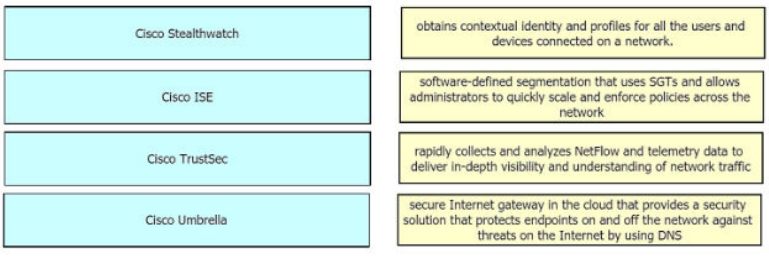
Drag and drop the solutions from the left onto the solution's benefits on the right.
Show answerHide answer

Explanation

Explanation: Cisco Stealthwatch - rapidly collects and analyzes netflow and telementy
data to deliver in-depth visibility and understanding of network traffic
Cisco ISE – obtains contextual identity and profiles for all users and device
Cisco TrustSec – software defined segmentation that uses SGTs
Cisco Umbrella – secure internet gateway ion the cloud that provides a security solution

Question 103 Choose 1
Why is it important to have logical security controls on endpoints even though the users are trained to spot security threats and the network devices already help prevent them?
Show answerHide answer

Correct answer: B because defense-in-depth stops at the network

Explanation

Explanation:
Cisco Advanced Malware Protection (AMP) for Endpoints is the solution that provides proactive protection directly on endpoints (like laptops, servers, and mobile devices) and is managed from a central console.

Let's break down why AMP is the correct answer and the role of the other products:

B) AMP is CORRECT.
Cisco AMP for Endpoints is an advanced antivirus and anti-malware solution that is installed directly on endpoints. It provides proactive protection through features like:

Behavioral Monitoring:
Analyzing running processes for malicious activity.

File Reputation & Sandboxing:
Checking files against global threat intelligence and detonating suspicious files in a sandbox.

Retrospective Security:
Continuously monitoring files and can detect and remediate threats after they have initially evaded detection.

All of this is managed from a central cloud-based or on-premises console, giving administrators visibility and control over all protected endpoints from a single pane of glass.

Why the other options are incorrect:

A) NGFW is INCORRECT.
A Next-Generation Firewall (NGFW) is a network-based security appliance. It protects the network perimeter and segments, inspecting traffic as it passes through. It does not provide protection on the endpoint itself and is not used to deploy and manage software on user devices.

C) WSA is INCORRECT.
The Cisco Web Security Appliance (WSA) is a gateway that filters and secures web traffic (HTTP/HTTPS). It protects users from web-based threats by blocking malicious sites and downloads. Like the NGFW, it is a network appliance, not an endpoint protection product.

D) ESA is INCORRECT.
The Cisco Email Security Appliance (ESA) is a gateway that filters and secures email traffic (SMTP). It protects against spam, phishing, and malware delivered via email. It is also a network appliance and does not provide protection on the endpoint or manage endpoint software.

Reference:
Cisco AMP for Endpoints Data Sheet: The official product description highlights its role in "protecting endpoints" and its "centralized management console" for investigation and response.

Cisco Security Portfolio Architecture:The portfolio is divided into Network Security (NGFW, WSA, ESA), Cloud Security, and Endpoint Security (AMP), clearly placing AMP in the role of proactive endpoint protection.
Question 104 Choose 1

What is a feature of Cisco NetFlow Secure Event Logging for Cisco ASAs?

Show answerHide answer

Correct answer: B

Advanced NetFlow v9 templates and legacy v5 formatting are supported

Question 105 Choose 1
What is the purpose of the My Devices Portal in a Cisco ISE environment?
Show answerHide answer

Correct answer: A to register new laptops and mobile devices

Explanation

Explanation:
The My Devices portal is a self-service, web-based portal in Cisco ISE that allows end-users to manage the devices they personally use on the corporate network.

Let's analyze each option:

A) to register new laptops and mobile devices is CORRECT.
This is the primary purpose of the My Devices portal. An employee can log into this portal using their corporate credentials and manually register the MAC addresses of their personal devices, such as a personal laptop, smartphone, tablet, or gaming console. Once registered, ISE can apply the appropriate authorization policy (e.g., a "BYOD" policy) to that device, allowing it onto the network without requiring help desk intervention.

B) to request a newly provisioned mobile device is INCORRECT.
This describes a procurement or IT fulfillment process, which is typically handled through a different IT service management (ITSM) tool or ticketing system, not the ISE My Devices portal.

C) to provision userless and agentless systems is INCORRECT.
"Userless" devices (like printers, IoT sensors) and "agentless" systems are typically profiled and onboarded automatically by the ISE Profiler service or through administrative configuration, not by end-users in a self-service portal.

D) to manage and deploy antivirus definitions and patches on systems owned by the end user is INCORRECT.
This function is performed by the ISE Posture Service. The Posture service is responsible for checking and enforcing compliance, which can include verifying antivirus status and patch levels. While a non-compliant device might be redirected to a portal where it can download necessary updates, the primary portal for compliance remediation is distinct from the "My Devices" portal used for registration.

Reference:

Cisco ISE Administrator Guide, "My Devices Portals":
The official documentation states, "The My Devices portal enables you to provide a self-service portal for end users to register their own devices (such as personal laptops, tablets, and other mobile devices) and manage them after registration."

Cisco BYOD Design Guides:
These guides consistently present the My Devices portal as the critical user-facing component for a Bring Your Own Device (BYOD) deployment, where users register their personal devices to gain network access.
Question 106 Choose 1

An organization recently installed a Cisco WSA and would like to take advantage of the
AVC engine to allow the organization to create a policy to control application specific
activity. After enabling the AVC engine, what must be done to implement this?

Show answerHide answer

Correct answer: C

Use an access policy group to configure application control settings

Explanation

The Application Visibility and Control (AVC) engine
lets you create policies to control application activity on the network without having to fully
understand the underlying technology of each application. You can configure application
control settings in Access Policy groups. You can block or allow applications individually or
according to application type. You can also apply controls to particular application types.

Question 107

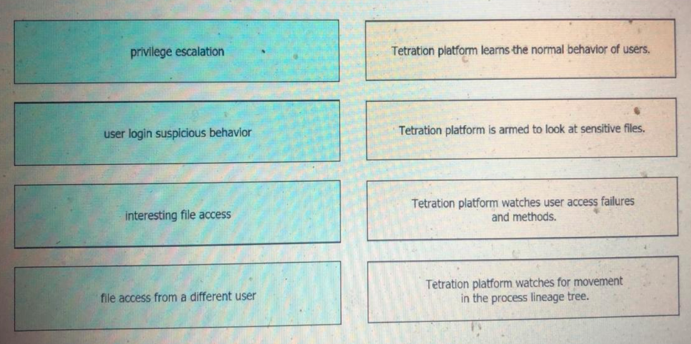
Drag and drop the suspicious patterns for the Cisco Tetration platform from the left onto the
correct definitions on the right.
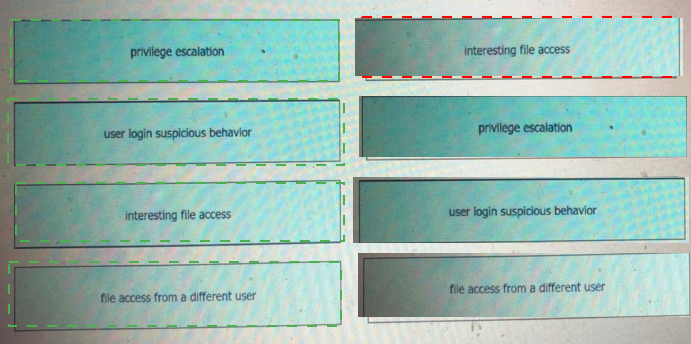
 

Show answerHide answer

Explanation

Question 108 Choose 1

A network administrator needs to find out what assets currently exist on the network. Thirdparty
systems need to be able to feed host data into Cisco Firepower. What must be
configured to accomplish this?

Show answerHide answer

Correct answer: A

a Network Discovery policy to receive data from the host

Explanation

You can configure discovery rules to tailor the discovery of host
and application data to your needs.The Firepower System can use data from NetFlow
exporters to generate connection and discovery events, and to add host and application
data to the network map.A network analysis policy governs how traffic is decoded and
preprocessed so it can be further evaluated, especially for anomalous traffic that might
signal an intrusion attempt -> Answer D is not correct.

Question 109

Drag and drop the capabilities from the left onto the correct technologies on the right.


Show answerHide answer

Explanation

Text, chat or text message

Description automatically generated

Question 110 Choose 1

Which suspicious pattern enables the Cisco Tetration platform to learn the normal behavior
of users?

Show answerHide answer

Correct answer: C

user login suspicious behavior

Explanation

Reference: https://www.cisco.com/c/en/us/products/collateral/data-centeranalytics/
tetration-analytics/whitepaper-c11-740380.html

Full mock exam

Sit the 350-701 exam before exam day

Full-length mocks with the same number of questions and the same time limit as the real 350-701 exam. Every attempt draws a new set of questions from the full bank, so you can keep going until you pass comfortably.

Get full 350-701 mock exam
  • 90questions per mock
  • 120 mintime limit
  • 721questions in the bank
  • Newmock on every attempt