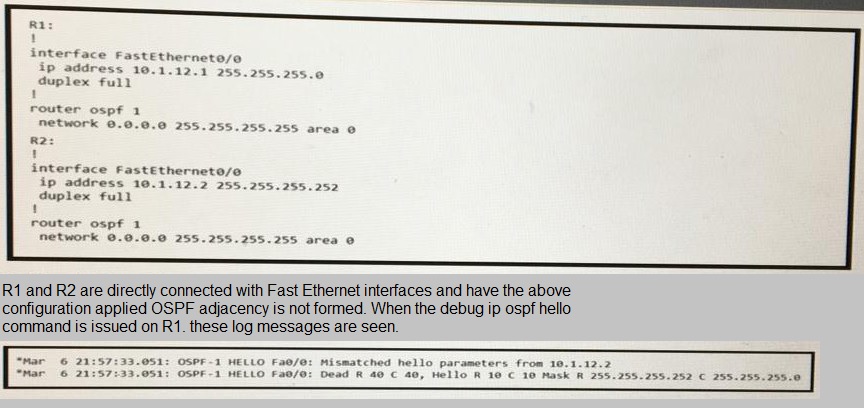
Refer to the exhibit.

While troubleshooting the OSPF adjacency between routers R1 and R2 an engineer
noticed that both routers are stuck in the EXCHANGE/EXSTART state. What should the
engineer fix to solve the ongoing issue?
While troubleshooting the OSPF adjacency between routers R1 and R2 an engineer
noticed that both routers are stuck in the EXCHANGE/EXSTART state. What should the
engineer fix to solve the ongoing issue?
Show answerHide answer
Correct answer: D match MTU value
Explanation
ExplanationThe exhibit shows that R1's OSPF interface is configured with `Network Type POINT_TO_POINT` and an MTU of 9216 bytes, while R2's OSPF interface is configured with `Network Type POINT_TO_MULTIPOINT` and an MTU of 1500 bytes. When two OSPF routers are stuck in EXCHANGE/EXSTART state, the most common cause is an MTU mismatch, because during database descriptor (DBD) exchange each router includes its MTU in the DBD packets, and if the MTUs do not match the routers refuse to proceed. Additionally, the network type mismatch (point-to-point vs point-to-multipoint) is also present and would cause adjacency problems because the hello and dead timer behavior differs between these network types. However, the specific symptom of being stuck in EXCHANGE/EXSTART is directly tied to the MTU mismatch. Among the options provided, matching the MTU value is the fix that addresses the EXCHANGE/EXSTART hang. This makes option D the correct answer.
Why the other options are incorrect:
A. match IPv4 addresses – The IP addresses 172.20.1.12/31 and 172.20.1.13/31 are in the same /31 subnet and are correctly configured. IP addresses do not need to match; they only need to be in the same subnet, which they are.
B. match OSPF areas – R1 is in Area 0.0.1.255 and R2 is in Area 511, which is a mismatch. While area mismatch would prevent adjacency, the routers would not progress to EXCHANGE/EXSTART state at all. They would be stuck in DOWN or INIT. The EXCHANGE/EXSTART symptom specifically points to MTU mismatch.
C. match OSPF network types – The network type mismatch (point-to-point vs point-to-multipoint) is a real issue that should also be corrected, but it is not the direct cause of the EXCHANGE/EXSTART hang. Network type mismatch typically causes the adjacency to fail earlier (INIT or DOWN) due to hello timer or DR election differences. The specific EXCHANGE/EXSTART state is a classic MTU mismatch indicator.
Reference:
RFC 2328 – OSPF Version 2 (Database Description packet MTU field); Cisco IOS XR Routing Configuration Guide – Implementing OSPF: Troubleshooting Adjacency Issues; Cisco 350-501 SPCOR Official Cert Guide, OSPF chapter.